
Belt Progression BJJ: Ranks, Timelines, and What to Expect
Learn how belt progression BJJ works, from adult belts to youth ranks and stripes, plus realistic timelines and academy-level factors that shape promotion.
Written by BJJ Academy Finder Editorial Team
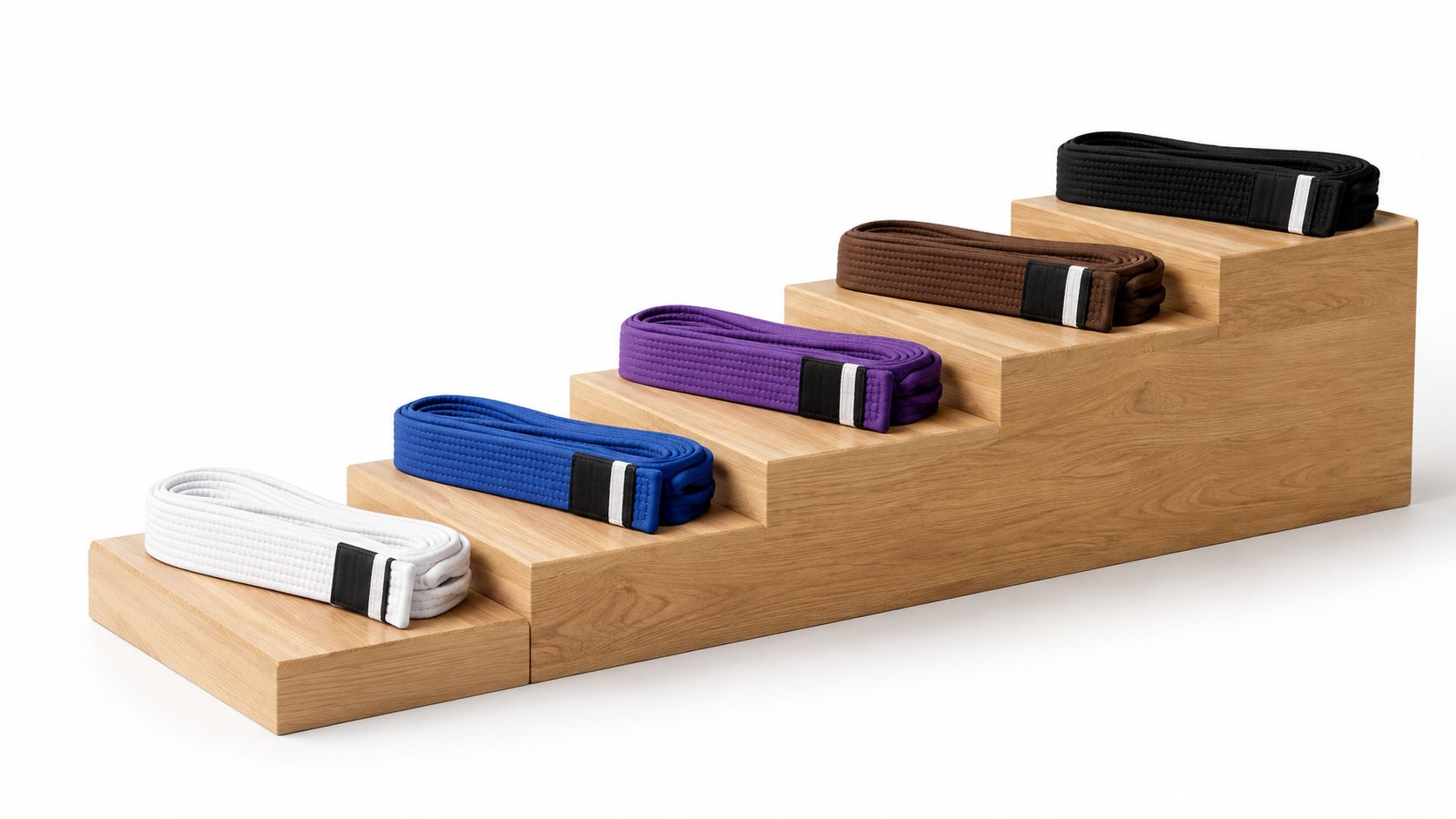
You tie on a white belt, step onto the mat, and quickly discover that the belt around your waist answers only one question: where you are in the formal ranking system. It doesn't tell you how long the next promotion will take, what your coach expects, or whether a tournament rule allows you to compete in a particular division. Those details come from both the International Brazilian Jiu-Jitsu Federation (IBJJF) framework and your academy's own promotion standards.
BJJ belt progression becomes easier to understand when you separate three ideas. First, adults and children follow different rank ladders. Second, stripes mark progress within a belt but aren't the same as a new rank. Third, competition eligibility isn't identical to academy promotion readiness. Training consistency, technical performance, behavior, recovery, and a coach's judgment all influence the practical journey.
Table of Contents
- How BJJ Belt Progression Works
- The Adult BJJ Belt Order From White to Red
- The Youth Belt System Explained
- Minimum Time at Each Belt Under IBJJF Rules
- What Stripes on a Belt Mean
- Promotion Criteria Beyond Time on the Mat
- Injury, Recovery, and Sustainable Progression
- Switching Schools Without Losing Your Rank
- Quick Reference for Comparing Academy Progression
- Key BJJ Progression Terms Defined
- Where to Verify and Keep Exploring
How BJJ Belt Progression Works
A new student can meet a competition requirement and still be months away from an academy promotion. That apparent contradiction becomes clear once you separate the formal belt structure from the standards used by individual instructors.
Practitioners aged 16 and older generally enter the adult sequence: white, blue, purple, brown, and black, followed by advanced black-belt degrees and the highest coral and red ranks. Children aged 4 through 15 follow a developmental system built around grey, yellow, orange, and green groups, with white-striped, solid, and black-striped versions. The IBJJF graduation system describes this age-based framework.
Youth ranks give children room to develop physically, technically, and socially before they enter the adult ladder. A move into an older division does not automatically produce the same result at every academy. The applicable rules and the coach's assessment determine how the transition is handled.
Three layers of progression
Your progression reflects three overlapping influences:
- Federation rules set age requirements, recognized ranks, and some minimum periods between adult promotions.
- Academy standards guide decisions about technical ability, live performance, consistency, conduct, and readiness to represent the school.
- Personal circumstances shape training continuity. Work, school, family responsibilities, competition plans, and injury recovery can all change the pace.
A federation minimum establishes eligibility for a recognized promotion. It does not require a coach to award the belt on that date. An athlete may satisfy a competition rule while still needing more mat time to demonstrate reliable skills in the academy's normal training environment.
Injury history matters here. Someone who trains steadily may progress differently from a practitioner whose recovery creates long gaps, even if both began at the same time. Returning safely and rebuilding confidence can be part of promotion readiness.
Practical rule: Ask a prospective coach, “What does promotion readiness look like here?” Do not ask only how long a belt usually takes.
Also ask which ladder applies to your age, whether the academy uses stripes, and how it evaluates attendance, assessment, competition, and coach observation. If you change schools, ask how the new instructor verifies a rank earned elsewhere. These answers explain progression better than a color chart alone.
The Adult BJJ Belt Order From White to Red
The adult ladder has five principal ranks. Each belt represents a change in how a practitioner understands positions, applies technique against resistance, and contributes to the training environment.
White belt is the foundation. You learn how to move safely, protect yourself in vulnerable positions, escape pins, defend submissions, and follow mat etiquette. The important achievement isn't collecting techniques. It's learning how to stay calm long enough to use basic movements under pressure.
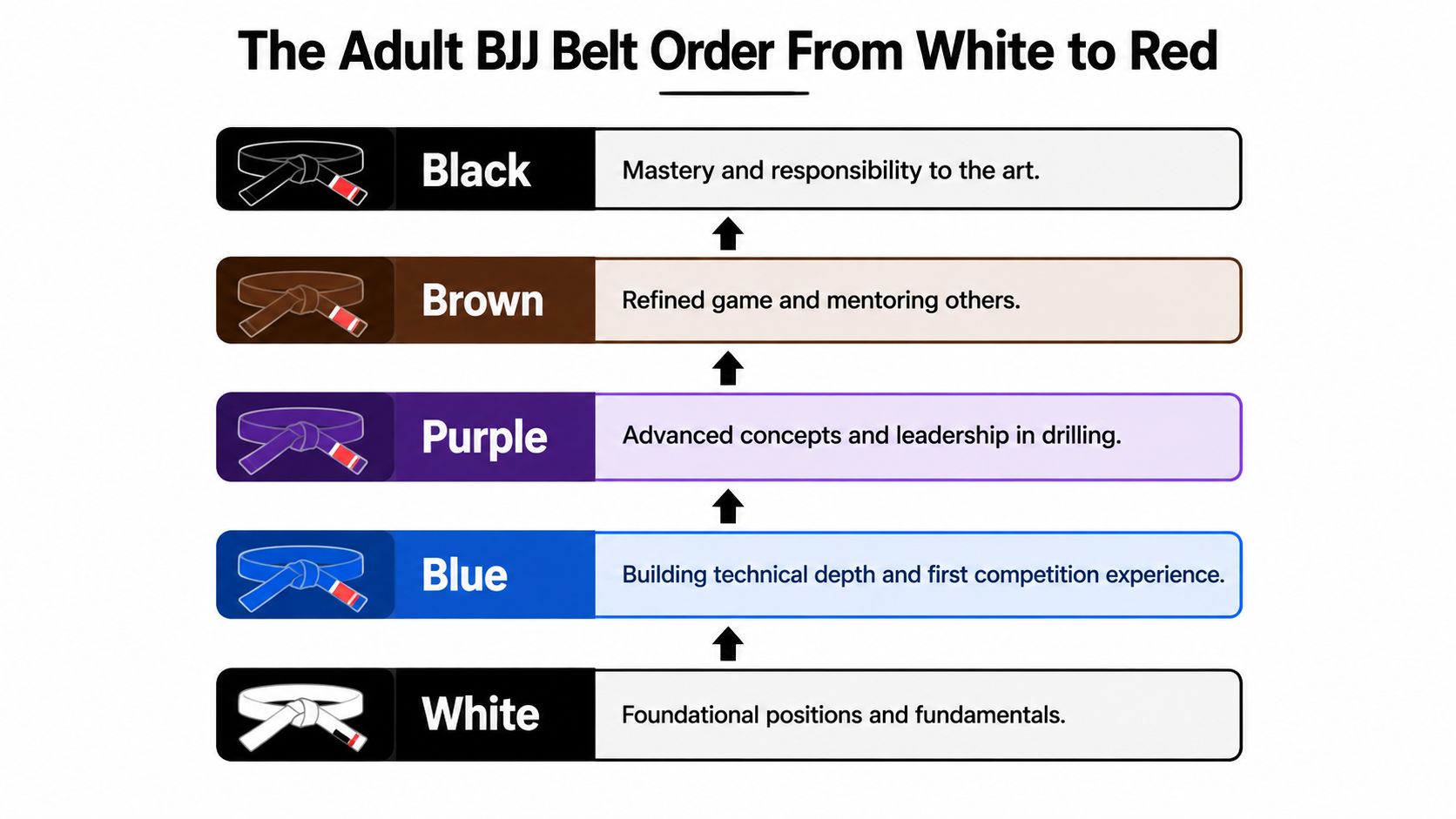
At blue belt, you should have a working understanding of the major positions and begin building a reliable personal game. You may develop preferred guards, passes, escapes, or submissions, but blue belt isn't an endpoint. It gives you the base from which deeper problem-solving begins.
Purple belt usually signals greater independence. Rather than memorizing isolated moves, you recognize connections, create sequences, adjust to reactions, and understand why a technique works. Purple belts often help newer students because explaining a fundamental movement exposes gaps in their own understanding.
Refinement and responsibility
Brown belt is a refinement stage. The practitioner sharpens timing, removes unnecessary movement, develops a more efficient game, and often takes on greater mentoring or teaching responsibility. Brown belt doesn't mean every area is perfect. It means the athlete can identify weaknesses and work on them with purpose.
Black belt represents advanced technical knowledge, sustained development, and responsibility to the art and training community. It isn't the end of learning. Beyond the principal black belt rank, the recognized degree system progresses through advanced black-belt degrees, including red-and-black, red-and-white, and red belts for the most senior practitioners.
The adult sequence is long by design. A coach isn't only checking whether you know more techniques than you did at the previous belt. They're evaluating whether your decisions, timing, composure, and ability to train with others have matured. That is why two people wearing the same color can have very different styles and strengths.
The Youth Belt System Explained
A child who starts BJJ at age 4 follows a different path from an adult beginner. The youth structure covers ages 4 through 15 and uses 13 developmental stages across grey, yellow, orange, and green belt families. Each family includes white-striped, solid, and black-striped versions. These ranks belong to the youth system rather than serving as shortened adult belts.
The order is:
- Grey group: grey-and-white, grey, grey-and-black.
- Yellow group: yellow-and-white, yellow, yellow-and-black.
- Orange group: orange-and-white, orange, orange-and-black.
- Green group: green-and-white, green, green-and-black.
A grey belt can reflect growing comfort with movement, basic positions, safe tapping, and respectful training. Yellow and orange belts generally mark more reliable fundamentals and stronger positional awareness. The green group is the advanced end of the youth ladder, although it remains separate from adult progression.
Age controls which stages a student can enter. Grey-group belts are available from ages 4 to 15. The green group begins at age 13 and continues through age 15. Under the current published graduation framework, adult blue and purple belts require a minimum age of 16, while brown and black belts require a minimum age of 18.
Competition eligibility and academy readiness are related, but they are not the same decision. An event may place an athlete in a division based on age and registered rank, while a coach evaluates promotion through skill, maturity, training continuity, and safe participation. A child who has missed substantial time through injury may need longer to rebuild movement quality and confidence, even if the calendar suggests readiness.
Competition divisions also combine age with rank. Events commonly use categories such as Juvenile, Adult, and Masters. Adult generally begins at age 18, while Masters categories often begin at age 30 and then rise in five-year increments. Parents should therefore ask how an academy applies the recognized youth structure, communicates readiness, and balances technical progress with age-appropriate training.
Minimum Time at Each Belt Under IBJJF Rules
The adult minimum periods are often misunderstood because they're easy to read as promises. Under the commonly published IBJJF framework, the minimum period is two years at blue before purple, 18 months at purple before brown, and one year at brown before black. These figures are eligibility thresholds, not automatic promotion dates, as explained in the IBJJF minimum graduation period update.
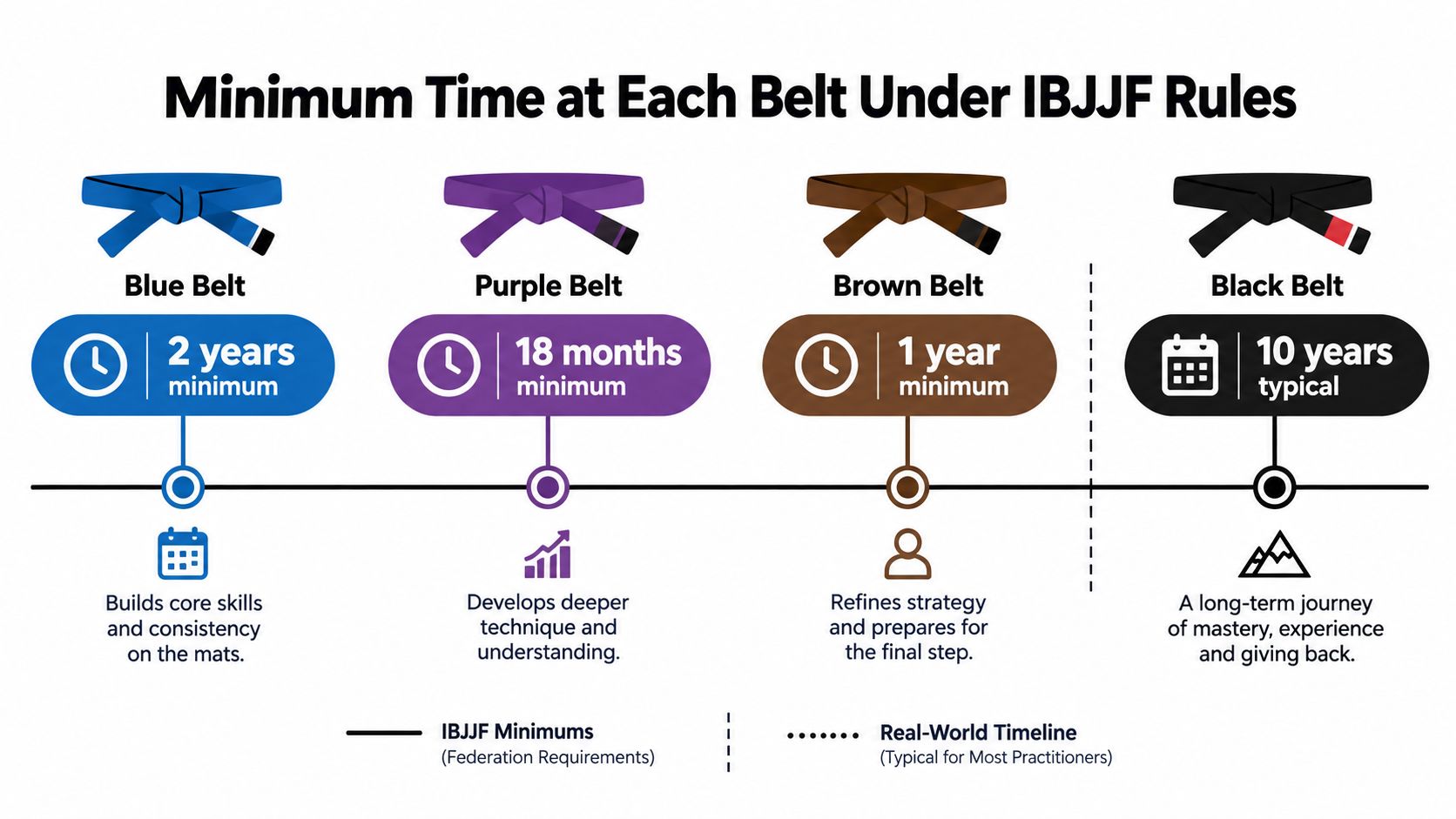
Suppose a blue belt reaches the applicable time threshold. That person may now satisfy the federation's time-in-grade requirement, but the coach still needs to decide whether the athlete demonstrates the required standard. The student may need stronger positional competence, better decision-making under live resistance, more consistent attendance, or greater maturity in training.
Why the rules include exceptions
The federation's update states that adult World Champions may have the minimum period waived for blue, purple, or brown rank. The white- and black-belt rules remain unchanged. This exception illustrates the central point: time requirements regulate eligibility within the competition framework, but demonstrated achievement can affect how the pathway operates.
That flexibility doesn't turn promotion into a race. A competition result may show a high level of performance, but a coach still considers whether the practitioner can train safely, explain fundamentals, adapt outside a preferred game, and contribute to the academy.
When comparing schools, ask whether the professor records time in rank separately from readiness. A transparent academy can explain how it uses attendance, technical assessments, stripes, rolling performance, and competition without suggesting that any single factor guarantees a belt.
What Stripes on a Belt Mean
A stripe is a progress marker placed on the belt you're already wearing. It can show that an instructor sees development in particular areas, but it isn't a separate federation rank and doesn't carry the same meaning at every academy.
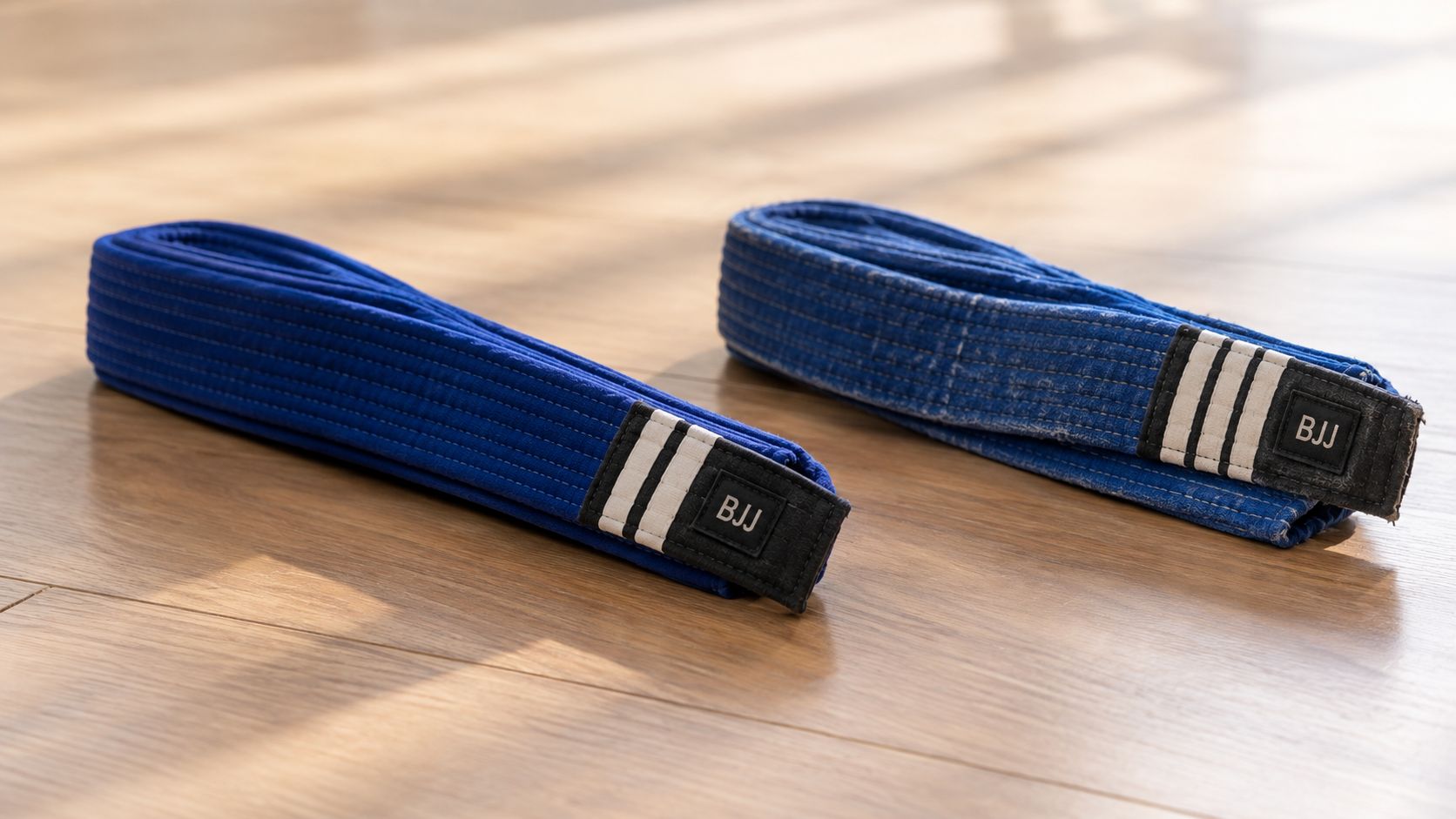
One school may use stripes as regular technical checkpoints. Another may treat them as a broad sign of consistency, attitude, and readiness for more responsibility. Some instructors use them frequently with children and more selectively with adults. A clean belt doesn't automatically mean the practitioner is new, just as a heavily striped belt doesn't prove that the athlete is stronger in every position.
Reading stripes with good judgment
When you train with someone from another academy, don't assume their stripe count maps perfectly to your school's system. Use the belt color as a broad orientation, then adjust the round by communicating clearly. A heavily striped white belt may know certain techniques well but still need a controlled pace. A lightly striped blue belt may have trained at an academy that rarely awards stripes.
The guide to white belt stripes in Jiu-Jitsu can help beginners understand why these markers exist, but your own coach's policy remains the most relevant reference.
Stripes work best when they identify the next skill to develop, not when they become a scoreboard.
Ask your instructor what each stripe represents at your academy. Is it attendance, technical competence, sparring application, conduct, or a combination? Then use the answer as a training checkpoint. Instead of asking only when the next stripe is coming, ask which escape, position, transition, or habit needs attention.
A short demonstration can also clarify expectations better than a calendar. Ask the coach to show what “ready for the next stripe” looks like during drilling and live rounds. That conversation turns a vague symbol into a useful development target.
Promotion Criteria Beyond Time on the Mat
Time creates opportunities to learn, but it doesn't demonstrate what you learned. Coaches usually watch how a student applies technique against resistance, handles unfamiliar positions, responds to feedback, and behaves when a round becomes difficult.
A useful promotion review may include several signals:
- Technical coverage: Can you escape, pass, control, and attack from the core positions?
- Application under pressure: Do your techniques still work when a partner resists, changes pace, or presents an unexpected reaction?
- Decision-making: Can you choose a sensible action instead of forcing a memorized sequence?
- Training conduct: Do you tap when necessary, protect partners, respect class structure, and manage intensity?
- Contribution: Can you help a newer student without turning instruction into a display of ego?
- Competition context: If competition matters to your goals or academy, do your preparation and performance support the expected rank?
Competition can provide useful evidence, but it isn't compulsory for every practitioner. A hobbyist, parent, older adult, or self-defense-focused student may make substantial progress without entering a tournament. Their coach can evaluate the same underlying skills through drilling, positional rounds, and regular sparring.
Questions that reveal an academy's standards
The gap between federation eligibility and academy promotion becomes manageable when the school explains its process. Ask whether coaches use formal assessments, continuous observation, stripe milestones, attendance records, or a written policy. Then ask how the academy evaluates someone who trains for health and skill rather than medals.
Training frequency also needs context. The guide to optimal training frequency can help you think about a sustainable schedule, but the right number of sessions depends on recovery, responsibilities, and injury history.
A good promotion decision is a judgment informed by evidence, not a mechanical reward for elapsed time. You may be eligible on paper and still need more development. You may also be progressing meaningfully even when your belt color hasn't changed.
Injury, Recovery, and Sustainable Progression
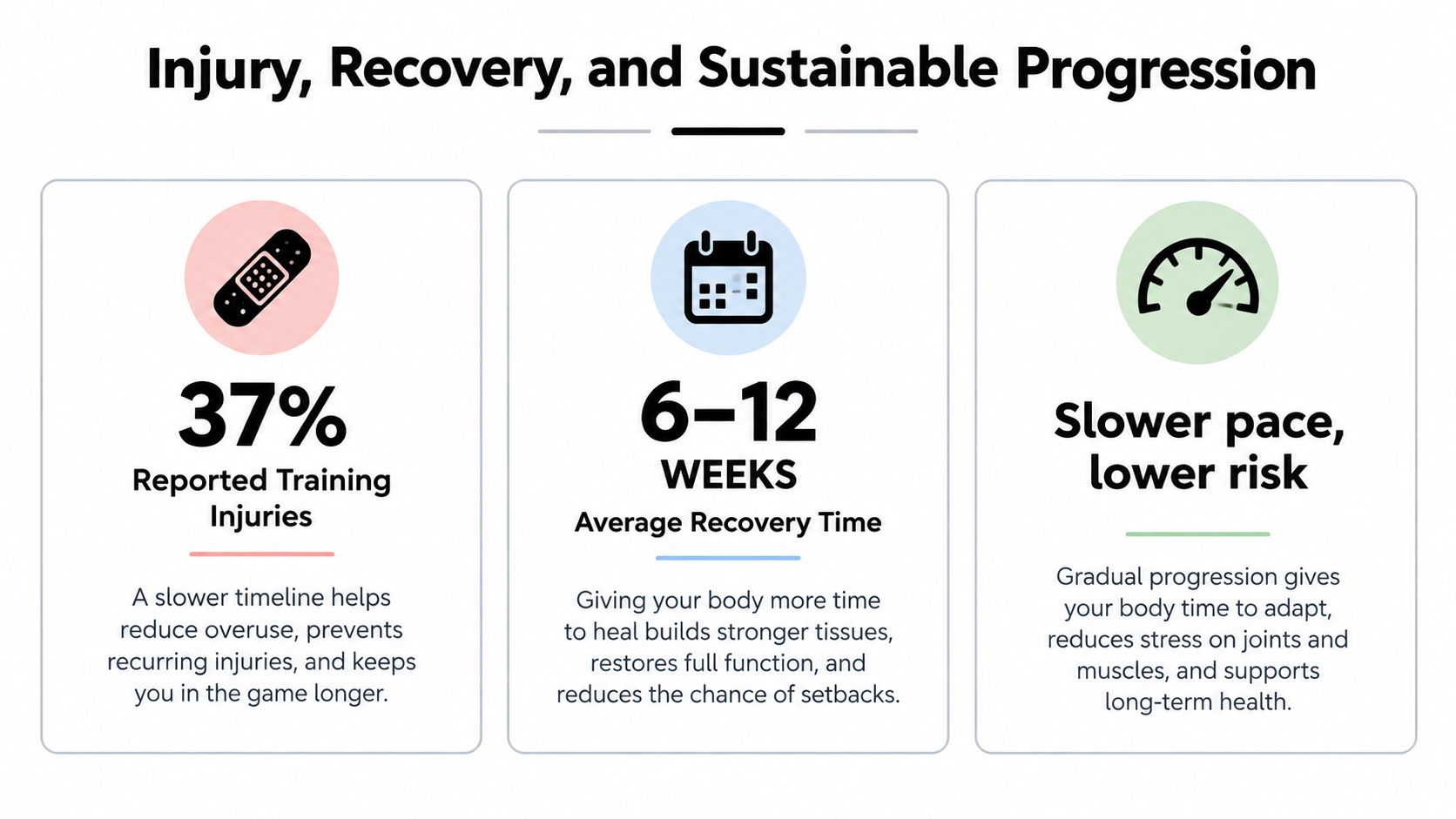
A belt timeline that treats uninterrupted attendance as the ideal can punish responsible training. Injury changes how often you can roll, how intensely you can drill, and how quickly you can return to live resistance. A slower promotion may reflect sensible recovery rather than weak instruction or lack of commitment.
A 2025 cross-sectional study of 881 practitioners found that BJJ injury prevalence is substantial among people training at least weekly, as reported in the published research. Earlier research in the same evidence discussion reported that 120 of 140 surveyed athletes, or 85.7%, had experienced an injury, with 487 total injuries, although that sample was limited and predominantly male. Those findings don't establish that a particular academy is unsafe, but they do show why injury planning belongs in a progression conversation.
What a supportive academy provides
Before joining, ask how the gym handles pain, rehabilitation, and returning students. Look for clear answers about:
- Modified training: Can you drill without loading an injured joint or avoid positions that aggravate symptoms?
- Tap culture: Do coaches normalize early, controlled tapping instead of rewarding stubbornness?
- Beginner intensity: Are new students taught how to roll safely before being thrown into chaotic rounds?
- Re-entry: Does a returning athlete receive a gradual path back to positional sparring?
- Evaluation after absence: Can a coach recognize accumulated technical growth instead of treating missed classes as lost progress?
Medical decisions belong with qualified healthcare professionals. For readers seeking general context on non-surgical recovery care in Sandy, a recovery-focused resource may help explain why returning gradually can support long-term participation.
Sustainable progress matters: Training through pain may preserve attendance today while undermining the continuity that makes long-term improvement possible.
Coaches should evaluate what you can do safely and consistently now, while recognizing the skills you built before a layoff. A promotion doesn't need to reward uninterrupted attendance. It should recognize technical development that remains useful when training resumes.
Switching Schools Without Losing Your Rank
Relocating can make belt progression feel uncertain. You may move to a new city, travel for an extended period, or leave an academy whose teaching style no longer fits. The receiving professor usually needs enough context to understand your rank before deciding how to handle it.
Bring practical records if you have them:
- Promotion history: Note the academy, instructor, belt, approximate promotion date, and stripe history.
- Contact confirmation: Keep a message, certificate, or other record that helps the new professor verify the promotion.
- Competition information: Save official registration or result details when they clarify your division and rank.
- Training context: Explain whether you trained in a competition, recreational, youth, gi, or no-gi track.
Some schools retain the rank after verification. Others may ask you to train at the same color without immediate stripes while the instructor evaluates your level. In some cases, an academy may recommend restarting at white belt, especially when the previous rank can't be verified or the coach's standards differ significantly.
The respectful approach is to ask rather than demand. Say, “I earned this belt at my previous academy. What would you like to see before confirming how I should train here?” That gives the new professor room to protect the meaning of the rank while treating your history seriously.
The guide to choosing a BJJ gym can help you compare schools before committing. On your first visit, disclose your current belt, previous instructor, training goals, and any injury restrictions. A short, honest conversation prevents confusion during the first rounds.
Quick Reference for Comparing Academy Progression
Use the same questions at every academy you visit. Consistency lets you compare policies instead of relying on a polished website or a single enthusiastic tour.
| Topic | Questions to Ask |
|---|---|
| Promotion standards | What technical, behavioral, and live-training qualities support promotion? |
| Time in rank | How does the academy use federation minimums, and what happens after a student meets them? |
| Stripes | Are stripes formal checkpoints, informal feedback, or both? |
| Competition | Is competing required, encouraged, or optional for promotion? |
| Attendance | How do coaches distinguish attendance from actual technical readiness? |
| Injury recovery | Can students modify training and return gradually after a layoff? |
| Youth programs | Which age-based belt system and competition divisions does the kids' program follow? |
| Transfers | What records should a relocating student provide for rank verification? |
Healthy promotion cultures usually give students feedback before a ceremony. Coaches can explain what a student does well, what remains inconsistent, and how the next stage changes expectations. They don't promise a belt on a fixed date just to close a sale.
Watch for warning signs at either extreme. A school that promotes unusually quickly may not explain its technical standards. A school that withholds every form of feedback may leave students guessing. The strongest comparison is practical: write down each academy's answers, then choose the environment whose expectations match your goals and capacity.
Key BJJ Progression Terms Defined
Time in grade means the period spent at a particular belt before a recognized promotion can be considered. It matters for IBJJF eligibility, but it doesn't replace an instructor's readiness assessment.
Stripe promotion is an intermediate marker placed on the current belt. A stripe may reflect technical development, consistency, conduct, or coach feedback, and its use varies by academy.
Academy promotion is the school's decision to award a new rank. The professor may consider live performance, positional understanding, teaching ability, competition, attitude, and training history.
Degree refers to an advanced marker associated with a black belt after the practitioner has reached that rank. Degrees sit within the long-term black-belt progression and aren't the same as stripes on a lower belt.
Juvenile identifies an age-based competition category for young athletes. Adult generally begins at age 18 in IBJJF event organization, while Masters categories often begin at age 30 and increase in five-year increments, subject to event rules.
Competition eligibility answers whether an athlete may enter a particular division under the event's age and rank rules. Promotion readiness answers whether the academy believes the athlete has developed enough skill, judgment, and responsibility for a new belt. Confusing those terms causes most timeline misunderstandings.
Where to Verify and Keep Exploring
Use the IBJJF graduation system for the recognized age and rank framework, then check current federation updates before registering for competition. This framework helps determine competition eligibility, while your academy decides whether your skills, judgment, and consistency support promotion. Academy policy remains the practical source for evaluation details.
For local research, compare adult, youth, recreational, and competition tracks. Ask instructors how they handle stripes, promotion standards, injury modifications, missed training, and transfers. A directory can narrow choices by location and program type, but clear answers about expectations matter more than a polished listing.
Training continuity shapes progression. An injury, careful recovery, or long break can change your pace without erasing your rank. Sustainable technical development matters more than chasing a calendar milestone. Your belt should represent what you can perform safely and consistently.
Brazilian Jiu-Jitsu Academy Finder helps beginners, parents, relocating practitioners, and competitors compare U.S. academies by location, programs, and contact information. Visit Brazilian Jiu-Jitsu Academy Finder to compare schools and progression expectations.
Share this article