
BJJ Belt Goals: White to Black
Roadmap from white to black belt in BJJ: timelines, key skills by rank, training priorities, and how to choose the right academy for steady progress.
Written by BJJ Academy Finder Editorial Team
BJJ Belt Goals: White to Black
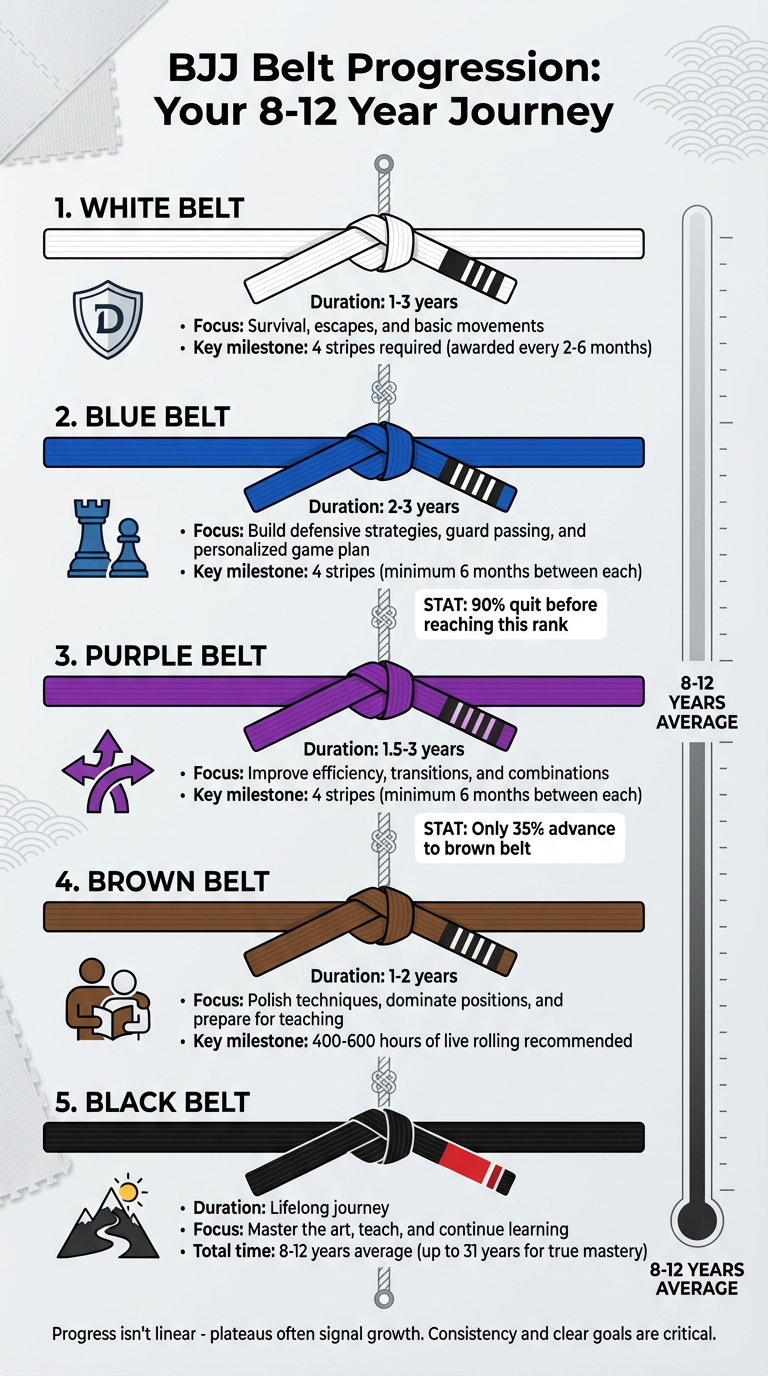
Earning a black belt in Brazilian Jiu-Jitsu (BJJ) takes patience and consistent effort. On average, it takes 8–12 years to progress through the ranks: white, blue, purple, brown, and black. Each belt represents a distinct phase of learning, from mastering survival skills as a white belt to refining techniques and mentoring others at brown belt. Here's a quick breakdown:
- White Belt (1–3 years): Focus on survival, escapes, and basic movements.
- Blue Belt (2–3 years): Build defensive strategies, guard passing, and a personalized game plan.
- Purple Belt (1.5–3 years): Improve efficiency, transitions, and combinations.
- Brown Belt (1–2 years): Polish techniques, dominate positions, and prepare for teaching.
- Black Belt (Lifelong): Master the art, teach, and continue learning.
Progress isn't linear, and plateaus often signal growth. Consistency, clear goals, and the right academy are critical to staying motivated. Whether you're aiming for competition or personal development, BJJ is a long-term journey that rewards dedication.
BJJ Belt Progression Timeline: White to Black Belt Journey
Every Jiu Jitsu Belt Explained In 18 Minutes!
White Belt Goals: Learning the Basics
The white belt stage is where your journey begins, and it’s all about building a solid foundation. This is the time to focus on developing good habits rather than trying to dominate every opponent. The main goal? Learn how to survive by honing your defensive skills. A strong defense is the backbone of your progress and should guide you throughout this stage.
Key Skills to Master
Start with escapes. Your first priority is learning how to get out of bad spots like mount, side control, and back control. If you're on the bottom, focus on creating space to escape. If you're on top, work on keeping your opponent’s space limited. Warm-ups aren’t just drills - they’re your tools for survival. Movements like bridging, shrimping, technical stand-ups, and forward rolls are essential for escaping tough positions during live rolling.
Understanding positional awareness is just as important. Get familiar with the four core positions: guard, side control, mount, and back control. Knowing where you are on the mat - and the risks associated with each position - will help you stay composed under pressure. Most schools require at least four stripes on your white belt before you can move to blue, with stripes awarded every 2 to 6 months based on your consistency and progress. Once you’ve got the basics down, shift your focus to refining your mindset and maintaining steady practice.
Focus Areas for Beginners
Leave your ego at the door and learn to relax. Many white belts make the mistake of tensing up and overexerting, which only slows down skill development. Accept that higher belts will dominate you - it’s part of the process. Rolling with them is invaluable because they’ll often provide safer, controlled sparring and even offer tips as you train.
Commit to training at least two to three times a week to build muscle memory. Resist the temptation to chase flashy moves like heel hooks or berimbolos you might see online. These advanced techniques can pull your focus away from mastering the fundamentals, like guard passing and positional control. Stick to the 80/20 rule: identify two or three escapes or passes that suit you best and dedicate 80% of your drilling time to perfecting them. Lastly, respect the mat and your training partners - wash your gi and belt after every session, and keep your nails trimmed to prevent injuries or infections.
Blue Belt Goals: Building Your Style
Reaching your blue belt is a milestone in Brazilian Jiu-Jitsu. It means you've overcome the initial hurdles - something noteworthy, considering about 90% of practitioners quit before achieving this rank. At this stage, you're transitioning from survival mode to crafting your own approach. The focus shifts to developing offensive strategies and building a system that works with your body type, strengths, and preferences. Instead of merely reacting to your opponent’s moves, you’re learning how to take control and execute your own game plan.
Core Techniques to Focus On
Your technical skills need to grow significantly at blue belt. A major area to work on is guard passing. Aim to master at least three different methods, such as pressure passing, speed passing, or leg drag variations. Sweeps from both closed and open guard should also be part of your repertoire. When it comes to submissions, focus on chaining moves together instead of relying on single, isolated attacks. For example, practice linking armbars, triangles, and chokes, and learn to bait opponents into your setups.
Don’t neglect takedowns. Many blue belts focus almost entirely on groundwork and are unprepared when matches begin standing. Develop at least two reliable hip throws and two leg takedowns, like single or double legs. Additionally, half-guard control becomes critical at this level. Whether you're on top or bottom, understanding the nuances of half-guard can make a big difference in your game.
Developing Your Game Plan
With your expanding skill set, it’s time to create a game plan tailored to your strengths. Focus on one or two positions that suit your style and build offensive strategies around them. For instance, taller practitioners might thrive using guard triangles, while those with a stockier build could excel in pressure passing and top control. Reviewing recordings of your rolls can help you spot patterns and identify which positions and techniques work best for you.
"I built my game off a solid defense. I first made it almost impossible for anybody to tap me out."
- Roger Gracie, Multi-time World Champion
Once you've identified your most effective techniques, dedicate most of your training time to sharpening them. Drill these moves repeatedly, troubleshoot counters, and refine your finishing mechanics. Competing in tournaments is another excellent way to test your game plan against unfamiliar opponents. Competitions quickly reveal any weaknesses in your strategy. Instead of focusing on when you’ll get promoted, ask your coach to help you identify areas for improvement.
Training Time Expectations
Expect to spend 2 to 3 years at blue belt - it’s a crucial phase in your BJJ journey. Most schools require four stripes at this rank, with a minimum of six months between each stripe. Consistency is the key to progress. Training at least three times a week helps you build the muscle memory needed to advance.
To handle the increased intensity of blue belt sparring, add grappling-specific strength training to your routine. This is also a great time to start mentoring white belts. Teaching others not only reinforces your own knowledge but also prepares you for future leadership roles. It’s common for blue belts to experience the "blue belt blues", where progress feels slow or self-doubt creeps in. Instead of obsessing over the next promotion, set process-oriented goals like “train three times a week” or “drill my best sweep 10 extra times after class” to stay motivated.
Purple Belt Goals: Improving Efficiency
Purple belt is often seen as the stage where movement and momentum take center stage. By this point, you're not just adding techniques to your repertoire - you’re learning to use your weight and your opponent’s momentum to execute techniques with precision and purpose. The goal is to cut out wasted effort and make every movement count.
The statistics are sobering: only 35% of purple belts eventually make it to brown belt. The difference between those who advance and those who stall often comes down to how well they address their weaknesses. At this level, it’s all about identifying the gaps in your skillset - those "holes in your game" - and turning them into strengths. Once you’ve built a strong foundation, the focus shifts to refining your movements and creating a fluid, efficient game.
Mastering Transitions and Combinations
A major focus at this stage is mastering smooth transitions by linking submissions, sweeps, and defenses together. For instance, if your opponent rolls to escape an omoplata, you should be ready to flow seamlessly into a triangle or an armbar.
As Jeff, the author and podcaster behind Dirty White Belt, puts it:
"If I just keep 'drilling the omoplata,' my knowledge of the move stays the same. If I break it down into drilling omoplata setups, omoplata position entries, and finishing the omoplata, the possibilities expand geometrically." - Jeff, Author and Podcaster, Dirty White Belt
To deepen your understanding, break your top 10 techniques into three parts: setup, entry, and finish. Dedicate specific training sessions to each phase. Tracking your rolls over a 2- to 4-week period can help you pinpoint which positions and submissions are working best, giving you a clear picture of your strengths and areas needing improvement.
Becoming a Complete Practitioner
To truly elevate your game, assess your skills across key areas like takedowns, guard sweeps, submissions, passing, transitions, defense, and escapes. Use a simple 1–5 scale to rate your proficiency in each area. This self-assessment will help you focus your training where it’s needed most. The mindset here is clear: turn weaknesses into strengths.
"Purple belt is also where you will finish laying the foundation of your entire game... focus on the weakest aspects of your jiu-jitsu - these are known as the 'holes in your game'." - Nicolas Gregoriades, 3rd-degree Black Belt
Aim to master three combination attacks from guard and three submissions from each dominant position. Explore different guard systems - like De La Riva, spider guard, X-guard, and leg entanglements - and specialize in those that align with your body type and style. This is also an ideal time to experiment with less conventional techniques, such as Keenan Cornelius's worm guard or modern leg lock systems, to see what fits your unique approach.
Incorporate positional sparring by starting rounds in weaker positions to improve your defensive transitions and problem-solving under pressure. Flow rolling - low-resistance sparring - can also be incredibly useful. It allows you to experiment with new transitions and techniques without the pressure to dominate.
Most practitioners spend about 1.5 to 3 years at the purple belt level, earning four stripes with at least six months between each. This extended period provides the time needed to develop a comprehensive, well-rounded game before moving on to the next level.
sbb-itb-d583f1e
Brown Belt Goals: Preparing for Black Belt
The journey to a brown belt is about refining the skills you’ve spent years developing. At this stage, the focus shifts to achieving precision and mastery. As Ryan Kellar, a BJJ black belt instructor, explains:
Like a forged blade that is almost complete, rough edges are refined into a sharp, reliable game.
The International Brazilian Jiu-Jitsu Federation (IBJJF) sets a minimum requirement of one year at brown belt, but many practitioners dedicate three to five years to this phase. Coaches often recommend accumulating around 400–600 hours of live rolling to measure readiness. These years are pivotal for honing positional control and stepping into leadership roles.
Perfecting Positional Control
Brown belts are expected to dominate from top positions with precision and efficiency. As Jiu Jitsu Brotherhood puts it:
A brown belt is evil from the top positions. In mount and side mount he knows how to use his body weight and makes sure the person on the bottom feels every ounce of it.
Rather than relying on brute strength, the goal is to apply calculated pressure through well-timed transitions. This means anticipating your opponent’s moves, countering effectively, and mastering a few go-to techniques that work consistently. Matt Kirtley from Inverted Gear describes this stage perfectly:
The submissions don't need to be anything fancy... but they need to be sharp, clean, and instill a sense of inevitable doom.
Beyond technical refinement, the brown belt phase is also about contributing to the growth of the community.
Teaching and Mentoring Others
Teaching is a powerful tool for reinforcing your own understanding of Jiu-Jitsu. As Jiu Jitsu Brotherhood highlights:
He also understands that teaching is a good way to consolidate the knowledge he has gained up to this point.
Look for opportunities to lead beginner classes or guide lower belts, focusing on explaining the reasoning behind techniques, not just the mechanics. William Vandry, a 5th-degree black belt, underscores the importance of this responsibility:
Senior belts should mentor junior belts.
Mentoring not only strengthens your own fundamentals but also prepares you for the leadership expectations of a black belt. By sharing knowledge, you help build a stronger community while refining your own path toward mastery.
Black Belt Goals: Continuing the Journey
Earning a black belt is often seen as a pinnacle of achievement, but in reality, it marks the beginning of an even deeper commitment to growth. Ryan Kellar, a BJJ black belt instructor, puts it perfectly:
It's the equivalent of reaching a plateau only to realize how much further the mountain extends.
Reaching this level typically takes around 10 years, but true mastery can span up to 31 years. This extended timeline underscores an important truth: a black belt signifies not just mastery of the fundamentals but the start of a lifelong journey of learning and refinement.
Committing to Continuous Learning
For black belts, training takes on a new dimension. Techniques that have been drilled countless times are revisited with fresh eyes. As Jiu Jitsu Brotherhood explains:
The black belt starts to look at everything with a fresh set of eyes. He can take the most basic movement that he has practised thousands of times and realize that he is still able to refine it.
This mindset highlights the value of efficiency - mastering the art of knowing when to move, when to stay still, and how to prioritize timing over raw strength or speed. One practical application of this philosophy is the 80/20 rule: focus on the 20% of techniques that yield 80% of your success. Instead of chasing new moves, refine your core techniques, troubleshoot counters, and perfect setups.
Black belts also maintain a student mindset, constantly learning from others. Whether visiting different academies or rolling with students of various skill levels, there’s always an opportunity to evolve. As your training partners improve, you’re naturally pushed to grow alongside them. This ongoing refinement often leads to a natural progression: stepping into a mentorship role.
Giving Back to the Community
As your skills mature, sharing them becomes a vital part of the journey. Transitioning from practitioner to instructor is a defining moment for many black belts. As Infinity BJJ points out:
Contrary to the misconception that achieving a black belt denotes the end of the journey, it signifies a commitment to lifelong learning and humility.
Teaching not only solidifies your own understanding but also helps shape the next generation of practitioners. Warren Stout, Head Instructor at Stout Training, emphasizes this responsibility:
A promotion to blackbelt SHOULD mean... that a student also qualifies as an expert and competent teacher.
Beyond teaching, black belts are expected to embody respect, discipline, and integrity both on and off the mats. Carlos Machado, a BJJ master, beautifully captures this purpose:
I enjoy seeing my student... really grasp the concepts of being a better human being, instructor and mentor.
To further contribute to the community, black belts can take steps like obtaining CPR and First Aid certifications to ensure safety. They can also organize seminars, mentor lower belts, and work to preserve their lineage while adapting to the ever-changing nature of the art.
Finding the Right Academy for Your Goals
Choosing the right academy is key to aligning your training with your personal goals. If you're aiming for competition success or international recognition, look for an IBJJF-registered academy that adheres to strict age and time requirements for belt progression. On the other hand, if your focus is self-defense or a more laid-back training environment, a non-affiliated school might be a better fit.
Instructor qualifications are non-negotiable. Only an accredited 2nd-degree black belt has the authority to promote students to black belt. Before signing up, confirm your instructor’s lineage and recognized rank. As one experienced practitioner points out, the belt system in Brazilian Jiu-Jitsu ranks among the most rigorous in martial arts. This highlights the importance of choosing an instructor who understands the patience and dedication required at every stage. Selecting the right mentor ensures your technical development aligns with your long-term goals.
Promotion policies differ widely. Some academies require formal testing with associated fees, while others base promotions solely on the instructor’s observations during regular training sessions. As Progress Jiu Jitsu explains:
promotion criteria vary heavily on the individual, academy and instructor.
It’s worth asking about testing fees, time requirements, and whether competition results influence promotions. If teaching is part of your advancement plan - a common expectation at brown and black belt levels - make sure the academy supports higher-ranked students in assisting with instruction.
Academy culture and curriculum are just as important. Some gyms are competition-driven with intense sparring sessions, while others focus on teaching fundamentals and self-defense techniques. Attend a class to see if the training intensity and feedback style match your preferences. Look for a safe, disciplined environment with clean mats and a culture that emphasizes humility and respect. This kind of setting will help you train consistently and avoid injuries over the years it takes to reach black belt.
To make your search easier, consider using dedicated resources.
Using Brazilian Jiu-Jitsu Gyms Directory

Finding an academy that aligns with your belt progression goals starts with having access to the right tools. Brazilian Jiu-Jitsu Gyms Directory (https://bjjacademyfinder.com) is a helpful platform for locating academies across the United States. You can filter by location to find gyms nearby, explore detailed program descriptions to see if they focus on Gi, No-Gi, or both, and even verify instructor credentials and lineage through student reviews and ratings.
The directory also allows you to find trial classes, giving you a chance to experience an academy’s teaching style firsthand. Whether you’re a white belt seeking a fundamentals-focused school or a blue or purple belt looking for an IBJJF-affiliated academy to support your competition goals, this tool helps you make an informed choice. Best of all, it’s free to use, so you can explore multiple options without any financial pressure.
Conclusion: Your Path from White to Black Belt
Earning a black belt in Brazilian Jiu-Jitsu is no quick feat - it typically takes 8 to 12 years of consistent effort. But here's the thing: the timeline isn't the most important part. What truly matters is the journey itself. Each belt represents a distinct phase of growth: white for mastering the basics, blue for building defense, purple for sharpening techniques, brown for honing control and mentoring, and black for ongoing mastery.
Instead of obsessing over the end goal, focus on what you can control in the present. Set small, actionable goals - train three times a week, drill a technique 10 to 20 extra times after class, or commit to stretching after every session. Progress isn’t always steady, and plateaus can feel discouraging, but they often signal that you're on the verge of improvement. Each belt level challenges you in new ways, rewarding persistence and dedication.
The IBJJF requires a minimum of 2 years at blue belt, 1.5 years at purple belt, and 1 year at brown belt before promotion. These timelines highlight why BJJ is considered one of the most demanding martial arts when it comes to earning rank.
Choosing the right academy is essential for your long-term success. Look for a gym with skilled instructors, a supportive culture, and clear promotion standards. Whether your goal is to compete, improve self-defense, or grow personally, the right environment will help you stay consistent and motivated. By embracing these principles, you’ll not only progress in your own training but also contribute to the larger BJJ community.
FAQs
How can I get past plateaus in my BJJ training?
Plateaus are a normal part of training in Brazilian Jiu-Jitsu, signaling that your body and mind are consolidating the techniques you’ve already learned. Instead of viewing these moments as setbacks, think of them as chances to refine your skills and prepare for the next stage of growth.
One effective way to move past a plateau is to shake up your training routine. Focus on areas you might be overlooking - if you’re comfortable playing guard, spend more time on top control or passing. If you tend to rely on a handful of favorite submissions, try experimenting with new setups or concentrate on improving your escapes. Combine this with purposeful drilling by breaking techniques into smaller, manageable steps. Start slow, then gradually increase your speed as the movements feel more natural and fluid.
It’s also important to embrace a growth mindset and seek support from your training partners and coaches. Being part of a strong community, like those you can discover through the Brazilian Jiu-Jitsu Gyms Directory, can offer fresh insights and constructive feedback. With steady effort and the right mindset, you can turn any plateau into a stepping stone toward achieving your next belt.
What should I consider when choosing a BJJ academy?
When choosing a Brazilian Jiu-Jitsu academy, start by focusing on quality instruction. Seek out coaches with a strong background and proven experience in guiding students through the belt system. A well-structured curriculum is key - one that prioritizes the fundamentals, giving you a solid base before moving on to more advanced techniques.
Equally important is the gym's culture and community. Aim for a place with a supportive, respectful, and inclusive environment. This kind of atmosphere not only boosts your confidence but also makes learning more enjoyable. Plus, it’s much easier to find reliable training partners for safe and effective sparring when the community is welcoming.
Don’t overlook practical considerations like cleanliness, class sizes, and scheduling flexibility. Make sure the gym’s programs align with your goals, whether you’re training for competition, self-defense, or simply for fun. Clear promotion criteria and a safe, motivating environment will help you stay on track as you work toward your BJJ belt goals.
How can mentoring others improve my BJJ skills?
Mentoring in Brazilian Jiu-Jitsu does more than just help others - it’s a powerful way to sharpen your own skills. Breaking down techniques into simple, digestible steps forces you to truly understand the mechanics behind each move. This process often uncovers gaps in your own knowledge, giving you the chance to refine and improve. Plus, teaching reinforces what you’ve already learned, making it stick and enhancing your precision.
Another bonus? Mentoring opens the door to feedback from higher-ranking practitioners. They might observe how you explain techniques and share tips to improve both your execution and teaching style. Beyond the technical benefits, mentoring boosts your confidence, strengthens your bonds within the BJJ community, and keeps you motivated to grow and progress.
Related articles
Share this article