
BJJ Classes Cost in 2026: Prices by Format and Location
Find out what BJJ classes cost in 2026, from drop-ins and unlimited memberships to kids, family and private rates, plus how to judge real value.
Written by BJJ Academy Finder Editorial Team
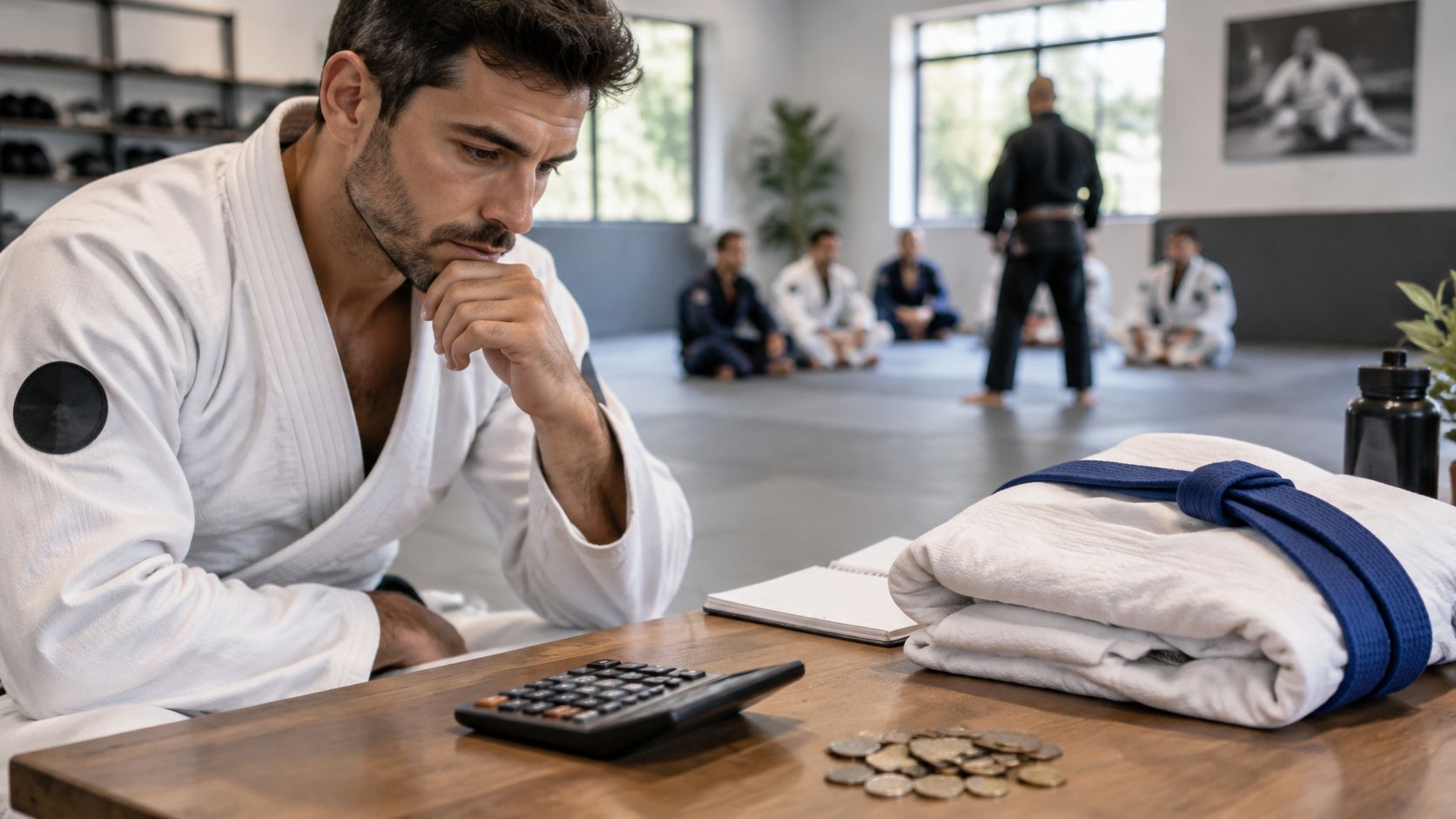
Most U.S. adult BJJ memberships run about $100 to $300 a month, with a national benchmark of about $145 for unlimited classes; drop-ins typically cost $20 to $45 per class. What you spend depends on how often you attend, which sessions your plan includes, and what the academy charges beyond tuition.
The useful comparison isn't cheap versus expensive. It's total commitment divided by usable training. A membership that looks affordable can become poor value when its timetable clashes with work, while a higher monthly price can make sense if you consistently use the coaching and classes you're buying.
Table of Contents
- Typical BJJ Class Prices at a Glance
- Where Location Shifts Your Monthly Bill
- Why Two Academies Charge Different Prices
- Kids, Families and Discounts Explained
- Hidden First-Year Costs and How to Compare Value
- Choose the Payment Model That Fits Your Attendance
Typical BJJ Class Prices at a Glance
| Format | Typical price | Source or basis |
|---|---|---|
| Drop-in class | $35 to $45 per class | Superprof's March 2026 academy comparison |
| Unlimited adult membership | $175 to $299 per month | Superprof's March 2026 comparison of selected U.S. academies |
| Unlimited membership benchmark | $145 per month | Gymdesk's 2025–2026 national benchmark |
| Lowest and highest membership tier | $161 and $195 per month | Average tier prices in Grapple Tactics' March 2024 survey of 58 U.S. gyms |
| Private lesson | Not established by the cited price data | Compare academy-specific quotes before calculating cost per lesson |
| Kids program | Not established by the cited price data | Check each academy's published program and tuition details |
| Family membership | Not established by the cited price data | Confirm household eligibility and the academy's quoted rate |
| Annual prepaid plan | Monthly rate multiplied by twelve, minus any written prepayment discount | A calculation baseline, not a published annual quote |
These figures describe different kinds of evidence, not interchangeable national averages. They include a national benchmark, averages from a gym survey, and prices reported for selected academies. The comparison also shows why a single headline rate cannot describe every format: some prices apply to recurring access, while others depend on the academy's specific offer.
In its March 2026 comparison, Superprof found unlimited adult memberships of $175 to $299 per month and single drop-in classes of $35 to $45 among the U.S. academies it checked. Those are published prices from a selection, not a measure of every local market. To compare them in practical terms, divide the monthly fee by the classes you expect to attend. The result is an estimated cost per class, not a guarantee of what training will cost if attendance changes.
What each format actually buys
Drop-ins buy flexibility. They suit visitors, travelers, and students who want to try a class before taking on recurring tuition. Their per-class price is easier to judge when compared with a monthly membership at the attendance level you expect.
Unlimited memberships buy access under the academy's rules. Check whether the plan covers all suitable classes or only sessions within a particular program. Access to adult fundamentals does not, by itself, establish access to competition practice or another discipline.
Private lessons buy focused instructor attention rather than the range of a group schedule. Since the cited figures do not establish a typical hourly price, request an academy-specific quote. Compare the lesson's duration, instructor, and purpose before judging its value against group training.
Kids and family prices require details beyond an adult individual rate. A children's starting price may cover a limited attendance option, while a household plan may include eligibility conditions. Ask what sessions and family members the quoted rate covers.
- Match the training format. Compare gi classes with gi classes, and check whether no-gi training is included or separately priced.
- Check the access rules. Confirm that beginners can attend the sessions that make the timetable attractive.
- Separate annual billing from annual commitment. Monthly payment does not necessarily mean monthly cancellation is allowed.
To compare programs before tuition, use a program-level guide such as Fitness GM's option to browse Fort Worth BJJ class types. Identify the training included rather than assuming every academy's membership covers the same sessions.
An annual prepayment quote should state the discount explicitly. Multiplying a monthly rate by twelve gives a comparison baseline, not necessarily the academy's prepaid offer, and paying upfront may affect cancellation rights.
Where Location Shifts Your Monthly Bill
Elite Sports reported in June 2025 that monthly BJJ prices averaged $160 to $200 across selected U.S. states, with ranges of $170 to $220 in California, $160 to $200 in Texas, $129 to $150 in Florida, and $180 to $250 in New York. These are directional comparisons from selected states and published prices, not a representative national survey or a quote for your neighborhood.
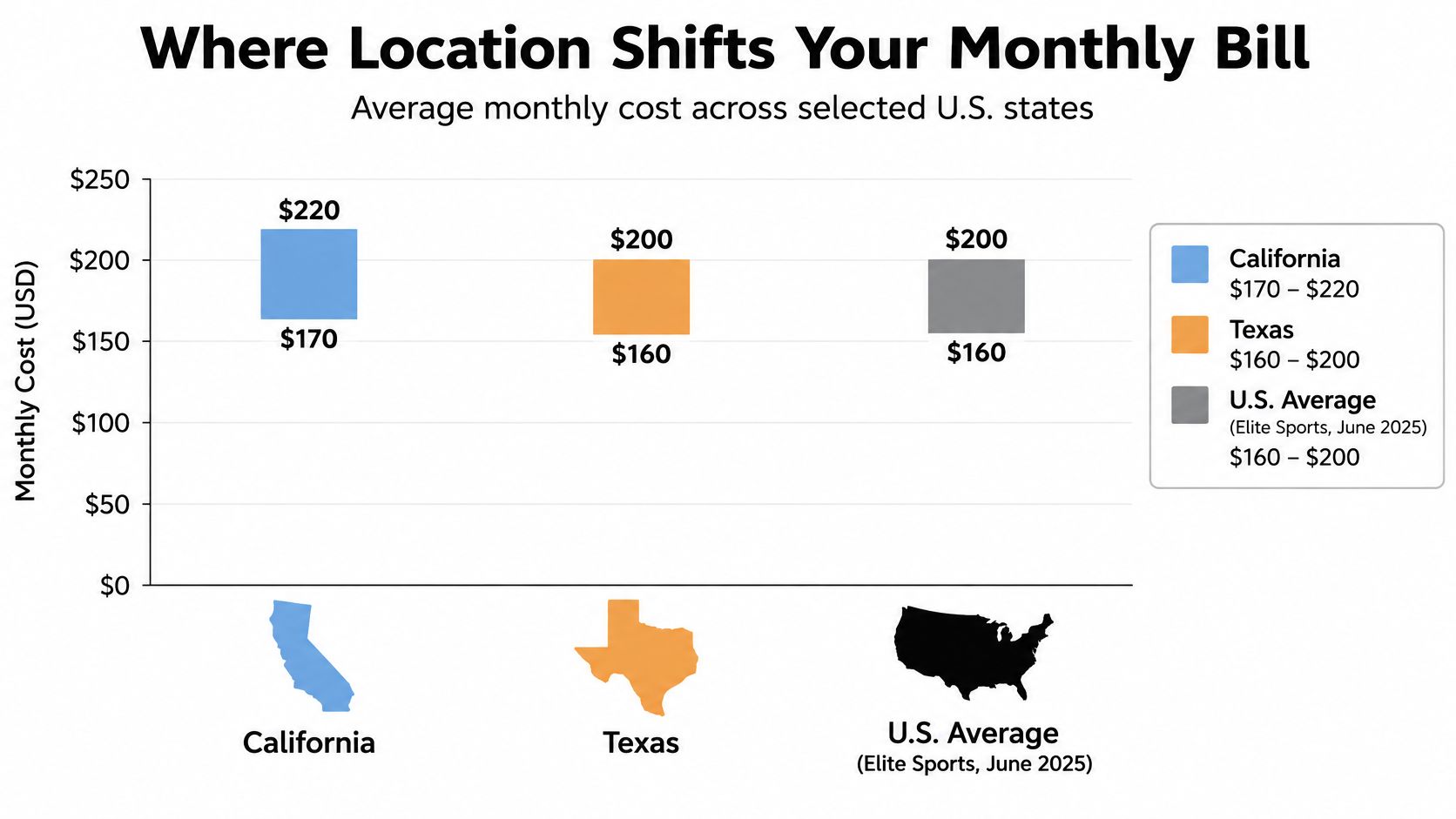
A relocating student shouldn't assume an existing training budget will transfer unchanged. Equally, a statewide range can't tell you whether a suburban academy, a downtown school, or a competition-focused facility will offer the best local deal.
Compare the trip, not just the address
Rent and facility costs help explain geographic differences, but your route to class matters independently of the academy's overhead. Consider parking charges, traffic at the actual class time, and whether you can get there directly from work.
A cheaper academy across town isn't necessarily cheaper in practice. If the journey makes you skip training, you'll pay for access you don't use; if a nearby academy offers suitable sessions around your workday, its higher tuition may buy more usable training.
For parents coordinating several activities, Vanta Sports' sports budgeting insights for parents provide a broader household-budget context. Keep BJJ travel and scheduling costs in the same worksheet as tuition rather than treating them as unrelated expenses.
- Search locally. Our homepage search accepts a city name, state name, or ZIP code, and our state listings cover all 50 states.
- Check the actual journey. Test the route near the time you'd leave for training, including parking and the walk to the academy.
- Request comparable quotes. Get written terms for the same program and realistic attendance pattern, not whichever starting price each school advertises.
Local comparison rule: A statewide price range helps set expectations. A current written quote and a workable commute help you choose an academy.
Why Two Academies Charge Different Prices
Gymdesk's 2025–2026 pricing benchmark places unlimited BJJ classes at $145 per month nationally, with most gyms charging $120 to $200 per month. That benchmark is a starting point for comparison, not evidence that a school charging more is overpriced or that one charging less is a bargain.

The differences become clearer when you separate instruction, facilities, access, and training goals. BJJ developed through distinct academy structures rather than a single tuition-setting system, a history described by Sports Foundation's account of the art's development.
Instruction and facilities
Coach experience can affect what an academy charges, but reputation alone doesn't establish value for a beginner. Find out who teaches your intended classes, whether that instructor gives useful corrections, and whether the curriculum makes sense at your level.
A renowned head instructor who rarely teaches your time slot isn't the same purchase as regular access to that instructor. Watch the class you'd attend rather than evaluating the academy solely through its competition credentials.
Facilities also change the offer. Dedicated mats, showers, lockers, parking, and air conditioning support different training experiences, but you should distinguish useful amenities from ones you won't use.
A shower can matter if you're returning to work after training. A polished reception area may matter less than a clean training space and attentive coaching.
Schedule and training purpose
Schedule breadth determines which parts of a membership you can use. Morning classes, evening fundamentals, and open mats aren't equivalent if your experience level or work hours prevent you from attending them.
Competition focus changes the questions to ask. Establish whether team practices, tournament coaching, seminars, and travel support are included, optional, or separately billed.
Children's instruction requires its own comparison. Age grouping, supervision, class structure, and attendance options matter more than whether the adult program has an impressive reputation.
Use a short inclusion checklist:
- Teaching: Named instructors, beginner curriculum, and opportunities for feedback.
- Access: Suitable class times, open-mat eligibility, and included training styles.
- Facilities: Cleanliness, changing space, showers, and practical parking.
- Extras: Clearly identified optional services and separate charges.
Our guide to how to choose a BJJ gym can help you assess these nonprice differences during a visit. The right conclusion isn't that expensive academies are better, but that you need an itemized understanding of what the tuition buys.
Kids, Families and Discounts Explained
Jay Pages Jiu-Jitsu's published pricing examples list adult plans at $120 to $195 per month, a $325 family membership, kids pricing from $65, and discounted rates for students, teachers, military members, veterans, and first responders. Treat that sheet as one academy's menu. The comparison that matters is cost per class and the yearly total once you know who will train.
Assume eight classes a month, two a week. The $65 kids rate is about $8 a class. One class a week makes the same dues about $16 a class. The $325 family plan is $3,900 over twelve months. Two adults at $120 plus one child at $65 come to $305 a month, or $3,660 a year, which is $240 under the family rate. Two adults at $195 plus that child come to $455 a month, or $5,460 a year, so the family plan saves $1,560. The lower headline wins only after you count the people who will attend.
A household discount pays off when the people on the contract train. List each member and the program they need, then set the sum of eligible individual memberships against the family quote on the same payment and cancellation terms. Drop a reluctant member. Unused dues raise the cost per class for everyone who shows up. Parents and children may still need separate trips even when they hold memberships at one academy. Our guide to jiu-jitsu family classes lays out how those schedules can be set up.
Questions to take to the academy
- Sibling pricing: What does adding another child cost, and does the discount apply to every eligible program?
- Family eligibility: Does the plan cover the whole household, or only a specified group of members?
- Children's attendance: Is the price based on age, weekly attendance, or a particular class track?
- Discount terms: Are student, military, veteran, teacher, or first-responder discounts available without a long contract?
- Proof and renewal: What documentation is required, and can eligibility or pricing change at renewal?
- Short-term access: Can a visiting family member or traveler buy a temporary pass without full enrollment?
- Household changes: What happens to the price if a parent pauses training or a child leaves the program?
Ask for the final household amount. A military or student discount may attach to one plan only, and combining it with the family rate is an assumption until the academy confirms both.
A lower kids rate saves money only for the classes that child will actually attend.
If a child makes four of eight scheduled classes, a $65 plan costs about $16 for each class taken, the same as training once a week on paper. Price the year on sessions you will use, not on the smallest number on the rate card.
Hidden First-Year Costs and How to Compare Value
| Item | Notes |
|---|---|
| Monthly dues, twelve months | $149 multiplied by twelve equals $1,788 |
| Enrollment fee | Published examples of $120 to $140, paid once in this scenario |
| Gi and uniform | Not included in the estimate; confirm required items and approved purchases |
| Seminars and belt testing | Confirm whether either carries a separate charge |
| Competition fees | Add applicable entry and related costs if you compete |
| Estimated first-year total | $1,908 to $1,928 before gear and other unpriced items, approximately $159 to $161 per month |
The worked example uses the $149 monthly adult jiu-jitsu price and $120 and $140 enrollment-fee observations compiled by Black Belt CRM's published-price roundup. Its evidence comes from businesses publishing prices, not a nationally representative survey, and the table combines those observations into a comparison scenario rather than quoting a single academy's package.
Gymdesk's 2026 explanation of BJJ expenses gives a general membership range of $100 to $300 per month across most areas. A broad tuition range helps establish the category's cost, but it can't tell you the amount due at signup or the full obligation you'll accept.
Turn every line into a question
Enrollment needs a payment rule, not just an amount. Is it charged once, charged again after a pause, or waived under a particular introductory offer?
Uniform requirements need an itemized answer. Ask whether you can bring suitable equipment you already own, whether academy-branded clothing is mandatory, and whether the quoted introductory package includes it.
Seminars and promotions require careful wording. Don't assume belt testing is either universally charged or universally free; request the academy's policy and identify optional events separately from mandatory charges.
Competition expenses belong in a separate training-goal budget. Establish which costs arise only when you enter an event and whether additional coaching or travel charges apply.
- Cancellation: Request the notice procedure, billing cutoff, and any remaining contractual obligation.
- Trial conversion: Confirm whether an introductory offer becomes a paid membership automatically.
- Included sessions: Check whether both gi and no-gi training fit within the quoted plan.
- Payment timing: Separate money due immediately from charges due later.
Use a complete denominator
For an annual comparison, divide the full expected annual cost by the classes you realistically expect to attend during that period. Include anticipated interruptions rather than assuming every available training week will be used.
Our listings include a Programs Offered section with details about classes, schedules, and training styles. Use it to identify relevant programs before requesting a written quote, but don't treat a listed program as confirmation that every membership includes it.
Budget test: An offer is only cheap if it fits the schedule you'll keep and the commitment you're prepared to accept.
Choose the Payment Model That Fits Your Attendance
Unlimited membership, drop-ins, class packs, and private lessons solve different problems. Choose between them using expected attendance and flexibility, not the appeal of the lowest advertised monthly rate.
A March 2024 Grapple Tactics survey of 58 U.S. BJJ gyms found average monthly membership prices of $161 for the lowest tier and $195 for the highest tier. Those tier averages show why you need the details of each offer: a plan's label doesn't tell you its attendance allowance, cancellation rights, or suitability for your routine.
Where membership overtakes drop-ins
FlexDropIn's BJJ pricing guide uses a $200 monthly membership against $30 drop-ins, which breaks even at about seven classes per month, and lists private instruction reaching roughly $125 per hour. The following calculations apply that example to different attendance levels.
| Classes per month | Drop-ins at $30 each | $200 membership | Cheaper option |
|---|---|---|---|
| 4 classes | $120 | $200 | Drop-ins |
| 7 classes | $210 | $200 | Membership, narrowly |
| 12 classes | $360 | $200 | Membership |
These calculations compare training charges only. An enrollment fee, restricted drop-in access, or a contract commitment could change the decision.
At occasional attendance, drop-ins preserve flexibility. You aren't paying for an unused allowance when work, travel, or family commitments interrupt training.
Near break-even, contract terms deserve more weight. A narrow saving isn't necessarily worth losing the option to pause, switch academies, or stop training without further payments.
With consistent attendance, unlimited access becomes more persuasive. The relevant question is whether you can sustain that attendance at the academy's actual class times, not whether you'd like to train frequently in principle.
A low-priced annual contract can still be poor value for a newcomer uncertain about the location, coaching, or routine. Don't trade away flexibility before you've tested those uncertainties.
Class packs and private instruction
Class packs can suit irregular attendance if the academy offers them on workable terms. Divide the package price by the sessions you're likely to redeem, not just the number printed on the offer.
Check expiration dates, booking restrictions, and whether unused sessions survive an illness or schedule change. A package discount disappears if you leave sessions unused.
Private instruction makes more sense when you can identify a specific objective, such as troubleshooting a guard position or preparing a particular competition sequence. Ask what you'll work on and how to practice it afterward; buying individual attention without a clear goal makes value harder to judge.
For another utilization example, the Health & Fitness Association's fitness-dues analysis supports comparing coached-session costs: a $180 unlimited membership used twelve times monthly costs $15 per session, while using it twenty times reduces that to $9. The calculation doesn't mean you should add sessions to lower the number; choose an attendance level you can recover from and maintain.
Make the decision using a realistic calendar
- Count usable sessions. Put intended classes into your calendar alongside work, commuting, family responsibilities, and recovery. Our guide to optimal training frequency can help you think through a sustainable routine.
- Price your actual pattern. Use the academy's written rates to calculate your own break-even point. Don't apply an example's threshold to a differently priced local offer.
- Test the environment. Take a trial class at the time you'd normally train before accepting a long commitment.
- Compare equivalent access. Ensure each candidate plan covers the classes and training styles you intend to use.
- Check the exit terms. Read the cancellation and pause provisions before focusing on a contract discount.
- Choose for continued use. Prefer a workable routine and appropriate coaching over access you won't use.
Academy owners reviewing gym retention advice from Zee Palm face the same practical issue from the other side: signing someone up isn't the same as helping them keep attending. As a buyer, judge whether the onboarding, communication, and timetable support your routine.
Our search results let you filter academies by rating, programs offered, and distance. Each listing also includes the address, phone number, website, and social media links, giving you direct contact routes to confirm current terms and arrange a visit.
Brazilian Jiu-Jitsu Academy Finder helps you compare nearby academies by location, programs, and community ratings before committing to tuition. Visit Brazilian Jiu-Jitsu Academy Finder, shortlist schools that fit your calendar, and use their direct contact details to request written pricing and book a trial class.
Share this article