
10 BJJ Omaha Academies: Listings, Ratings, and Programs
Compare BJJ Omaha academies by address, hours, phone, website, ratings, kids and no-gi programs, plus how to claim a listing.
Written by BJJ Academy Finder Editorial Team
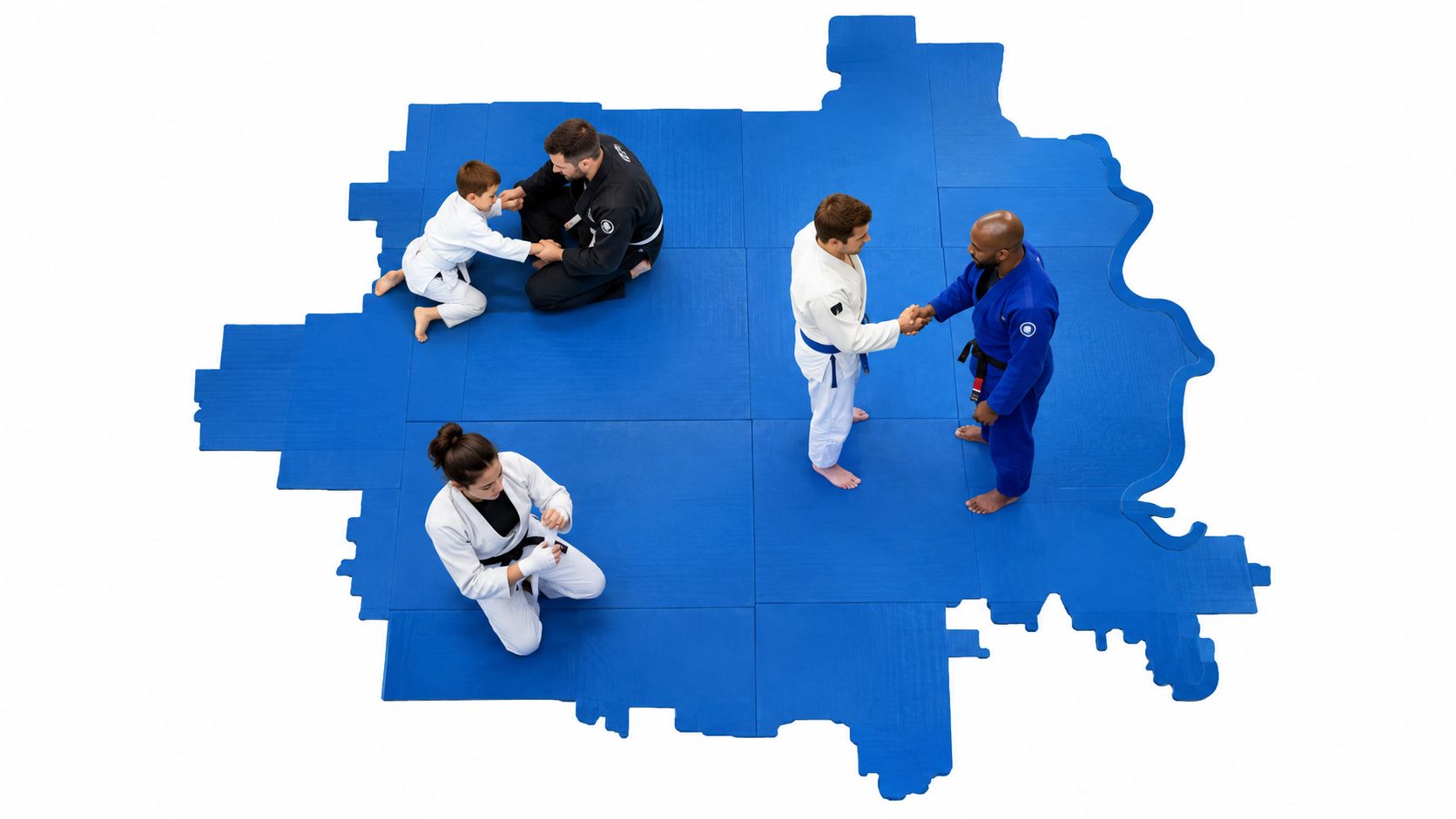
You're choosing a first academy with more than one question in mind. A new adult wants a welcoming beginner class, a parent wants to know how children are supervised, and a competitor relocating to Omaha wants enough gi or no-gi training to support a serious schedule. All three ask the same thing: which academy is worth visiting first?
This guide covers 10 BJJ Omaha academies and discovery tools, with attention to community ratings, kids' and adult programs, competition orientation, gi versus no-gi emphasis, and neighborhood access. It also separates what a listing can confirm from what you still need to ask in person. Address, hours, phone number, and website details should appear only when verified through an academy's own listing or site. If a detail isn't verified, treat it as a question, not a fact.
Tuition often isn't published, so expect to call for membership rates, trial terms, contracts, uniforms, and family discounts. A directory such as Brazilian Jiu-Jitsu Academy Finder can help you browse Omaha listings and compare contact details before you start calling. That kind of organized research also supports broader operational work, including financial stability for sports clubs, because accurate public information helps prospective members make informed decisions.
Table of Contents
- 1. Brazilian Jiu-Jitsu Academy Finder
- 2. Gracie Jiu-Jitsu Omaha
- 3. 10th Planet Jiu-Jitsu Omaha
- 4. Omaha's Academy of Brazilian Jiu Jitsu
- 5. Ares BJJ Omaha
- 6. Premier Combat Center
- 7. Mid America Martial Arts
- 8. Lōkahi Jiu-Jitsu Collective
- 9. Dojo Omaha
- 10. Mick Doyle's Gym
- Omaha BJJ - 10-Academy Comparison
- Choosing Your Omaha Mat Next Steps
1. Brazilian Jiu-Jitsu Academy Finder
The fastest way to build a first-visit shortlist isn't always opening individual academy websites one by one. Brazilian Jiu-Jitsu Academy Finder organizes BJJ academies by city and state, making it useful for Omaha beginners, parents, competitors relocating to the metro, and travelers looking for a drop-in.
Its practical advantage is the path from discovery to contact. You can search for local options, compare visible details, review community feedback, and follow direct website or phone links. The platform also publishes curated city pages for high-density markets, which is useful when you're comparing several neighborhoods rather than deciding from a single search result.
The directory has more than 10,400 active listings across all 50 states and Washington, D.C., according to the publisher's supplied platform information. It also offers academy owners tools to claim or submit listings and manage profile information. Those tools matter because a stale phone number or outdated schedule can waste a prospective student's only free evening.

What to check before you call
Use the directory as a filter, not as a substitute for a conversation. Ratings can reveal community sentiment, but they won't tell you whether the beginner class has live rounds, whether kids train in separate groups, or whether the schedule works with your commute.
- Contact accuracy: Open the linked website and confirm the phone number, location, and current schedule.
- Training fit: Look for notes about kids, women's self-defense, competition, gi, no-gi, and open mat sessions.
- Commercial placement: Paid placements may appear before organic results, so visibility reflects sponsorship as well as relevance.
- Pricing expectations: Standard membership prices aren't generally listed, so ask each academy directly about rates and trial conditions.
Practical rule: Use ratings to choose whom to contact, then use the phone call to test how clearly the academy answers practical questions.
For Omaha-specific browsing, the directory's Omaha jiu-jitsu guide can help you turn a broad search into a manageable shortlist. The best outcome is not finding the gym with the most impressive profile. It's finding three realistic options, confirming the details, and visiting the one whose coaching style, schedule, price structure, and commute make consistent training possible.
2. Gracie Jiu-Jitsu Omaha
Gracie Jiu-Jitsu Omaha is a strong first stop for someone who wants a clearly defined entry point rather than an open-ended introduction to grappling. Its public program structure includes Gracie Combatives for beginners, Master Cycle for advanced students, Women's Self-Defense, and children's programs such as Mat Munchkins, Little Champs, and Jr. Grapplers.
That structure is the academy's main trade-off. A new student can understand the intended progression from introductory training toward more advanced work, and parents can identify a youth-specific pathway instead of assuming children join an adult class. The same standardization may feel restrictive to a competitor who wants an academy organized primarily around tournament preparation, frequent hard rounds, or a particular competition team.
The academy advertises a free trial and online booking for first visits through Gracie Jiu-Jitsu Omaha's official website. Confirm the current class time before traveling, especially if you're comparing Omaha neighborhoods or coming from outside the city.
Call script
Ask: “I'm new to BJJ and interested in a first class. Which program should I book, what should I wear, and how much live sparring is included in the beginner session? Could you also explain current membership rates, uniform requirements, cancellation terms, and the schedule for the program I'd enter?”
For a parent, add: “How are children grouped by age and experience, and how many coaches supervise the class?” The public program names show that youth instruction exists, but a listing alone won't show the coaching ratio, transitions between activities, or how instructors respond when a child is nervous.
3. 10th Planet Jiu-Jitsu Omaha
10th Planet Jiu-Jitsu Omaha operates from SIMS Dojo in Bellevue, so the first decision is geographic as much as technical. For someone living or working near Bellevue, the location may be convenient. For someone on the opposite side of the Omaha metro, the drive can change whether a frequent training schedule remains realistic.
The academy's defining feature is its no-gi emphasis. The 10th Planet system appeals to grapplers who prefer rash guards and shorts, modern leg-lock and submission systems, and training that doesn't depend on a traditional uniform. It also provides a dedicated beginner route through Jiu-Jitsu 101, which gives newcomers a clearer starting point than dropping into an advanced mixed class.
The trade-off is straightforward. Students seeking regular gi training may find fewer suitable sessions at this location, while no-gi-focused athletes may see that limitation as the main reason to visit. The academy offers an online free class trial through 10th Planet Jiu-Jitsu Omaha's website, but confirm the current Bellevue schedule before booking.
Call script
Ask: “I'm interested in no-gi training and I'm a beginner. Is Jiu-Jitsu 101 the correct first class, and how often can a new student train? How much gi instruction is available, what does the trial include, and what are the current membership rates and cancellation terms?”
If you're relocating, ask about parking, peak-hour arrival time, and whether the schedule has enough beginner and intermediate sessions to support your intended training frequency. The right no-gi curriculum won't help if the commute makes attendance inconsistent.
4. Omaha's Academy of Brazilian Jiu Jitsu
Omaha's Academy of Brazilian Jiu Jitsu, commonly referred to as OABJJ, fits the reader who values a conventional local academy setup with adult classes, youth instruction, open mat time, and a posted schedule. It presents itself as a community-oriented training environment rather than a narrowly specialized competition laboratory.
A public schedule is useful because it lets you test the academy against your actual week. Look for whether the available sessions match your work hours, whether open mat is separate from coached instruction, and whether kids' classes run at times that make family logistics manageable. A weekend open mat can also matter to experienced practitioners who want extra rounds, although you should ask whether it's open to trial students and visitors.
The academy directs prospective students to call for adult BJJ-only pricing, so tuition isn't fully transparent online. That isn't automatically a negative, but it means you should ask for the complete first-year cost instead of accepting a monthly figure without context. Include initiation fees, required gi purchases, automatic renewal, cancellation rules, and family pricing.
Call script
Ask: “I'm comparing adult BJJ programs and would like to attend a first class. Which session is best for a beginner, are visitors allowed at open mat, and what are the current monthly and enrollment costs? Is a gi required immediately, and how do your kids' classes differ from adult instruction?”
Verify the current address, phone number, and schedule through OABJJ's official site before leaving home. A simple website can still provide enough information for a useful first call, but it won't answer the coaching and safety questions you can observe only on the mat.
5. Ares BJJ Omaha
Ares BJJ Omaha offers a balanced choice for students who don't want to decide between gi and no-gi before they've developed basic grappling habits. Its public program information describes gi and no-gi classes across levels, separate adult and kids' tracks, and a weekly schedule with morning, evening, and weekend options.
That schedule breadth can be more important than a gym's reputation if you're trying to train consistently around work, school, or family obligations. A morning class may suit one adult while a weekend session works better for another. Parents should also confirm the precise age grouping and supervision model rather than relying only on the stated children's range, which the academy describes as serving ages 3 to 15 on its official website.
Ares also advertises a free first class and emphasizes instructor lineage and a competition-tested curriculum. That can appeal to athletes who want a sport-oriented environment, but a faster competition pace may not suit every absolute beginner. Ask how new students are introduced to positional work, drilling, and live rounds before assuming that “competition-friendly” means beginner-hostile or beginner-perfect.
Call script
Ask: “Which gi or no-gi class should a first-time adult attend, and how are new students introduced to sparring? Could you explain the current free-class terms, membership options, uniform requirements, and the kids' coaching setup, including how groups are supervised?”
The visit should answer what the website cannot. Watch whether instructors correct technique without rushing students, whether partners are matched sensibly, and whether beginners have a clear way to scale intensity.
6. Premier Combat Center
Premier Combat Center is the broadest cross-training option on this list. Alongside BJJ for beginners through competitors, it offers MMA, Muay Thai, and boxing, with adult and kids' schedules published online. That combination works well for someone who wants one facility for grappling and striking rather than a single-discipline academy.
The schedule is a major practical advantage. Multiple daily BJJ slots can make training easier to sustain when work shifts, school pickup, or commute conditions change. The advertised two-week free trial gives a prospective member more time to evaluate different sessions than a single introductory class, although you should confirm current terms before relying on the offer.
The trade-off comes from the facility's size and multi-discipline identity. A busy time slot may provide strong energy and plenty of training partners, but individual attention can vary. Someone seeking a compact, BJJ-only room with a tightly defined competition culture may prefer a more specialized academy.
Call script
Ask: “Does the two-week trial include all BJJ classes, or only selected sessions? Which class should a beginner attend, how much gi and no-gi training is available each week, and what are the current membership rates if I want BJJ only?”
Also ask whether children train in separate groups and how coaches handle differences in age, size, and experience. Confirm the current address and hours through Premier Combat Center's website, then visit at the time you'd realistically train. A quiet midday class may feel very different from the evening session you will attend.
7. Mid America Martial Arts
Mid America Martial Arts, or MAMA, suits families who want access to several martial arts under one roof. Its program mix includes adult Brazilian Jiu-Jitsu, youth martial arts, judo, Muay Thai, and other training tracks. That breadth can reduce the need to manage separate memberships when different family members have different interests.
The family advantage is also the central trade-off. A broad martial arts environment can create a lively, supportive kids' culture and provide useful cross-training. It may feel less focused, however, for a competitor specifically seeking a BJJ room where most students share tournament goals and the schedule centers on grappling.
The academy provides centralized onboarding information and clear contact details through Mid America Martial Arts. Pricing isn't fully published, so ask whether the quoted membership covers one program, several programs, or the entire family. Don't compare a multi-program membership directly with a BJJ-only rate until you know what access each price includes.
Call script
Ask: “I'm looking for adult BJJ and may also enroll a child. How are the kids' classes staffed and grouped, what BJJ sessions are available for adults, and does membership include judo or striking programs? Please also explain current family pricing, contracts, uniform costs, and cancellation terms.”
Parents can use the guide to choosing a martial arts school as a broader framework, then apply the same questions during the visit. Watch for clear transitions, age-appropriate instruction, and whether coaches can explain how children progress.
8. Lōkahi Jiu-Jitsu Collective
Lōkahi Jiu-Jitsu Collective stands out because it publishes practical information that many academies leave for a phone call. Its youth program states a 6:1 student-to-coach ratio, and its site lists starting membership pricing of $139 per month, with no signup or cancellation fees, according to the academy's published information at Lōkahi Jiu-Jitsu Collective.
That transparency is valuable for parents comparing more than a promotional monthly rate. A smaller stated youth coaching ratio gives you a concrete question to verify during a visit, while no signup or cancellation fees make the financial commitment easier to understand. The published starting price still may not be the final cost for every student, so ask about family discounts, uniforms, drop-ins, and any program-specific conditions.
The academy also offers adult and youth programs, open mat opportunities, and discounts described for first responders, educators, students, families, and needs-based participants. Its community orientation may be a good fit for someone who wants a supportive training environment rather than a purely competition-centered room.
Call script
Ask: “Is the 6:1 youth ratio maintained in the class my child would attend, and are assistant coaches included in that count? For adults, what does the starting membership price include, how flexible are the terms, and how much gi versus no-gi training is on the weekly schedule?”
If cost clarity is your priority, request the complete first-year estimate in writing. Compare the total against other academies, not just the advertised monthly starting figure.
9. Dojo Omaha
Dojo Omaha brings a Pedigo Submission Fighting connection to its adult BJJ program, with gi and no-gi instruction, a beginner-friendly presentation, instructor pages, and posted class information. That combination may appeal to a student who follows the PSF competition system but still wants an approachable first class.
The academy's “what to expect” guidance is useful for reducing beginner uncertainty. New students often worry about what to wear, whether they'll be expected to spar immediately, and how much prior fitness they need. Public guidance can answer some of those concerns, but it can't show whether the actual class feels calm, crowded, technical, or intense.
Pricing isn't published publicly, so the first call should cover membership terms rather than focusing only on the trial. Youth programming is referenced in local community material, but parents should confirm the current children's schedule and coaching structure directly with the academy. The official source for current program and contact information is Dojo Omaha.
Call script
Ask: “I'm new to BJJ and interested in the gi and no-gi options. Which class should I attend, what should I bring, and how does the first session work? Could you also confirm current adult and youth schedules, membership pricing, trial terms, and whether competition training is optional?”
During the visit, look for alignment between the beginner guidance and the class itself. A friendly website is useful, but the coaching behavior on the mat is the evidence that matters most.
10. Mick Doyle's Gym
Mick Doyle's Gym, also called Mick Doyle's Kickboxing & Fitness Center, suits students who want BJJ alongside striking and conditioning. The facility combines grappling with Muay Thai, boxing, and fitness, so one membership may support several training goals. That breadth can be useful, although it may not match someone seeking a room focused only on competitive grappling.
The academy is near 108th and Blondo, according to the supplied academy information. Check the address, parking, and evening traffic before booking a trial. Omaha commute data reports an average travel time of about 16.6 minutes one way, compared with approximately 20.9 minutes across the metro, according to Omaha commuting data. A convenient route often matters more than a small difference in listed class quality because attendance depends on reaching the mat consistently.
Public pricing is not listed. Ask whether BJJ is included in a broader membership or billed separately through Mick Doyle's Gym. Confirm the current adult schedule, the balance of gi and no-gi classes, and whether beginners train in a dedicated class or join a mixed-level session. Parents should also ask directly about children's programming and coaching ratios if they are considering the gym for a young athlete.
Call script
Ask: “I'm mainly interested in BJJ but may add striking or conditioning. Which class is suitable for a beginner, how much gi and no-gi training is available, and what does membership include? Could you confirm the current address, parking, trial terms, cancellation policy, and youth schedule?”
For fitness-focused training, Brazilian Jiu-Jitsu for fitness provides useful comparison points. During the visit, judge whether the mixed-program format supports your goals or divides attention between disciplines.
Omaha BJJ - 10-Academy Comparison
| Name | Core focus & features ✨ | Experience & quality ★ | Target audience 👥 | Price / Value 💰 |
|---|---|---|---|---|
| Brazilian Jiu‑Jitsu Academy Finder 🏆 | ✨ Verified listings, high‑density city pages, direct website & phone links | ★ Community‑backed (examples 4.8–5.0); ✨ fast Search→Compare→Connect flow | 👥 Beginners, parents, competitors, academy owners | 💰 Free to use; paid placements appear first |
| Gracie Jiu‑Jitsu Omaha | ✨ Gracie Combatives/Master Cycle, Women Empowered, kids programs, online booking | ★ Strong structure & safety focus | 👥 Beginners, families, women | 💰 Free trial; pricing on inquiry |
| 10th Planet Jiu‑Jitsu Omaha (SIMS Dojo) | ✨ No‑gi‑centric 10th Planet curriculum, Jiu‑Jitsu 101, online trial | ★ No‑gi specialists; modern system | 👥 No‑gi enthusiasts, competitors, beginners | 💰 Free class trial; inquire for membership |
| Omaha's Academy of Brazilian Jiu Jitsu (OABJJ) | ✨ Adult & kids classes, regular open mat, posted schedule | ★ Consistent schedule; positive local word‑of‑mouth | 👥 All levels, local community, families | 💰 Call for rates |
| Ares BJJ Omaha | ✨ Gi & no‑gi classes, kids 3–15, posted weekly schedule, first class free | ★ Competition‑tested lineage; balanced training | 👥 Families, competitors, beginners | 💰 First class free; pricing by contact |
| Premier Combat Center | ✨ Multi‑discipline (BJJ, MMA, Muay Thai, boxing), many daily slots, 2‑week trial | ★ Broad schedule; strong fight‑community reputation | 👥 Cross‑trainers, fighters, busy schedules | 💰 Two‑week free trial; inquire for plans |
| Mid America Martial Arts (MAMA) | ✨ BJJ, judo, Muay Thai, youth programs, centralized onboarding | ★ Well‑established; strong kids scene | 👥 Families, youth, multi‑martial artists | 💰 Call for rates |
| Lōkahi Jiu‑Jitsu Collective | ✨ 6:1 kids ratio, published $139/mo start, discounts, open‑mat | ★ Pricing transparency; community‑focused | 👥 Parents, kids, community‑minded students | 💰 $139/mo starting; no signup/cancel fees |
| Dojo Omaha (Pedigo PSF affiliate) | ✨ PSF methodology, gi & no‑gi, "what to expect" guidance, instructor pages | ★ Beginner‑friendly culture; PSF appeal | 👥 New students, PSF followers | 💰 Contact for pricing |
| Mick Doyle's Gym | ✨ BJJ alongside Muay Thai, boxing, conditioning; central location | ★ Longstanding local reputation | 👥 Cross‑trainers, locals seeking varied classes | 💰 Call for rates |
Choosing Your Omaha Mat Next Steps
Start with your actual goal, not a generic “best gym” label. A beginner may need a patient onboarding process and predictable fundamentals classes. A parent may care most about youth supervision, age grouping, and whether the class environment feels organized. A competitor may prioritize no-gi volume, hard but controlled rounds, open mat access, and coaching that supports tournaments.
Shortlist three academies that fit that goal. Include one convenient option, one program-specialist option, and one academy whose culture you want to test in person. Omaha's BJJ history grew from a very small regional network in the 1990s, when a local account identified approximately 6 to 10 known Nebraska practitioners training under Rodrigo Vaghi in St. Louis and gathering at Dr. William Steiner's dojo or home, as described in Legacy BJJ Omaha's local history. That documented estimate isn't a statewide census, but it shows how far local continuity has developed from informal training access to a metropolitan academy ecosystem.
Before visiting, confirm the current address, hours, phone number, and trial policy on the academy's own site. Then call with specific questions:
- Trial terms: Is the first class free, and does the trial include only one session or broader access?
- Price structure: What are the initiation fees, monthly rates, uniform costs, contract terms, automatic renewal rules, and cancellation requirements?
- Training mix: How much gi and no-gi instruction is scheduled each week?
- Kids' coaching: What is the student-to-coach ratio, how are children grouped, and who supervises transitions?
- Beginner intensity: Are new students separated from advanced athletes, and when are live rounds introduced?
- Competition access: Is there a competition team, tournament coaching, or an expectation that every student competes?
- Commute fit: Can you reliably reach the class you'd attend after work or school?
Safety deserves its own conversation. A cross-sectional study of 1,287 adult practitioners found that 59.2% reported at least one injury over six months, with risk associated with more training days per week and instructor status, while the knee was the most common injury site overall, according to the published injury study. That finding doesn't prove one Omaha academy is safer than another, and a beginner program alone isn't proof of safety. Ask about controlled sparring, progression standards, first-aid capability, and how coaches scale rounds for new students.
Competition-focused readers should also separate training exposure from tournament exposure. A global study recording 310,830 training hours found 5.5 injuries per 1,000 training hours, compared with 55.9 injuries per 1,000 matches, while 89% of 1,913 reported injuries occurred during training rather than competition, according to the competition and training injury research. The practical lesson is simple: ask how an academy manages ordinary weekly rounds, not only how many medals its competitors have won.
Use Brazilian Jiu-Jitsu Academy Finder to Search by city, Compare contact details and ratings, and Connect with academies directly. Academy owners who need to correct a phone number, update a schedule, or add a location can use the platform's claim and submission tools so prospective students aren't choosing from outdated information. Good listings don't replace a first visit, but they make that first visit more likely to be informed.
When you compare cost, don't stop at the advertised monthly rate. Omaha evidence includes a local provider listing $20 drop-ins, $75 per month with a 12-month commitment, $90 month-to-month, and family plans between $150 and $175 monthly, while a separate local roundup reports an average of roughly $149 per month among only two gyms publishing rates, as summarized in the supplied Omaha affordability report. Those figures show why flexibility, fees, uniforms, and family terms belong in the same conversation as tuition. A lower annualized rate isn't necessarily the better choice if you're uncertain about your schedule, commute, training environment, or injury tolerance.
Your final decision should come after a real class. Notice how coaches speak to beginners, whether experienced students control their intensity, how clean and organized the space feels, and whether the schedule matches the life you live. Consistent attendance at a good-fit academy will serve you better than an impressive option you can't reach reliably.
Brazilian Jiu-Jitsu Academy Finder helps you search Omaha listings, compare academy details, review community ratings, and connect directly with gyms. Visit Brazilian Jiu-Jitsu Academy Finder to build a practical shortlist before booking your first class.
Share this article