
Brazilian Jiu Jitsu for Women: A Practical Start
Brazilian jiu jitsu for women, from class formats and safety checks to your first month and a local academy search.
Written by BJJ Academy Finder Editorial Team
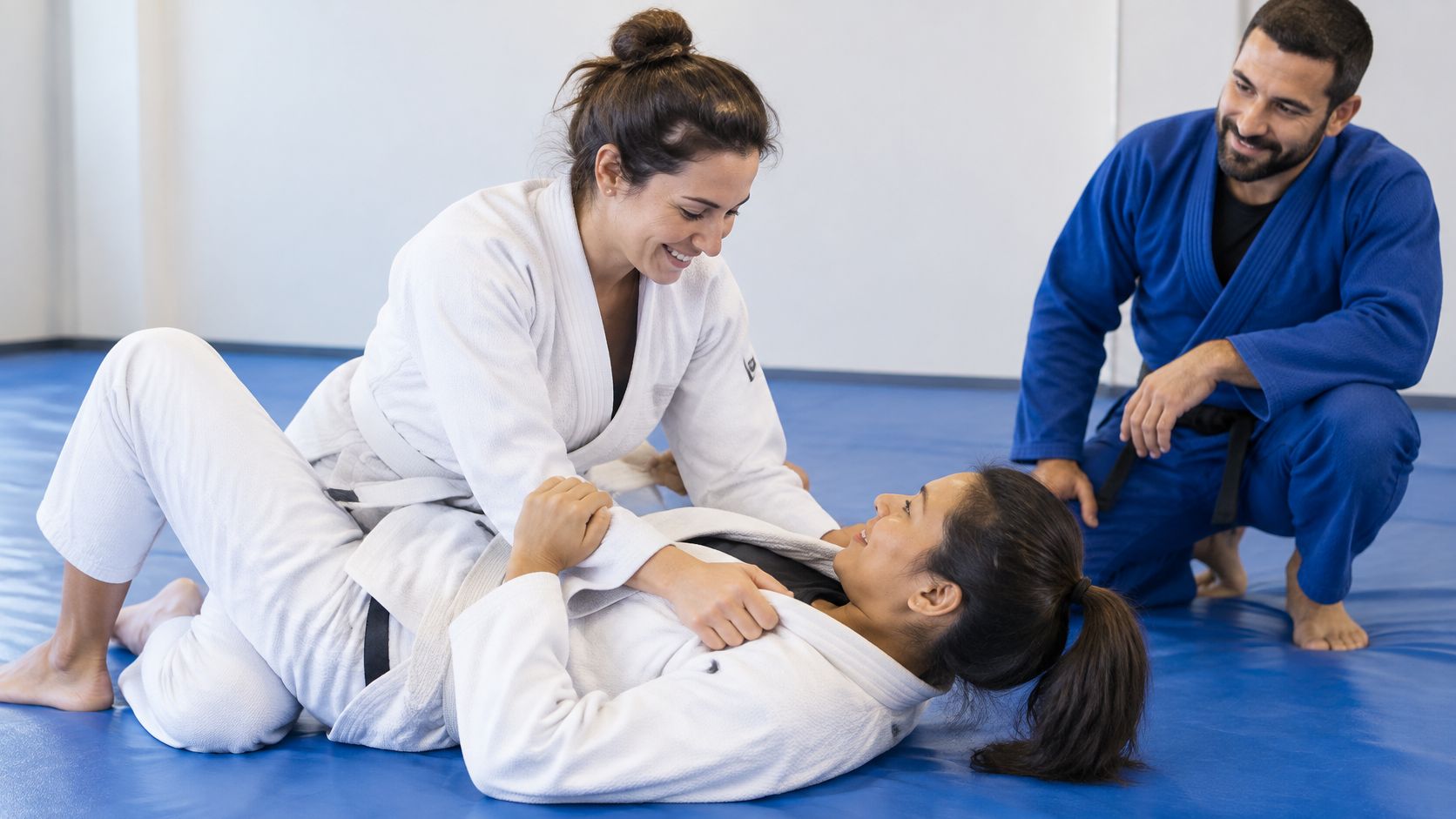
Women are a visible part of Brazilian jiu-jitsu, though they remain a minority in its membership. A first class can still feel intimidating, especially if you're unsure about close contact or entering a room where most students are men. The practical question is how to find a class where you can learn at your pace, set boundaries, and decide whether the training suits you. A women-only label alone cannot answer that; pay attention to how the coach and students handle consent and concerns.
Table of Contents
- Why Women Are Walking Onto the Mats
- Women-Only Coed Gi and No-Gi Compared
- Signals That an Academy Is Actually Safe
- What Training Gives You in the First Year
- Joints and Head Impacts While You Train
- Cycle Symptoms Weight and Modified Rounds
- Common Questions Before Your First Class
- From First Search to First Trial
Why Women Are Walking Onto the Mats
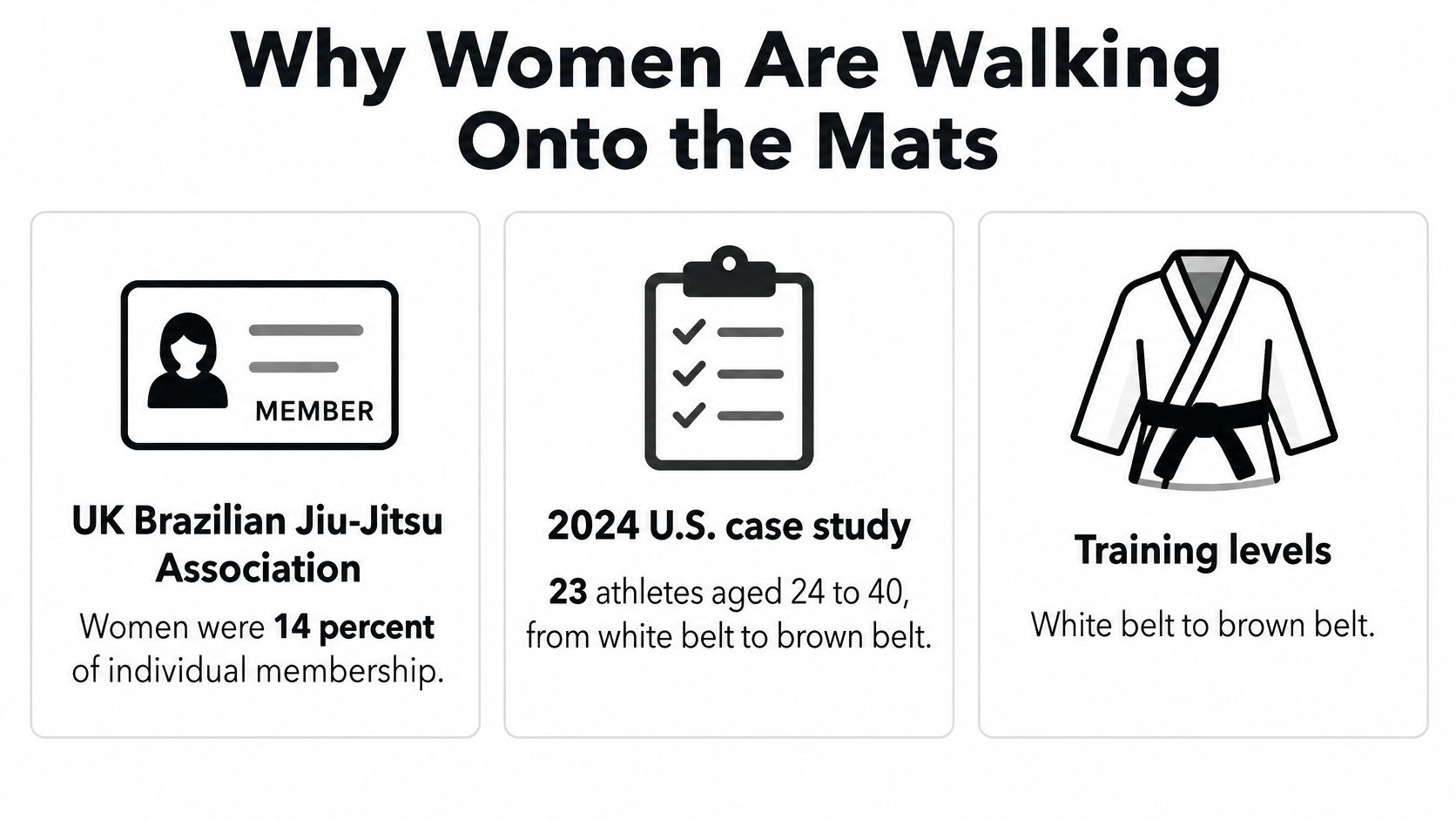
Women come to Brazilian jiu-jitsu with different ages, experience, and goals. A 2024 U.S. case study explored the experiences of women who train, including challenges linked to male-dominated gym culture, gender expectations, and the sport's close contact. Those pressures can shape a first visit, but they do not define every student or every academy.
In a fundamentals class, the coach demonstrates a movement, students practise with partners, and the session may end with positional work. Partners begin in a defined position and try to improve it, so you can learn how contact and pressure feel in a structured exercise rather than being expected to spar freely. You can ask questions, pause, or tell your partner or coach you need a break.
What matters on a first visit
Start with what you want from training, then pay attention to how the class is run. Notice whether the coach explains the exercise, checks that partners understand the drill, and responds calmly when someone asks to stop or adjust. A women-only label alone cannot tell you how an academy handles consent or concerns.
BJJ can help you practise distance, balance, and body control. It cannot guarantee safety in every situation. This guide to Brazilian jiu-jitsu and self-defense explains the distinction.
Training also involves looking after your everyday needs around class. For convenient snack ideas, Gym Snack's protein guide for women offers options to consider alongside your usual meals.
Your goals, comfort with contact, and prior experience may differ from another student's. Treat the first visit as a trial class, not a contract. You are deciding whether the environment and the training suit you.
Women-Only Coed Gi and No-Gi Compared
If you want same-gender training partners and space to ask beginner questions, start by looking for a women-only gi fundamentals class. It gives you a structured introduction to basic positions and movements, and the slower pace can make it easier to notice what your body is doing. If that class isn't available at a workable time, coed fundamentals can also be a sound starting point, provided the coach takes partner choice and size matching seriously.
| Format | Best first fit | What you wear | First-month feel | Watch-out |
|---|---|---|---|---|
| Women-only gi | Newcomers who want same-gender partners | Clean gi and white belt | Drilling, questions, slower pace | Fewer weekly time slots |
| Women-only no-gi | Students who prefer rashguards or a hot room | Rashguard and grappling shorts | Closer, faster scrambles | Less time on gi grips |
| Coed gi fundamentals | Most U.S. beginner tracks | Clean gi and white belt | Curriculum shared with mixed partners | Large size and experience gaps |
| Coed no-gi or open mat | Later months, or people with wrestling | Rashguard and grappling shorts | Athletic and less formal | Poor default for night one |
| Competition class | Athletes entering women's brackets | Gi or no-gi by the event rules | Specific drills and harder rounds | Not a first-class choice |
A gi class includes a jacket and pants, and partners can grip the fabric. In no-gi, students wear a rashguard and grappling shorts, so there's no jacket to hold. Each format teaches useful skills, but gi grips can give a new student something concrete to practise while learning posture and basic movement.
Choose a class you can attend
Women-only no-gi may suit you if you prefer less clothing or enjoy a quicker, more athletic feel. It can involve faster scrambles, so you may want a little time to learn posture, frames, and how to move safely before joining open mat. If you've wrestled before, you may already feel at home with no-gi movement, but you still have the right to ask about the class pace.
Coed fundamentals are a reasonable choice when that's the class on the schedule. Ask the coach how partners are paired and whether you can decline or switch partners without having to justify the choice. An academy that considers size and experience can help make the first class more comfortable.
Leave coed no-gi open mats and competition classes for later unless you already have relevant grappling experience. Open mats are often less structured than a coached fundamentals lesson, while competition classes usually focus on athletes preparing for harder rounds and event-specific situations.
For gi training, wear a clean gi and white belt. For no-gi, wear a rashguard and grappling shorts. Keep nails trimmed and long hair tied back for either format. A mouthguard becomes more useful once you start live rounds.
Choose the format you'll attend, then check the academy's safety and conduct before you pay for a membership.
Signals That an Academy Is Actually Safe
A gym's listing for a women-only class isn't proof that its culture is safe. A martial-arts survey with 289 respondents, most of whom primarily practised BJJ, found that 43% knew of harassment in their community, including bullying, sexual harassment, or sexual assault. In that survey, 51% of women reported awareness, compared with 40% of men, according to the martial-arts survey published by Bowling Green State University.
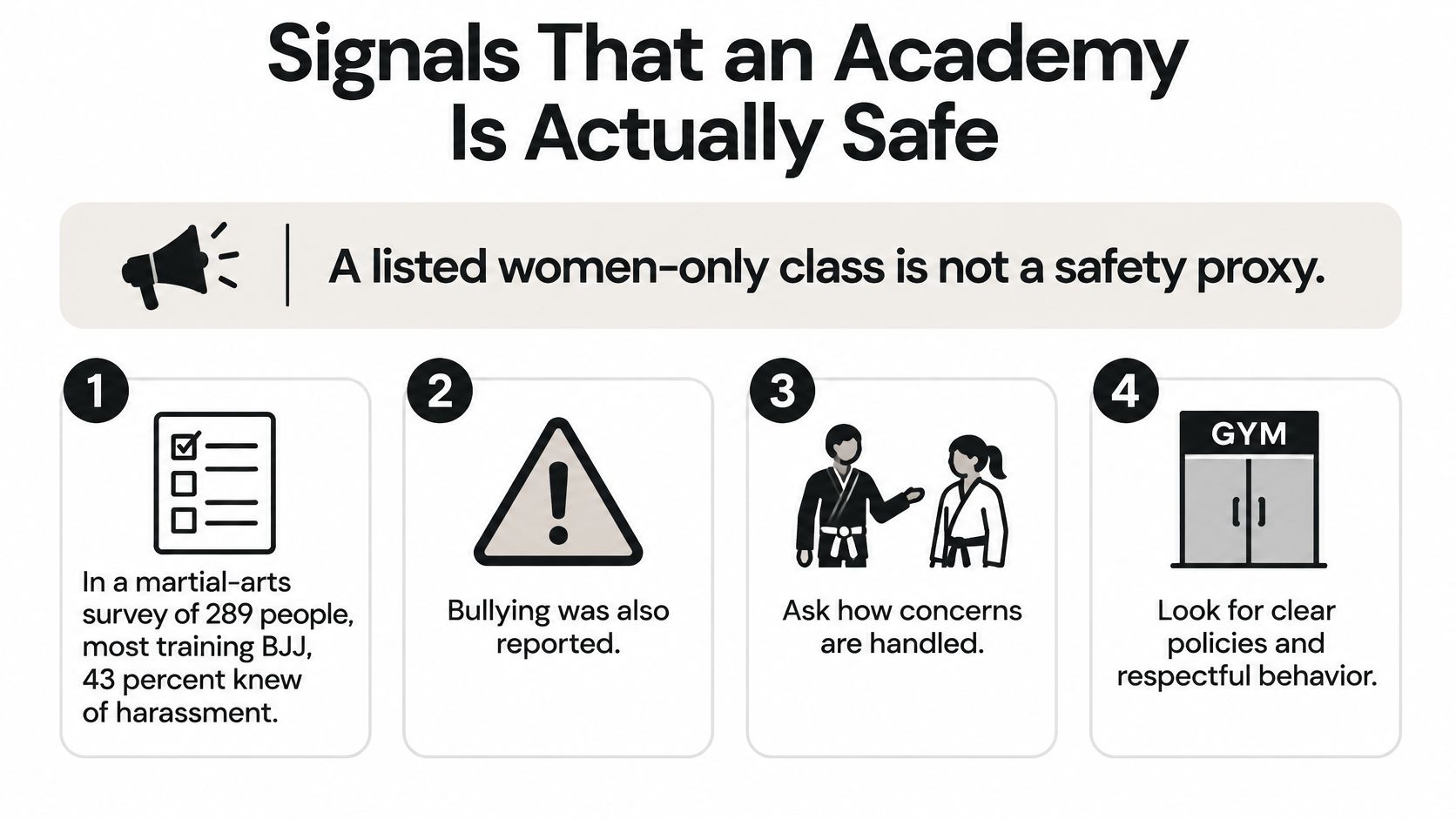
Women in the U.S. case study recommended support for newcomers, greater awareness, and trying more than one gym before committing. A dedicated women's class can be one helpful option, but it shouldn't replace checking how people behave during regular classes. You can assess those behaviors on a trial without sharing personal history or tolerating unwanted contact.
| Signal | What good looks like | Red flag |
|---|---|---|
| Partner choice | You can decline or switch partners without explanation | Forced pairing or guilt for saying no |
| Sparring | Positional rounds and an explicit tap rule | Live hard rounds on night one |
| Supervision | A coach watches live rounds | Unsupervised intensity |
| Consent | Close contact is explained and jokes don't override boundaries | Boundary complaints treated as humor |
| Complaints | A named person and a stated response | No policy beyond a star rating |
| Coaching mix | A female instructor or a real women's open mat | Women-only mentioned only in ads |
| Commitment | Several gyms and a trial are normal | Same-day contract pressure |
Make the first visit a culture check
Watch how the coach introduces partner work. Does the coach explain how to ask for a pause, how tapping works, and what happens if someone declines a drill or round? Look at whether the instructor notices students who appear overwhelmed, not just the most experienced students in the room.
You don't need to test the gym by accepting a partner you don't want. If you're paired with someone you'd rather not train with, say, “I'm going to switch partners, thanks,” and see whether the coach supports the request. A respectful academy doesn't require a detailed explanation.
Ask a direct question about complaints: Who should a student talk to, and what happens after a concern is raised? A rating or testimonial can't answer that on its own. Look for a person responsible for receiving concerns and a clear explanation of how the academy responds.
Leave if someone ignores your refusal, mocks you for tapping, or pushes you to sign before you've had time to decide. The screen is complete when you can name who to tell and what the next step would be if something went wrong.
What Training Gives You in the First Year
BJJ's practical benefits can show up in ordinary moments, not just in a photo after class. Grip work may make it easier to carry groceries, a child, or luggage. Shrimping, bridging, and practising a stable standing base ask you to coordinate your hips and posture, and those movements may feel useful after a long day at a desk, as long as training doesn't force painful positions.

Self-defense skills are more specific than a promise that one class will stop an assault. Training can help you practise maintaining balance, managing distance, and staying composed while someone applies pressure. Those skills are useful, but they don't make every situation predictable or remove the need to seek safety and help.
Progress feels ordinary before it feels dramatic
Your social experience matters, too. A familiar class can become a repeating room where partners know your name, the coach understands how you learn, and tapping is treated as useful feedback rather than failure. Confidence may follow later, when you can work through a class without needing to narrate every movement to yourself.
Control of your own body is the point, not toughness performed for the room.
A woman returning after pregnancy may need a gradual re-entry. A smaller adult in a heavy room may need careful partner matching. A former athlete may gain physical skills quickly while still needing time to feel socially safe. All belong in fundamentals; previous fitness doesn't mean anyone has to accept a faster pace or more contact.
The amount you train should fit your recovery and schedule. If you're trying to plan a sustainable routine, this guide to optimal training frequency can help you think about consistency without turning every week into a test of willpower.
A good coach helps you build skill at a pace that lets you keep returning. The benefits of BJJ depend on an academy that has already passed your safety screen, so you don't need to endure a bad room to chase them.
Joints and Head Impacts While You Train
In a U.S. survey of 778 adult BJJ practitioners, 25.2% reported having had a BJJ-related concussion. Women reported a higher lifetime prevalence than men in that survey, 43.0% compared with 22.9%, a statistically significant difference, according to the BJJ concussion survey published in the National Library of Medicine.
Those figures describe the surveyed group, not your personal risk. Use them to guide practical questions: How are takedowns taught? Does the coach adjust drilling intensity? Are beginners introduced to sparring gradually? Positional rounds can make early live practice more manageable by setting a specific starting position and goal.
Ask what happens after a head impact
Headache, dizziness, and loss of balance after a head impact are stop signs, not routine fatigue. Ask whether a coach removes students from training when symptoms appear and what the academy's return-to-training process is. If you feel dizzy after a throw, the round should stop. You should not be urged to shake it off and continue.
If a medical device or procedure affects your return to exercise, ask your clinician what activity is appropriate. Lake City Physical Therapy explains cerclage, a term that may come up in questions about a procedure, but personal guidance should come from your clinician.
Joints need clear boundaries, too. Fingers, shoulders, and knees can be strained during grappling, in training or competition. A careful academy builds intensity progressively, teaches students to tap early, matches partners by size and experience, and lets students modify a drill or sit out when a joint hurts.
Notice how partners apply pressure
For fingers, release grips rather than holding on until a partner has to pry your hand free. For shoulders, tap before a submission forces the joint past a comfortable range, and expect partners to respond immediately. For knees, ask how leg entanglements are introduced and whether students learn the escape before resisting at speed.
What should happen if someone feels dizzy after a throw? The coach should stop the round and remove the student from training. Symptoms are not a routine part of class.
Cycle Symptoms Weight and Modified Rounds
Menstrual symptoms do not follow one training calendar. Two people in the same cycle phase may feel very different, and contraception, pregnancy, perimenopause, or irregular cycles can make a fixed schedule a poor fit. Use your symptoms that day to choose whether to train, modify the session, or stop.
| Symptom | Training decision | See a clinician? |
|---|---|---|
| Normal period with steady energy | Keep the planned class | No |
| Heavy cramps or fatigue | Focus on technical drilling or rest from live rounds | If it persists |
| Dizziness or unusual joint looseness | Stop live rounds, rest, or modify | If it recurs |
| Fainting or severe one-sided pain | Stop training | Yes, promptly |
| Bleeding far outside your normal pattern | Stop training | Yes, promptly |
| Any head impact in any phase | Leave training | Follow the academy's head-injury protocol |
Research involving female BJJ athletes and grapplers has reported difficulty making weight and injuries across different menstrual phases. A practical takeaway is to track your own symptoms if it helps you make training decisions, rather than assuming a calendar predicts how you will feel.
Choose the session by the symptom
Steady energy during a normal period may be compatible with your planned class. Heavy cramps or fatigue can make technique work or a rest from live rounds a better fit. Dizziness or unusual joint looseness means stopping live rounds; if either keeps returning, speak with a clinician.
A brief request is enough: “I need a lower-intensity round today.” You do not have to explain why. A respectful coach should help adjust the session without treating a modified round as a lack of commitment.
For a beginner event, regular meals and steady hydration are more useful goals than a rapid weight cut. If you plan to compete, ask a coach to help you make a realistic weight plan and refer you to qualified strength-and-conditioning support if needed. Exercise can also feel different during menopause; managing menopausal symptoms during exercise with Lila offers context for adapting activity to individual needs.
Common Questions Before Your First Class
Do I need to get fit first?
No. A beginner class should teach you the movements at your own pace, and your fitness can develop through training. Tell the coach if you need a slower start.
How often should I train?
Starting with two sessions a week gives you a regular chance to practise while leaving room for recovery. If your joints stay sore or you feel run down, reduce the pace or frequency and talk with your coach.
Will I be the only woman in the room?
You might be, or you might not. Check the schedule for women-only classes or sessions with a female instructor, and ask the academy how often women train in its mixed classes.
Can I bring a friend to a trial?
Many academies welcome visitors, but policies differ. Contact the gym first and ask whether a friend can observe or join the trial.
Do I need to buy a gi before the first class?
Not necessarily. Ask whether the academy can lend you one for a trial, then buy your own once you know which format you want to keep.
Do I have to compete?
No. You can train recreationally and keep attending fundamentals without entering a tournament. Competition is an option, not a requirement.
From First Search to First Trial
Search your city in the Brazilian Jiu-Jitsu Academy Finder and shortlist academies with beginner or women's classes. Compare their location pages, contact details, websites, and community reviews, paying attention to comments about coaching and culture rather than relying only on ratings.
Email each gym before you go. Ask about its trial policy, women-only schedule, female coaches, and whether new students do positional rounds instead of open sparring on their first day. If you want help considering what to look for in a local gym, read this guide to where to learn Brazilian jiu-jitsu.
Arrive early with trimmed nails and tied-back hair. Bring a clean gi or no-gi kit if the academy requests it; otherwise, ask what a trial student should wear and whether loaner gear is available.
Drill the techniques and join positional work if you feel ready. You can skip open mat or any live round that feels too intense. A trial is a chance to learn how the instructor teaches, not a test of how much discomfort you can tolerate.
Try more than one gym before signing a contract. Women organized an early BJJ tournament in 1985, while the 1998 IBJJF World Championship offered two female divisions compared with 50 men's divisions, as described by Jiu Jiteira Magazine's account of women's competition history. That history reflects how competitive opportunities developed gradually, and how much local coaching and training partners still matter.
After you've trained consistently for several months, ask your coach about measured sparring with partners whose size and experience suit you. You don't need to progress on another student's timeline.
Consider a local women's bracket only when you and your coach agree you can tap, restart, and manage weight without a crash cut. If competing isn't your goal, you can stay a recreational student.
Your decision is made when you have a trial date on the calendar at a gym where you can decline a partner and still receive respectful coaching.
Brazilian Jiu-Jitsu Academy Finder helps you compare academy locations, schedules, contact details, and community reviews so you can shortlist gyms that fit your goals. Visit Brazilian Jiu-Jitsu Academy Finder to find a nearby class, contact a gym, and book a trial that feels right for you.
Share this article