
Comparing Gym Cultures in BJJ
Compare five BJJ gym types—competition, structured, community, traditional, and mixed—to match your training goals, safety needs, and progression path.
Written by BJJ Academy Finder Editorial Team
Comparing Gym Cultures in BJJ
Brazilian Jiu-Jitsu gyms differ widely in their training styles, goals, and overall atmosphere. Whether you're a competitor, a beginner, or someone seeking a supportive community, understanding gym types can help you make the right choice.
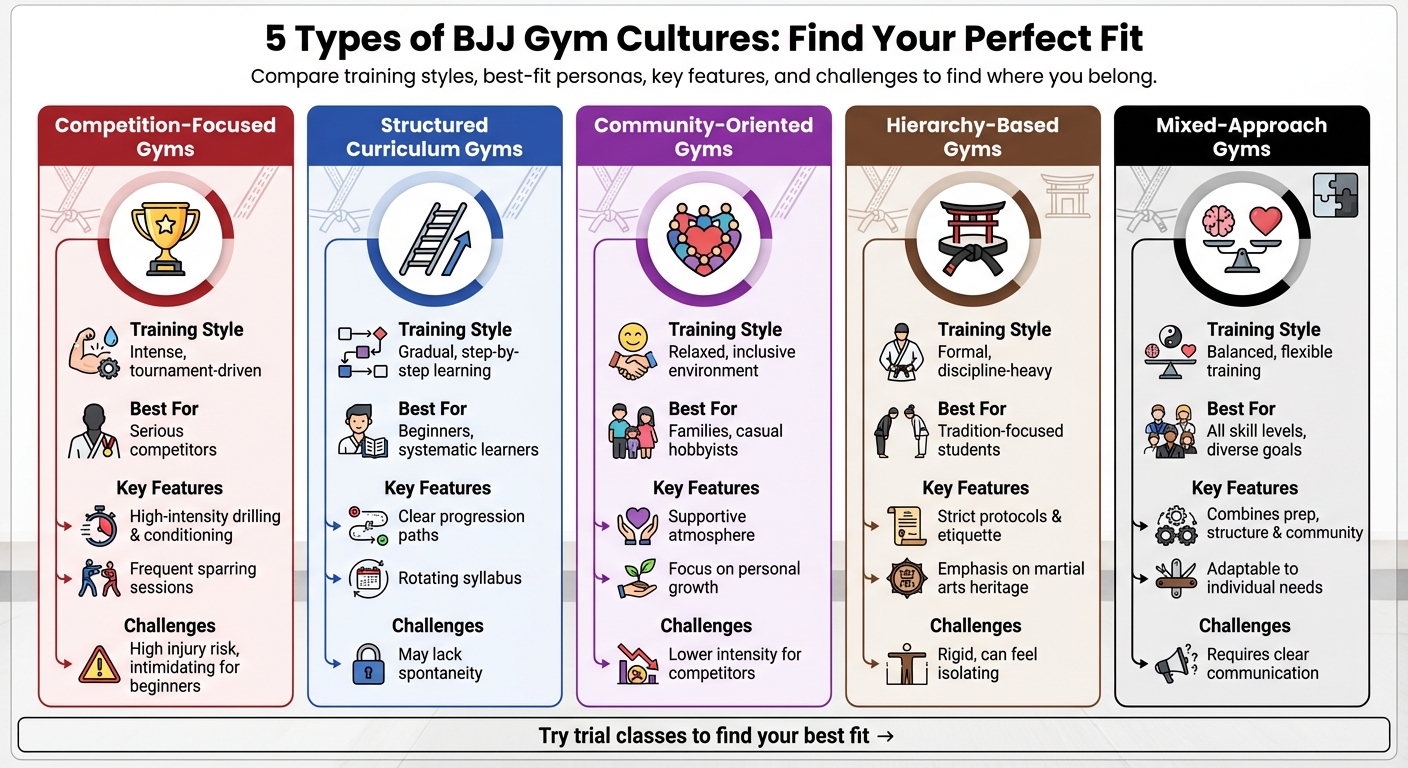
Here are the five main BJJ gym styles:
- Competition-Focused Gyms: High-intensity training geared toward tournaments, with a focus on drilling, conditioning, and sparring. Great for serious competitors but can be overwhelming for beginners.
- Structured Curriculum Gyms: Step-by-step learning with clear progression paths, ideal for beginners and those who prefer a systematic approach.
- Community-Oriented Gyms: Emphasize inclusivity, safety, and personal growth over competition. Perfect for hobbyists and families.
- Hierarchy-Based Gyms: Follow strict traditions, with formal protocols and a disciplined environment. Best for those who value martial arts heritage.
- Mixed-Approach Gyms: Combine elements of competition prep, structured learning, and community focus, catering to a variety of goals.
Quick Comparison
| Gym Type | Training Style | Best For | Challenges |
|---|---|---|---|
| Competition-Focused | Intense, tournament-driven | Serious competitors | High injury risk, intimidating for beginners |
| Structured Curriculum | Gradual, step-by-step learning | Beginners, systematic learners | May lack spontaneity |
| Community-Oriented | Relaxed, inclusive | Families, casual hobbyists | Lower intensity for competitors |
| Hierarchy-Based | Formal, discipline-heavy | Tradition-focused students | Rigid, can feel isolating |
| Mixed-Approach | Balanced, flexible | All skill levels, diverse goals | Requires clear communication |
Choosing the right gym depends on your goals, whether it's mastering techniques, competing, or finding a supportive environment. Trial classes are a great way to assess a gym's teaching style, safety measures, and overall vibe.
BJJ Gym Types Comparison: Training Styles, Best Fit, and Key Challenges
How to Pick a Martial Arts Gym
1. Competition-Focused Academies
Competition-focused academies are all about one thing: winning tournaments. These gyms attract athletes who are serious about testing their skills at the highest level, and the training reflects that ambition. Students sharpen their techniques against skilled, resisting opponents, creating a challenging and intense environment. However, this focus often gives the gyms a reputation for being more serious or even "clique-y" compared to the laid-back vibe of community-oriented gyms. This intensity shapes the unique atmosphere of competition gyms, where strategies in Brazilian Jiu-Jitsu (BJJ) are constantly refined.
Training Intensity and Style
Training at competition-focused academies is on another level. Forget casual "flow rolling" - these gyms emphasize dominating opponents with both skill and physicality, replicating the pressures of a real tournament. Tom Renshaw, a purple belt and educator at Jiu Jitsu Brotherhood, sums it up perfectly:
"80% of your success in sparring probably comes from 20% of your techniques".
This philosophy explains why high-level competitors may drill a single move thousands of times - sometimes as many as 95,000 repetitions - to ensure it becomes second nature during a match.
Physical conditioning is also a core part of the training. High-intensity interval training (HIIT) and explosive strength exercises are built into the curriculum, not treated as optional extras. Nicholas Salles from Movement Art highlights the benefits of such training:
"High-intensity training makes normal rolls feel easier".
This kind of mental and physical preparation is key to thriving in these demanding environments. However, the relentless pace also underscores the importance of recovery and safety practices to avoid burnout and injuries common in such rigorous settings.
Safety Practices
Even with their intense training regimens, successful competition academies prioritize safety to prevent chronic injuries and burnout. Lucas Walker, author of BJJ Self Help, offers insight:
"I have seen more moderate gyms have success by engaging this 'go hard' mode of training in short bursts. Instead of killing each other every day, they spend most of the time building each other up. Optional training camps that last a few weeks to a month help prepare their competitors without making training unbearable".
Many gyms enforce "catch and release" policies, especially for techniques like leg locks, where practitioners release the hold if their partner is unaware of the danger. Instructors also rely on experienced grapplers, often called "mat enforcers", to manage overly aggressive beginners and maintain a safe environment.
Recovery has become a top priority in modern competition gyms. Practices like proper sleep, hydration, and mobility work are now considered "non-negotiable" to counter the high injury rates of old-school training methods. These protocols not only reduce injuries but also create a structured and sustainable training system.
Student Progression and Development
Progression in these academies follows a carefully planned peaking and tapering system. Training camps typically last 4 to 7 weeks leading up to major tournaments. Early on, students train intensely - up to 5 or 6 sessions per week - but this tapers to 3 or 4 sessions as competition day approaches.
BJJ athlete Chris Wojcik’s experience at the ADCC East Coast Trials in October 2023 highlights the importance of this approach. Despite previously defeating his opponent, he lost 3-0 in the rematch, attributing the loss to a lack of a proper training camp and poor preparation due to travel and illness.
During these camps, students focus on "specific rounds", working from disadvantageous positions like turtle or defending leg locks. This helps them build technical precision under pressure. Two weeks before a tournament, the focus shifts entirely to refining signature moves, with no new techniques introduced. The final week is reserved for rest or light activity, allowing full recovery before competition day. This structured, methodical approach sets competition-focused academies apart in the world of BJJ.
2. Structured Curriculum Schools
While competition-driven academies focus on intense, high-pressure training, structured curriculum schools take a more methodical approach. These gyms emphasize a gradual, step-by-step learning process. Students start with fundamental techniques - like sweeps and escapes - and work their way up to advanced transitions and strategic concepts. This systematic progression ensures a solid foundation for practitioners. As Laura Peretti from JSBJJ Academy puts it:
"A structured curriculum is essential for building a successful BJJ school. It provides your students with a clear path for progression, fosters consistency in training, and ensures that each student... receives the appropriate level of instruction".
Training Intensity and Style
In structured schools, training intensity is carefully managed. Confidence is built through controlled positional sparring, where students practice from specific positions such as mount or side control. This approach combines detailed instruction, repetitive drilling, and live sparring sessions. Many academies also use a rotating syllabus for beginners, covering foundational techniques over a 6- to 8-week period to ensure all essential skills are addressed. Lucas Walker from BJJ Self Help underscores the benefits of this method:
"Pre-planned curriculum allows for a structured learning environment. Students learn the different needed concepts and never feel like they are wasting their time because the teacher is just 'winging-it'".
Safety Practices
Safety is a top priority in structured curriculum schools, with clear and consistent protocols in place. High-risk techniques, such as scissor takedowns, slamming, neck cranks, and jumping into closed guard, are generally prohibited. For instance, some schools, like Art of Ground Games (March 2025), enforce these safety measures rigorously. Many academies also follow IBJJF belt-level restrictions, which prevent white belts from practicing moves like heel hooks. Hygiene and mat etiquette are equally important, with strict rules requiring clean gis and rash guards, prompt mat clearing after classes, and traditional practices like bowing and lining up by rank.
Student Progression and Development
Structured schools establish clear belt requirements, so students always know what skills they need to master to advance. Progress is evaluated through formal belt testing, situational sparring under resistance, and assessments of positional awareness. Instructors keep a close eye on each student’s development, adjusting their teaching methods when necessary to address challenging concepts. This hands-on approach not only helps students build skills effectively but also contributes to better retention rates.
Up next, we’ll look at gyms that prioritize fostering a family-like community atmosphere.
3. Family and Community-Oriented Gyms
After exploring competition-driven and structured academies, many practitioners now gravitate toward gyms that focus on fostering community and family connections. These gyms have a more relaxed, club-like vibe, steering away from rigid hierarchies. Instead of chasing championship titles, they emphasize cultivating the "peaceful warrior" - someone who hones both their physical skills and personal character. The goal is to create an inclusive space where people of all ages and skill levels feel welcome.
Training Intensity and Style
Training here is designed to be sustainable and enjoyable. Techniques are introduced gradually, giving training partners plenty of time to tap, with the focus firmly on learning rather than overpowering. The philosophy, often described as "rolling as a conversation, not a conquest", encourages technical growth over brute strength.
"Your culture is what you tolerate and what you model." - MAAT
Inclusivity and Community
To make newcomers feel at home, these gyms use structured introductions and pair them with training buddies. A diverse membership base is seen as a sign of a healthy gym culture. Nicci from Lightning Kicks puts it perfectly:
"Women in the BJJ gym have been compared to the canary in a coal mine – if she is thriving, then it's a safe place for everyone." - Nicci, Lightning Kicks
When women, children, and older practitioners thrive, it reflects an environment free from toxicity. Success here isn’t just about medals; it’s about celebrating moments like a shy student leading warmups or a parent returning to the mats after recovering from an injury. This approach is crucial, especially considering that 80–90% of beginners in Brazilian Jiu-Jitsu quit within their first year.
This welcoming culture is reinforced by strict safety and etiquette practices.
Safety Practices
Safety is a top priority in community-focused gyms. Dangerous techniques are strictly prohibited, ensuring a secure training environment. Students are taught to apply submissions slowly, allowing their partners enough time to tap, and to adjust sparring intensity to suit their partner’s comfort level. Hygiene is also taken seriously - students are required to wash their gis after every session, keep their nails trimmed, and stay off the mats if they’re injured or unwell. Instructors actively address unsafe behavior as it happens to maintain a safe and respectful atmosphere.
Student Progression and Development
Progression in these gyms reflects a balanced approach. The saying "the belt is a milestone, not a measure" captures their philosophy. Advancement recognizes consistency and personal growth alongside technical skills. This approach is ideal for students who can’t train as frequently due to work or family commitments. Growth is measured not just in skill but in character, which is a cornerstone of a supportive gym culture.
sbb-itb-d583f1e
4. Old-School and Hierarchy-Based Academies
Some Brazilian Jiu-Jitsu (BJJ) academies embrace a more relaxed and inclusive vibe, but traditional schools stick closely to time-honored customs. These academies aim to preserve the roots of Brazilian Jiu-Jitsu by enforcing strict protocols. For example, students are required to bow when stepping on or off the mat, line up in belt order before and after class, and address their instructors with titles like "Professor", "Sensei", or sometimes even "Master". Lower-ranked students are also expected to wait for an invitation from higher belts before initiating a roll.
Training Intensity and Style
The training style in these traditional schools is often intense, adopting what many refer to as a "Sparta" mentality. The focus is on toughening students through rigorous workouts and challenging sparring sessions. Lucas Walker, a BJJ practitioner and author, captures this experience well:
"To new people it feels largely like being thrown into a shark tank and told to swim".
Higher belts in these settings often take it upon themselves to push lower belts hard during sparring, treating it as a test of their resolve and commitment.
Inclusivity and Community
This intense, sink-or-swim approach can be intimidating for new or casual practitioners. As Walker puts it:
"For the casual hobbyist grappler, this environment can be an unwelcoming nightmare".
Traditional academies also tend to enforce strict dress codes, such as requiring students to wear white-only gis or gear branded with the academy's logo. The rigid hierarchy and formal structure can make beginners feel isolated, especially if they’re looking for more personalized guidance. Nelson Puentes of Inverted Gear highlights these practices:
"Traditional schools have carried over many practices from traditional martial arts - bowing on and off the mat, lining up in belt order before and after class - and some have strict rules in the way lower belts interact with upper belts".
These rules and rituals shape not just the day-to-day environment but also the overall student experience within these academies.
Student Progression and Development
In these traditional settings, promotions and student advancement are often subjective. Emily Kwok, founder and instructor at Princeton BJJ, explains:
"BJJ has also traditionally been an extremely subjective art. There is no standardized framework for what competencies a student should possess through each belt level".
Promotions depend entirely on the judgment of the head instructor, which can make progression feel unpredictable. Additionally, some of these academies discourage students from cross-training at other gyms, limiting their exposure to different techniques and perspectives. This approach reinforces the school's insular culture and emphasizes loyalty to the academy above all else.
5. Mixed-Approach Gyms
Some gyms have struck a balance by blending elements from various training philosophies. These mixed-approach gyms cater to both competitive athletes and recreational practitioners, creating a space where everyone can work toward their personal goals without feeling out of place. By combining high-intensity competition prep with structured, community-focused training, these gyms offer an environment that meets a range of needs.
Training Intensity and Style
Rather than maintaining a constant focus on high-intensity training, mixed-approach gyms take a more measured approach. They organize short bursts of intense preparation, like optional competition camps lasting a few weeks, specifically for students gearing up for tournaments. For the rest of the year, training emphasizes skill development and technique in a more sustainable manner.
These gyms also offer flexibility in training intensity. Students can choose their preferred level, whether it's "soft flow rolls" to refine techniques or high-pressure rounds that mimic competition scenarios. The emphasis is on personal choice - there's no rigid, one-size-fits-all approach. Instead, students can tailor their training to align with their goals and physical readiness.
Inclusivity and Community
While fostering a sense of inclusivity like community-oriented gyms, mixed-approach academies also support competitive ambitions. Leadership often sets the tone by training alongside all members, regardless of skill level, and demonstrating humility by "tapping often". As MAAT puts it:
"Your culture is what you tolerate and what you model".
To prevent cliques, these gyms actively address exclusive behavior as it happens. They also implement welcoming practices for new members, such as first-week check-ins and pairing them with training buddies. This ensures that even beginners feel comfortable training alongside seasoned competitors. The presence of successful female practitioners is often seen as a marker of a gym's overall safety and inclusivity.
Safety Practices
Safety is a top priority in mixed-approach gyms. Instructors monitor sparring sessions closely, stepping in when necessary to correct unsafe behavior. Before sparring, students are encouraged to communicate about skill levels and any injuries.
These gyms also promote a "tap early" culture, viewing submissions as opportunities to learn rather than failures. As MAAT explains:
"You don't learn when you win, you confirm".
This mindset reduces injuries and encourages students to experiment with new techniques without hesitation. Hygiene is another focus - clean uniforms, trimmed nails, and regularly sanitized mats are non-negotiable.
Student Progression and Development
To support student growth, mixed-approach gyms often use tiered curriculums. Beginners follow a rotating 6–8 week syllabus of fundamentals before moving into mixed-level classes. This ensures they build a strong foundation without feeling overwhelmed. Advanced students, meanwhile, have more freedom to explore individual strategies or prepare for competitions, if that’s their focus.
Progression isn’t just about competition wins. Many gyms track attendance digitally and celebrate milestones like completing a set number of classes in a month. This approach keeps both casual practitioners and dedicated competitors engaged, ensuring everyone feels valued regardless of their training frequency or goals.
Pros and Cons
Breaking down the strengths and weaknesses of different gym cultures can help you decide which environment best suits your training goals. Each type of gym offers distinct advantages and challenges, so it’s worth taking the time to evaluate them.
Competition-focused academies are ideal for those seeking high-level instruction and a challenging environment. These gyms often feature coaches with elite competition experience and teammates who push each other to improve quickly. However, the intensity can be intimidating for beginners, and the rigorous training increases the risk of injuries. Membership fees, which typically range from $100 to $250+ per month, may also feel steep for non-competitors who might not fully benefit from the competitive focus. As Lucas Walker from BJJ Self Help puts it:
"For the casual hobbyist grappler, this environment [Sparta-style] can be an unwelcoming nightmare".
On the other hand, structured curriculum schools offer a more beginner-friendly, step-by-step learning experience. These gyms focus on mastering fundamentals before advancing to more complex techniques. Ryan Young from Kama Jiu-Jitsu explains:
"Once you master the fundamentals, advanced techniques follow naturally".
While this structured setup helps students avoid feeling lost, it may lack the spontaneity and intensity of live, resistive training. As Lucas Walker notes:
"A bit of the 'Sparta' mentality is required to make sure techniques are truly being mastered. Making sure that under the guise of being technical we aren't living in a fantasy world is really important".
Family and community-oriented gyms shine in creating a supportive and welcoming atmosphere. These gyms celebrate personal progress and normalize tapping as part of the learning process, making them great for long-term retention. However, the lower intensity might not meet the needs of serious competitors who require high-level partners and preparation for tournaments.
For those who value tradition, old-school hierarchical academies emphasize discipline and respect for martial arts heritage. While this structure can be appealing, the rigid protocols may feel restrictive to those who prefer a more relaxed training environment.
Understanding these differences is key to finding a gym culture that aligns with your personal goals and training aspirations.
Conclusion
Finding the right Brazilian Jiu-Jitsu (BJJ) gym is about aligning with your personal goals and creating an environment where you can thrive. Whether you're chasing competition glory, prefer a structured curriculum, or value the camaraderie of a family-oriented gym, each option offers its own path for growth. As Tsavo Neal, Founder of BJJ Equipment, wisely puts it:
"There's no perfect BJJ gym or culture for everyone. There's only the best particular gym for you."
Take the time to attend trial classes to get a feel for the instructor's teaching approach, the overall safety measures, and the gym’s atmosphere. Check the instructor’s credentials and choose a location that fits your routine for long-term consistency. Be cautious of warning signs like mandatory fees, restrictions on cross-training, or unclear pricing structures. These considerations will help ensure your choice is a solid investment in your BJJ journey.
For an easier way to explore your options, the Brazilian Jiu-Jitsu Gyms Directory (https://bjjacademyfinder.com) allows you to search and compare academies across the U.S. using filters for location and training style.
Since BJJ is a long-term commitment, taking the time to find a gym that feels like the right fit will set the tone for years of progress and enjoyment on the mats.
FAQs
How can I find the right Brazilian Jiu-Jitsu gym for my goals?
Finding the right Brazilian Jiu-Jitsu (BJJ) gym starts with understanding what you want to get out of your training. Are you aiming to compete, improve your fitness, learn self-defense, or just have fun? Pinpointing your goals will help you pick a gym that aligns with your priorities - whether it’s focused on competition or offers a more laid-back, recreational vibe.
Practical details matter too. Think about location, class schedules, and cost. Choose a gym that’s convenient to get to, has classes at times that work for you, and fits within your budget. In the U.S., monthly memberships typically range between $120 and $180. Don’t forget to check out the instructor’s qualifications and teaching approach - these can play a big role in helping you achieve your goals.
Before committing, visit the gym to get a feel for its environment. If possible, observe a class or take a trial session. A positive, respectful atmosphere can make all the difference in how much you enjoy and stick with your training. To streamline your search, tools like the Brazilian Jiu-Jitsu Gyms Directory can provide detailed information on options near you.
What can I expect during a trial class at a Brazilian Jiu-Jitsu gym?
When you attend a trial class at a Brazilian Jiu-Jitsu (BJJ) gym, you can expect a friendly and organized introduction to the sport. Most gyms will have you fill out a liability waiver - this might be done online ahead of time or in person when you arrive. Once you're there, you'll check in, meet the instructor (often referred to as the "professor" or "coach"), and get a brief overview of the gym's culture and rules.
Classes usually kick off with a warm-up, followed by demonstrations of techniques and partner drills to practice what you've learned. Some sessions might wrap up with light rolling (sparring), though this can vary depending on the gym. Pay attention to any specific guidelines, like bowing onto the mat or respecting rank etiquette, as these customs differ from one academy to another. After class, take a few minutes to ask about membership options or programs to see if the gym aligns with what you're looking for.
If you discovered the gym through the Brazilian Jiu-Jitsu Gyms Directory, mention it! It's a great way to show your enthusiasm and connect with the academy.
What safety practices should I look for when choosing a BJJ gym?
When choosing a Brazilian Jiu-Jitsu gym, cleanliness and upkeep should be your first considerations. Look for gyms that regularly sanitize their mats, provide hand-washing stations, and enforce hygiene rules to help prevent skin infections like ringworm or staph. The training area should be free of hazards - no sharp edges or clutter - and a well-stocked first-aid kit should always be on hand for minor injuries.
Safety also hinges on the gym's culture and the quality of instruction. Experienced instructors should tailor techniques to your skill level, focusing on controlled training. They should emphasize the importance of respecting tap-outs and discourage overly aggressive sparring. A great gym fosters a welcoming atmosphere, lays out clear safety guidelines, and encourages mutual respect among all members.
If you're looking for gyms that check these boxes, the Brazilian Jiu-Jitsu Gyms Directory is a helpful resource. It can guide you to academies that prioritize safety, cleanliness, and skilled instruction.
Related articles
Share this article