
Group BJJ Training: What Families Should Know
Practical advice for families starting Brazilian Jiu-Jitsu: schedules, family memberships, age-based classes, safety tips, and keeping kids focused.
Written by BJJ Academy Finder Editorial Team
Group BJJ Training: What Families Should Know
Training Brazilian Jiu-Jitsu (BJJ) as a family offers more than just fitness - it’s a way to connect, build trust, and grow together. Parents and kids can train side-by-side, learning discipline, self-defense, and perseverance while overcoming common hurdles like busy schedules and skill differences. Here’s what you need to know:
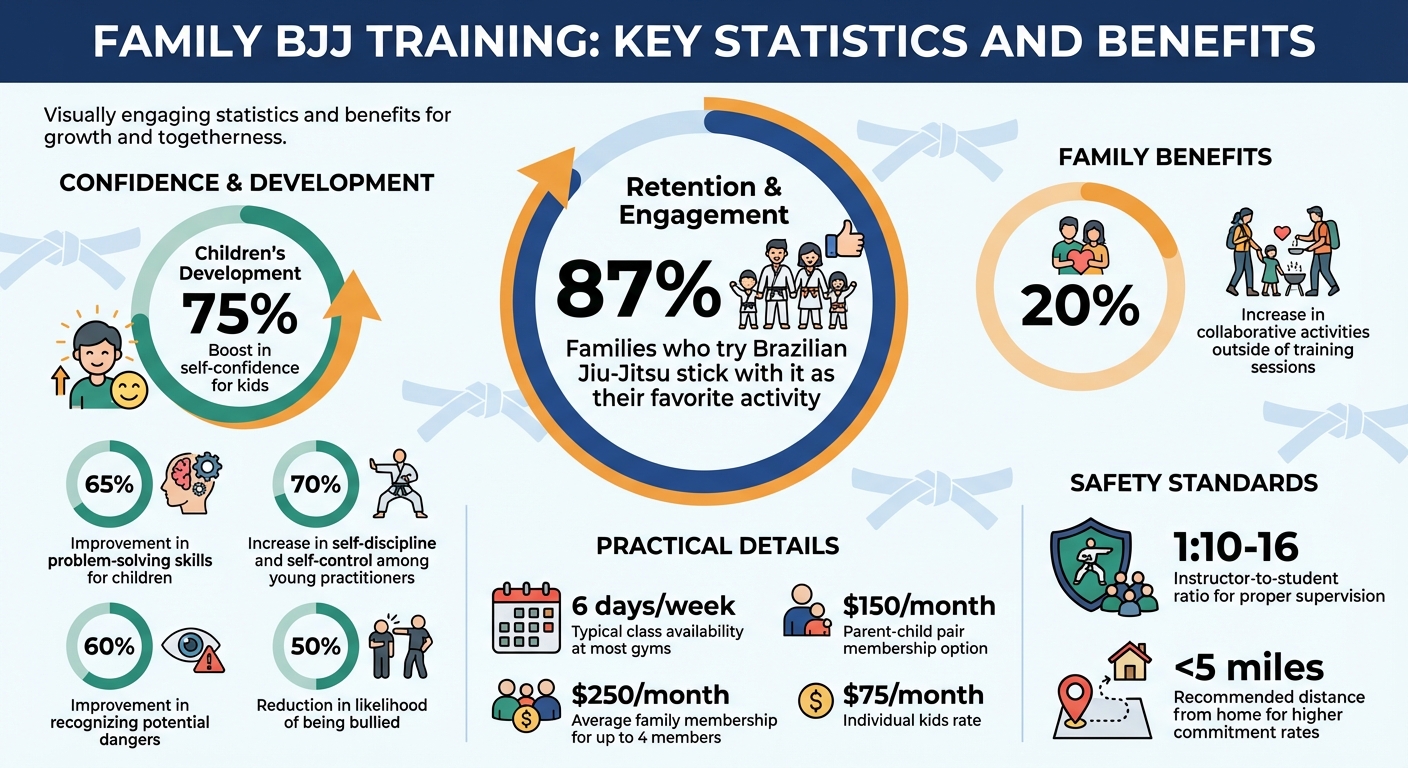
- Shared Benefits: BJJ improves physical health, self-confidence (up to 75% for kids), and problem-solving skills (65% boost for children).
- Flexible Options: Most BJJ gyms near you offer classes six days a week, family membership plans (starting around $250/month), and overlapping sessions for parents and kids.
- Skill Levels Managed: Classes are often divided by age and experience, ensuring tailored instruction for everyone.
- Focus and Safety: Structured classes, rewards, and close supervision help kids stay engaged and safe during training.
Family BJJ Training Benefits and Key Statistics
Parents & Kids Train Jiu Jitsu Together I Jiu Jitsu Modern Family Roll
sbb-itb-d583f1e
Managing Family Schedules for BJJ Training
Balancing work, school, homework, and extracurricular activities can make carving out time for family Brazilian Jiu-Jitsu (BJJ) training tricky. To make it work, families need to approach it with a plan. Thankfully, most BJJ gyms offer classes at least six days a week [3], giving plenty of options to find a schedule that fits.
The secret? Treat BJJ like any other non-negotiable appointment. As one practitioner explains: "Pick a consistent class and protect it. I treat Thursday night like a dentist appointment I can't miss" [7]. Committing to 2–3 specific training days each week and building other activities around those slots can make all the difference.
Finding Academies with Flexible Class Times
Choosing the right academy is just as important as scheduling. A conveniently located gym makes it easier to stick with training. Finnie McMahon, Owner of McMahon Training Center, shares: "Research shows that if the location where you train is less than five miles from your house, you have a much higher chance of committing to training" [9]. So, when searching for a gym, prioritize proximity to home or work before considering class schedules.
Many academies offer a variety of class times to fit different routines. Early morning classes let parents train before dropping kids off at school or heading to work, while evening and weekend options cater to more traditional schedules. Some gyms even have programs like homeschool BJJ, perfect for families with daytime availability. Taking advantage of free trial classes can help you test whether a schedule works in practice. As Gracie Lake Norman puts it: "A flexible schedule enables students to maintain regular practice while balancing work, family, and other commitments" [10].
Once you've found the right academy, it's worth exploring membership plans designed for families.
Looking into Family Membership Options
Family membership plans make it easier for multiple members to train together or at overlapping times. Many academies offer family packages that cover up to four immediate family members for a single monthly fee - usually around $250.00. This is a better deal compared to individual rates, which are typically $99.00 for adults and $75.00 for kids [11]. For smaller families, options like "Just the 2 of Us" memberships - $150.00 per month for a parent-child pair or couples - are available [11].
Some gyms also offer overlapping sessions where kids and adults can train at the same time, cutting down on extra trips and keeping everyone on the same schedule. For families with unpredictable commitments or seasonal sports, flex passes are a great alternative. These passes cost $125 for five classes (valid for three months) or $230 for ten classes (valid for six months) [12]. They provide flexibility without requiring a long-term financial commitment, making it easier to stay consistent even with a busy calendar.
Handling Different Skill Levels in the Family
Training in Brazilian Jiu-Jitsu (BJJ) as a family brings together people with varying skill levels - from absolute beginners to seasoned teens and adults. Most academies are well-prepared to manage these differences. They typically organize classes by age groups - Kids (ages 4–12), Teens (ages 13–17), and Adults (18+) - to align instruction with each group's physical and developmental needs [8][13]. This structure ensures that a 6-year-old isn’t expected to keep up with a teenager, and adults can focus on techniques suited to their goals and abilities.
Many family-friendly gyms also offer simultaneous training sessions. This means kids and adults can train at the same time but in separate groups. Parents can drop their kids off for class and head to the adult mat themselves, keeping everyone on the same schedule without compromising on quality instruction [13]. By tailoring programs to both age and ability, these academies make it easier for families to train together while addressing individual needs.
Age and Skill-Based Class Programs
Having structured programs is key to helping families progress together. Most gyms divide their classes by both age and skill level. For example:
- Mat Munchkins (ages 3–4) focus on coordination skills.
- Little Sharks (ages 5–7) introduce self-defense basics.
- Junior Grapplers (ages 8–13) teach more advanced techniques [15].
Adults typically have separate tracks for Fundamentals and Advanced techniques, allowing everyone to train at a pace that suits them.
As Professor Carlos Daniel, Head Instructor at Gracie Barra Salt Lake City, puts it:
"Training together means setting goals together, celebrating victories together, and learning side-by-side" [13].
Even when family members attend different classes, they can still work toward shared milestones - whether it’s attending a set number of classes each week or earning their next belt stripe [6][5]. This approach balances individual progress with the shared experience of training as a family.
Pairing Different Skill Levels During Training
In addition to separate classes, many academies use mixed-level drills to enhance learning. Once students have a solid grasp of the basics, pairing those with different skill levels can be a great way to reinforce progress. Advanced members can solidify their knowledge by teaching, while beginners benefit from hands-on guidance [6].
Kelly Leleux, Assistant Kids' Coach at Guto Campos BJJ, emphasizes the importance of this dynamic:
"Working with partners of various sizes and skill levels teaches teamwork and respect" [6].
Because BJJ prioritizes leverage and strategy over brute strength [13], even a smaller, more experienced family member can guide a larger beginner safely. Jon Dysert from Seymour Brazilian Jiu-Jitsu Academy highlights the unique bonding opportunity this creates:
"Parents who train with their children get the chance to engage with them in a meaningful way. This isn't like watching a game from the sidelines - you're right there on the mat, learning together" [1].
All partner work happens under close supervision, with instructors maintaining a ratio of roughly one coach per 10–16 students to ensure safety and provide personalized feedback [14]. By blending individual progress with shared experiences, these methods not only address skill gaps but also strengthen family connections through mutual learning and achievement.
Keeping Kids Focused and Disciplined During Training
Balancing schedules and managing varying skill levels is one thing, but keeping kids engaged during training? That’s a whole different challenge. Young children often have short attention spans and boundless energy, making it tricky to hold their focus. Thankfully, the structure and values of Brazilian Jiu-Jitsu (BJJ) naturally foster discipline, while smart use of rewards can help maintain their attention.
Using BJJ's Core Values
BJJ relies on rituals and etiquette to instill discipline. Classes often start and end with bows, and students bow when stepping on or off the mat - simple gestures that signal it's time to focus. Kids also learn to keep their gi tidy, which promotes respect for their training partners and the space. The ranking system, where students line up by rank and address black belt instructors as "Professor", reinforces respect for authority and experience.
One of the most important lessons comes from the tap-out system. Instead of framing tapping as a loss, instructors teach kids that it’s a chance to learn and stay safe. As Gracie Barra Northridge puts it:
"Tapping is not losing; tapping is learning. It is a safety mechanism that allows them to reset and try again." [16]
BJJ also challenges kids both physically and mentally. Focusing on balance, breathing, and technique helps quiet their minds and improve concentration. This focus often leads to a 70% boost in self-discipline and self-control among young practitioners [5].
Parents play a big role here too. Arriving 15 minutes early can help kids shift smoothly from "school mode" to training mode. And while it’s tempting to coach from the sidelines, it’s better to save feedback for after class with simple questions like, "Did you have fun?"
Once these core values are in place, structured rewards can take motivation to the next level.
Using Rewards and Recognition
Acknowledging progress is a great way to keep kids motivated. BJJ’s belt and stripe promotion system provides clear milestones and visible proof of improvement. As JiuJitsu.com explains:
"Earning new stripes and belts is more than just a pretty symbol - it's proof that kids are making progress and have the chops to take on the next challenge." [17]
But it’s not just about promotions. Celebrating smaller wins - like nailing a new move, showing up consistently, or staying focused during drills - can build confidence. Kelly Leleux, Assistant Kids' Coach at Guto Campos BJJ, advises:
"Celebrate every achievement, big or small, to show the value of effort and progress. Your encouragement makes BJJ a rewarding experience for both of you!" [6]
For younger kids, tools like sticker charts can work wonders. Some instructors even wrap up classes with a favorite game or organize team rewards, like an ice cream outing after a successful training period, to reinforce good behavior.
The focus should always be on effort rather than natural talent. Praising persistence during tough drills, rather than athletic ability, helps kids value hard work. Combined with BJJ’s structured environment, this approach doesn’t just improve focus during training - it often spills over into better performance in school and other areas of life.
Keeping Family Training Safe
Training as a family comes with valid safety concerns, especially when participants vary in age, size, and skill. Ensuring a safe environment is essential so that everyone - from young children to adults - can train confidently. Fortunately, Brazilian Jiu-Jitsu (BJJ) is structured with safety in mind, and with the right precautions, families can enjoy training together while minimizing risks.
Focusing on Grappling Techniques
BJJ emphasizes ground fighting and submission grappling instead of striking, which naturally reduces the risk of head injuries [21]. By prioritizing leverage and technique over brute strength, it becomes an ideal activity for mixed groups, allowing parents and children to train alongside each other [13].
The art also teaches breakfalling, which is the practice of falling correctly to reduce impact and protect the head and joints [19][22]. This foundational skill is essential before advancing to more complex techniques.
Another key principle in BJJ is "position before submission." Students are taught to stabilize and control their partner’s position on the ground before attempting any submissions. This approach not only hones technical skills but also prevents reckless movements. Additionally, the universal "tap out" system - where participants tap their partner or the mat to stop the action - empowers students to set their own physical limits. This system is a vital safety tool, not a sign of failure [18].
Reputable academies also prohibit dangerous techniques for children and beginners, like certain leg locks or neck cranks [22]. For younger participants, instructors often use creative games such as "kicking aliens off Earth" with armbar movements to make training fun and controlled [23].
While proper technique plays a huge role in reducing injuries, consistent supervision ensures a safe and positive training experience.
Training Under Proper Supervision
Even with the safest techniques, vigilant supervision is critical. Many instructors use "helicopter coaching", closely monitoring interactions on the mat to ensure safety [19]. When considering a BJJ academy, it’s important to ask about the student-to-instructor ratio - smaller class sizes allow for more individual attention [20].
Parents should also confirm that instructors are certified to teach children and mixed-age groups and that they undergo regular background checks [20]. Another key factor is how students are paired during training. Ideally, partners should be matched by size, age, and skill level to ensure fair and safe practice [20].
Here’s a quick safety checklist to keep in mind:
| Safety Element | Details |
|---|---|
| Supervision | Adequate number of instructors for proper monitoring |
| Environment | Clean mats and well-maintained facilities |
| Curriculum | Techniques tailored to age and skill level |
| Pairing | Partners matched by size, age, and ability |
| Gear | Properly fitted uniforms (gi) and protective equipment, when needed |
It’s also wise to ask about injury protocols and how safety violations are addressed during sparring sessions [18]. Classes should follow a consistent structure: warm-ups to prevent muscle strain, technical instruction, supervised drills, and light sparring only when students are ready [21]. Additionally, ensuring mats are sanitized daily with hospital-grade disinfectants can help prevent skin infections [18].
Ultimately, a strong safety culture is the backbone of any good academy. As Living Art BJJ puts it:
"If you have to choose between losing and hurting your training partner, the right choice is to lose." [19]
With qualified instructors, clear safety protocols, and open communication, families can confidently train together in a secure and supportive environment.
Finding BJJ Academies for Families
Choosing the right Brazilian Jiu-Jitsu (BJJ) academy is essential when balancing schedules and skill levels for family training. After deciding to train together, the next step is finding a gym that aligns with your family’s needs. With thousands of options out there, having clear criteria can make the search easier. Use directories to pinpoint potential academies, then dive deeper into their programs to ensure they fit your goals.
Using Brazilian Jiu-Jitsu Gyms Directory

The Brazilian Jiu-Jitsu Gyms Directory simplifies your search by letting you filter academies based on location - whether by city, state, or proximity. Since consistency is key to improving in BJJ, a conveniently located gym can make all the difference.
This directory also allows you to refine your search for family-focused programs. Many gyms offer specialized options like age-specific kids’ classes (commonly divided into groups such as 3–6, 7–9, and 10–15 years old) and women-only sessions [26][24]. You can also compare instructor qualifications and read reviews to determine if a gym truly caters to families [26]. For instance, Infinite Jiu Jitsu Academy in Loveland, CO, and 10th Planet Burbank in California both boast perfect 5.0/5 ratings from numerous reviews [26].
When exploring reviews, look for terms like "family-friendly", "patient instructors," and "cleanliness" to get a feel for the gym’s environment [26][1]. The directory also highlights gyms offering beginner-friendly options like "Fundamentals" or "Executive" programs - ideal for parents starting BJJ alongside their kids [1][24].
Checking Academies for Family Programs
Once you’ve identified potential gyms, take a closer look at their specific offerings. Start by asking about class structure and age groupings. A good academy will have age-appropriate classes for kids. For example, Gracie Barra Northridge offers a "Future Champions" program divided into three tiers: Little Champions I (ages 3–6), Little Champions II (ages 7–9), and Juniors & Teens (ages 10–15+) [24].
Next, assess instructor qualifications. As Seidler Rodrigo Ziser, Head Professor at Gracie Barra Riverton, explains:
"Being a great black belt doesn't automatically make someone great with children. Teaching kids requires patience, communication, empathy, and structure" [20].
Ask if instructors have specific certifications for teaching youth and whether they’ve undergone background checks [20].
Inquire about family membership discounts [8]. Flexible scheduling is another factor - look for gyms offering back-to-back classes for different age groups or weekend sessions, making it easier for everyone to train without logistical headaches [26][2].
Lastly, always request a trial class. Most reputable gyms provide free trials, giving you a chance to observe the environment firsthand [26][1]. During the visit, check for clean mats, clearly posted rules, and a "warmly demanding" atmosphere - supportive yet structured [20][25]. A trial class often reveals more about a gym than any online description.
| Feature to Evaluate | Benefits for Families |
|---|---|
| Age Segmentation | Ensures kids train at a pace suitable for their development [20][24] |
| Instructor Background | Guarantees safe and effective teaching for younger students [20] |
| Family Discounts | Makes training more affordable for larger families [8] |
| Class Schedule | Provides flexibility for parents and kids to train together [25] |
| Hygiene Protocols | Helps prevent skin infections in close-contact settings [20][24] |
Benefits of Solving Family Training Challenges
Tackling challenges like scheduling conflicts, skill level differences, and maintaining consistency in training can lead to benefits that go far beyond the gym. When families address these hurdles, they often see improvements in overall fitness, including better cardiovascular health, increased strength, enhanced flexibility, and greater endurance [5].
Beyond the physical, Brazilian Jiu-Jitsu (BJJ) acts as a form of "moving meditation", helping to reduce anxiety and depression while offering a productive way to manage daily stress [4][5]. By overcoming obstacles such as mismatched schedules or skill disparities, families unlock these mental health benefits together. For parents, training can lead to a calmer, more balanced mindset, while children develop a "growth mindset", learning to embrace challenges. Many kids even become more motivated to complete homework or chores as a way to earn their time on the mat [5].
Training as a family also strengthens relationships in unexpected ways. Kelly Leleux, Assistant Kids' Coach and Purple Belt at Guto Campos BJJ, highlights this dynamic:
"BJJ builds physical skills and boosts confidence, discipline, and social interaction. Plus, training together creates excellent bonding moments."
When families train together, they develop a shared understanding of techniques and goals. The collaborative nature of drills and sparring fosters trust that extends well beyond the gym [4]. In fact, studies show that families who train together experience about a 20% increase in collaborative activities outside of their training sessions [5].
For children, the benefits are profound. They gain self-confidence and a 60% improvement in recognizing potential dangers, while the likelihood of being bullied drops by 50% [5]. These self-defense skills empower both kids and adults, making them more assertive and confident in their daily lives.
These outcomes underscore the importance of addressing training challenges to fully enjoy the rewards that family BJJ sessions can provide.
Before and After Training Comparison
The table below highlights the transformative impact families experience when they overcome training challenges.
| Family Dynamic | Before Resolving Training Challenges | After Resolving Training Challenges |
|---|---|---|
| Communication | Fragmented; limited shared interests or common ground | Improved communication through a shared language of BJJ |
| Physical Fitness | Sedentary habits or disconnected individual exercise routines | Unified focus on health with better cardio, flexibility, and strength |
| Stress Management | High daily stress with few healthy outlets | Training serves as a reset, reducing stress and boosting endorphins |
| Family Bonds | Isolated routines with limited shared experiences | Active participation deepens trust on and off the mat |
| Discipline & Focus | Struggles with routine or school motivation | Enhanced discipline, with training as a reward for responsibilities |
| Conflict Resolution | Reactive behavior during stressful situations | A more grounded approach with improved problem-solving skills |
Conclusion
Managing schedules and addressing skill differences can help families overcome common obstacles in Brazilian Jiu-Jitsu (BJJ) training. Training together not only builds physical strength but also fosters mental and emotional growth. Consider this: 87% of families who try Brazilian Jiu-Jitsu stick with it as their favorite activity, and children often see a 75% boost in confidence through their training [5].
Choosing the right academy is key. Look for schools that offer age-appropriate classes, prioritize cleanliness, and have instructors skilled in child development - not just in BJJ techniques. As Professor Seidler Rodrigo from Gracie Barra Riverton says:
"Choosing a Jiu-Jitsu school for your child isn't just about location or price. It's about finding a place where your child will feel safe, seen, and supported" [20].
Take advantage of free trial classes and explore family membership options to find the best fit for your needs [3][13]. The Brazilian Jiu-Jitsu Gyms Directory (https://bjjacademyfinder.com) is a great resource to locate academies across the U.S., offering details on programs, instructor qualifications, and family-friendly features.
When families commit to training together, they create a shared experience that strengthens their bond. The mat becomes a space where parents lead by example, showing resilience and dedication, while children develop discipline and problem-solving skills. With the right academy and consistent effort, the benefits of family BJJ training extend far beyond the gym.
Start your journey today and watch your family grow stronger, both on and off the mat.
FAQs
What age should my child start BJJ?
Children can begin learning Brazilian Jiu-Jitsu as young as 4 years old. That said, many experts suggest starting between the ages of 5 and 7. Why? At this stage, kids usually develop stronger motor skills and can focus for longer periods - both of which are key for learning the techniques. Ultimately, the decision comes down to your child’s interest and readiness to engage with the practice.
How can our family train together if we’re at different skill levels?
Families with varying skill levels can enjoy training together in Brazilian Jiu-Jitsu by emphasizing shared goals, mutual support, and tailored instruction. Many gyms provide classes designed for all ages and abilities, ensuring everyone progresses at their own speed. Training as a family builds teamwork, strengthens communication, and encourages collective growth, no matter the differences in experience. Classes are often organized to create an inclusive environment where everyone can improve and have fun together.
What should I look for in a safe, family-friendly BJJ academy?
A family-friendly Brazilian Jiu-Jitsu (BJJ) academy should focus on creating an environment that prioritizes safety, respect, and overall well-being. Pay attention to whether instructors emphasize injury prevention through proper techniques and structured training. A supportive atmosphere where everyone feels welcome and respected is equally important. Additionally, clean and well-maintained facilities are a must to ensure a safe and enjoyable experience for every family member.
Related articles
Share this article