
Is Brazilian Jiu Jitsu Hard? an Honest Guide
Is Brazilian jiu jitsu hard? Compare the physical, technical, and mental load, see realistic timelines, and learn how to start more safely.
Written by BJJ Academy Finder Editorial Team
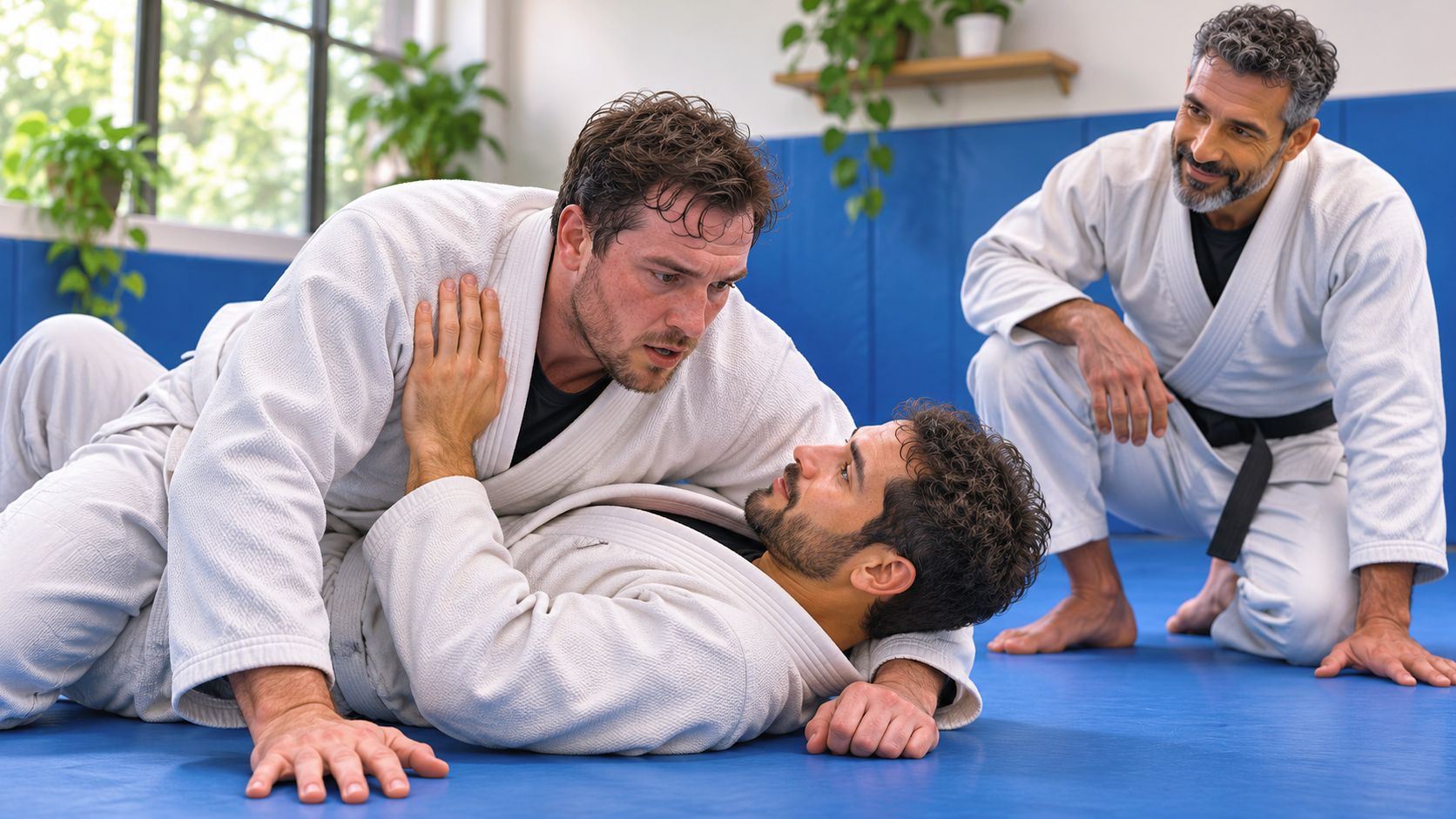
Yes, Brazilian Jiu Jitsu is hard, and the strain shows up faster than expected. Early rounds can empty your lungs while your hands are still searching for the right grip, because a resisting partner keeps changing the problem before you have an answer.
Answering “is Brazilian Jiu Jitsu hard” means separating three layers: what your body feels in the first ten minutes, what your brain has to do while it is tired, and what the room around you decides about pace, pairing, and safety. Some difficulty is built into the art. Some belongs to the first ninety days and to how well the academy manages them.
Children are a different answer: good kids classes trade adult intensity for balance, boundaries, and control in a room built for smaller bodies.
Table of Contents
- How Hard Brazilian Jiu Jitsu Feels Next to Other Training
- Why the Body Tires So Fast on the Mat
- Why Technique Makes Small Mistakes Costly
- Why Losing Rounds Feels Harder Than the Workout
- Realistic Timelines From First Class to Blue Belt
- Which Parts of the Risk You Can Control
- How Hard BJJ Is for Children and Parents
- How to Choose a Safer First Academy
How Hard Brazilian Jiu Jitsu Feels Next to Other Training
Brazilian Jiu Jitsu is hard for most new adults, and the reason isn't a lack of general fitness. It's that the sport asks for technical decisions inside a live resistance loop, and almost nothing in a normal training week prepares you for a partner who reverses your plan every few seconds. A strong runner and a decent lifter can both finish a first round flat on their back, breathing hard, with no idea what to do next.
| Activity | Main demand | Usual beginner barrier | How BJJ differs |
|---|---|---|---|
| Easy run | Self-paced aerobic work | Building a steady pace | A partner sets the pace and can change position |
| Weight training | Load and recovery between sets | Choosing a manageable weight | Strength helps, but technique still fails when grips and breath go |
| Boxing | Timing, impact, and conditioning | Being hit and staying composed | Difficulty is positional and grip-based rather than striking |
| Wrestling | Takedowns and live scrambling | Explosive contact against a partner | More time is spent in prolonged ground control with submissions |
| Yoga | Mobility and body awareness | Flexibility and balance | There is no resisting partner and no joint-lock consequence |
Built-in difficulty versus difficulty a school chooses
Some of the hardness comes with the art. Live resistance, grip fatigue, and a large set of positions aren't optional extras, they're the sport. You will grip a collar or a wrist until your fingers complain, and you'll spend months learning to recognize positions a coach can name in one breath.
The nearest comparison in the table is wrestling, and the difference is where the time goes. Both sports put you against a resisting partner who can scramble, but a BJJ round spends far longer in ground control and ends with joint-based submissions that a partner can apply slowly or suddenly. That's why the technical vocabulary is larger and why the tap carries so much weight.
Other parts are decisions a room makes. How hard live rounds run, who a beginner gets paired with, and how soon sparring starts all vary from academy to academy, and they shape the first 90 days more than any fitness level does. Two students who start the same month at different schools can have completely different experiences of the same sport.
What to ask on a tour: "When do brand-new students start live rolling, and who do they roll with in the first month?" The answer tells you more about your first 90 days than the mat space or the logo on the wall.
Why a fit runner still struggles in week one
Say a runner comfortably holds a steady pace for 25 minutes and has done so for years. That person walks into a fundamentals class, the warm-up feels easy, the technique demonstration makes sense, and then a three-minute round starts against a blue belt.
Within 40 seconds the forearms burn from holding grips. By the second minute the breathing is short and the movements that looked obvious in the demo have vanished. Nothing about that round was aerobic in the way the run was. It was short, repeated, and decided by technique under load, which is a different kind of fitness and a different skill.
That gap is why general fitness gets a beginner through the door but not through the learning curve. The body adapts to the bursts, the technique catches up in pieces, and neither happens in the first week.
The next few sections take those pieces apart: the physiology that makes a round feel so heavy, the decision-making that makes small mistakes expensive, and the mental weight of losing rounds to people who make it look easy. Then come the timelines and the parts of the risk a student can screen for before signing anything.
Why the Body Tires So Fast on the Mat
A round isn't a steady effort. Brazilian Jiu Jitsu sparring mixes repeated high-intensity bursts, such as gripping, bridging, scrambling, and resisting positional pressure, with stretches of lower-intensity technical control. The study of advanced grapplers describes that intermittent structure as demanding conditioning across the whole match rather than relying on strength or a single energy system.
That structure works less like a jog and more like repeated sprints with someone hanging off your torso. Your aerobic base decides how fast you recover, but the bursts themselves run on shorter fuel supplies, and those supplies empty quickly.
The graphic below shows where the technical decisions sit inside that fatigue.
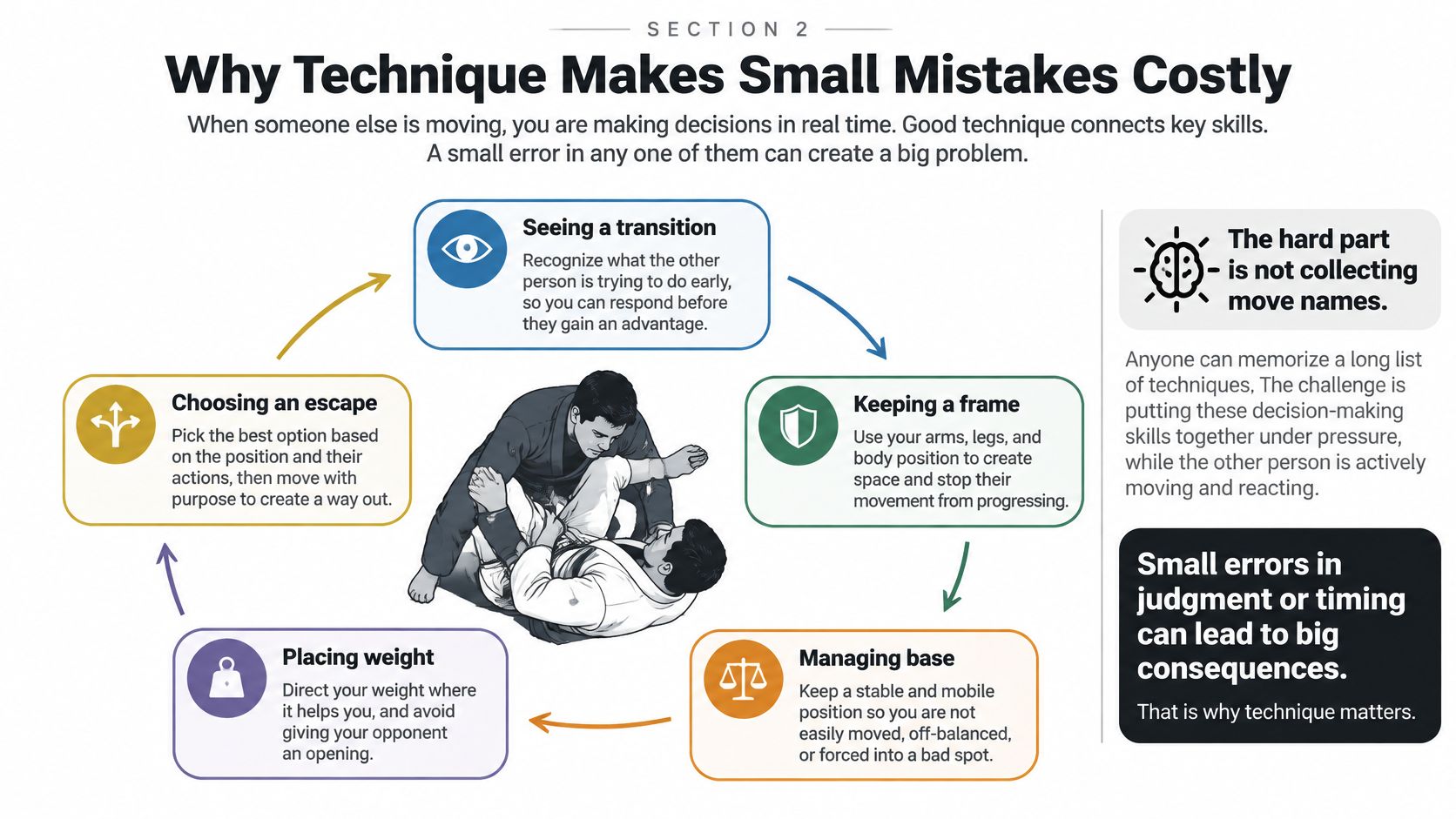
In the same study, six minutes of no-gi sparring produced an estimated anaerobic contribution of roughly 72% from glycolytic metabolism and 28% from the phosphagen system. Glycolytic work is the pathway that leaves your forearms burning and your breathing ragged, and it doesn't refill quickly between bursts. The phosphagen system covers the first few seconds of an explosive effort, which is why the third scramble of a round feels so different from the first.
No academy removes this demand. What a good room controls is how much of it a new student faces at once, and how much rest sits between the bursts.
What a beginner actually feels
The symptoms are predictable enough to plan around.
- Forearm and grip failure: the hands go before the legs do, and once the grip is gone, guards open and submissions appear.
- Breath that arrives suddenly: you'll feel fine during a slow drill and desperate 90 seconds into a live round.
- Technique that disappears under load: a sweep that worked in drilling turns into a shove when someone is posting on you.
- Hips and legs that won't cooperate: bridging and shrimping use ranges most desk-bound adults haven't loaded in years.
Competition sits at the top of that curve, and it's useful as an upper bound rather than as a picture of a normal class. A 2015 study of 26 expert male athletes at the 2013 European Open Jiu-Jitsu Championship measured fatigue after an official match: average handgrip force fell from 49.65 to 44.85 kgf, countermovement-jump height dropped from 34.0 to 30.8 cm, and blood lactate reached 14.8 mmol/L, as reported in the match-fatigue analysis. Upper and lower body both lose output, so this isn't an arm problem.
Aerobic fitness still counts. It supports recovery between bursts and across a series of rounds, which is why a cardio training plan built for BJJ helps a beginner last longer, and why the NexiHerb stamina building guide is a sensible addition on the days you're not on the mat. Neither erases the anaerobic demand, but both shorten the time it takes to feel human again.
Practical rule: two or three short rounds with a clear goal beat one long grinding round. Positional drilling, rest between rounds, and a gradual rise in live volume build tolerance without wrecking the following day.
Why Technique Makes Small Mistakes Costly
Fitness explains the burn. It doesn't explain why a smaller training partner can hold you in place for four minutes while barely breathing hard. The technical difficulty comes from errors being punished through mechanically constrained positions, joint isolation, and shifting mechanics. Recognizing transitions, keeping frames, managing base, placing weight, and choosing an escape while someone counters all happen at once.
Driving is the closest everyday comparison, up to a point. Memorizing the controls takes an afternoon in an empty lot. Driving in traffic takes months, because every correct action depends on what the other driver does next. A BJJ round has the same dependency, except the other driver is allowed to grab your steering wheel.
Here's how one small error becomes an expensive one.
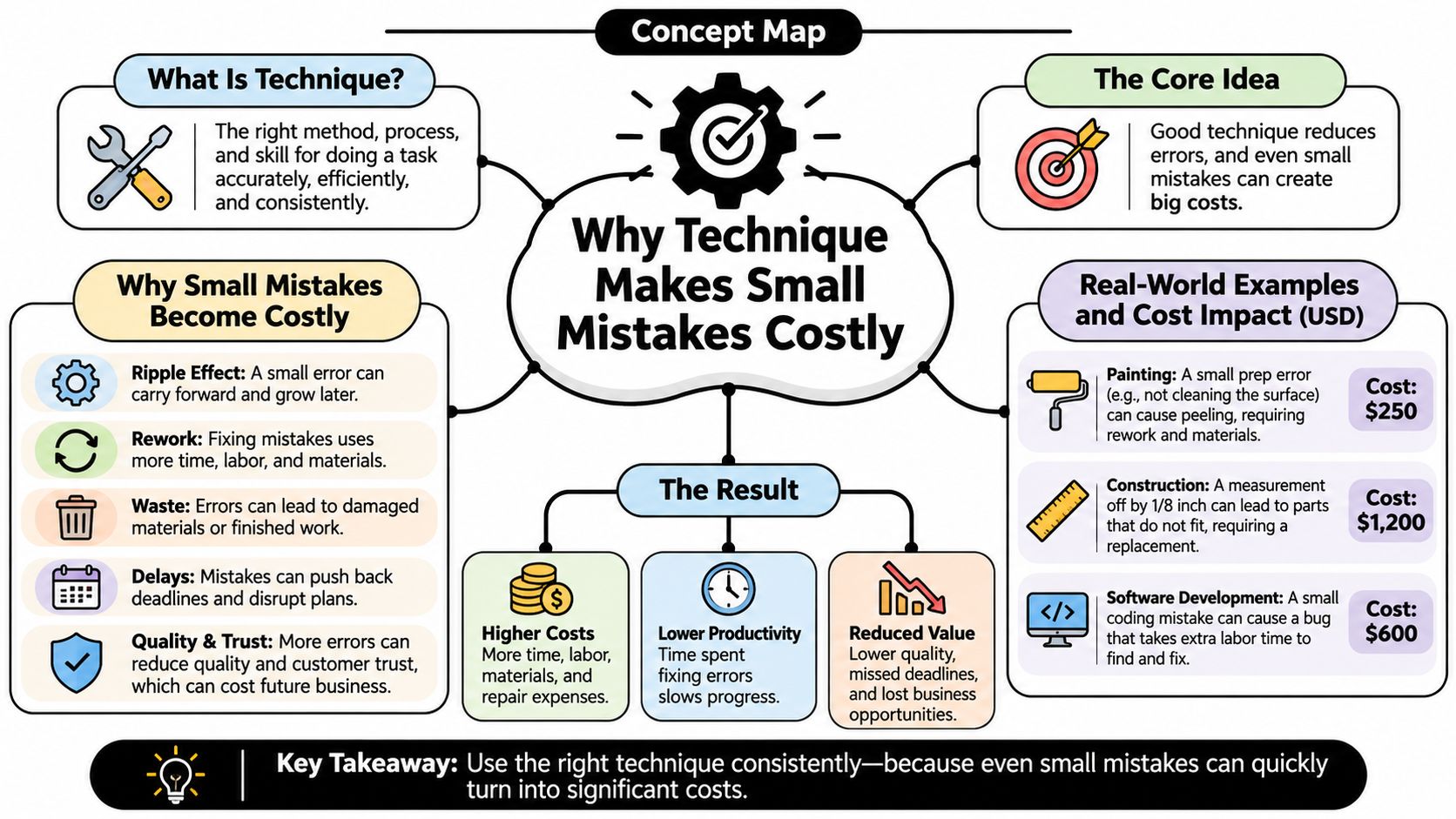
One position, three decisions, one tap
You're inside someone's closed guard and your posture breaks. That single mistake, a rounded back and hands low, lets your partner climb their legs, break your base, and isolate an arm. Nothing dramatic happens until the arm is extended and the elbow reaches its limit, and by then the choices are gone except one.
The correct move happened earlier: posture up, keep the elbow tight, strip the grip before it becomes a clamp. That's what makes the sport hard to learn. The mistake is cheap when it happens and expensive three seconds later, and beginners can't yet see the three seconds coming.
Tap when the submission is locked. Not after a heroic escape attempt, and not two seconds later to prove you're game. A locked joint lock is the moment to stop, and a partner who respects that is worth more than a room with a reputation.
The integrative systematic review of jiu-jitsu injuries found the knee, chest and rib region, and shoulder among the most commonly affected areas, with injuries tied to training and reported often among beginners. That pattern matches the mechanism: poor posture, a late tap, an uncontrolled takedown, or a partner using too much force turns a positional mistake into a joint or rib problem. Sharp joint pain is a stop signal. Soreness the next day is not the same thing.
A well-coached room teaches safe falling, tapping conventions, positional escapes, and supervised drilling, then pairs partners by size and experience. Those habits keep the sport challenging without making every error dangerous.
Why Losing Rounds Feels Harder Than the Workout
Mental difficulty is real and usually underplayed. A fit beginner can get shut down for a full round by a partner who has trained for a year, then line up and do it again in front of everyone. Nothing in a gym or a running club prepares you for that kind of public, repeated losing.
Three pressures drive early quitting. Tapping to someone smaller hits the ego, even when the technique is legitimate. A movement that looked clean in the demonstration disappears the moment someone resists. And a stuck position tempts you to squeeze harder, which burns the grip you'll need 30 seconds later.
Reframe for month one: the scoreboard isn't rounds won. It's positions survived and one escape that worked against a partner who wasn't cooperating.
Three habits make the mental load manageable.
- Measure survival, not wins. Count the positions you recognized and the frames you held, and treat a round where you stayed calm in mount as progress.
- Tap early, then ask. When a joint lock lands, tap and ask what the partner did to get there. You learn more from that question than from fighting the last two seconds.
- End a round when breath or temper is gone. Step off, reset, and come back for the next one. A round that turns into a grudge match teaches nothing and raises the injury risk.
Attention, humility, and recovery between classes carry more weight in the first year than grip strength. A coached room protects beginners by pairing them with patient partners and stopping ego-driven force. Most beginners find the panic fades before the technique catches up.
Realistic Timelines From First Class to Blue Belt
Progress in Brazilian Jiu Jitsu is measured in positions rather than weeks, but the phases below are what an adult hobbyist training two or three times a week usually moves through.
| Phase | What usually happens | On-track marker |
|---|---|---|
| First class | Confusion, grip burn, and frequent taps | You know how to tap and finish the class |
| Weeks 1 to 4 | Soreness and slow recall of movements | You can name mount, guard, and side control |
| Days 30 to 90 | Better survival in common positions | One escape works against a cooperative partner |
| Months 4 to 12 | Fewer panic reactions during rolls | You can rebuild position after losing it |
| Year 1 to 2 | Blue-belt range for many consistent hobbyists | Attendance stays near two or three sessions a week |
These are ranges for a consistent hobbyist, not promises. The belt itself depends on a coach's assessment of skill, attitude, and mat time, and attendance moves the date more than athletic talent does.
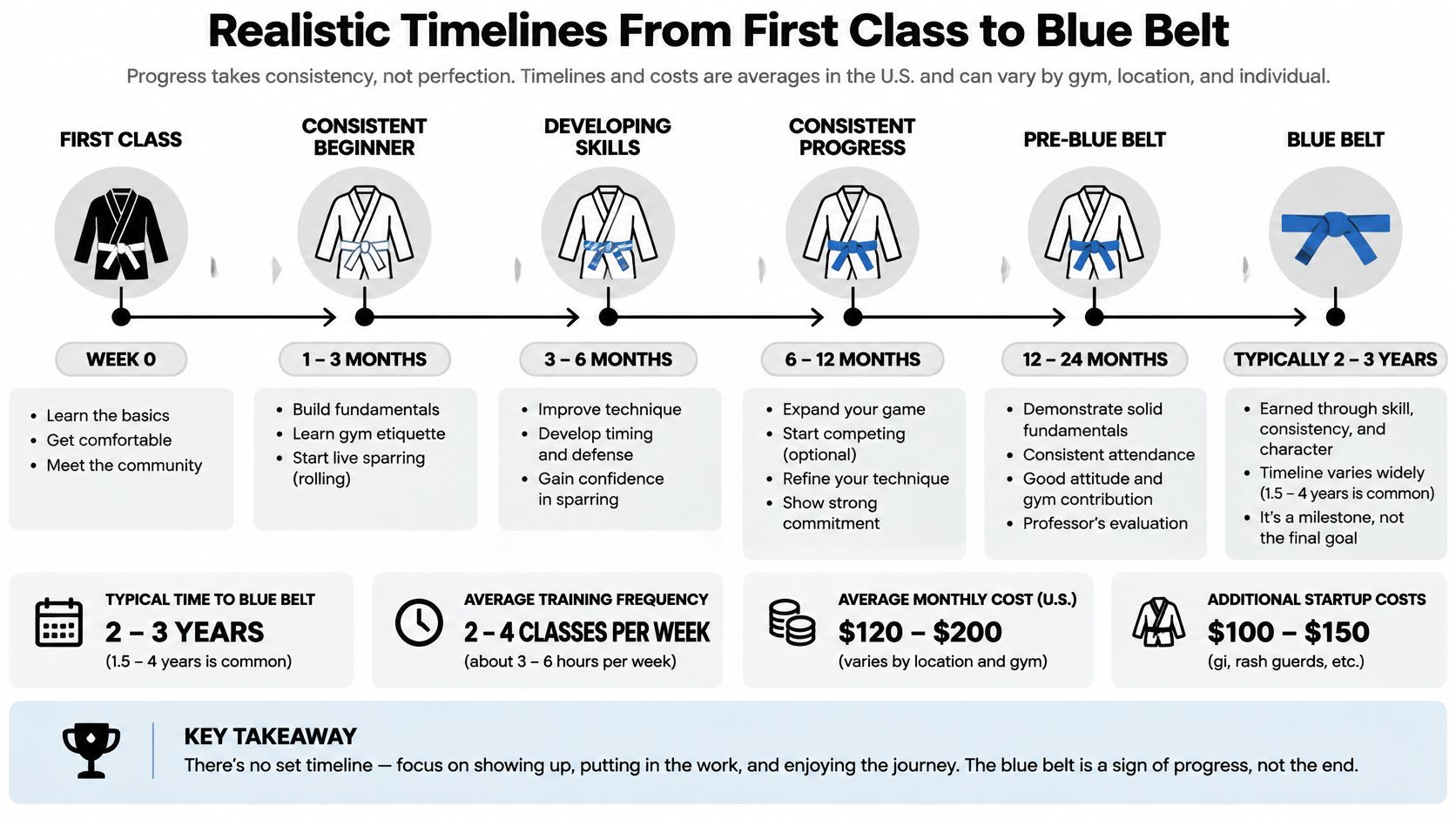
What each phase actually asks of you
- First class: the goal is getting through it intact and knowing how to tap. Nothing else counts.
- Weeks one to four: vocabulary. By the end of that month you should name mount, guard, and side control even while your escapes fail.
- Days 30 to 90: survival. One escape landing against a cooperative partner is a real milestone, and it usually arrives before anything works against full resistance.
- Months four to twelve: fewer panic reactions and the first hint of a game. Rebuilding position after losing it is the marker, and it's the point where a beginner starts looking like a student.
- Year one to two: blue belt commonly arrives somewhere in that window for many consistent hobbyists. The guide to how long it takes to reach blue belt breaks down the factors that shift the date in either direction.
Habits that shorten the first 90 days
- Take one note after class. Write down a single position and one detail about it, then review it before the next session.
- Drill before adding rounds. More live sparring on a shaky technique just rehearses the mistake.
- Ask for a different partner when size is a mismatch. A large weight gap changes what you can practice safely.
- Treat missed weeks as normal. A cold or a work trip isn't proof of failure. Restart at a lighter volume.
Soreness is expected. Sharp pain, repeated headaches, or a joint that feels unstable are reasons to stop and tell the coach, not to push through. The first 90 days should feel technically and mentally hard, and the volume of live resistance should rise on purpose rather than all at once.
Which Parts of the Risk You Can Control
Risk here isn't a fixed number, and the honest way to read the figures below is as exposure rather than as a verdict on an ordinary beginner class.
| Source setting | Reported figure | Beginner takeaway |
|---|---|---|
| Six-month training study, 2019 | 59.2% had at least one injury | More weekly days raised risk; more years of training lowered it |
| 2009 No-Gi Worlds | 62 injuries among 951 fighters | Competition exposure is not a normal class |
| 2025 global study of 881 | 81% in the prior year; 5.5 per 1,000 hours; 55.9 per 1,000 matches | Lower belts had higher rates |
| 2024 review of 2,847 practitioners | Higher share among beginners and men over 30 | Age and inexperience justify a slower start |
The six-month and championship figures come from injury surveillance research on jiu-jitsu practitioners, which found that injury likelihood rose with training days per week while more years of training lowered six-month incidence. Less experienced athletes more often reported head, upper-extremity, and elbow injuries.
A 2025 global cross-sectional study of 881 practitioners found that 81% reported at least one training or competition injury during the previous year, at 5.5 injuries per 1,000 training hours and 55.9 per 1,000 matches, with higher rates among lower belts. That last detail is the one to sit with, because it undercuts the advice to tough it out.
A 2024 systematic review covering 2,847 practitioners reported injuries especially common among beginners and men older than 30. Age and inexperience aren't reasons to stay home. They're reasons to start slower than your enthusiasm wants to.
Six controls a school decides for you
Live rolling intensity, tapping culture, partner matching, warm-ups, coach supervision, and whether a beginner can decline or modify a high-risk technique. Those six choices set the difficulty of your first 90 days more than your fitness does, and every one of them is worth asking about before you sign up. Adults returning from an injury should get clear answers on all six before any full sparring.
Busy professionals often try to train hard while recovering badly, and the sports science discussion of injury and burnout on the Peak Performance podcast is a useful reminder that load management applies to grappling as much as to running.
Simple test: if a school can't tell you when beginners start sparring and how partners are matched, you've learned something important about month one.
All six controls are visible in a single trial class if you know what to look at.
How Hard BJJ Is for Children and Parents
Don't reuse the adult answer for a child. A six-year-old, a teenager, and an adult competitor are doing different versions of the same art, with different bodies, different rules, and different supervision needs.
Parent-facing numbers are limited but useful. Recent U.S. emergency-department research identified 264 pediatric BJJ injuries over a 10-year analysis, representing an estimated 8,357 cases, according to the published pediatric injury study. The average patient was 11.6 years old, sprains or strains accounted for 28.3% of diagnoses, and fractures for 20.1%. The head, shoulder, and lower arm were among the most frequently injured areas, and the study reported a statistically significant upward trend from 2012 to 2021.
Read that carefully. Emergency departments capture only a subset of injuries, and the period ends earlier than today, so the figures don't prove kids' classes are broadly unsafe. They do explain why a parent's checklist looks different from an adult's.
A parent's screening list
- Age-specific class structure: a five-year-old's class should look like games, movement, and cooperative drills long before any competitive sparring.
- Coach vetting: ask about background checks, first-aid training, and how long the instructor has taught children.
- Mats and hygiene: clean mats, a shoes-off policy, and a plan for skin infections.
- Supervision during live practice: someone watching the whole room, not one pair.
- Rules for takedowns and submissions: what's allowed at each age, and who enforces it.
- Concussion response: a written protocol, and no return to drilling on the same day as a head knock.
- Size mismatches and the right to stop: how instructors group children, and whether a child can sit out a technique without being treated as less committed.
Confidence and fitness can be real benefits of a children's program. They're not a reason to skip the questions, and the coach who welcomes them is usually the one running the safer room.
How to Choose a Safer First Academy
Pick the room that controls the first 90 days, not the room with the toughest reputation. Reputation gets built on competition results and storytelling. Your first months get built on class structure and supervision.
Seven checks on one trial visit.
- There's a beginner or fundamentals class that runs separately from the advanced group.
- The coach leads a visible warm-up and explains the tap before any live contact.
- Partners are matched by size and experience, at least for newcomers.
- One instructor can see the whole mat during drilling and rolling.
- A new student may decline or modify a high-risk technique without a debate.
- The school says when newcomers start rolling, and early rounds stay short.
- Tapping early or calling a size mismatch is treated as normal, not as a character flaw.
The checklist graphic below condenses the same points for a phone screen.
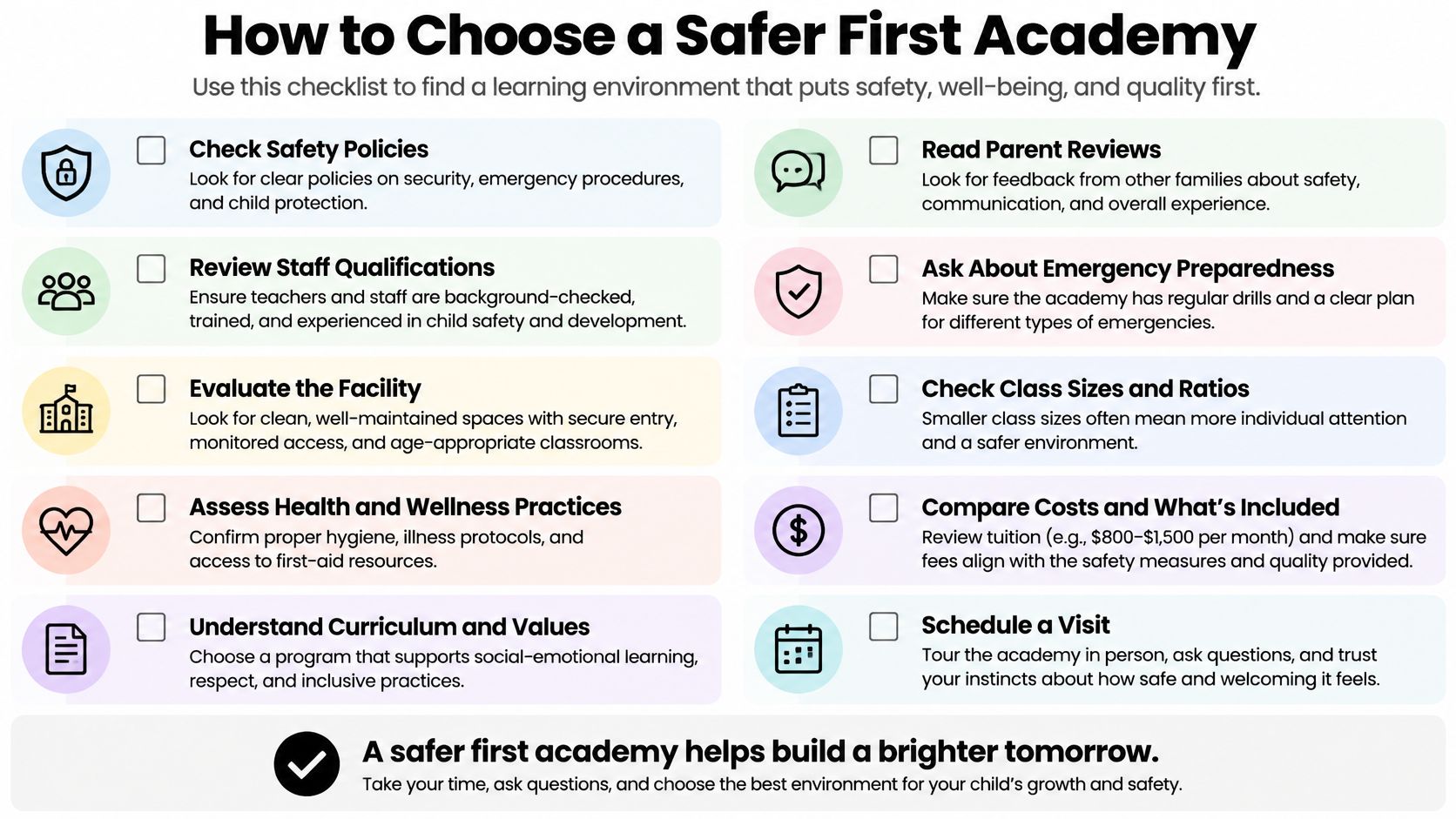
Parents should use the kids' checklist from the previous section instead of judging a children's program by adult sparring. Age grouping, supervision, and submission rules tell you more than a wall of trophies. Our guide to the red flags when choosing a BJJ gym covers the warning signs that surface in the first conversation.
For the search step, Brazilian Jiu Jitsu Academy Finder lists academies across the United States, with browse-by-state pages that include all 50 states and the District of Columbia. Type a city, a state, or a ZIP code into the search bar on the homepage and compare nearby schools before you call. California's 1,116 listed academies show how deep the coverage runs, not which city tops a ranking.
Book one trial, watch a round before joining it, and leave if the room punishes a beginner for tapping.
Finding a room that teaches the tap before it teaches toughness matters more than any fitness test you can pass before your first class. Brazilian Jiu Jitsu Academy Finder lets you browse academies by state across all 50 states and the District of Columbia, then compare nearby schools on beginner programs, kids' classes, and how each one describes sparring. Search your city, state, or ZIP code at Brazilian Jiu Jitsu Academy Finder and walk into your first class knowing what to look for.
Share this article