
Jiu Jitsu Belt Ranks Adults: Colors, Timelines and Rules
Jiu Jitsu Belt Ranks Adults explained: belt colors, realistic promotion timelines, IBJJF age and time rules, and how academies decide when you move up.
Written by BJJ Academy Finder Editorial Team

An adult black-belt match lasts 10 minutes, compared with 5 minutes at white belt in the IBJJF framework described by Fight Encyclopedia. That difference reframes the belt around your waist: it doesn't just recognize progress. It changes the conditions under which you compete.
For anyone comparing jiu jitsu belt ranks, adults need to separate competition eligibility from academy promotion. A governing organization can define the earliest point at which you're eligible for a rank, but your instructor still has to decide whether your skills justify it. Understanding that distinction helps you choose a gym, interpret promotion promises, and avoid treating a minimum requirement as a personal deadline.
Table of Contents
- Adult BJJ Belt Colors and Ranks at a Glance
- How Long Each Belt Takes in Practice
- Common Belt Myths Adults Get Wrong
- How Your Belt Affects Competition Eligibility
- Adjusting Belt Progression for Older and Injury-Prone Adults
- Check Promotion Policy Before You Enroll
Adult BJJ Belt Colors and Ranks at a Glance
Adult Brazilian Jiu-Jitsu follows white, blue, purple, brown, and black as its principal belt progression. Coral and red ranks sit above black in the senior graduation framework, rather than serving as ordinary milestones for a beginner planning their training.
Think of the main ranks as stacked tiers of responsibility. At first, you're learning where you are and how to protect yourself. As you advance, your instructor expects you to connect positions, solve problems under resistance, and train with greater control.
Adult BJJ belts, match lengths and stripe norms
| Belt | Adult match length in the IBJJF framework | What the belt signals in practice | Common stripe norm |
|---|---|---|---|
| White | 5 minutes | Learning positions, escapes, and basic submissions | Instructor-awarded progress markers before blue |
| Blue | 6 minutes | Applying core guard, passing, and defensive skills against resistance | Academy-defined checkpoints before purple |
| Purple | 6 minutes | Connecting positional control with submission setups | Instructor assessment before brown |
| Brown | 8 minutes | Refining advanced positional play and reliable transitions | Academy-defined recognition before black |
| Black | 10 minutes | Broad technical understanding with depth across positions | Senior degrees follow a separate graduation framework |
The match durations reflect the classification described by Fight Encyclopedia. The skill descriptions are practical coaching shorthand, not universal examination criteria.
The hierarchy makes the order easier to recognize at a glance.
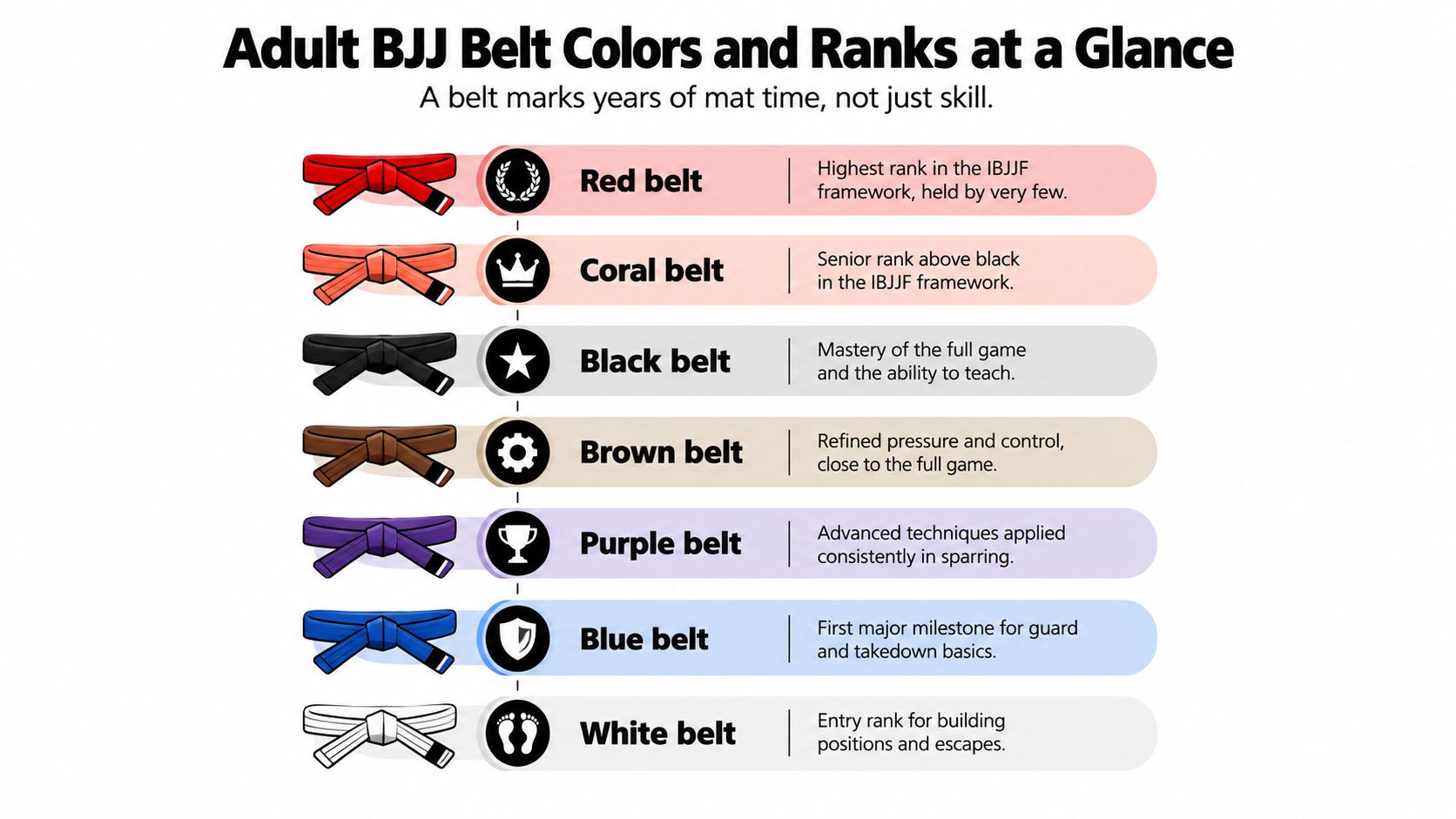
Read the skills behind the color
A white belt should prioritize recognizing mount, side control, guard, and back control. Learning to tap, protect vulnerable joints, and escape without uncontrolled movement matters more than collecting submissions.
At blue and purple, look for increasingly connected decisions. Can the student recover guard after a failed escape? Can they change a pass when their partner blocks the original route?
Brown and black suggest deeper refinement, not freedom from mistakes. A technically mature practitioner should understand why a position works, recognize when it has failed, and adjust without relying entirely on strength.
Stripes aren't a separate universal ranking system. Some academies use them as frequent feedback; others emphasize belt promotions instead. Ask what a stripe means locally before comparing your progress with someone training elsewhere.
The useful interpretation is cumulative: higher ranks should retain the foundations while adding reliability, adaptability, and judgment. A more advanced belt doesn't make basic escapes obsolete.
How Long Each Belt Takes in Practice
The IBJJF graduation system specifies standard minimum time-in-grade requirements of two years at blue before purple, 18 months at purple before brown, and one year at brown before black, subject to championship and prior-rank exceptions. These are eligibility floors, not promises of promotion.
Minimum time-in-grade versus real-world timelines
| Transition | IBJJF minimum time-in-grade | Real-world timeline | Main variables |
|---|---|---|---|
| White to blue | No minimum set | Instructor-assessed, not a universal calendar | Attendance, defensive competence, academy curriculum |
| Blue to purple | 2 years | May extend beyond the eligibility floor | Positional breadth, live application, instructor assessment |
| Purple to brown | 18 months | May extend beyond the eligibility floor | Consistency, transitions, unresolved technical weaknesses |
| Brown to black | 1 year | May extend beyond the eligibility floor | Depth, adaptability, reliability, academy standards |
The timeline graphic summarizes the ordinary minimums, not an individualized training plan.
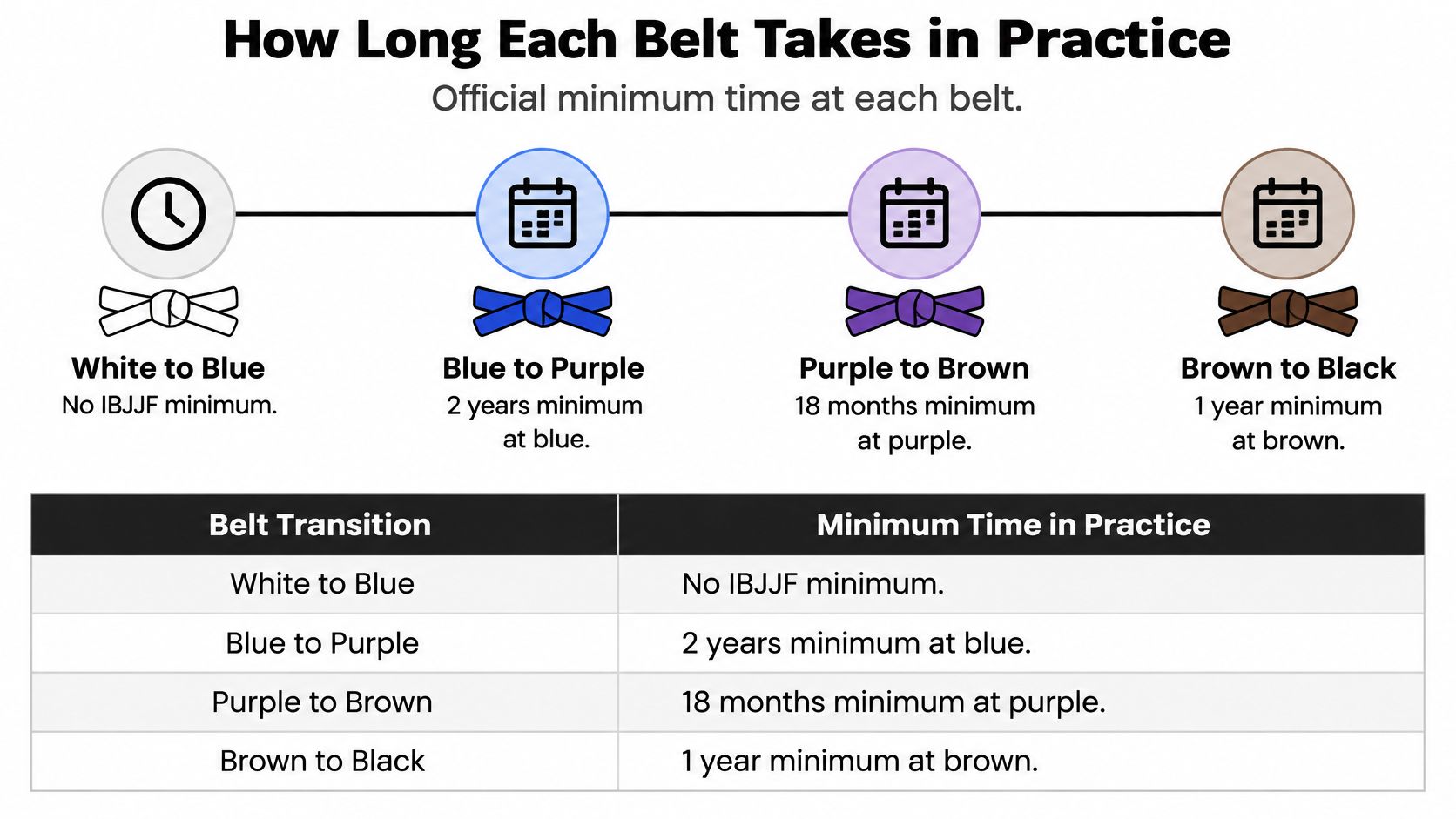
Why an eligibility floor isn't an estimate
A minimum tells you when a transition may become permissible under the applicable framework. It doesn't tell you when your instructor will have enough evidence to promote you.
Commonly circulated promotion ranges can sound more precise than they are. Without a defined group of students, attendance pattern, and academy standard, a typical duration isn't a reliable forecast. An academy-specific estimate is more useful than an unsupported sport-wide average, provided the coach explains its assumptions.
Say a beginner attends regularly, drills deliberately, and asks for feedback after positional rounds. Another student attends in bursts and repeatedly misses the classes addressing their weakest positions. Time passes for both, but the instructor doesn't observe the same development.
Even frequent attendance isn't enough by itself. Repeating a favored attack while avoiding bottom positions can leave gaps that a promotion assessment exposes.
Track different kinds of progress
Keep these questions separate:
- Competition entry: Are your age, rank, and registration appropriate for the event?
- Time-in-grade: Have you satisfied the applicable minimum and documentation requirements?
- Technical readiness: Can you demonstrate the academy's expected skills against resistance?
Planning rule: Use minimums to check eligibility. Use coach feedback to plan your training.
Injury layoffs, relocation, and changes in training partners can all interrupt an otherwise steady progression. Ask how the academy records promotion dates and whether eligibility calculations use registration records or ceremony dates.
For longer-term planning, the guide to how long it takes to get a BJJ black belt can help frame the questions to discuss with your instructor. Treat any projected completion date as conditional, not contractual.
For a visual companion to the progression discussion, watch the following video.
Common Belt Myths Adults Get Wrong
A blue belt means exactly the same thing everywhere. It identifies a rank, but it doesn't establish an identical technical profile. An academy emphasizing takedowns may produce different strengths from one emphasizing guard retention, even when both instructors take promotion seriously.
That difference isn't automatically evidence that either gym has lower standards. Ask what each school evaluates before deciding what a color tells you.

Mistaking recognition for a schedule
Stripes should arrive at predictable intervals. That assumes every school uses the same observation process. In practice, a coach may recognize a technical improvement, review attendance alongside performance, or reserve recognition for designated evaluations.
You must train daily to advance. No belt color supplies an individualized training prescription. A schedule you can sustain, with useful practice and recovery, is a better starting point than copying a competition team's workload.
A black belt should beat every purple belt. A sparring outcome isn't a complete rank assessment. Size, conditioning, specialized experience, starting position, and the task being practiced can affect a round without measuring the practitioner's entire understanding.
Belts are coaching judgments within a ranking framework, not universal grades for every possible matchup.
Confusing age and transfer rules with personal limits
Starting as an adult means you've missed your chance. A minimum-age requirement isn't a maximum-age cutoff. The practical question is whether your health, training access, and academy environment support continued development, not whether you began alongside childhood competitors.
Don't replace a pessimistic assumption with a guaranteed black-belt promise, either. A coach can offer a pathway and feedback, not certainty about your future circumstances.
Changing gyms means either automatic promotion credit or starting over. Neither assumption helps. Bring your rank history, explain your experience, and ask how the new instructor assesses incoming students.
A useful first conversation focuses on what you can demonstrate and what you need to learn. Defending every stripe or demanding an immediate promotion decision makes that conversation harder than it needs to be.
How Your Belt Affects Competition Eligibility
The IBJJF adult graduation document sets minimum ages of 16 for blue and purple, 18 for brown, and generally 19 for black, with a narrow exception for an adult brown-belt world champion. Those thresholds constrain recognition under the framework even when an instructor considers a student technically capable.
Minimum age and competition consequence by belt
| Belt | Minimum age or entry condition | Competition consequence |
|---|---|---|
| White | Entry into the adult belt progression includes older juveniles | Register in the appropriate age and white-belt division |
| Blue | 16 | Rank and age must support the selected division |
| Purple | 16 | The same age floor doesn't remove separate graduation requirements |
| Brown | 18 | The age threshold constrains brown-belt eligibility |
| Black | Generally 19, with a narrow adult brown-belt world-champion exception | Black-belt registration must satisfy the applicable graduation rules |
The adult belt progression and an event's Adult age division aren't interchangeable terms. Older juveniles can enter the adult-colored belt progression while still needing the correct age category at a tournament. Don't select an event division solely because your belt belongs to the adult sequence.
Internal promotion and event recognition
Compare the academy's decision with the organizer's decision:
- The instructor evaluates development. They decide whether the student meets the school's promotion standard.
- The governing organization checks eligibility. Its requirements determine whether the student can register at that rank in the intended category.
- The competitor must reconcile both. A promotion ceremony doesn't eliminate registration or documentation requirements.
Before entering an event, ask the academy whether its promotion records are compatible with IBJJF registration. Confirm who handles rank verification and what information the student needs to submit.
This matters especially after a transfer. A training history that makes sense in conversation may still need formal documentation before it supports tournament registration.
Technique knowledge isn't technique permission
Rank also affects technical legality. Learning an advanced submission in class doesn't establish permission to use it in your next sanctioned match.
Ask your coach to distinguish techniques you may drill, techniques permitted during academy sparring, and techniques allowed in your competition category. Those are different decisions, and confusing them can create avoidable safety and rules problems.
For example, a coach might demonstrate an advanced leg-lock position to explain how to recognize danger while restricting its use during beginner rounds. Recognition is useful even when attacking from that position isn't appropriate for the student's event.
Prepare for the broader ruleset as well. The guide to the BJJ scoring system helps connect positional training with competition strategy, but event-specific rules still need checking before registration.
Coral and red ranks belong to the senior structure beyond black. They shouldn't be treated as additional beginner competition milestones when comparing introductory programs.
Adjusting Belt Progression for Older and Injury-Prone Adults
In a survey of 1,287 adult BJJ practitioners, 59.2% reported at least one injury during a six-month period, according to the injury study indexed by PubMed. Knees were the most common injury location, and injury incidence was associated with training frequency.
Less-experienced practitioners more often reported head, upper-extremity, and elbow injuries. An association between frequency and injury doesn't prove that reducing attendance alone will prevent injury, but it does undermine the simplistic advice to solve every plateau by adding more rounds.

Build a sustainable training agreement
Discuss a modified plan with your coach and, where appropriate, your treating clinician. Make the adjustments specific enough that training partners can follow them.
- Reduce uncontrolled situations. Use positional sparring from a defined start instead of unrestricted scrambles when appropriate.
- Choose suitable partners. Ask for partners who respect the agreed pace and release immediately when you tap.
- Set clear restrictions. Name prohibited movements or positions rather than asking everyone to be careful.
- Review recovery. Adjust training volume when symptoms or fatigue make normal participation unsuitable.
These are options to discuss, not a rehabilitation prescription. Pregnancy, disability, chronic conditions, and recent surgery can require individualized guidance that a generic belt plan can't supply.
For general preparation and recovery reminders, SunnyBay tips for avoiding sports injuries offers an additional resource. Use it alongside individualized advice, not as clearance to return after an injury.
Assess the coach's response to limitations
Ask whether modified rounds still count as meaningful technical work. A student practicing controlled guard recovery may be developing relevant competence even when full-intensity rolling isn't appropriate.
Safety check: A coach should be able to explain the missing skill without demanding that you ignore pain to demonstrate it.
A legitimate standard might require better defensive positioning before promotion. Unsafe pressure would insist that you prove toughness by continuing through a movement your clinician has restricted.
Look for clear return-to-training procedures, supervision during beginner sparring, and scheduling that accommodates recovery. A sustainable academy relationship depends on how the coach handles limitations, not just how enthusiastically they welcome you on a trial day.
Check Promotion Policy Before You Enroll
An academy's promotion policy should describe what its instructors need to observe. Use the following checklist to start that conversation, rather than assuming every item carries equal weight at every school.
- Technical readiness across positions. Can you explain and demonstrate the relevant escapes, controls, and attacks, rather than reproduce a memorized sequence?
- Attendance and mat experience. Has the instructor observed enough of your training to make a defensible assessment?
- Live application. Can you adapt when a partner blocks the technique instead of cooperating?
- Top and bottom competence. Do your skills extend beyond the positions you prefer?
- Partner treatment. Can you control intensity, respect taps, and work safely with less-experienced students?
- Competition goals. Does the school expect tournament participation, or can recreational students demonstrate readiness in class?
The Brazilian Jiu-Jitsu ranking-system overview distinguishes instructor-dependent promotion practices from the formal framework used for recognized progression. That distinction makes the academy's actual assessment process more useful to a prospective student than a confident promise about promotion speed.
The checklist graphic provides additional conversation prompts. Teaching and mentorship may matter at some schools, but you should ask whether they're expectations or optional contributions.
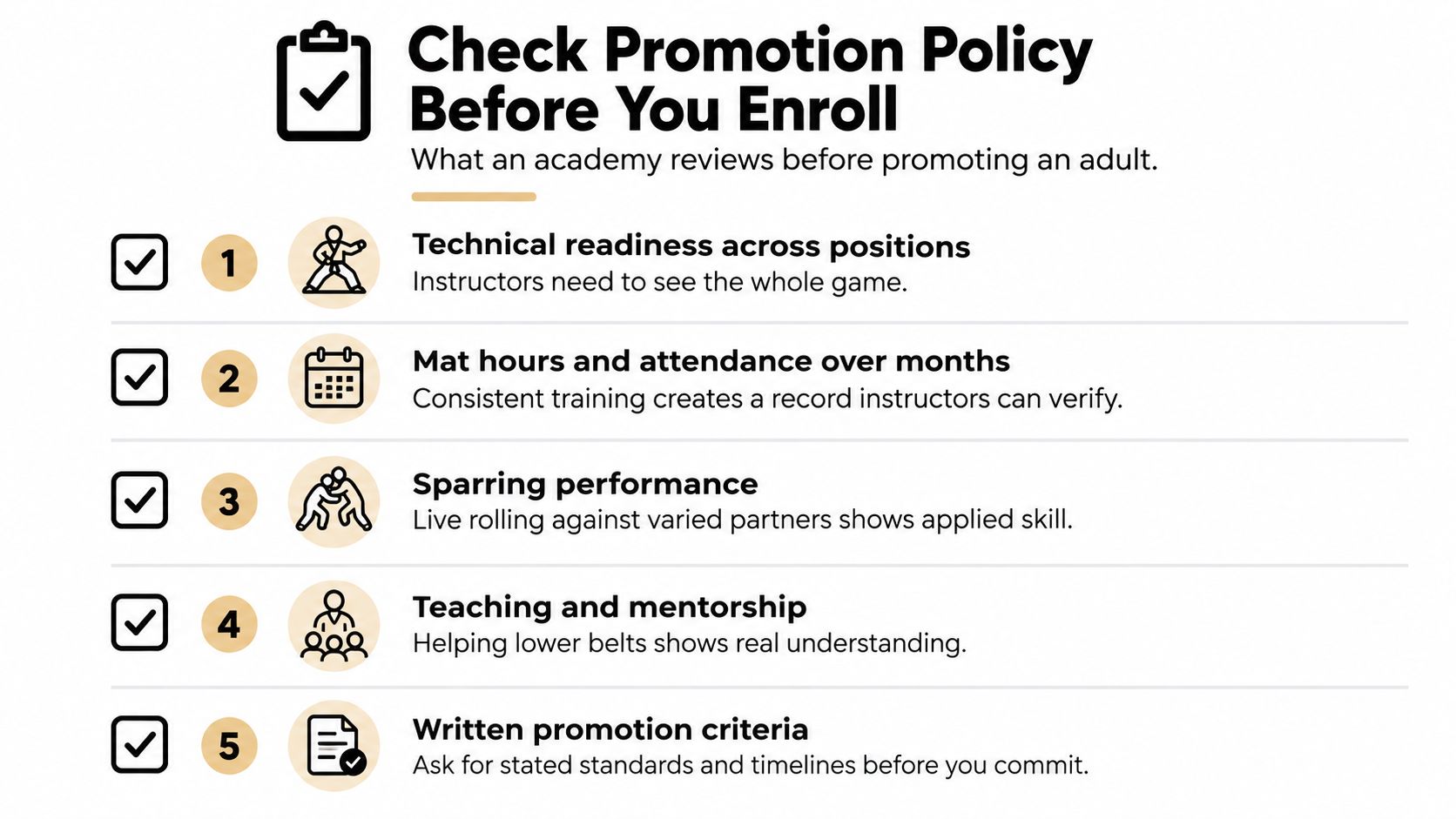
Ask questions that produce usable answers
Ask how the academy defines readiness. Request examples of skills assessed during live rounds. A useful answer might describe recovering guard, escaping mount, maintaining top control, and choosing safe submissions. A vague instruction to keep showing up doesn't tell you what to improve.
Ask which graduation standard it follows. Does the academy align its promotions with IBJJF requirements, use an internal curriculum, or combine both? You aren't asking the coach to defend every teaching choice. You're checking whether the school's approach fits your intended training and competition pathway.
Ask how it records and transfers rank. Find out who maintains promotion records, how dates are documented, and how incoming belts are handled. If you've relocated, bring your previous instructor's name and whatever rank documentation you have. Resolve missing information before tournament registration creates urgency.
Ask how competition paperwork works. Identify who can explain registration compatibility and review your intended category. A coach doesn't need to promise that every organizer uses the same rules, but someone should be able to distinguish academy records from event requirements.
Listen for concrete explanations, not just reassuring language. An instructor who says your escapes need work should be able to identify a position, describe the recurring mistake, and suggest a training task.
That feedback gives you something actionable. A promise that you'll advance soon may feel encouraging, but it doesn't help you decide what to practice.
Evaluate the policy during a trial class
Observe how coaches handle mismatched partners. Do they intervene when an experienced student overwhelms a beginner, or leave the beginner to manage alone?
Watch how they teach transitions and failed attempts. An academy that explains what to do when a pass stops working gives you a clearer route to adaptable skill than one where every drill ends with effortless success.
Pay attention to feedback access, too. You should know whether to ask questions after class, request a progress conversation, or work through an assigned coach.
Written criteria can help, but they aren't a substitute for observation. A published syllabus tells you what the school intends to teach. The trial class shows how instructors supervise the process.
The guide to how to choose a BJJ gym can help you weigh those observations alongside schedule, location, and training goals. The right comparison isn't which academy promises the fastest belt, but which one offers a credible way to develop the skills you want.
Compare the pathway rather than the promise
For a relocating practitioner, ask what happens during the settling-in period. A new instructor may need to understand your strengths before advising you about your next promotion, even when they accept your current rank.
For a beginner, ask how progress is communicated before any promotion discussion. Clear feedback about posture, framing, escapes, and positional choices helps you recognize improvement that isn't yet visible on your belt.
Be cautious if a school guarantees rank without discussing your participation or technical development. Be equally cautious if promotion remains deliberately mysterious and students can't obtain useful feedback.
A credible policy combines clear expectations with room for individual judgment. It doesn't need identical outcomes for students with different bodies, goals, and training histories.
When comparing local options, put the answers beside practical details: class availability, travel time, supervision, and whether the school supports your preferred training intensity. A demanding curriculum is only useful if you can participate consistently and safely.
Brazilian Jiu-Jitsu Academy Finder offers verified U.S. academy listings you can search by city or state, with contact details and community ratings to compare. Use its Search, Compare, Connect flow to shortlist suitable gyms, then contact them directly about promotion criteria, transferred ranks, and competition documentation before booking a trial class.
Share this article