
Jiu Jitsu Classes for Adults: How to Choose a Gym
Find jiu jitsu classes for adults near you, compare class types, know what your first class looks like, and pick the right academy.
Written by BJJ Academy Finder Editorial Team
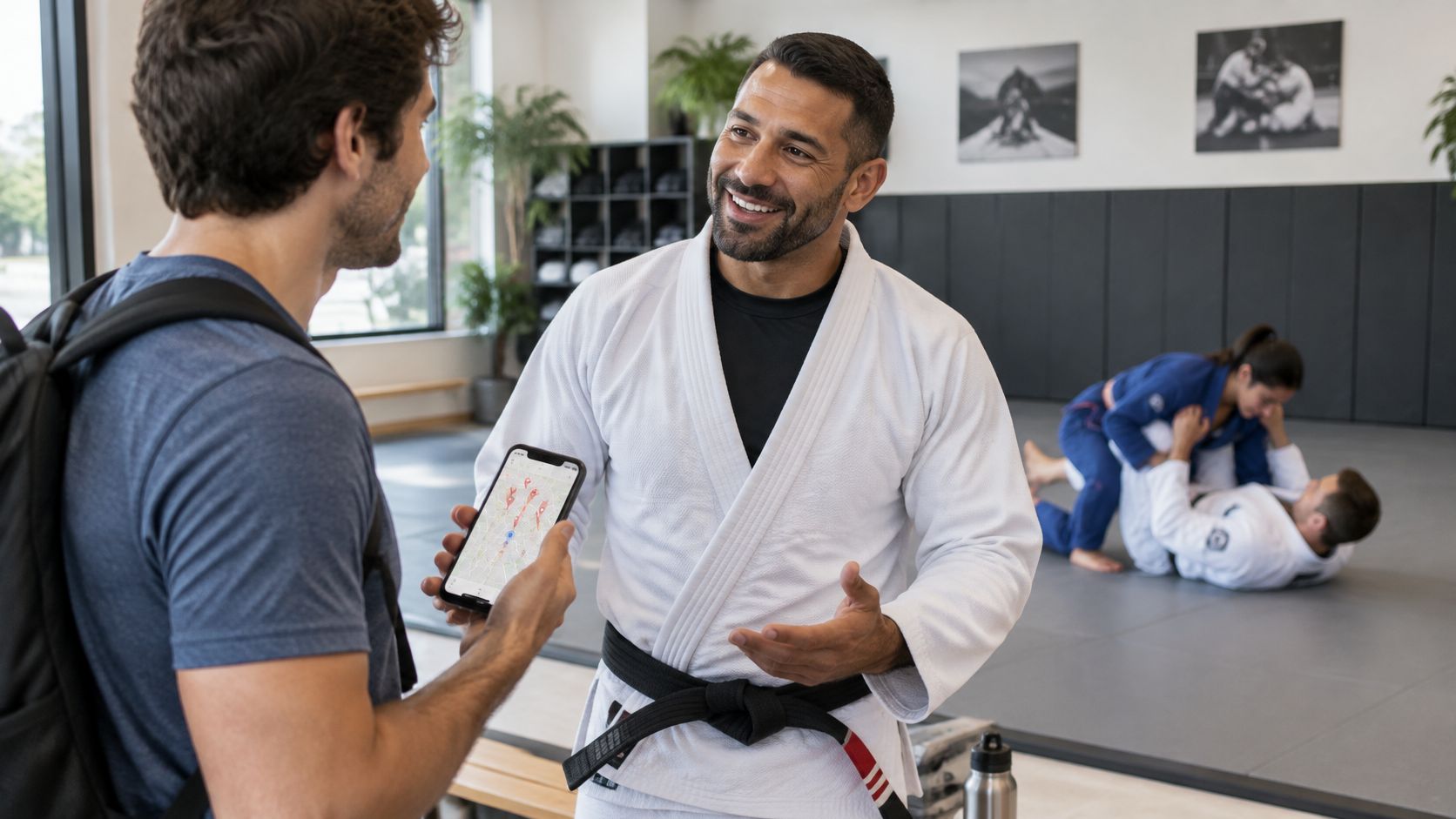
You've found a few nearby gyms, opened their schedules, and hit unfamiliar labels: fundamentals, no-gi, open mat. You want exercise and useful skills, but you're also wondering whether everyone else will already know what they're doing, and whether you'll be expected to wrestle a stranger immediately.
Choosing jiu jitsu classes for adults starts with understanding what you'll do, then checking how an academy teaches and protects beginners. A good-looking website and enthusiastic reviews aren't enough. You need clear answers about instruction, training partners, boundaries, and what happens when someone wants to stop.
Table of Contents
- What Adult Jiu Jitsu Is and Where It Came From
- Adult BJJ Class Types Compared
- Health Benefits and Injury Risks to Weigh
- What Your First Class Looks Like and Common Questions
- How to Choose the Right Academy
- Searching and Comparing Gyms with a BJJ Academy Finder
- Decide After Your Trial Class
What Adult Jiu Jitsu Is and Where It Came From
Brazilian jiu-jitsu, usually shortened to BJJ, is a grappling art where much of the training happens on the ground. Instead of exchanging strikes or rehearsing forms alone, students practise controlling positions, escaping pressure, and applying submissions against a partner.
Think of using a lever to move a heavy object. Correct placement makes your effort more effective. On the mat, you might move your hips and frame with your forearms rather than try to bench-press someone off your chest. Strength still matters, but it doesn't replace positioning.
How the art developed
An academic account of BJJ's development identifies Mitsuyo Maeda's arrival in Brazil in 1915 and Carlos Gracie's academy opening in Rio de Janeiro in 1925 as key milestones.
- Japanese foundations: Maeda taught Carlos Gracie, who later trained his brothers. Today's beginner inherits a method built around learning techniques with a partner.
- An academy tradition: Carlos's school helped establish a setting where students could practise and refine those techniques through regular instruction.
- Brazilian adaptations: Carlos and Hélio Gracie emphasized mechanical advantage, positional control, and submissions, reducing dependence on strength and supporting participation across different ages, sizes, and genders.
That explains why an adult beginner can learn alongside an experienced practitioner without being expected to match their athletic ability. The experienced partner can provide manageable resistance while the newcomer learns where to place their body.
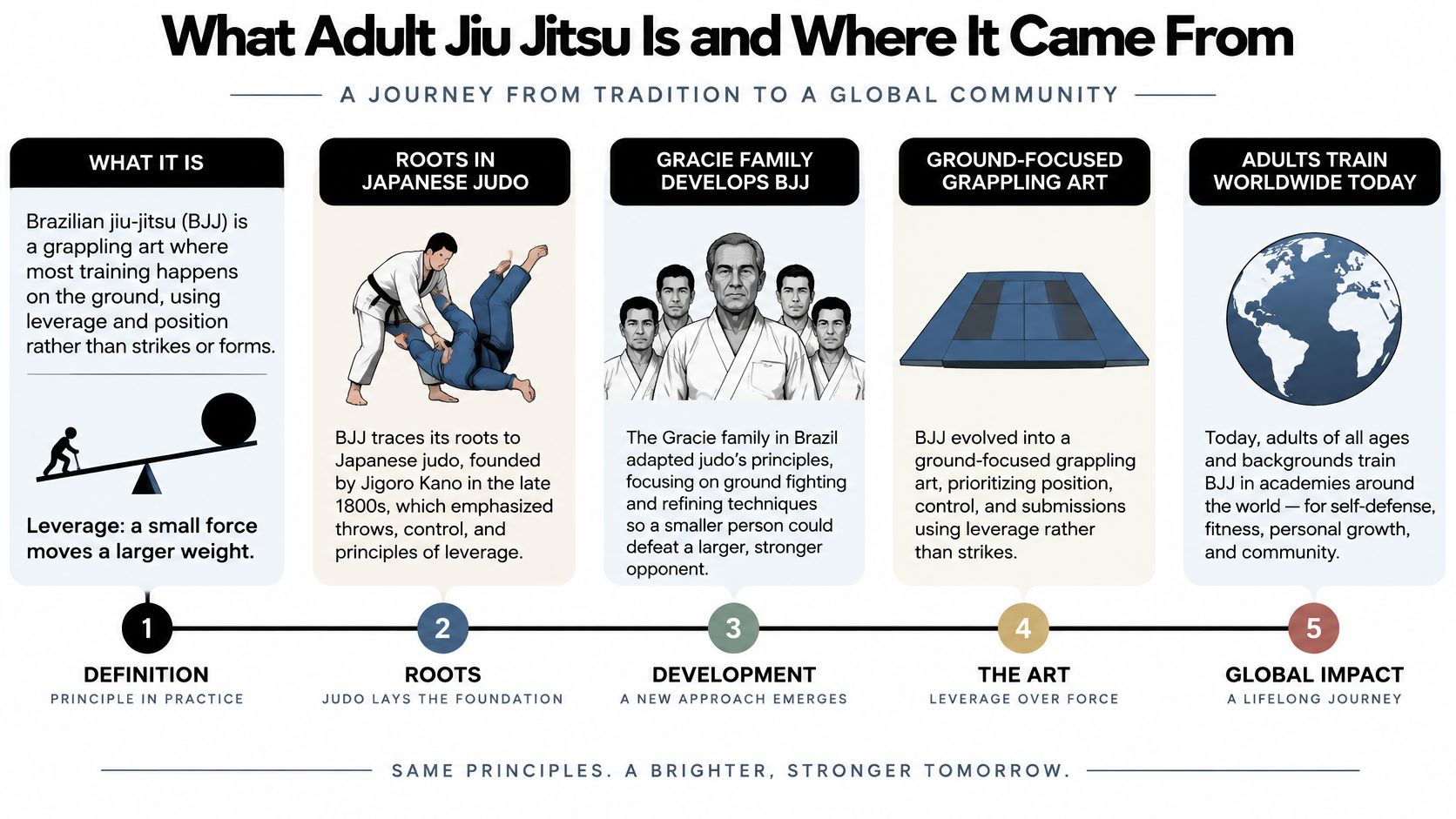
BJJ later spread through competition, self-defense teaching, and mixed martial arts visibility. Its technical ancestry is Japanese, while its identity and academy culture developed in Brazil.
Adult BJJ Class Types Compared
Say you work at a desk, want better fitness and self-defense skills, and have never grappled. A timetable full of class names can make starting feel harder than it needs to be. Beginner fundamentals is usually the clearest entry point, but the other labels describe different clothing, teaching priorities, or practice formats.
These categories overlap. A fundamentals session might use a gi, while a women's class might teach no-gi techniques. Ask about both the format and the experience level.
| Class type | Best for | Typical dress | Usual intensity |
|---|---|---|---|
| Beginner fundamentals | Complete beginners | Gi or rash guard and shorts | Low to moderate |
| Gi class | Students who want grip-based technique and traditional drilling | Gi, also called a kimono | Moderate |
| No-gi class | Students who enjoy faster scrambling and athletic grappling | Rash guard and shorts | Moderate to high |
| Competition or sparring class | Students with experience preparing for live rounds or tournaments | Gi or no-gi | High |
| Open mat | Experienced students who want free drilling with partners | Academy-approved gi or no-gi clothing | Self-selected, from gentle drilling to hard rounds |
| Women's class | Women who want a women-only training environment | Gi or no-gi | Set by the lesson, gentle drilling or more demanding rounds |
Choose by teaching format, not clothing alone
In gi classes, collar and sleeve grips give you additional ways to control a partner. In no-gi, you use grips on the body rather than clothing, and exchanges can feel more slippery. Our gi versus no-gi BJJ guide explains those practical differences.
Neither format automatically makes a class beginner-friendly. A carefully coached no-gi fundamentals lesson can be more approachable than an advanced gi session.
Open mat isn't a substitute for an introductory lesson. Students generally arrange their own drilling or rounds, so a newcomer needs an instructor's permission and a suitable partner. Competition sessions have a different purpose again: preparing students for demanding exchanges rather than introducing basic movement.
Starting rule: Choose a class that teaches you what to do before asking you to do it against resistance.
Make fundamentals your default. Add another format when you can follow basic instructions, recognize unsafe positions, and maintain control under light resistance. Choose an alternative that interests you, not just whichever class promises the hardest workout.
Health Benefits and Injury Risks to Weigh
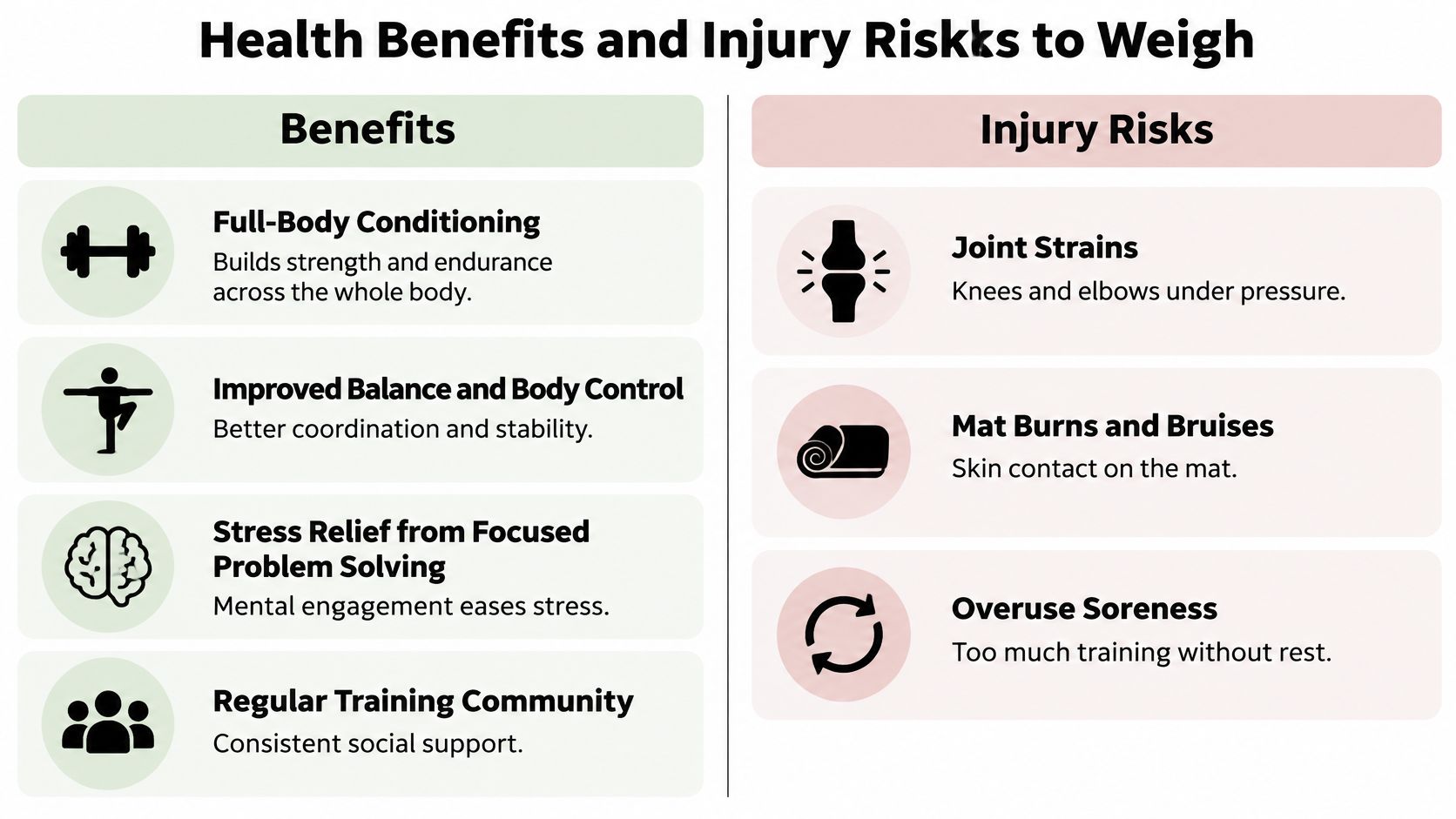
BJJ combines pushing, pulling, gripping, balancing, and moving under another person's pressure. It offers opportunities to develop full-body conditioning and body control, while the concentration required can provide a break from everyday worries. Regular partners can also make exercise feel more social.
Those are reasons to try it, not promises about how you'll feel. Our guide to the benefits of BJJ explores these goals, but they should be weighed against the demands of contact training.
Understand the injury evidence
In a 2019 survey of 1,287 adult BJJ practitioners, 59.2% reported at least one BJJ-related injury during the previous six months; the knee was the most frequently affected area. Less-experienced practitioners more often reported head, upper-extremity, and elbow injuries, while more-experienced athletes more often reported lower-back injuries.
The same survey associated injury incidence with more training days per week. That supports a cautious start rather than filling every available evening with classes.
A 2025 cross-sectional study of practitioners estimated 5.5 injuries per 1,000 training hours, compared with 55.9 per 1,000 competition hours. Competition and ordinary practice shouldn't be treated as equivalent exposures.
Manage effort before adding volume
- Leave room for recovery: Begin with a manageable schedule and increase it only when soreness, sleep, and joint comfort allow.
- Explain old injuries: Tell the instructor which movements or positions concern you before joining drills.
- Address grip habits: If you repeatedly cling to sleeves under strain, ask your coach for alternatives. Evermost LLC's resource on how to fix your grip technique offers additional hand-care context.
- Stop for concerning symptoms: Sharp pain, instability, swelling, or persistent symptoms call for a pause and appropriate clinical advice.
Research on adult BJJ competitors links higher aerobic fitness with more efficient tolerance of sparring workloads, while cautioning that sparring alone may not adequately improve aerobic endurance in trained practitioners. Comfortable walking, cycling, or other suitable conditioning can complement class.
These figures describe groups, not your individual future. Their practical value is to make supervision, progression, and recovery part of your academy decision.
What Your First Class Looks Like and Common Questions
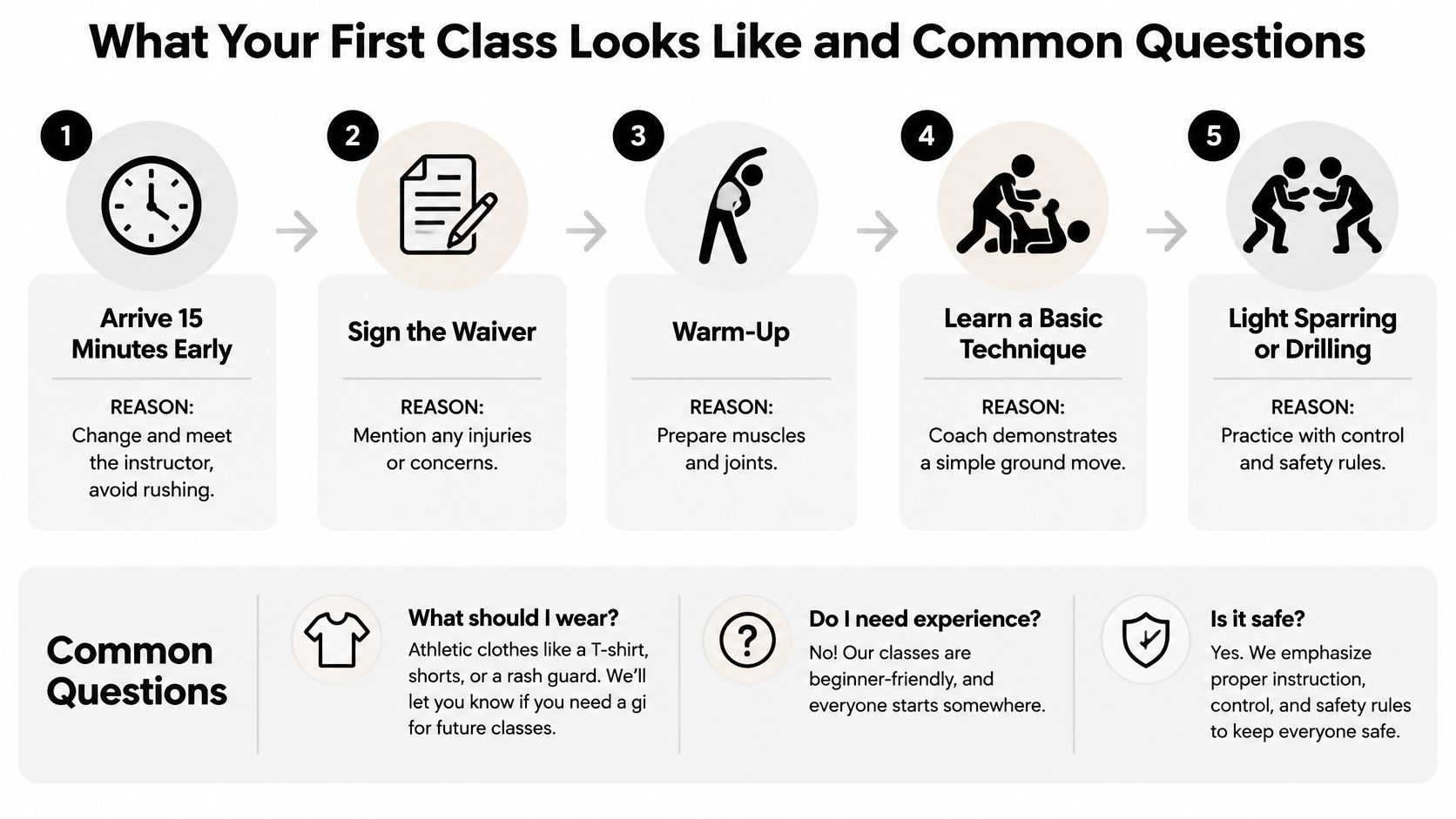
Your first class should introduce the room, the movements, and the rules before testing your ability. The exact order differs between academies, but a beginner-oriented session should make each transition understandable.
A typical first visit
Arrive early enough to settle in. Find the changing area, meet the instructor, and say plainly that you've never trained. Rushing onto the mat makes it harder to hear important instructions.
Complete the waiver and discuss relevant injuries or medical conditions privately. A waiver doesn't replace a safety conversation. Explain any restrictions a clinician has given you.
Change into approved, clean clothing. For no-gi, this usually means a close-fitting athletic top and shorts without exposed zippers, hard fittings, or loose pockets. For gi, confirm whether loan gear is available before arriving.
Join the warm-up at a manageable pace. You may practise hip escapes, controlled ground movement, or movements used later in the lesson. If you don't understand a drill, ask for a slower demonstration rather than copying it blindly.
Watch the technique demonstration. The instructor might show how to escape a pinned position or maintain balance on top. Notice where the hands, knees, and hips go, and what the partner is supposed to do.
Practise with a partner at slow speed. This is drilling, not a contest. Take turns and reset when either person loses track of the movement.
Join controlled resistance only if appropriate. Some academies introduce positional sparring; others keep newcomers drilling. Before participating, learn how to tap physically and verbally, and confirm that either signal means immediate release.
Finish by asking what to practise next and which class to attend. You should leave knowing your next step, even if you can't remember every detail of the technique.
Questions beginners don't always ask aloud
Do I need to be athletic first? You don't need to arrive with grappling fitness. You do need permission to work at your current capacity, rest when necessary, and learn without being shamed for fatigue.
Will I get a belt quickly? Don't choose an academy around a promised promotion date. Ask how instructors assess adult beginners, what attendance they expect, and which technical skills demonstrate progress.
Should I buy equipment before the trial? Confirm the dress rules and borrowing arrangements first. Don't assume the academy lends a gi, and avoid buying specialized gear before you know which format you'll attend.
What should I bring? Pack water, a towel, clean training clothes, and footwear for walking off the mat. Trim fingernails and toenails, remove jewelry, and cover minor abrasions appropriately. Don't train with a suspicious rash or contagious illness.
Feeling confused is normal. Being ignored, pressured, or deliberately overwhelmed isn't a necessary part of learning.
Some muscle soreness and frequent tapping can accompany starting, but pain isn't proof of progress. A successful first class leaves you with patient explanations, manageable practice, and enough confidence to return.
How to Choose the Right Academy
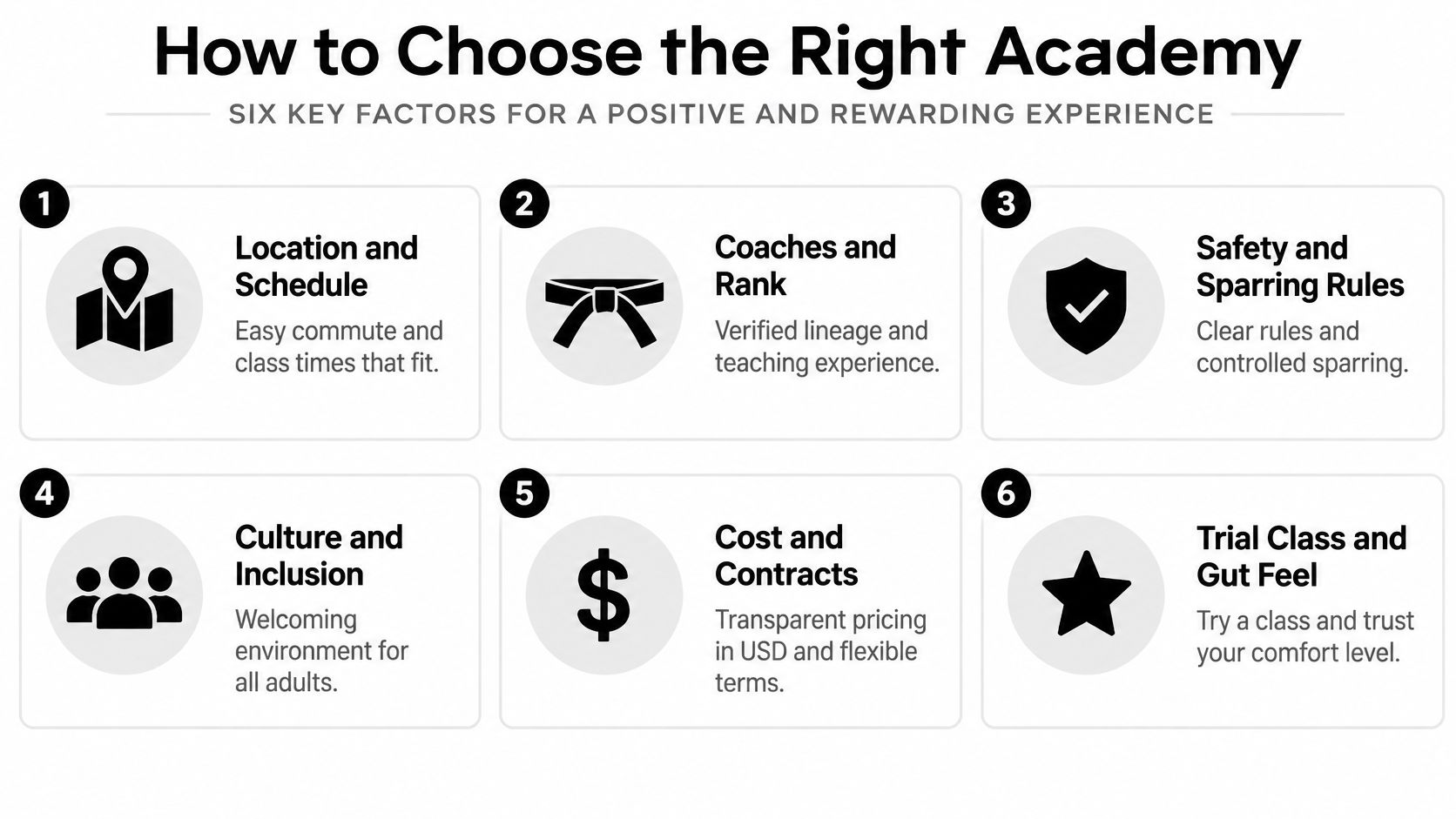
Judge an academy against observable criteria rather than a single overall impression. A prestigious competitor may not be the right beginner teacher, and an attractive training room tells you little about how instructors handle concerns.
| Criterion | What good looks like | Red flag | Question to ask |
|---|---|---|---|
| Location and schedule | A realistic commute and adult sessions you can attend consistently | Few adult classes or only unsuitable time slots | Which adult classes run each week, and when? |
| Coaches and rank | Clear credentials and experience teaching adults | No identifiable head instructor or unclear belt structure | Who teaches beginners, and what is their background? |
| Safety and sparring rules | Controlled positional practice, explicit tap rules, thoughtful partner matching | Uncontrolled twisting submissions or no explained stopping rules | How do you manage beginner sparring and injuries? |
| Culture and inclusion | Visible conduct policy, respectful treatment, women's classes where offered | No reporting process or dismissive answers | Can I request partners, and how are conduct concerns reported? |
| Cost and contract | Written pricing, trial option, clear cancellation terms | Pressure to sign a long contract immediately | What does the trial cost, and how does cancellation work? |
| Beginner support | Fundamentals instruction and an orientation | Newcomers sent into unrestricted rounds without preparation | What will I learn during my introductory training? |
Make inclusion checkable
A 2025 U.S. case study interviewing 23 female BJJ athletes identified male-dominated culture, gender norms, and contact-training realities as challenges; participants recommended women-only classes and stronger newcomer support.
A description such as friendly atmosphere doesn't tell you whether someone can refuse a partner without consequences. Ask who receives complaints, whether there's an alternative contact if the concern involves an instructor, and how staff respond to unwanted contact.
Women's classes can provide a useful entry point, but their presence alone doesn't establish that the broader academy is inclusive. Watch whether instructors distribute attention fairly, interrupt inappropriate comments, and respect students who decline a round.
Verify teaching and safety in practice
Credentials deserve checking without turning the visit into an interrogation. Our guide to recognizing a fake BJJ black belt explains warning signs, but legitimate rank is only part of the decision. Ask how the coach adapts instruction for adults with different mobility, experience, and goals.
Watch an actual class. Does the instructor notice escalating intensity? Do partners release promptly? Can someone sit out without being mocked?
For the visit, bring your weekly availability, injury restrictions, contract questions, and approved trial clothing. Keep your questions on your phone so enthusiasm doesn't distract you from checking the practical details.
Searching and Comparing Gyms with a BJJ Academy Finder
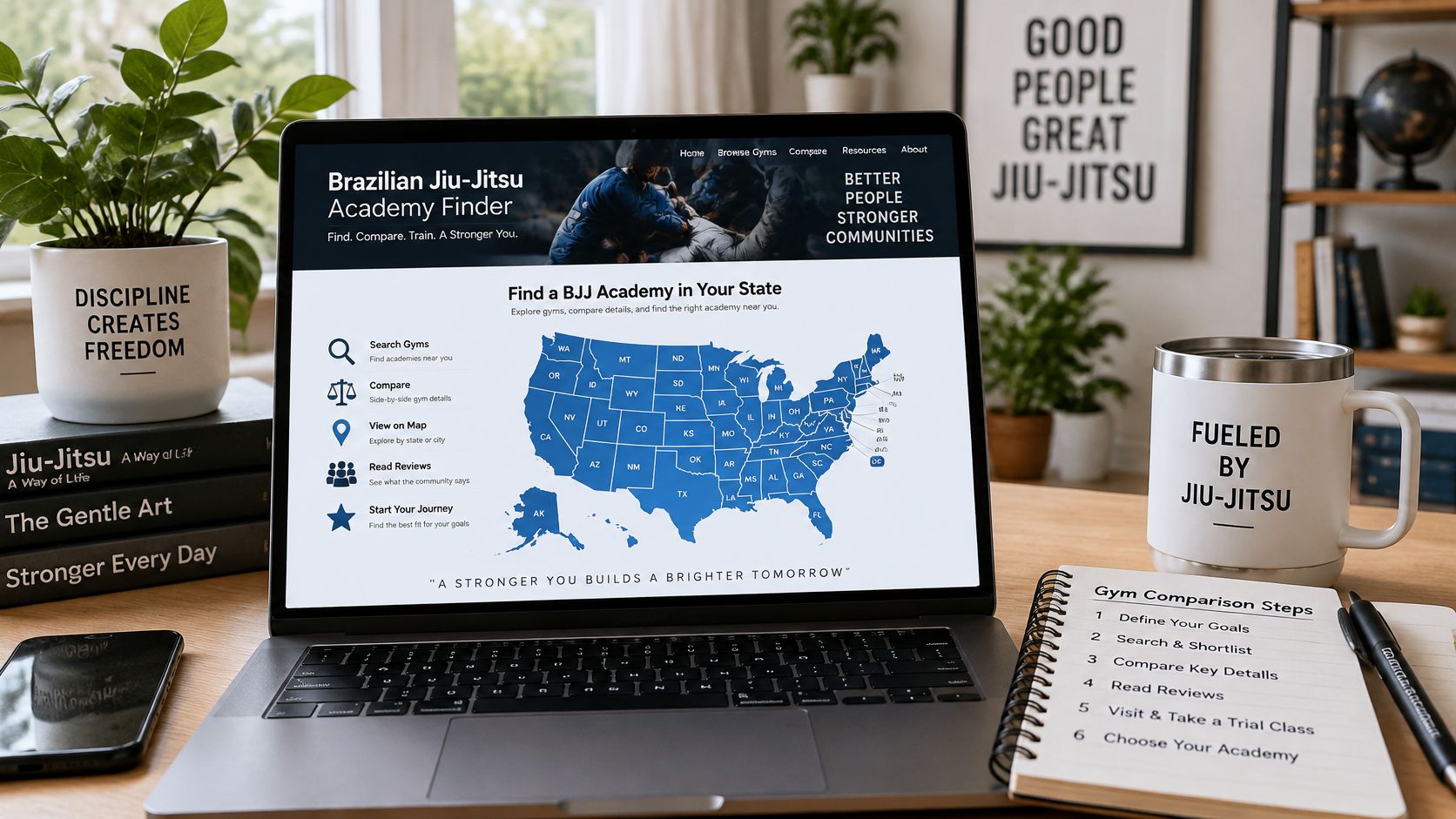
Our Brazilian Jiu-Jitsu Academy Finder directory covers academies across the United States, with state browsing that includes the District of Columbia. Use it to build a practical shortlist, then confirm the teaching environment through direct contact and a visit.
Start with the area you can realistically reach from home or work, not just the neighborhood you'd ideally like to train in.
Build a shortlist you can actually visit
Search your location. Enter a city name, state name, or ZIP code into our homepage search bar. A local starting point keeps the comparison relevant to your normal week.
Narrow the results using programs offered, distance, and rating. Start with the program you need, such as adult fundamentals, rather than assuming the highest-rated academy offers suitable beginner instruction.
Read the Programs Offered section. Our listings include class, schedule, and training-style details. Identify the exact session you'd attend, then confirm the current timetable when booking.
Check the address and interactive map. Consider the route at class time, parking, and the journey home. A short map distance can still involve an awkward commute.
Compare a manageable shortlist. Keep notes under the same headings for every academy: suitable class, instructor, safety answers, inclusion policies, and contract terms. Consistent notes are more useful than trying to remember which website sounded most welcoming.
Contact your preferred academies to arrange a trial. State that you're an adult beginner, explain your goals, and ask which session they recommend. Confirm clothing, arrival arrangements, and any trial charge before setting out.
In a large metro area, browsing every available academy can become distracting. Filtering for the program you need helps you avoid comparing an advanced competition room with a school organized around introductory teaching.
This video provides an additional visual reference as you prepare to compare options.
A listing helps you discover and contact an academy. It doesn't establish how a particular coach will treat you, so keep the trial visit as a separate part of the decision.
Decide After Your Trial Class
Give yourself time after the session to evaluate the experience. Excitement, fatigue, and relief can make almost any completed first class feel like a success. You're choosing somewhere to learn regularly, not celebrating getting through the door.
Check safety, direction, and practicality
- Did you feel safe enough to speak up? Consider what happened when you hesitated, asked for a modification, or needed a break. Respect should remain consistent when you aren't doing exactly what the group is doing.
- Do you know what to learn next? You don't need a complete curriculum in your head. You do need a clear next class, an understandable learning priority, and access to someone who answers beginner questions.
- Can you maintain this routine? Test the actual timetable against work, family responsibilities, travel, and recovery. Don't build your decision around an ideal week you rarely have.
If those checks are positive, choose a modest introductory routine and set a point to reassess it. Look for better understanding, manageable recovery, and growing comfort asking questions. Don't judge progress solely by whether you can submit another student.
Choose the room where you can learn honestly, including admitting that you're tired, confused, or uncomfortable.
If an important check fails, try the next academy rather than negotiating yourself into a poor fit. An inconvenient timetable may have a workable alternative. Dismissed conduct concerns or pressure to accept unwanted contact require a different response: leave.
Use reviews as supporting evidence
Aggregated ratings from Google and other platforms appear on our academy listings. Read them for specific descriptions of teaching and beginner treatment, not just praise or a high average score.
Use the listed phone number, website, or social media links to clarify anything unresolved before enrolling. Keep written pricing and cancellation information, and don't sign a long agreement because someone says the offer disappears when you leave. The right decision should still make sense after you've showered, rested, and looked at your calendar.
Find nearby adult programs, compare location and class information, and contact academies through Brazilian Jiu-Jitsu Academy Finder. Build a shortlist that fits your week, then book a beginner trial with your safety, inclusion, and teaching questions ready.
Share this article