
How to Find Jiu Jitsu for Beginners Near Me in 2026
Find jiu jitsu for beginners near me with this step-by-step guide. Search tips, beginner checklists, safety questions, and etiquette for new students.
Written by BJJ Academy Finder Editorial Team
You've opened a map, typed “jiu jitsu for beginners near me,” and found a page full of academies that all say they welcome beginners. One has a polished website, another is close to home, and the reviews don't tell you whether a first-timer gets careful instruction or gets thrown into hard sparring.
Don't choose from the map alone. Use search to build a shortlist, then compare the safety culture, beginner curriculum, schedule, and trial experience at two or three gyms before you sign anything. The right academy isn't just nearby. It's a place where you can learn, train consistently, and feel comfortable returning.
Table of Contents
- Why Finding the Right Beginner BJJ Gym Is Harder Than It Looks
- Searching for Jiu Jitsu for Beginners Near Me the Smart Way
- What a Real Beginner Program Should Teach First
- Your First Trial Class and What to Watch For
- Asking the Safety Questions Most Beginners Forget
- Etiquette, Hygiene, and Unwritten Rules for Your First Class
- Putting It All Together and Choosing Where to Train
Why Finding the Right Beginner BJJ Gym Is Harder Than It Looks
The first search can make every academy seem interchangeable. Listings show addresses, photos, star ratings, and claims like “all levels welcome,” but they rarely explain how a coach introduces a new student to grappling. A high rating may reflect friendly service or a strong competition team, not a structured path for someone who's never been on the mat.
Distance matters, but it shouldn't make the decision for you. A nearby gym with a schedule you can't attend, unclear beginner instruction, or pressure to spar before you're ready may be a worse fit than an academy a little farther away that welcomes questions and teaches at a measured pace. Convenience gets you through the door. The culture and class structure help you keep showing up.
Compare what listings can't tell you
Reviews are useful when you read for patterns rather than treating one person's experience as a verdict. Look for comments that describe how coaches explain techniques, whether beginners receive attention, and how students treat training partners. If several reviews mention confusing onboarding or aggressive sparring, ask the academy about it directly instead of assuming every comment is accurate.
A listing can also leave out what you care about most: whether there's a fundamentals class, whether you can observe before participating, or whether the academy teaches gi, no-gi, or both. Those differences matter because Brazilian jiu-jitsu academies vary in emphasis, including sport competition and self-defense. Your goal isn't to find the gym with the flashiest photos. It's to find a few promising options and test them in person.
A useful filter: Don't ask only, “Is this gym close?” Ask, “Can I get there consistently, and does the way they teach suit a true beginner?”
Build a shortlist of two or three academies that fit your travel route and available class times. Then contact each one with the same questions. That gives you a fair comparison instead of letting a single impressive website or convenient location decide for you.
Searching for Jiu Jitsu for Beginners Near Me the Smart Way
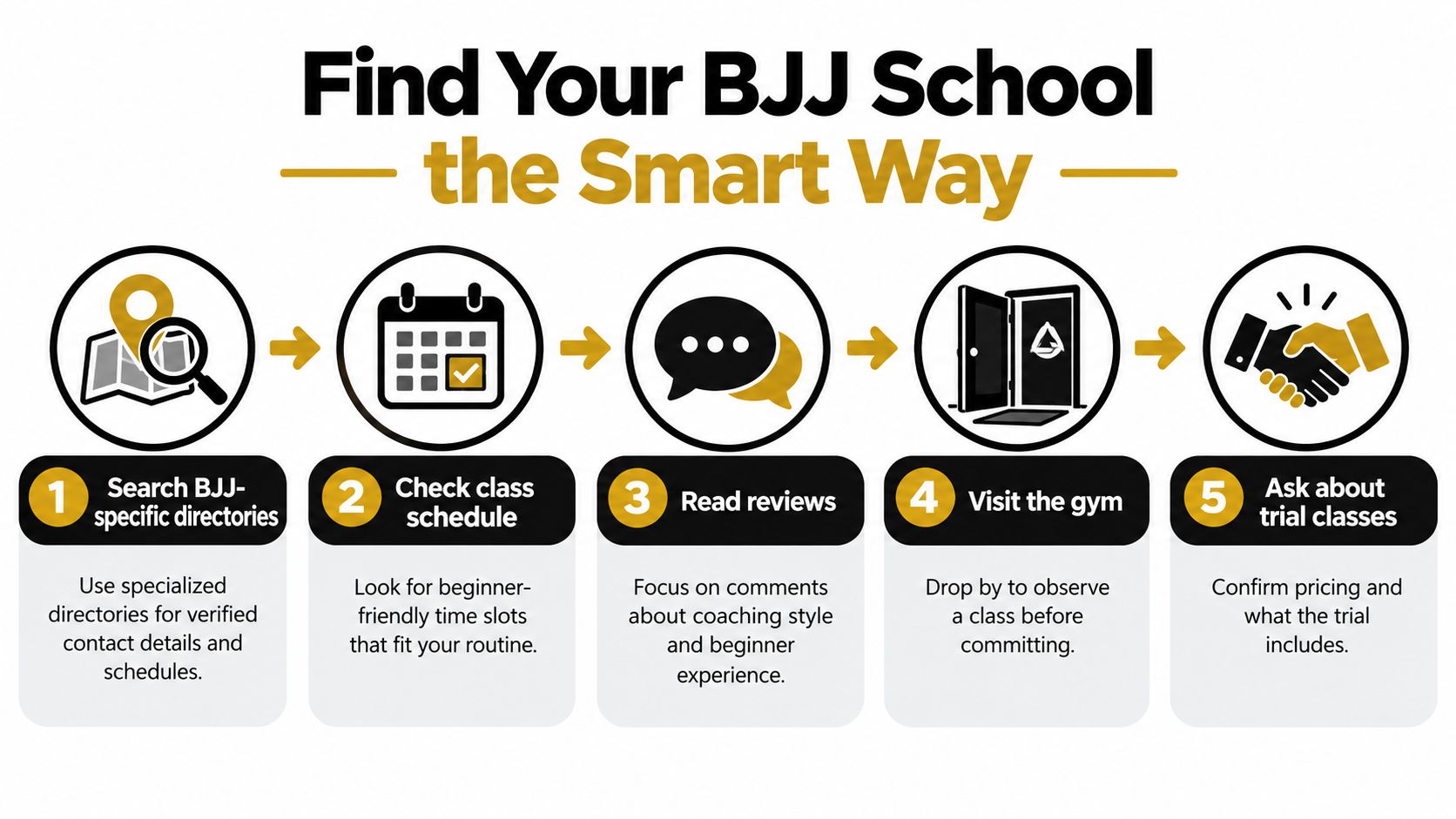
Search broadly, then narrow deliberately. A directory focused on Brazilian jiu-jitsu can help you find academy listings and contact details; Google Maps can show which options are practical from home, work, or school. Neither one tells the whole story, so use them together rather than trusting a single ranking.
Start with a few variations of your search: “BJJ fundamentals near me,” “beginner Brazilian jiu-jitsu classes,” and “jiu jitsu trial class” with your neighborhood or city. Check each academy's own schedule and website. A listing that says “all levels” isn't the same as a clearly described beginner class.
Shortlist with evidence, not vibes
Read reviews for details about the experience, not just the rating. A beginner describing patient coaching is more useful to you than a vague compliment, while a parent's review may help if you're looking for a children's program. Browse public class photos or videos, too, and see whether the gym shows instruction and everyday training, not only competition results.
Record the practical details side by side: location, class times, beginner options, gi or no-gi availability, how to book a trial, and what you need to bring. Keep the list short enough that you can actually visit each academy. If you're looking for a local example of how a school presents classes and training information, Sydney jiu jitsu classes offers one reference point, even if you're searching in another area.
Brazilian jiu-jitsu grew from judo and jujutsu traditions brought to Brazil in the early twentieth century. The first Gracie academy is traditionally dated to 1925 in Rio de Janeiro, and modern schools still differ in their emphasis on competition, self-defense, and gi or no-gi training (background on Brazilian jiu-jitsu's history). That's another reason to compare the actual program, not just the academy name or lineage.
What a Real Beginner Program Should Teach First
A real beginner program gives you tools for staying composed before it asks you to solve a live grappling problem. You should learn how to fall safely, maintain posture, use frames to create space, and escape from common positions such as mount and side control. You should also get an introduction to guard, side control, mount, and back control, along with clear rules for practicing submissions safely.
The order matters. A sensible class demonstrates a technique, gives you time to drill it with a cooperative partner, and lets the instructor correct the details. Live sparring shouldn't be the only way a new student learns whether a technique works.
A peer-reviewed study of 1,140 BJJ athletes reported 9.2 injuries per 1,000 match participations. In that study, white belts had the lowest reported injury incidence among the belt groups, at 0.73 on the study's measured scale (study of injury patterns among BJJ athletes). Those findings don't make training risk-free. They do support learning fundamentals with control instead of treating a first class like a test of toughness.
Beginner Program Fundamentals Checklist
| Fundamental | Why It Matters | Question to Ask the Gym |
|---|---|---|
| Safe falling and posture | Helps you learn movement and balance with control. | “Do beginners learn breakfalls and posture before takedown practice?” |
| Frames and positional escapes | Teaches you to make space and work out of bad positions. | “Which escapes do you cover in the introductory classes?” |
| Guard and positional basics | Gives you a working map of common ground positions. | “Do you teach guard, side control, mount, and back control in a planned sequence?” |
| Controlled submissions | Helps you understand technique without turning drilling into a scramble. | “How do you teach tapping and releasing submissions during practice?” |
| Supervised drilling | Lets a coach spot confusion and correct unsafe movement. | “Will an instructor watch and give feedback while beginners drill?” |
| Gradual sparring | Introduces live resistance without making intensity the lesson. | “Can a beginner observe or sit out live rounds while learning the basics?” |
Ask those questions before enrolling, or use them during a trial. The coach doesn't need to promise a perfect class. They should be able to explain what beginners learn, how they practice it, and when live rounds make sense.
Your First Trial Class and What to Watch For
Book the class in advance and tell the academy you're new. Ask what to wear, whether they lend or rent a gi, and when you should arrive. Bring water and clean athletic clothes if the gym says a uniform isn't needed for a trial.
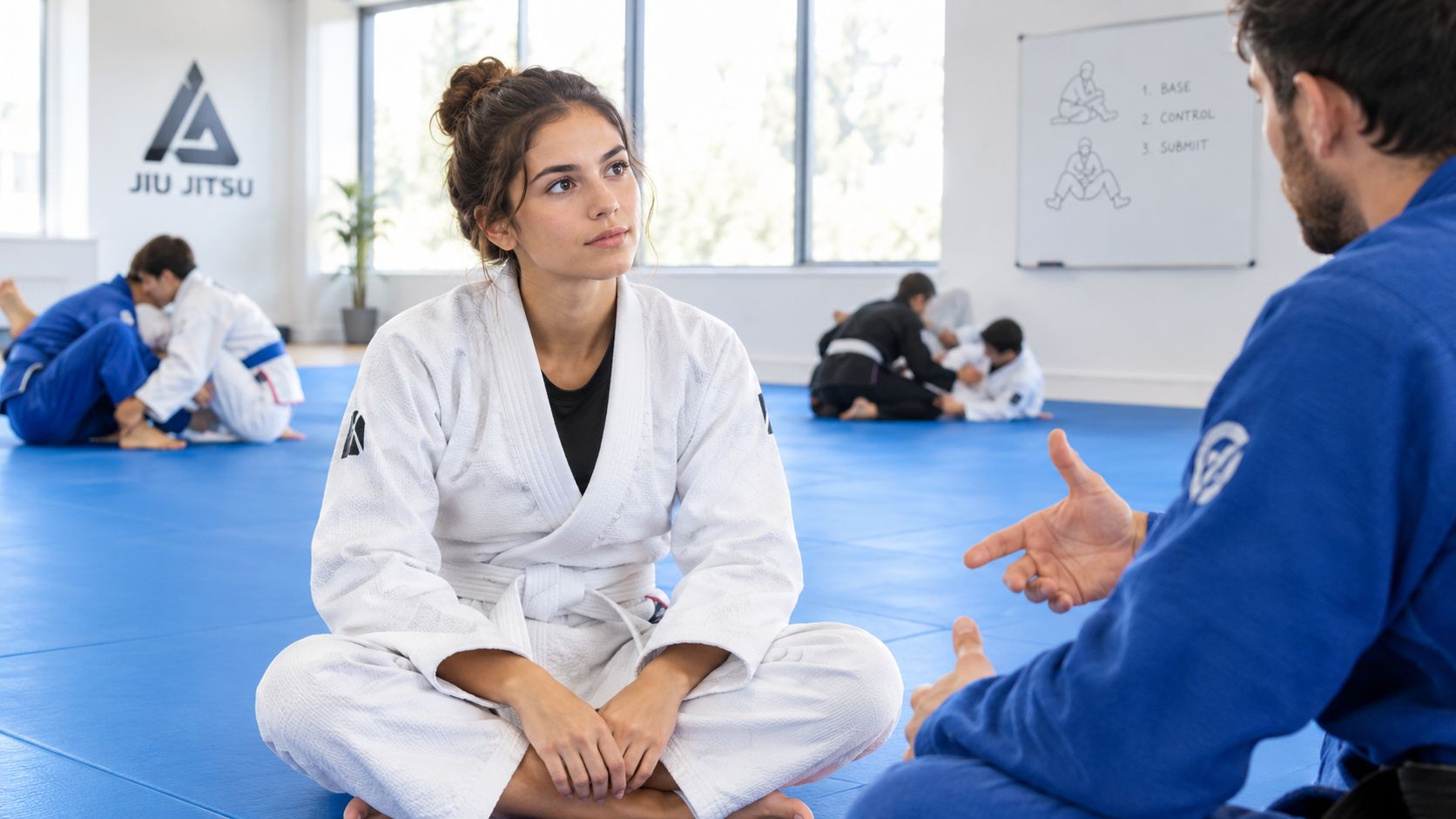
Watch how the coach welcomes you and explains the class. A warm-up may include basic movement drills, followed by a technique demonstration and partner practice. You don't need to understand everything at once. You do need to know what you're practicing, how to stop, and whom to ask if you're unsure.
Read the room while you train
Notice whether your partner listens when you say you're new and whether the instructor checks that the drill makes sense. Pay attention to how the coach responds when students make mistakes. Clear corrections and patient explanations are good signs; being ignored while you struggle with the technique isn't.
A 2025 global cross-sectional study of 881 BJJ practitioners recorded 888 injuries. The study found that 89% occurred during training, and 79% of those training injuries happened during sparring (global study of BJJ injuries). That's why you should watch the transitions between drilling and live rounds. Does the coach explain expectations, match partners thoughtfully, and let newcomers opt out if they aren't ready?
If there are live rounds, observe before joining. Look for controlled pace and partners who release when someone taps. You can also ask whether sparring is optional during your first visits and whether a coach can suggest a suitable partner.
Before you head in, watch this class overview to get a sense of what a first visit might involve:
A trial isn't a performance review of you. It's your chance to see whether the gym teaches in a way that makes you feel safe enough to keep learning.
Asking the Safety Questions Most Beginners Forget
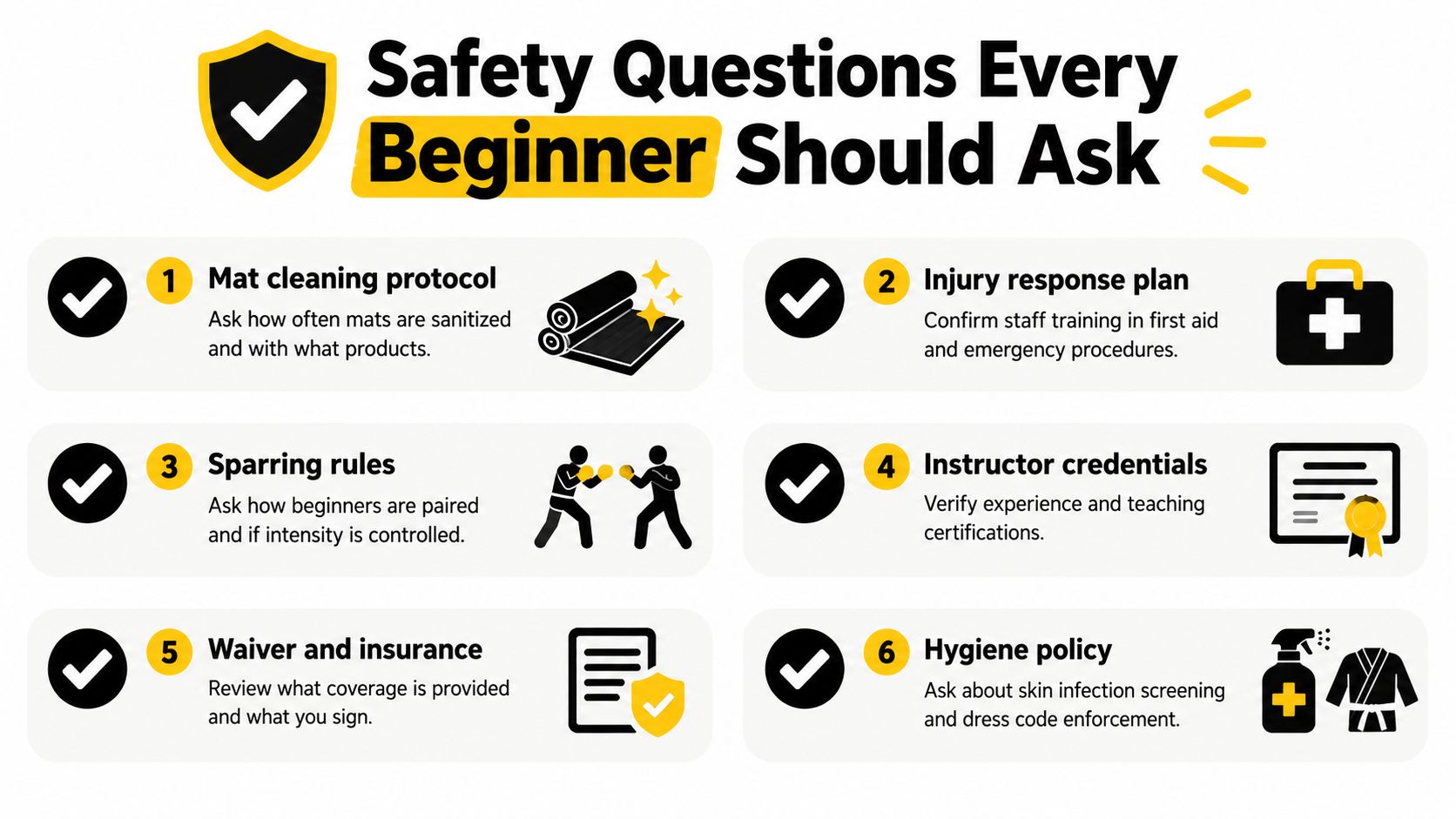
“Is this gym safe?” is too broad to get a useful answer. Ask how the academy manages the situations that can make training risky: partner matching, sparring intensity, tapping, and responding to an injury. A coach should answer plainly, not brush off the questions as nerves.
A review of seven studies covering 2,847 jiu-jitsu practitioners found frequent musculoskeletal injuries involving the knee, chest and ribs, and shoulder, with beginners commonly represented (review of jiu-jitsu injury research). Use that as a reason to be upfront about old or current injuries and to ask whether the academy can adapt drilling. Don't ask a coach to diagnose an injury. Ask what modifications they can offer, and seek medical advice when appropriate.
Ask directly, and listen to the answer
Try these questions during your call or visit:
- Partner matching: “How do you pair beginners by size and experience?”
- Live rounds: “Are beginners expected to spar right away, or can I watch and drill first?”
- Tap-and-release: “What do coaches do if someone doesn't release immediately after a tap?”
- Injury response: “How do students report an injury, and who handles it?”
- Class supervision: “Who keeps an eye on beginners during partner drills and live rounds?”
- Training adjustments: “Can I do technique-only work if I'm returning from an injury or need to limit impact?”
The answer matters, but so does the way the staff responds. A good coach takes a safety question seriously and explains the gym's expectations without making you feel awkward for asking. If you're also checking instructor credentials and academy claims, this guide to spotting a fake black belt in BJJ can help you know what to verify.
Etiquette, Hygiene, and Unwritten Rules for Your First Class
You don't need to memorize an academy's traditions before you arrive. Ask about the dress code, follow the instructor's lead, and treat your training partner with care. The exact customs vary, but cleanliness and respect aren't optional.
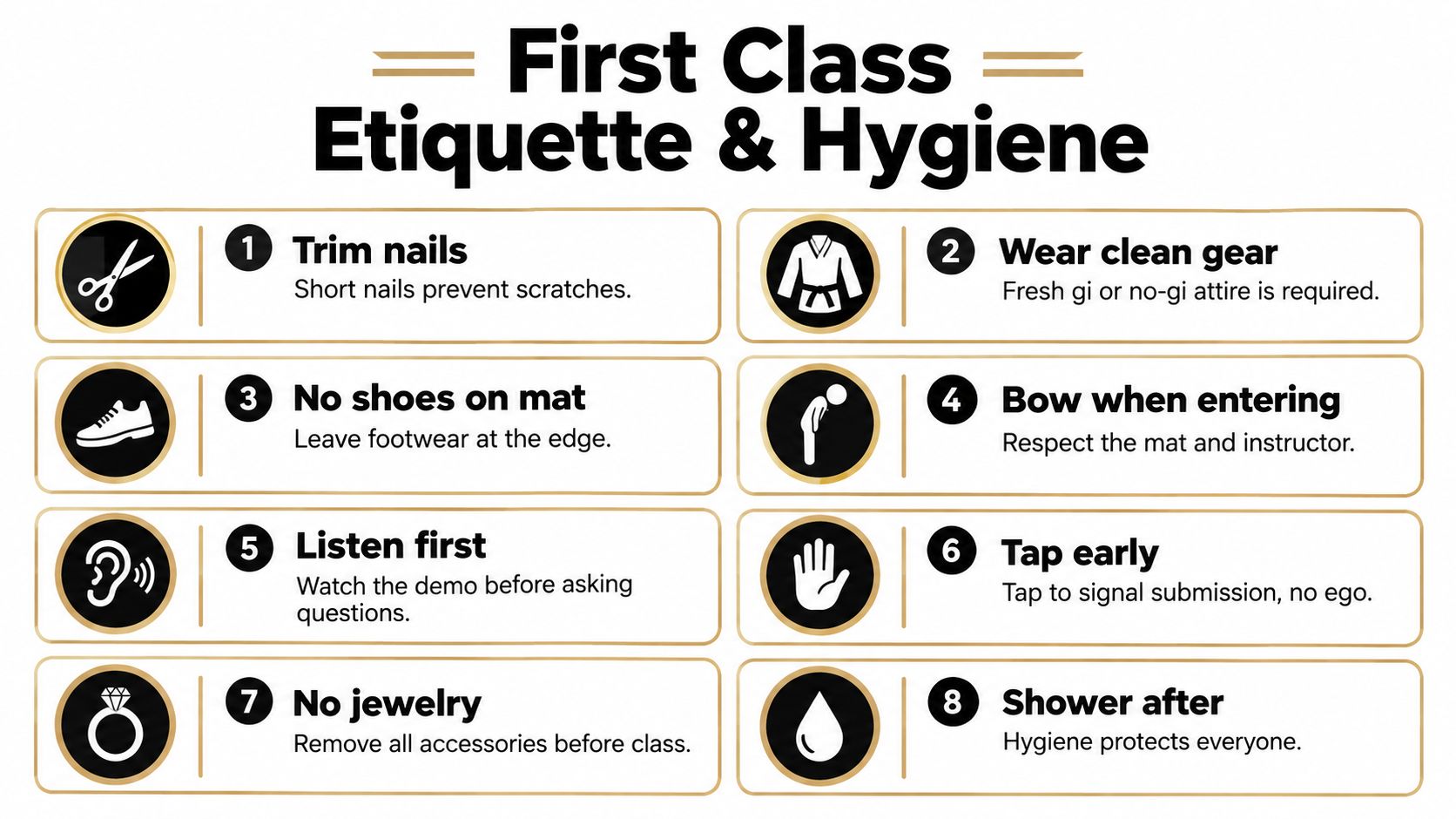
Before class, check what the academy allows for gi or no-gi training. Wear clean gear, trim your fingernails and toenails, remove jewelry, and bring sandals for walking off the mat. If you're unsure what clothing is acceptable, ask before buying anything. This guide to what to wear to jiu jitsu covers common first-class gear questions.
A quick mat-side checklist
- Follow the room: If students bow when entering or leaving the mat, follow their lead. If you don't know how to address the instructor, ask what they prefer.
- Listen before drilling: Watch the demonstration, then ask for clarification when there's a natural pause. During partner practice, work at the pace your partner can manage.
- Tap early: Tap when you feel pressure or need to stop. If your partner taps, release immediately. Don't try to prove toughness by waiting.
- Keep the mat clean: Don't wear shoes on the training surface, and don't train with dirty gear or open cuts. Shower after class and tell staff if you notice a possible hygiene issue.
- Start with an open mind: Most academies will place a new student at white belt, even if they've trained another martial art. Let the coach explain the school's rank and etiquette customs.
You're not expected to know every rule on day one. You are expected to ask when you're unsure and help keep the mat a respectful place to learn.
Putting It All Together and Choosing Where to Train
Use a simple loop: Search, Compare, Connect. Search directories, maps, and neighborhood queries to find options; compare schedules, beginner instruction, and answers to your safety questions; then connect by booking a trial at two or three academies before committing.
Check the cost, required gear, cancellation terms, and any contract details before you enroll. This guide to jiu jitsu class costs can help you prepare questions about pricing. Once you choose a gym, start with two to three sessions a week and increase only if your soreness, recovery, and technique feel manageable.
The best academy for you is the one where coaches teach clearly, partners respect your limits, and the schedule makes regular training realistic. Book a trial, take notes afterward, and choose the place that makes you want to come back.
Brazilian Jiu-Jitsu Academy Finder helps you search for academies by location and compare listings, contact details, and community ratings. Use Brazilian Jiu-Jitsu Academy Finder to build your shortlist, then contact the gyms directly to ask about beginner classes and trial visits.
Share this article