
Morning vs. Evening BJJ Classes: What Works Best?
Compare morning and evening BJJ classes by energy, class size, commute, and sleep impact to find the schedule you can stick with for steady progress.
Written by BJJ Academy Finder Editorial Team
Morning vs. Evening BJJ Classes: What Works Best?
When deciding between morning and evening Brazilian Jiu-Jitsu (BJJ) classes, the best choice depends on your schedule, energy levels, and personal preferences. Here’s a quick breakdown:
- Morning Classes: Great for smaller class sizes, focused learning, and starting your day with a sense of accomplishment. Ideal if you’re an early riser or want free evenings. Requires going to bed early and warming up properly due to stiffer muscles.
- Evening Classes: Perfect for a lively, social atmosphere with more sparring partners. Your body is naturally more flexible and stronger later in the day. However, fatigue from work or family commitments can make it harder to stay consistent.
Quick Comparison
| Factor | Morning Classes | Evening Classes |
|---|---|---|
| Energy Levels | Fresh mind but stiffer body | Warmer body but potential mental fatigue |
| Class Size | Smaller, more personal attention | Larger, more social environment |
| Commute | Lighter traffic | Heavier traffic during rush hours |
| Sleep Impact | Requires early bedtime | Late sessions may disrupt sleep |
Ultimately, the best time to train is the one you can stick with consistently. Try both and see which fits your routine and energy levels better. Consistency is what drives progress in BJJ.
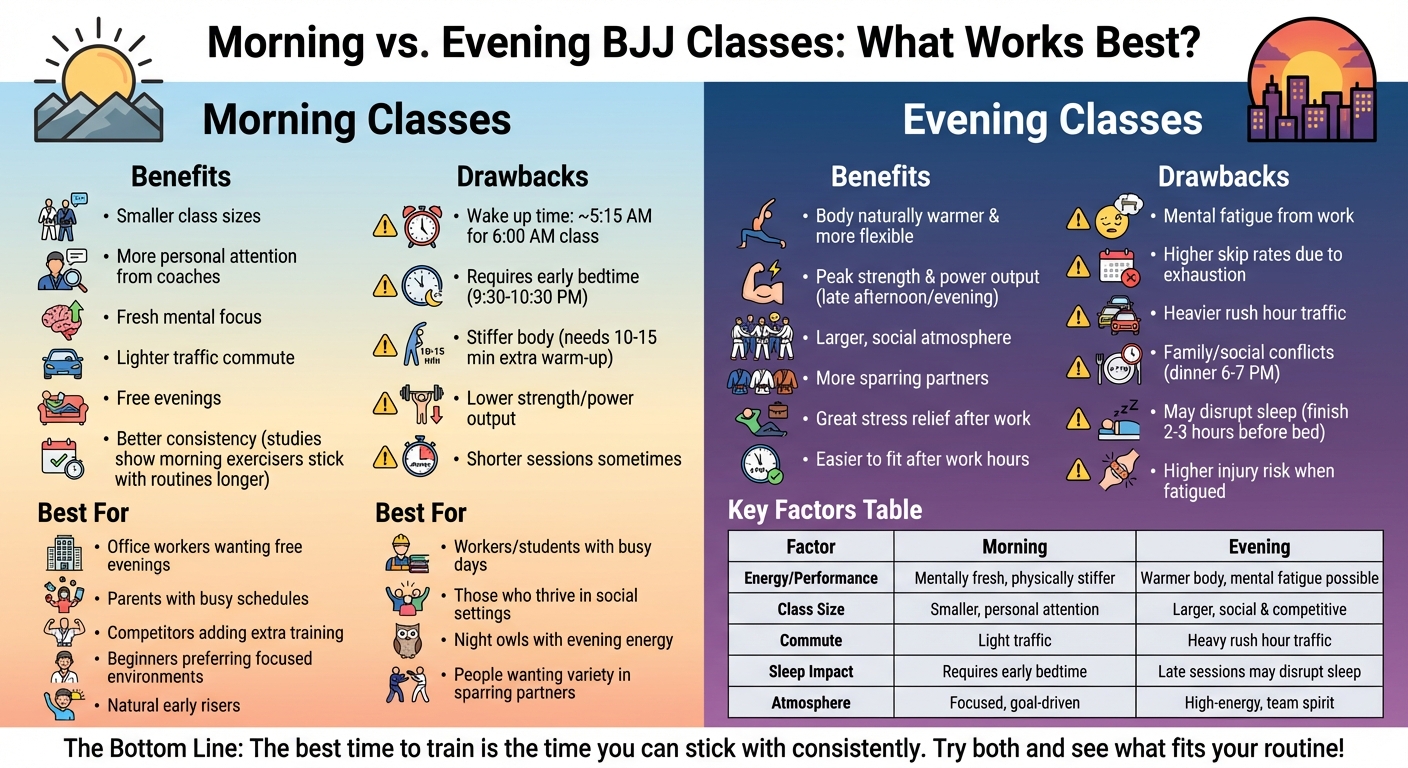
Morning vs Evening BJJ Classes Comparison Chart
The Best Time to Train BJJ
What to Consider When Choosing Your Class Time
Picking the right class time isn’t just about convenience - it’s about syncing your training with your daily routine, energy levels, and travel logistics. Let’s dive into how these factors can influence your decision and help you stay consistent without burning out.
Your Daily Schedule and Responsibilities
Your work hours will likely play a big role in determining when you can train. For example, morning classes often mean waking up before 6:00 a.m. To make that work, you’ll need to adjust your bedtime to around 9:30–10:30 p.m. to get the recommended 7–9 hours of sleep. On the other hand, evening classes are easier to fit in after work, but they might clash with family dinners (typically between 6:00–7:00 p.m.), kids’ homework, or other social plans.
If you’re a parent, balancing training with school drop-offs and homework can be tricky. Morning classes might interfere with getting the kids to school, while evening sessions could work better - though that depends on your family’s routine. For single parents juggling dinner prep and other responsibilities, evening classes might be out of the question. Meanwhile, shift workers, college students, and retirees often have more freedom to train during off-peak hours when gyms are less crowded.
Energy Levels and Focus Throughout the Day
Your energy and performance fluctuate throughout the day, and that can make a difference in your training. Strength and power output tend to peak in the late afternoon and early evening because your core body temperature is higher, and your muscles are naturally more flexible. That’s why many grapplers feel stronger and more capable during evening sessions.
But mornings have their own advantages. Many people find they’re mentally sharper earlier in the day, which can be especially helpful when learning complex techniques. Morning classes might mean your body feels a bit stiffer at first, but the trade-off is often better focus during drills. If you’re naturally an early riser, morning classes could be a great fit. Night owls, on the other hand, may find their energy and focus improve later in the day.
Travel Time and Class Availability
Commute times can also affect your decision. Evening commutes are often longer, which can eat into your training time or make it harder to arrive on time. Morning commutes, by contrast, are usually lighter, making it easier to plan your arrival. However, many gyms in the U.S. offer fewer morning classes compared to evening options, so availability might limit your choices.
Proximity to your gym is another factor to consider. With over 13,000 verified Brazilian Jiu-Jitsu academies spread across all 50 states - including 245 in California, 231 in Texas, and 198 in Florida - you’ve likely got options. Tools like the Brazilian Jiu-Jitsu Gyms Directory can help you find academies offering classes that fit your schedule, reducing travel time and making it easier to stick to your training routine.
Morning BJJ Classes: Benefits and Drawbacks
Benefits of Training in the Morning
Morning BJJ classes come with a host of perks, starting with an energy boost that can carry you through the rest of your day. Many practitioners in Colorado academies have noted how training early clears their schedule, leaving the rest of the day open for work or personal commitments. Plus, there's something deeply satisfying about knocking out a productive session before most people have even had their coffee - it can leave you feeling accomplished and focused as you tackle your day.
Another advantage? Morning classes are often smaller, which means more one-on-one time with coaches and the chance to spar with higher belts. The quieter environment also makes it easier to focus on learning intricate techniques and drilling them effectively, especially when your mind is fresh. Studies even suggest that people who exercise in the morning tend to stick with their routines more consistently over time. For competitors, these early sessions can be a great way to squeeze in extra training without disrupting a packed schedule.
Drawbacks of Morning Training
Of course, training early isn’t without its challenges. The biggest hurdle? Waking up early. If your class starts at 6:00 a.m., you’ll likely need to set your alarm for around 5:15 a.m., which means going to bed earlier to get the recommended 7–9 hours of sleep. Skimping on rest can leave you feeling drained during drills and might slow down your recovery.
Another consideration is that your body might feel stiffer in the morning due to lower body temperature. This means you’ll need to spend an extra 10–15 minutes on mobility drills to loosen up your hips, shoulders, and spine before rolling. Additionally, morning sessions are sometimes shorter, as you’ll need time to transition into the rest of your day after class.
Who Should Train in the Morning
Morning BJJ classes are ideal for specific groups of people. They’re perfect for office workers who want their evenings free, parents juggling busy schedules, competitors looking to add more training hours, and beginners who thrive in smaller, more focused class environments. If you’re naturally an early riser or trying to build discipline and consistency, starting your day with BJJ can set a positive tone that lasts long after you step off the mats.
sbb-itb-d583f1e
Evening BJJ Classes: Benefits and Drawbacks
Benefits of Training in the Evening
Evening Brazilian Jiu-Jitsu (BJJ) classes come with some distinct perks. After a full day, your body is already warmed up, which can help reduce the risk of injuries and improve your ability to execute techniques smoothly. Plus, these sessions can act as a great stress reliever. The intense drilling and sparring provide an excellent way to unwind after work, helping you transition from the pressures of the day to your personal time.
Evening classes also tend to attract larger groups, creating a lively and social environment. For many grapplers, this dynamic atmosphere is a huge motivator, offering a chance to train with a variety of sparring partners and build camaraderie with teammates.
Drawbacks of Evening Training
On the flip side, evening training isn't without its challenges. After a long day, fatigue can set in, making it harder to focus, maintain proper technique, and even increasing the risk of injuries. It’s no surprise that evening classes often see higher skip rates as practitioners struggle to muster the energy to train after work.
Scheduling conflicts can also be an issue. Family dinners, kids' activities, overtime at work, or social commitments might make it tough to attend consistently. Additionally, the timing of evening classes can interfere with sleep. High-intensity training close to bedtime can raise adrenaline levels and body temperature, making it harder to wind down. To avoid sleep disruptions, experts suggest wrapping up your session at least 2–3 hours before heading to bed.
Who Should Train in the Evening
Evening classes are ideal for those juggling busy daytime schedules, like workers or students who can’t commit to morning training. They're also a great option if you thrive in a more social setting or enjoy having a variety of sparring partners. If you tend to feel more alert in the evening despite overall fatigue, these sessions might suit you perfectly. Just make sure to refuel after work and start early enough to allow your body time to settle before bed.
Morning vs. Evening Classes: Side-by-Side Comparison
Comparison Table: Morning vs. Evening Classes
| Factor | Morning BJJ Classes | Evening BJJ Classes |
|---|---|---|
| Energy/Performance | You're mentally fresh, but your strength might be a bit lower, so a solid warm-up is essential | Your body is naturally warmer and stronger, though mental fatigue from the day can set in |
| Class Size | Classes are generally smaller, making it easier to get personal attention in a quieter setting | Larger classes create a more social and competitive environment |
| Atmosphere | Often more focused and goal-driven, with a serious tone to training | High-energy and lively, with a variety of partners fostering a "team spirit" vibe |
| Commute & Traffic | Traffic is usually lighter before the morning rush | Heavier traffic during rush hour may require extra commute time |
| Impact on Sleep | Works best if you're an early sleeper; sacrificing sleep to attend isn't ideal | Late classes might interfere with sleep if they end too close to bedtime, but earlier evening slots can help |
This table highlights how the timing of your training sessions can influence everything from energy levels to recovery and overall progress.
How Class Timing Affects Progress and Recovery
Your training schedule plays a major role in how you progress and recover. Ultimately, the best time to train is the time you can stick with consistently. Showing up regularly matters far more than whether you train in the morning or evening. For beginners, starting with 2–3 sessions per week helps your body adjust to the demands of Brazilian Jiu-Jitsu while steadily improving your skills. Whether you reach blue belt in one year or three depends more on consistency than the clock.
That said, training when your mind is sharp can give you an edge in mastering techniques. Brazilian Jiu-Jitsu is a highly technical art, where focused practice often beats brute strength . If mornings are when you feel most alert, that might be your ideal training time. If evenings work better, aim to finish at least 2–3 hours before heading to bed.
Finding Classes That Fit Your Schedule
Once you've figured out your preferred training time, use the Brazilian Jiu-Jitsu Gyms Directory to find academies that match your schedule. This directory lets you search by location across all 50 states and filter results based on class times and program details. You can also check instructor credentials, read reviews, and find gyms offering early or late classes.
Look for academies with trial class options. Testing out a specific time slot can help you decide if it matches your energy levels and recovery needs before committing long-term.
Conclusion: Pick the Time That Works for You
When it comes to choosing between morning or evening BJJ classes, there’s no one-size-fits-all answer. The best option is the one that aligns with your lifestyle, energy levels, and what you can stick with over time. Morning classes offer a fresh mental start and smaller groups, while evening sessions take advantage of your body’s natural warmth and a more social vibe. The key is to experiment and find what fits your rhythm.
Give both a try. Many academies offer trial classes, so you can experience the unique feel of each option. Pay attention to how your body reacts, your ability to focus, and even the logistics like your commute. Some practitioners find balance by mixing it up - training in the mornings on some days and evenings on others, depending on their work or family commitments.
To streamline your search, check out the Brazilian Jiu-Jitsu Gyms Directory. It allows you to compare schedules, read reviews, and explore instructor credentials. With filters tailored to your needs, you can pinpoint gyms offering morning or evening programs that cater to your focus, whether it’s mastering Gi fundamentals or preparing for No-Gi competitions.
At the end of the day, the best training time is the one you’ll consistently show up for. Consistency always outweighs perfection. Whether you’re hitting the mats at sunrise or winding down your day with a 7:00 p.m. roll, the real progress comes from building a routine that works with your life. Match your schedule and energy to your training, and you’ll be setting yourself up for steady growth in BJJ.
FAQs
How do I decide between morning and evening BJJ classes?
Choosing between morning and evening BJJ classes comes down to your schedule, energy levels, and daily priorities. Are you more alert and energized in the morning, or do you find your groove later in the day? Some people love starting their day with training, while others prefer to unwind with a session after work.
Think about your work hours, family obligations, and commute. How easily can you fit training into your routine without adding stress? The goal is to pick a time that keeps you consistent, makes training enjoyable, and works well with the rest of your life.
What are the main advantages of attending smaller morning BJJ classes?
Morning BJJ classes with fewer participants offer a more focused and encouraging environment. Instructors can dedicate more time to each student, providing personalized feedback that helps refine techniques and address individual needs.
Smaller classes also tend to create a tight-knit community. With fewer people, it's easier to form stronger bonds with training partners, making the experience both productive and enjoyable. Plus, the intimate setting allows for more one-on-one instruction, ensuring students get the tailored guidance they need to progress.
How does the time of day affect my energy and performance in BJJ training?
The time you choose to train in Brazilian Jiu-Jitsu can have a big impact on your energy levels and overall performance. Morning classes often set a positive tone for the day. With a fresh mind and a well-rested body, you might feel more focused and ready to tackle challenges. That said, easing into the session might take a bit longer, especially if you're not naturally a morning person.
Evening classes, by contrast, often feel more dynamic. After a day of moving around, your body is already warmed up, which can make transitions and techniques feel smoother. While the day's activities might leave you a bit tired, this is also when many people find their strength and endurance are at their highest, making it easier to handle advanced moves. In the end, the choice between morning or evening training comes down to your daily routine, how your energy fluctuates, and what you want to achieve in your practice.
Related articles
Share this article