
Sport Jiu Jitsu vs Self Defense: Choosing the Right Path
Sport jiu jitsu vs self defense explained. Compare goals, rules, drills, safety considerations, and training plans to find the best BJJ path for your goals.
Written by BJJ Academy Finder Editorial Team
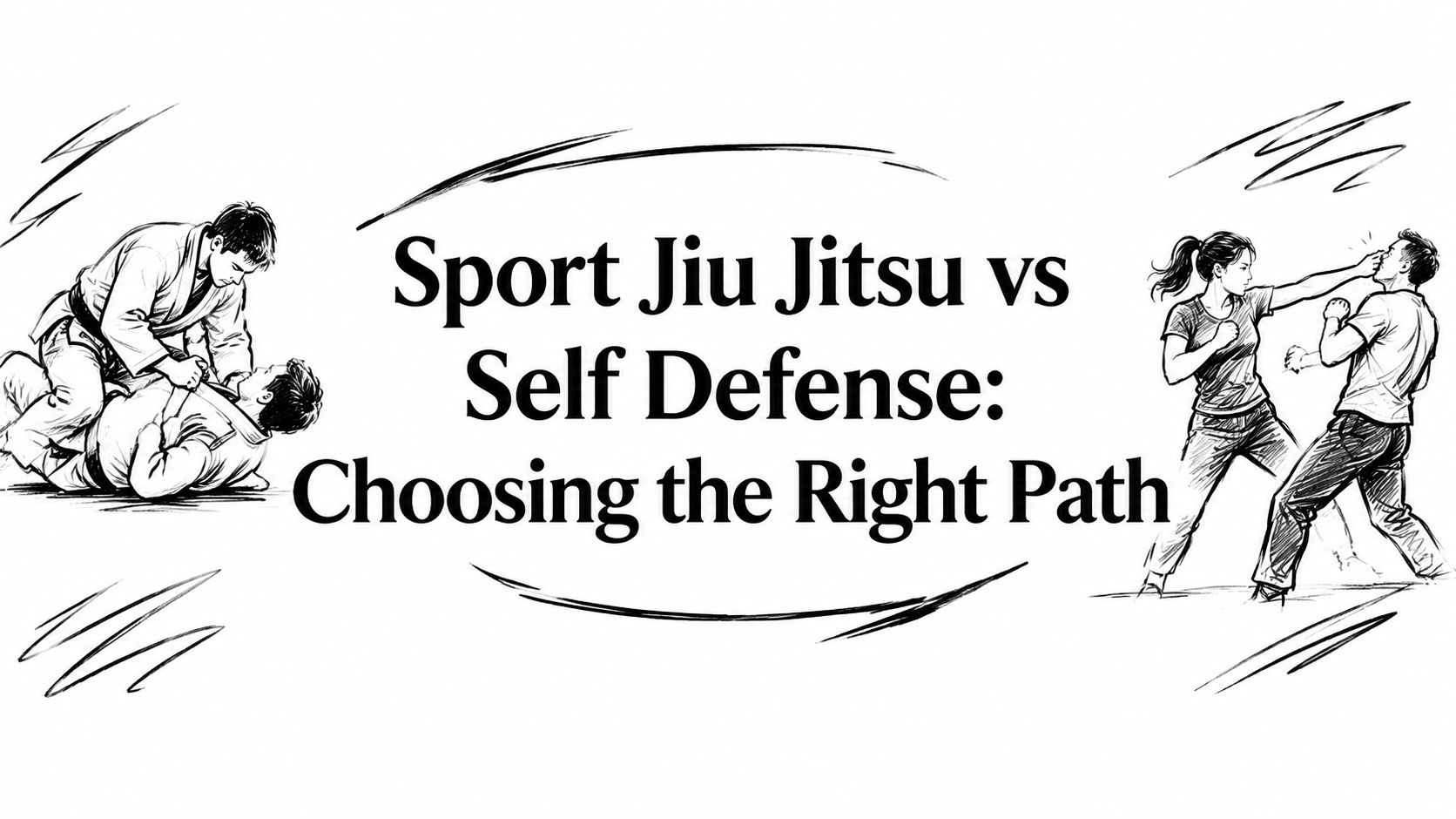
You're standing in a gym after your first trial class, trying to decide whether the room's tournament medals or its self-defense posters matter more. One class spent the evening building guard passes, positional points, and chokes against a skilled partner in a clean gi. Another had students protecting their heads, working from a wall, and escaping a resisting partner who was allowed to strike lightly. Both called the training Brazilian jiu-jitsu.
The difference matters immediately. Your choice shapes the warm-up, the positions you repeat, the intensity of sparring, the partners you train with, and the habits you carry outside the academy. The right answer in the sport jiu jitsu vs self defense debate isn't whichever school has the better logo. It's the track that matches what you want to do.
Table of Contents
- Why the Sport vs Self-Defense Question Matters on Day One
- Defining Each Track in Plain Language
- How Training, Rules, and Environment Actually Differ
- What the Evidence Says About Real-World Transfer
- Matching the Path to Your Goal and Your Life
- How to Evaluate an Academy Before You Sign Up
- Sample Weekly Training Plans for Each Path
- Common Questions and Your Next Step
Why the Sport vs Self-Defense Question Matters on Day One
A sport-focused student learns to make decisions inside a defined contest. The clock matters. Points matter. The referee matters. A competitor might willingly sit to guard, hunt a sweep, or accept a position that would be dangerous if strikes were legal, because the rules reward that exchange.
A self-defense student faces a different problem. The partner may start with a shove, a headlock, a swinging punch, or a grab near a wall. The student must protect the head, stay balanced, create distance, regain the feet, or control the attacker long enough to escape. The floor might be hard, the space cramped, and the situation unpredictable.
Neither class is automatically superior. They develop different priorities because they solve different problems. Sport BJJ builds timing against a trained opponent who understands the same technical language. Self-defense BJJ builds responses to aggression that may begin before anyone reaches the ground.
Coach's rule: Decide what you want your training to prepare you for before you judge the techniques.
That decision affects more than the syllabus. A competition academy may organize its week around technical instruction, positional rounds, full rolling, and tournament preparation. A self-defense program may spend more time on verbal boundaries, distance management, clinch entries, ground survival, and controlled scenario work.
This article cuts through the marketing. It defines both paths, identifies where each one transfers well, and gives you a practical way to evaluate an academy before you commit. Your goal matters more than the school's branding.
Defining Each Track in Plain Language
Sport jiu jitsu is grappling trained for competition. You face a resisting opponent under a ruleset, then win by scoring, controlling positions, or submitting before time expires. The rules create the game, and serious athletes optimize every choice for that game.
The sport's modern identity developed through several milestones. Royce Gracie's victory at the UFC's 1993 debut demonstrated that Brazilian jiu-jitsu could function against opponents from different fighting backgrounds, helping move BJJ from a niche grappling method into a globally recognized combat system. The IBJJF was formally incorporated in 2002, contributing to unified belt standards, rules, and a regular tournament calendar, while the ADCC Submission Wrestling World Championship launched in 1998, accelerating interest in no-gi grappling outside traditional gi competition. These historical developments help explain why modern BJJ contains both a competition track and a self-defense track. The documented history and divergence are discussed in this PubMed record.
Self-defense jiu jitsu is training built around survival and escape rather than winning a match. It addresses untrained aggression, strikes, grabs, standing grappling, walls, uneven surfaces, and decisions made under stress. The preferred result usually isn't a prolonged ground battle. It's getting safe, disengaging, and leaving.
Sport BJJ vs Self-Defense BJJ at a Glance
| Dimension | Sport Jiu Jitsu | Self-Defense Jiu Jitsu |
|---|---|---|
| Primary objective | Score points or submit a trained opponent | Survive, control briefly, escape, and seek safety |
| Opponent | Skilled grappler following the same rules | Potentially untrained, aggressive, or unpredictable attacker |
| Main environment | Tournament mat with a clock and referee | Everyday spaces, including walls and difficult surfaces |
| Common emphasis | Guard work, passing, positional control, and submissions | Distance, clinching, striking protection, takedown safety, and escape |
| Ground strategy | Stay engaged to improve position or finish | Avoid unnecessary ground exposure and stand up when possible |
| Progress marker | Technical development, live rounds, and competition results | Reliable decisions under pressure and safe exits from common attacks |
| Best fit | Students pursuing tournaments and competitive mastery | Students prioritizing practical safety and confidence |
Sport BJJ asks, “How do I win this grappling exchange?” Self-defense BJJ asks, “How do I avoid injury and get away?” Those questions overlap, but they aren't interchangeable.
How Training, Rules, and Environment Actually Differ
The cleanest way to compare the tracks is to examine what each class rewards. A sport academy builds an athlete for a contest. A self-defense academy builds a student for disruption, uncertainty, and escape.
| Criterion | Sport Jiu Jitsu | Self-Defense Jiu Jitsu |
|---|---|---|
| Objective | Win under a specific competition ruleset | Stay safe, neutralize immediate danger, and disengage |
| Rules | Points, advantages, time limits, referee decisions, and submission restrictions | Scenario-specific safety rules, controlled contact, and escape-focused outcomes |
| Positions | Guards, passing sequences, mount, back control, and submission chains | Standing defense, clinch control, wall work, top stabilization, and safe recovery to the feet |
| Attire | Gi or approved no-gi clothing, depending on the event | Clothing and movement may be adapted to everyday conditions |
| Striking | Usually absent from live grappling rounds | Integrated in controlled drills where appropriate |
| Training surface | Predictable mat space | Mat work plus wall, confined-space, and scenario variations |
| Partner behavior | Trained grappler using familiar technical strategies | Resisting partner simulating grabs, strikes, pressure, and disorder |
| Class culture | Open mats, point sparring, tournament teams, and competition cycles | Scenario practice, verbal boundaries, safety controls, and practical decision-making |
Sport training drills takedowns, guard retention, sweeps, passes, transitions, and submissions from positions that occur repeatedly in competition. A student may spend a long time refining grip fighting, guard entries, back control, and choke sequences because those skills produce reliable results inside the rules.
Self-defense training gives more attention to inferior starting positions and the moments before a takedown. Headlock escapes, wrist grabs, bear hugs, punch protection, clinch entries, wall escapes, and getting up safely deserve repetition because an everyday confrontation won't politely begin in closed guard.
The rules also change behavior. Sport rounds commonly use a clock, positional scoring, advantages, and referee intervention. Competitors can take calculated risks because the opponent isn't allowed to strike, bite, slam, or introduce a weapon. Depending on the ruleset and division, leg locks and heel hooks may be permitted or restricted, which further changes the athlete's tactical choices.
A responsible self-defense class still needs rules. “Anything goes” isn't a training method, and careless realism only creates injuries. Good instructors add pressure without pretending that a gym scenario reproduces every variable of violence.
What the environment teaches
Sport academies often make progress visible through live rounds, competition preparation, and clear technical specialization. Self-defense programs should make progress visible through increasingly difficult scenarios, controlled resistance, and decisions that prioritize escape over domination.
The strongest academy can explain why a drill exists, what resistance level it uses, and where the skill stops transferring. If an instructor promises that one submission solves every real-world problem, keep looking.
What the Evidence Says About Real-World Transfer
BJJ transfers to self-defense unevenly. The pressure of live grappling is valuable, but a sport round doesn't automatically teach you how to handle strikes, multiple attackers, weapons, concrete, or the legal consequences of using force.
A recent theory-driven BJJ self-defense program for nurses improved self-efficacy and threat perception, but it didn't significantly change attitudes toward handling workplace violence. That distinction matters. Feeling more capable is a useful training outcome, yet it doesn't prove that a student will make better decisions under stress or behave differently during an actual confrontation. The study abstract documents this gap between confidence and behavioral change.
A separate 2026 analysis of BJJ finish patterns emphasized that competition success commonly centers on back control and chokes. Those positions are technically important, but their prevalence in competition doesn't answer whether staying on the ground is wise against several attackers or near a hazardous surface. This practical analysis examines the difference between competition finishes and real-world context.
| Variable | Sport BJJ Assumption | Real Altercation |
|---|---|---|
| Opponent | Trained grappler who follows the rules | Attacker may be untrained, intoxicated, or unpredictable |
| Contact | Grappling without strikes | Punches, grabs, head impacts, and sudden escalation |
| Surface | Clean, predictable mat | Floor, pavement, walls, furniture, or confined space |
| Number of people | One opponent | Additional people may be present |
| Objective | Score, control, or submit | Avoid injury, escape, summon help, and stop engaging |
| Time and structure | Clock, referee, and restart procedures | No referee, no reset, and no guaranteed pause |
| Success measure | Winning the exchange | Reaching safety with the least necessary force |
Sport training gives you useful attributes: balance, pressure tolerance, timing, positional awareness, and experience resisting another person. It also creates habits developed to fit its rules. Grip fighting, referee pauses, and comfortable ground engagement can become liabilities if you never train to protect against strikes or stand up from danger.
For beginners, the correct conclusion isn't that sport BJJ fails. It's that transfer requires calibration. A competitor who wants practical safety should add striking awareness, standing work, escape drills, and scenario training. A self-defense student should still pressure-test techniques against resistance rather than relying on rehearsed compliance. For a deeper beginner-focused discussion, see whether Brazilian jiu-jitsu is good for self-defense.
Matching the Path to Your Goal and Your Life
Your schedule, motivation, age, and risk tolerance matter as much as your stated objective. The right program is the one you'll attend consistently and understand clearly.
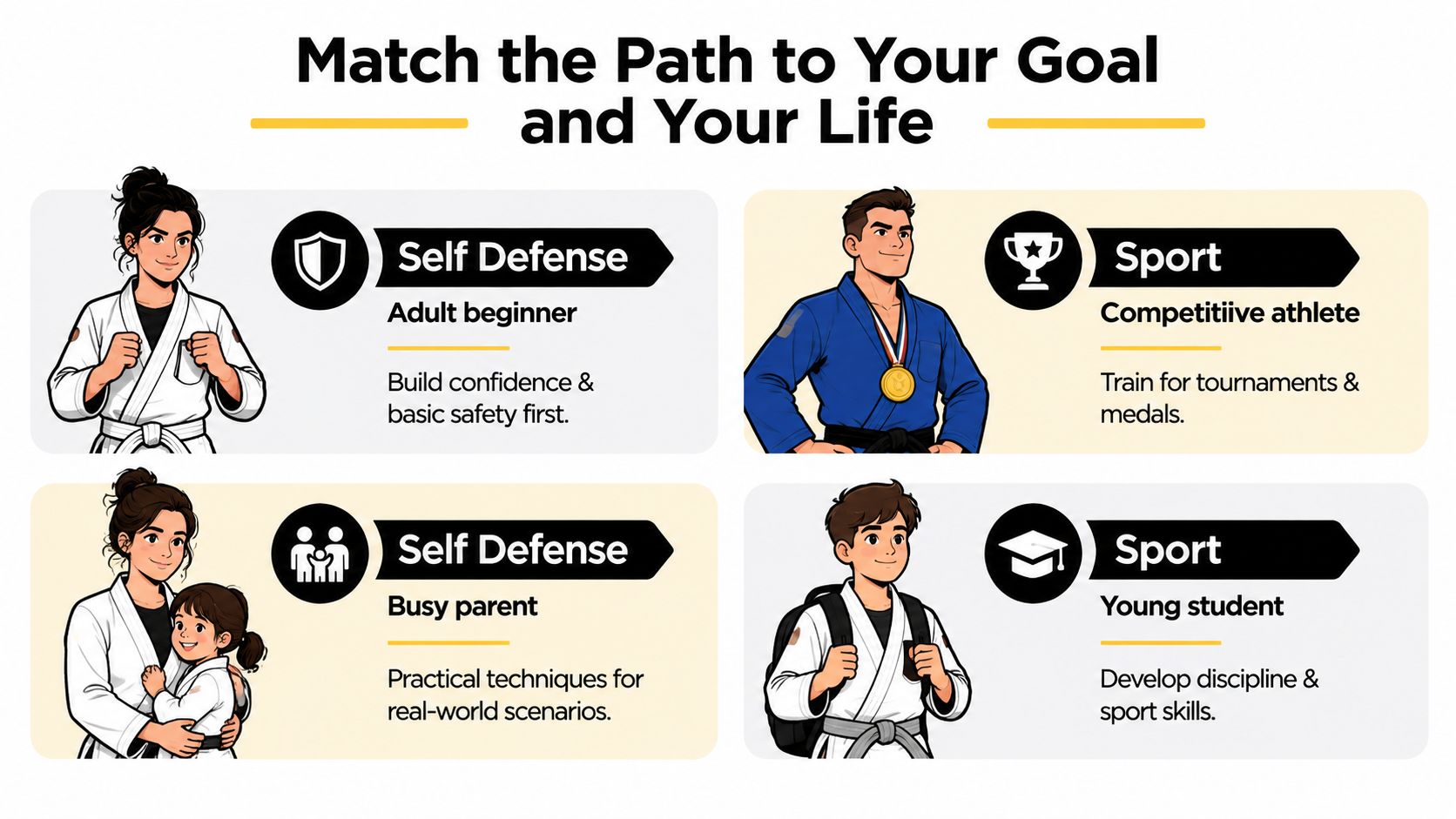
The adult beginner who wants confidence and basic safety
Choose a self-defense-first program with controlled sparring. You need simple responses to common grabs, standing pressure, clinching, and ground escapes, followed by live resistance that stays safe enough for a new student to learn.
Don't accept a class that only demonstrates techniques on a cooperative partner. Ask how the instructor increases resistance and how students learn to protect themselves before attempting control.
The parent choosing for a child
For a child between 7 and 12 years old, look for a dedicated kids' curriculum that combines age-appropriate anti-bullying scenarios with light sport elements. Children should learn boundaries, posture, movement, and confidence, not be placed in an adult class and expected to absorb adult pacing.
A good kids' program uses clear rules, active supervision, and drills suited to attention span and physical development. Competition can be a healthy option, but it shouldn't become the only definition of progress.
The competitor chasing medals
Choose sport BJJ. You need a competition pipeline, rule-specific drilling, positional sparring, tournament preparation, and strength work that supports your technical goals. The academy should know which ruleset you're entering and prepare you for its scoring, legal techniques, and match structure.
A general self-defense class won't replace the focused repetition and competition rounds required to perform at a tournament.
The hobbyist who wants both
Use a hybrid plan. Keep sport rolling for technical depth, then add self-defense sessions that cover standing entries, punch-aware clinching, wall work, and getting up safely.
Every student still needs situational awareness, de-escalation, and legal awareness. Self-defense training doesn't give you permission to use force, and local law determines whether a response is justified. Your first objective is always to avoid the confrontation when you can.
How to Evaluate an Academy Before You Sign Up
A trial class should answer practical questions, not just give you a good feeling. Watch the coach, watch the students, and ask how the program delivers the outcome it advertises.
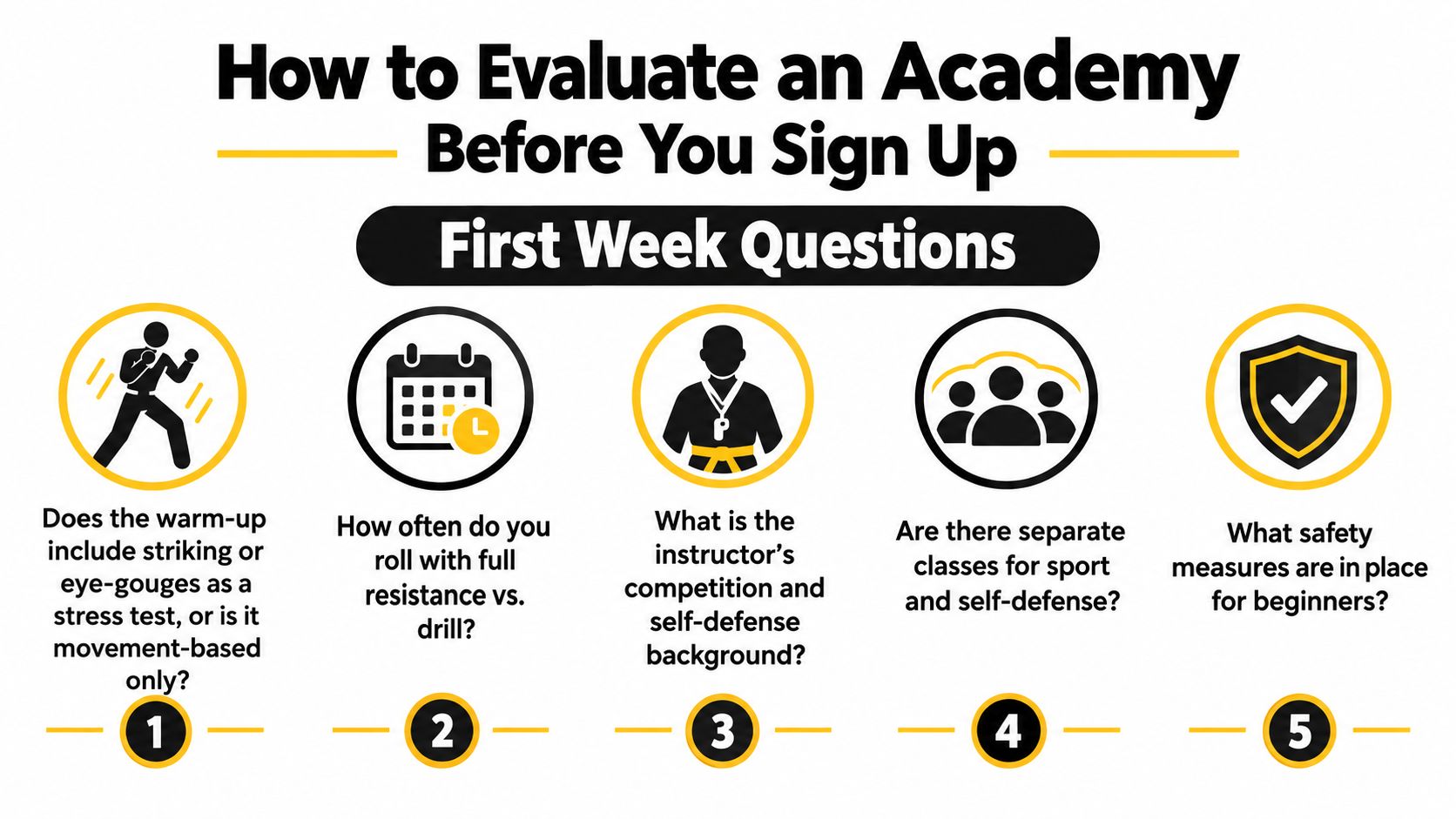
Start with the first-week checklist below:
- Inspect the warm-up: Does it include striking awareness or stress exposure, or is it movement-based only?
- Ask about resistance: How often do beginners drill, roll, and work with live resistance?
- Request the curriculum: Can the instructor explain the progression, or does each class depend on whatever comes to mind?
- Clarify the track: Does the academy separate sport preparation from self-defense instruction?
- Check safety controls: How are new students paired, coached, and protected from reckless partners?
Self-defense programs should explain how they pressure-test against resisting partners. Ask how they simulate multiple attackers without creating unsafe chaos, whether they cover pre-contact skills such as distance management, and how they teach students to disengage rather than chase a finish.
Sport programs should explain their competition pipeline, drilling-to-rolling balance, and approach to injury prevention. You're looking for a coach who can describe how beginners become competent competitors without pretending every student needs the same workload.
Red flags: No clear curriculum, no answer about sparring intensity, pressure to sign a long contract immediately, and children's classes that function as miniature adult sessions.
The best green flag is transparency. Coaches should ask about your goal before recommending a class. Students should respect tapping, control their intensity, and help newer partners learn. For a broader gym-selection checklist, use this guide to choosing a BJJ gym.
If you want to see how an academy presents instruction and training culture, review this example before or after your trial visit.
Don't sign because the instructor is charismatic or the room looks intense. Sign when the academy can connect its training methods to your goal and explain the limits of what it teaches.
Sample Weekly Training Plans for Each Path
Beginners need a plan they can recover from. More sessions aren't automatically better, especially when every class includes hard sparring. Use the templates below as starting points, then adjust around sleep, work, injuries, and coaching advice.
| Day | Sport-Focused, 5 sessions | Self-Defense-Focused, 4 sessions | Hybrid, 4 sessions |
|---|---|---|---|
| Day 1 | Technique, takedown entries, 60 to 90 minutes | Scenario fundamentals, 60 minutes | Sport technique, 60 to 90 minutes |
| Day 2 | Positional sparring, grip-fighting rounds, 60 to 90 minutes | Mobility or rest | Rest or mobility |
| Day 3 | Technique, sweep chains and guard passing, 60 to 90 minutes | Clinch entries and wall work, 60 minutes | Self-defense scenario work, 60 minutes |
| Day 4 | Positional sparring, 60 to 90 minutes | Rest or light technique review | Rest |
| Day 5 | Full rolling, 60 to 90 minutes | Ground survival with controlled strikes, 60 minutes | Sport rolling, 60 to 90 minutes |
| Day 6 | Strength and conditioning, kept separate from hard rolling | Scenario review or mobility | Open mat, controlled intensity |
| Day 7 | Full rest | Full rest | Full rest |
Sport-focused training
The sport plan places two technique sessions before two positional sessions and a full rolling day. Drill specific chains, such as grip fighting into a takedown, a sweep into a pass, or back control into a choke, then test those sequences against resistance.
Strength and conditioning belongs on a separate day when possible. If fatigue makes your technique sloppy or your reactions slow, reduce intensity before adding volume.
Self-defense-focused training
The self-defense plan prioritizes realistic decision-making without turning every class into a brawl. Work scenario entries, clinch control, wall escapes, and ground survival against carefully controlled strikes. Review techniques lightly on recovery days and keep mobility work easy.
A good instructor changes the pressure gradually. New students shouldn't be thrown into uncontrolled scenario rounds.
Hybrid training
The hybrid plan gives you exposure to both tracks without pretending you can train every quality at maximum intensity. Alternate sport rolling with scenario work, then use the open mat for technical practice rather than another exhausting competition.
For more guidance on balancing attendance and recovery, review this explanation of optimal BJJ training frequency. Consistency beats a heroic schedule you abandon after a few weeks.
Common Questions and Your Next Step
Does sport BJJ teach self-defense?
Yes, it builds pressure tolerance, balance, timing, and control against a resisting person. Sport training alone doesn't cover every self-defense demand, especially strikes, weapons, multiple attackers, or safe disengagement.
Should children train in sport or self-defense BJJ?
Choose a dedicated kids' program first. The class should teach confidence, boundaries, safe movement, and age-appropriate grappling, with competition offered as an option rather than forced onto every child.
How long until techniques feel usable outside the gym?
Usability grows through repeated practice against resistance, not through memorizing a move once. A student should judge progress by better decisions, calmer movement, and the ability to create an exit, not by confidence alone.
Can you switch paths later?
Yes. Many students begin with self-defense and discover competition, while others start as competitors and add practical scenario work. Your fundamentals remain useful, but your training must change when your goal changes.
The next step is simple. Compare academies by their actual programs, schedules, coaching backgrounds, and kids' offerings instead of choosing from branding alone. Brazilian Jiu-Jitsu Academy Finder lets you search, compare, and connect with listed academies by location and program details, including schools that identify with sport grappling or self-defense training.
Use Brazilian Jiu-Jitsu Academy Finder to shortlist academies that match your goal, schedule, and preferred training track. Contact two or three gyms, ask the evaluation questions above, and book a trial class before you commit.
Tags
Share this article