
Tape for BJJ: Types, Taping Steps, and Rules
Tape for BJJ, matched to fingers, skin, and gi repairs, with wrapping steps, competition checks, and when pain means you should stop.
Written by BJJ Academy Finder Editorial Team
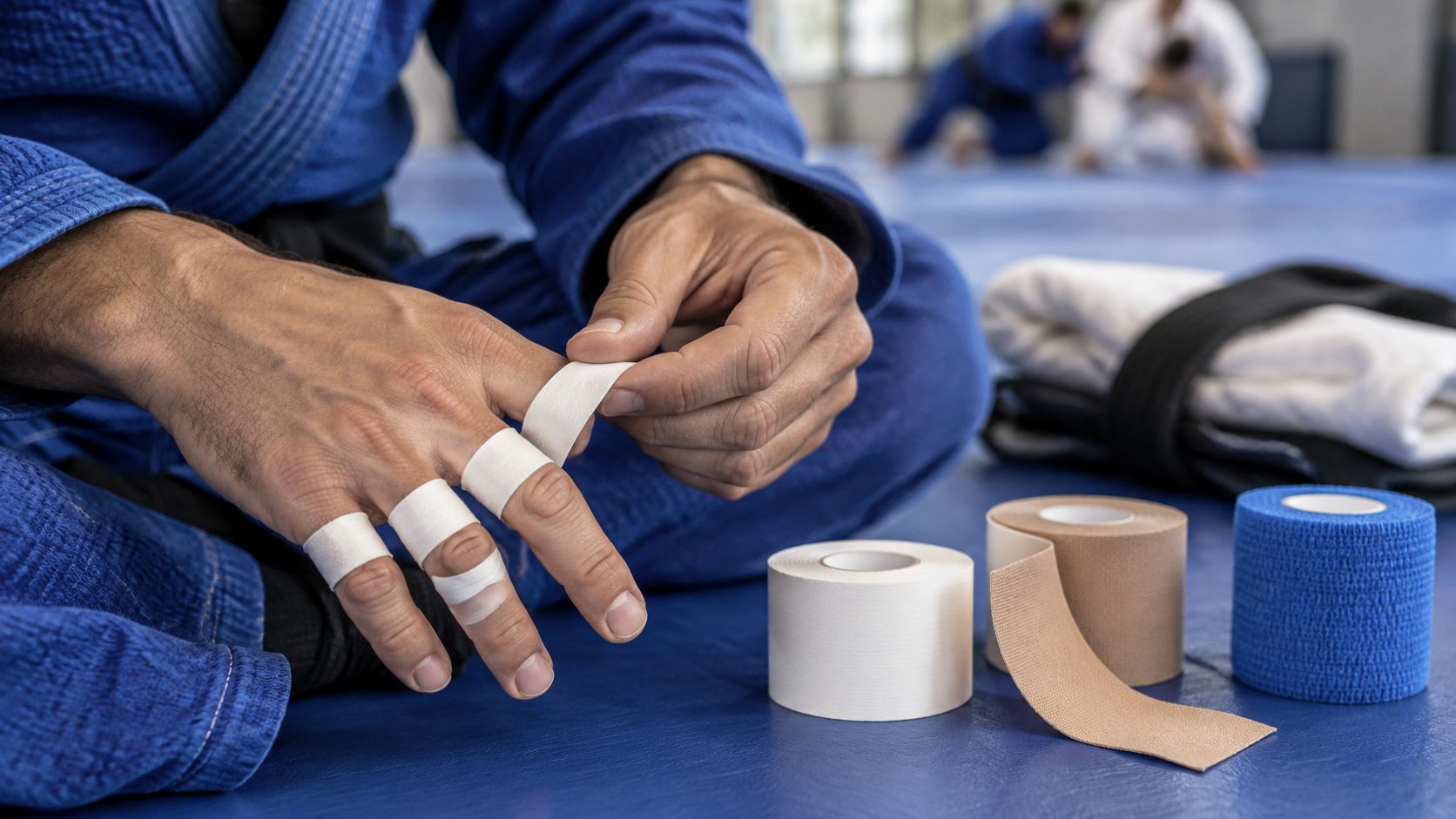
The most popular advice about tape for BJJ is also the easiest to misunderstand: wrap your fingers before class and you'll protect them from injury. Tape isn't insurance for your hands. It can make a familiar movement more comfortable, limit unwanted motion, or help manage friction, but it doesn't make a hard grip safe to keep fighting.
Start with the problem, not the roll. A sore finger joint, irritated skin, and a torn gi seam need different solutions. A good gym teaches that distinction alongside the wrapping technique, so you know when to tape, when to change your training, and when to leave the mat.
Table of Contents
- Pick the Right Tape for Each BJJ Job
- How to Tape Fingers and Thumbs for Training
- Why Finger Tape Helps Comfort but Does Not Prevent Injury
- Skin Reactions, Sweat, and Safe Removal
- Competition Checks and When Tape Is the Wrong Fix
- Buy a Simple Roll and Ask the Gym First
Pick the Right Tape for Each BJJ Job
Which tape for which BJJ job
| Tape | Best job | Feel on the mat | Skip it when |
|---|---|---|---|
| Zinc-oxide athletic tape | Fingers, thumbs, toes, mild joint support | Rigid, sweat-resistant stick | Skin is broken, fingertip goes numb, or fracture is suspected |
| Pre-cut finger tape | Same finger job, faster between rounds | Narrow rigid strips you can tear by hand | Wrap is wet, dirty, or tight enough to cut circulation |
| Kinesiology tape | Larger-area reminder such as shoulder or knee | Elastic and moves with skin | You're trying to lock a finger or thumb joint |
| Cohesive self-adherent wrap | Sensitive skin or short support over a sleeve | Sticks to itself, low residue | You need adhesive to grip bare sweaty skin for a full round |
| Gi or rash-guard repair tape | Split seams and loose threads | Fabric patch, not medical tape | The job is joint support, open skin, or infection |
Rigid tape and elastic tape do different work
Zinc-oxide athletic tape is the usual starting point for finger wrapping because it doesn't stretch much. Its job is mechanical: the fabric resists movement where you apply it. White versus tan matters less than whether the roll tears cleanly, lies flat, and stays attached without requiring excessive tension.
Pre-cut finger tape is a convenience version of that same idea, not a stronger category of support. Narrow strips make it easier to keep knuckle creases clear and avoid a bulky ridge inside a collar grip. If you struggle to tear a wider roll neatly, prepared strips remove that annoyance.
Kinesiology tape stretches with the skin. It may suit someone who wants a light movement reminder across a larger area, but it won't behave like rigid finger tape. Wrapping extra layers around a thumb won't turn an elastic product into a reliable splint.
Skin comfort and equipment repair need separate choices
Cohesive wrap adheres to itself rather than relying on glue against the skin. That can make it worth considering when adhesive removal is the main problem, although it still needs careful tension control. A wrap can squeeze a finger even when it contains no skin adhesive.
Fabric repair tape belongs with your equipment, not your medical supplies. Use an appropriate fabric patch to contain a small tear temporarily, then arrange a proper repair if the seam continues opening. Don't leave a stiff patch edge, loose thread, or peeling strip where a partner's fingers could catch.
Shopping rule: Name the job before choosing the tape. “My middle finger needs light support” is useful. “I want stronger hands” isn't a tape specification.
For rubbed but intact skin, first consider whether changing the grip or reducing friction solves the problem. A raw abrasion calls for wound care and an appropriate dressing, not athletic adhesive pressed onto damaged tissue.
Keep the rest of your kit equally straightforward. This BJJ training-equipment guide helps put tape alongside the clothing and basic supplies you need, rather than treating every ache as a reason to buy another accessory.
How to Tape Fingers and Thumbs for Training
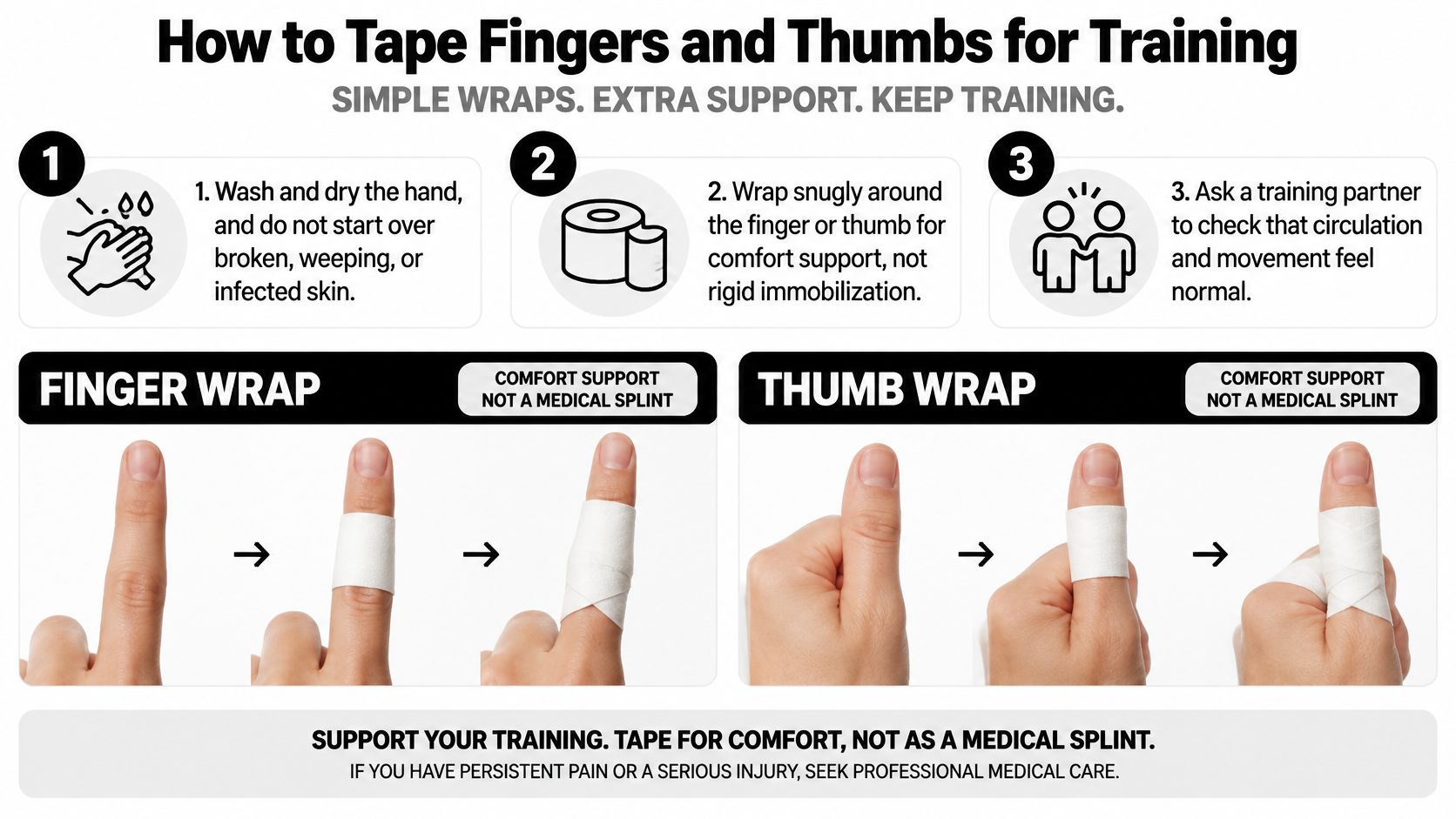
These are comfort-support wraps, not medical splints. Use them for a familiar, mild problem that hasn't changed the shape or normal function of the hand, or follow the specific plan your clinician has given you. A newly injured finger that's crooked, stuck out of line, or possibly broken isn't a practice opportunity.
Prepare the hand and choose the wrap
Wash and dry your hands. Inspect the sides of the fingers and the spaces between them. Don't start over broken, weeping, or infected skin, and don't hide an unexplained rash beneath adhesive.
Prepare the strips before wrapping. Use narrow finger tape or tear a wider athletic roll lengthwise. Cut enough to overlap securely without building a thick collar of material; excessive layers make it harder to judge pressure.
Position the hand comfortably. Keep the fingers relaxed and slightly bent rather than pulling them straight under tension. Smooth every strip as you place it, because folds can dig into the skin when you close your hand.
For buddy taping, select the neighboring finger carefully. Pair the sore finger with an adjacent finger only when that pairing feels comfortable and is appropriate for the problem. Place a thin piece of clean gauze between them to reduce skin-on-skin rubbing.
Apply the buddy bands around both fingers. Place a band below the affected joint and another above it, avoiding the knuckle creases. Lay the tape on with light tension rather than stretching it tight, and leave enough freedom to bend the fingers together.
For light thumb-base support, use a wrist-to-thumb path. Begin with a loose wrist anchor, guide a strip across the base of the thumb, and return to the anchor. Keep the thumb in a comfortable position and avoid pinching the web between thumb and index finger.
For a visual explanation of the thumb route, the guide on how to support a sore thumb with MEDISTIK offers additional context. Treat the illustration as help with placement, not permission to train through an undiagnosed thumb injury.
Check the result before touching a gi
Open your hand, then make a gentle fist. Both movements should remain comfortable. Remove the tape immediately if a fingertip becomes pale, dusky, cold, numb, or tingly; don't assume the hand will adjust once you warm up.
Ask a partner to inspect the wrap. Have them check for folded edges, trapped skin, and loose tails. Then hold fabric lightly, without pulling hard, to see whether the wrap bunches or changes how you close your hand.
Recheck during training. Pause if an end lifts or a band migrates. Remove the failed strip, dry the skin, and replace it rather than wrapping fresh tape over a wet, wrinkled base.
Remove the support after class. Peel slowly while holding the skin down, then clean away residue and let the area dry. Inspect where the tape edges sat before deciding whether to use the same arrangement again.
For toes, the buddy principle is similar, but footwear-free movement and damp mats make bulky wrapping particularly awkward. Use minimal tension, keep the toe joints able to move, and stop if the wrap changes your footing.
Why Finger Tape Helps Comfort but Does Not Prevent Injury
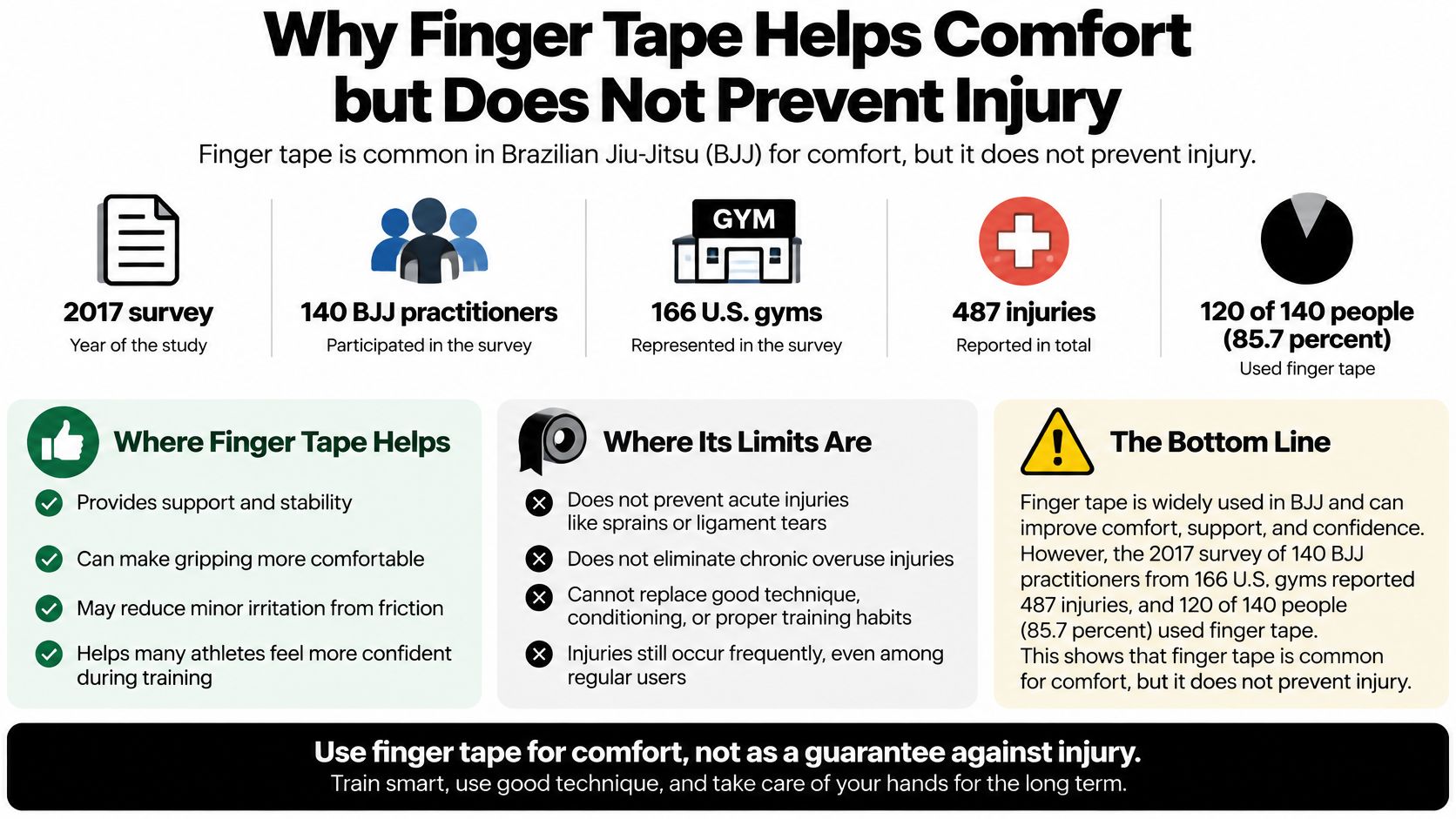
Finger tape is common because hand problems are common, not because widespread use proves that it works as prevention. In a 2017 survey published in Sports, 120 of 140 BJJ participants, or 85.7%, reported at least one injury, and hands and fingers were the most frequently injured region, with 70 reported cases.
That's a reason to take hand care seriously. It isn't evidence that everyone should tape healthy fingers, nor does it show that taped athletes avoided injuries. Counting injuries and testing a preventive intervention are different tasks.
Mechanical support isn't the same as stronger tissue
Your finger flexor tendons run through retaining structures called pulleys, which help keep the tendons close to the bones. Under load, a tendon can move farther away from the bone, a movement described as bowstringing. Tape placed around the finger can influence that movement under certain conditions.
A systematic review of finger taping found reductions in tendon bowstringing of roughly 15–22% in some conditions, but rated certainty for outcomes including pain, return to sport, pulley rupture, and performance as low to very low.
The distinction matters. A measurable change in tendon position doesn't establish that a grappler can safely keep a sleeve grip while an opponent strips it away. It also doesn't show that the tape restores an injured structure's normal capacity.
Much of this mechanical evidence comes from climbing-related work rather than live BJJ rounds. Climbers and grapplers both load their fingers, but a predictable test grip isn't the same as a partner suddenly rotating, pulling, or landing on the hand. Apply the evidence cautiously rather than turning a laboratory finding into a promise.
A finger that feels more supported isn't necessarily ready for more force.
Tape doesn't earn you a harder grip
There's no good basis here for treating tape as a grip-strength upgrade. The review's experimental evidence in healthy climbers didn't establish a meaningful strength benefit from taping. Copying an elaborate wrap from an experienced competitor therefore doesn't give a beginner a reason to squeeze harder.
Think about a sleeve grip during guard retention. If the partner stands and starts peeling your fingers away, the useful decision is whether to release and regrip, not whether another layer would let you hang on. Tape can't make that tactical choice for you.
A practical load-management approach changes the round itself:
- Change the task. Choose positional work that doesn't demand repeated hard gripping with the affected hand.
- Change the grip. Ask your coach for an alternative that avoids the uncomfortable finger position.
- Change the intensity. Agree on controlled drilling rather than discovering during a scramble that your partner thought you were fully recovered.
- Change the stopping point. End the exercise when symptoms increase instead of using the wrap to finish a planned round.
Judge the response, not the appearance
An impressive-looking wrap can encourage false confidence. A modest wrap paired with a sensible training adjustment is a more defensible choice than extensive taping paired with unchanged effort. If you need progressively more tape to tolerate the same session, arrange an assessment rather than perfecting the wrapping pattern.
For a diagnosed injury, a graded return should follow the clinician's plan. Useful questions include which movements are permitted, what symptoms mean you should stop, and how training load should progress. A roll of tape can't answer those questions.
Good academies apply the same reasoning to other familiar grappling injuries. Understanding cauliflower ear in BJJ, for example, is part of learning to recognize a problem and respond appropriately rather than accepting it as a badge of commitment.
Use tape to support a training decision, not to avoid making one. The important outcome is a hand that tolerates the chosen activity without worsening symptoms, not a wrap that survives a demanding round.
Skin Reactions, Sweat, and Safe Removal
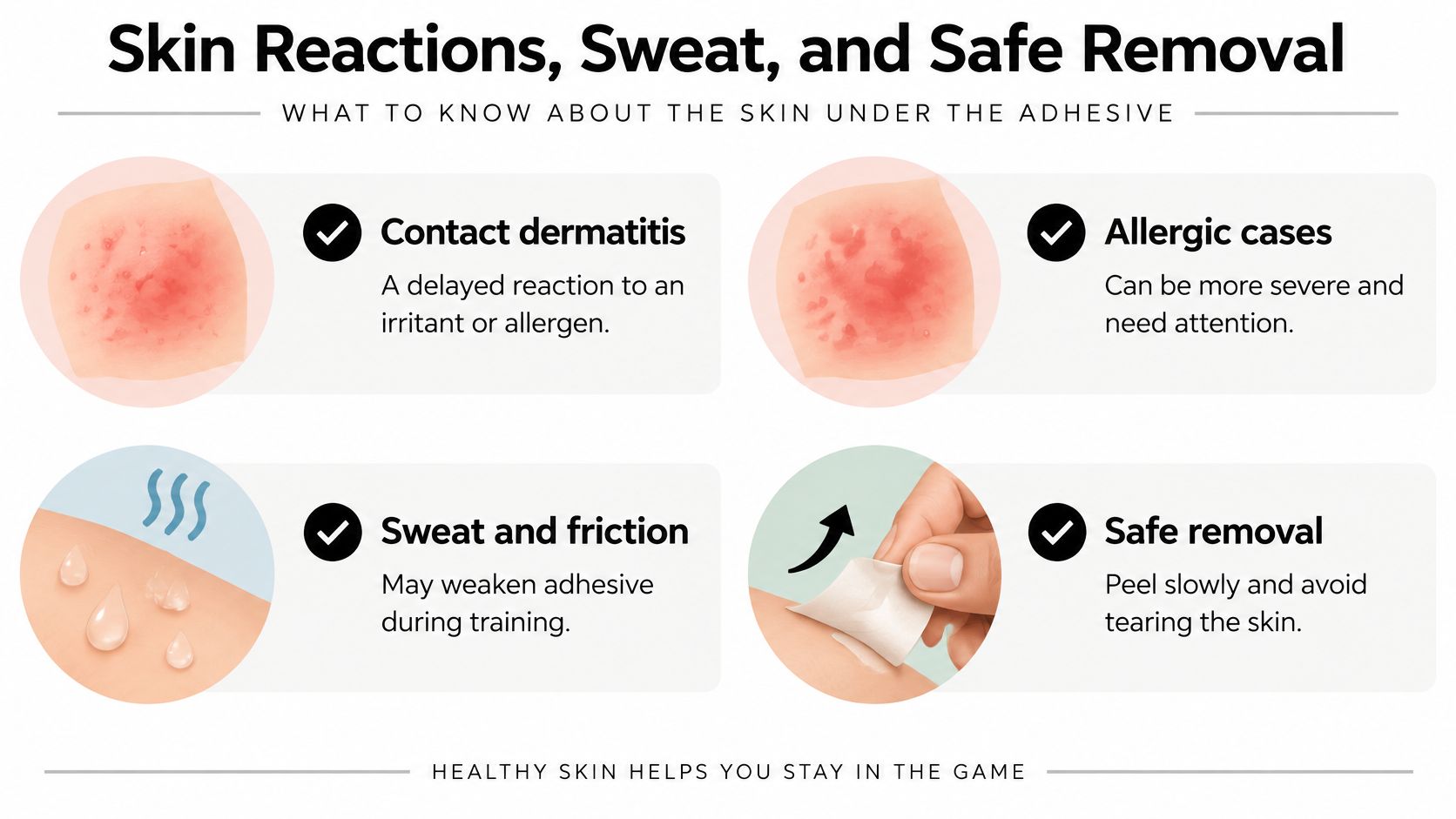
Itching, sharply outlined redness, blistering, swelling, or worsening pain under tape deserve attention. Remove the wrap rather than assuming every skin reaction is normal friction. Don't keep testing the same adhesive on an area that's already inflamed.
The DermNet guide to contact dermatitis distinguishes irritation from allergic contact dermatitis and explains the role of patch testing in identifying contact allergy. A home trial of a new product isn't equivalent to clinical patch testing.
Change the material without ignoring the reaction
If standard athletic tape repeatedly irritates intact skin, consider a low-residue product or a cohesive wrap once the skin has recovered. Hypoallergenic isn't a guarantee, and latex-free describes only one part of a product's composition. Check both the backing and adhesive information if you know you have an allergy.
Try an unfamiliar product on a small area of healthy skin away from training first. Stop if it causes a reaction, and seek medical advice for recurring or significant symptoms. Don't use a trial patch to challenge a known allergy.
Tape also shouldn't become a cover-up for a possible infection. A boil, a spreading rash, or a suspicious ring-shaped patch calls for assessment and a pause from contact training, not a better way to conceal it. Tell the coach why you're sitting out.
Make removal part of the session
- Remove promptly. Take training tape off after class rather than leaving a damp wrap on overnight.
- Support the skin. Hold the skin beside the adhesive and peel the tape back slowly, close to the surface.
- Soften stubborn residue. Use soap and water or a little skin-compatible oil on intact skin, then wash gently.
- Inspect before reapplying. Look for softened skin between buddy-taped fingers, small blisters, and irritated tape edges.
- Keep the roll clean. Store it in a pouch instead of loose beside sweaty clothing, and discard strips that have contacted the mat.
Don't scrub adhesive off until the skin feels raw. If removal hurts, slow down and soften the adhesive rather than pulling harder. Avoid applying oils or adhesive removers to open wounds unless the product is specifically appropriate for that use.
Parents can make this an ordinary after-class check: ask the child whether anything itches or burns, remove the tape, and look between the fingers. A child who says the wrap hurts needs help removing it, not encouragement to get used to it.
Competition Checks and When Tape Is the Wrong Fix
A wrap passing equipment inspection does not mean an injured hand is ready to compete. Those are separate checks: one concerns what the event permits, the other whether the hand can safely handle grips and weight.
Competition injury findings summarized in the BJJ injury literature include 46 injuries across 5,022 match exposures. Reported hand diagnoses include joint strain, thumb sprain, finger dislocation, and metacarpal fracture. Tape may make a mild symptom more comfortable, but it cannot make these different injuries equivalent or establish that a joint is ready for a match.
Match the response to the injury
General guide to common hand injuries and their usual tape fit
| Hand injury | Tape fit | Next step |
|---|---|---|
| Distal interphalangeal joint strain | Light support may suit | Train lighter and reassess |
| Thumb sprain | Light thumb support may suit | Persistent instability needs a clinician |
| Index-finger PIP dislocation | Not a taping fix | Medical assessment before training |
| Ring-finger metacarpal fracture | Not a taping fix | Medical care, no training or match |
The distal interphalangeal joint is nearest the nail. The proximal interphalangeal joint, or PIP, is the middle finger joint. A metacarpal is a bone in the hand, not a finger joint. That distinction matters because “my finger hurts” does not identify what is injured.
Even a mild-sounding injury needs judgment. If a thumb feels unstable during a gentle pinch, seek assessment. Persistent finger pain should not be treated as a simple strain just because a wrap makes it more tolerable. Never try to straighten a displaced finger yourself.
Competition check: Ask whether the organizer accepts the wrap, then separately ask whether your hand is fit to compete.
Check the actual event requirements
Check the current IBJJF or organizer rulebook for your tournament, and ask staff about anything unclear before match day. A wrap accepted at one event may not pass inspection at another. Show any brace, padding, or unusual tape arrangement to the relevant official.
Keep the wrap flat and secure, with no exposed hard components or loose tails. Ask how the event handles bleeding, damaged skin, or tape that comes loose during a match. Match preparation also includes knowing the BJJ scoring system, not only checking equipment.
Stop training and seek care for a crooked finger, a painful pop followed by loss of function, increasing swelling, or pain that changes how your hand closes. These signs call for injury assessment, not a tighter wrap. Tape is a comfort aid for suitable situations, not a substitute for care or a way to push through a hand that cannot function normally.
Buy a Simple Roll and Ask the Gym First
Most beginners don't need a collection of specialty taping products. Start with a retail roll of rigid zinc-oxide athletic tape that tears cleanly, and choose a latex-free version if that's relevant to your needs. A packet of narrow pre-cut strips is useful if preparing tidy finger bands is awkward.
Keep the shopping list tied to actual problems:
- For light finger support, buy rigid athletic tape or narrow finger strips.
- For adhesive sensitivity, consider a cohesive option after the skin has recovered and you've checked the product materials.
- For equipment damage, carry a fabric repair patch separately from your skin supplies.
- For clean storage, use a small pouch and keep a spare roll away from damp kit.
Let the coach check the habit
Before your first grip-heavy class, ask a coach to watch you apply the wrap. Ask them to demonstrate an early sleeve-grip release and a replacement grip, too. That conversation is more useful than copying the most heavily taped person in the room.
Check whether the roll leaves ragged edges, whether the adhesive removes comfortably, and whether the strip stays flat during ordinary drilling. Don't keep a product just because the packaging says it's made for grapplers. Fit, skin tolerance, and a clean application matter more than branding.
You can buy ordinary retail supplies from a pharmacy, sporting-goods shop, or academy shop without committing to factory quantities. Spend the remaining attention on choosing a gym where coaches listen when someone reports pain and help modify the session.
Buy for one job, learn the wrap, and ask for feedback. Tape belongs in the bag as a small practical tool, not as permission to ignore what your hand is telling you.
Visit Brazilian Jiu-Jitsu Academy Finder to search U.S. academies by city or state and compare locations, contact details, and community ratings. Contact a nearby gym and ask how its coaches teach safe gripping, check beginner wraps, and adapt training when a hand is sore.
Share this article