
Beginner Jiu Jitsu Gi Guide for Your First Class
Choose your first beginner jiu jitsu gi with confidence. Learn sizing, weave, budget, care, and academy rules before you step on the mat.
Written by BJJ Academy Finder Editorial Team
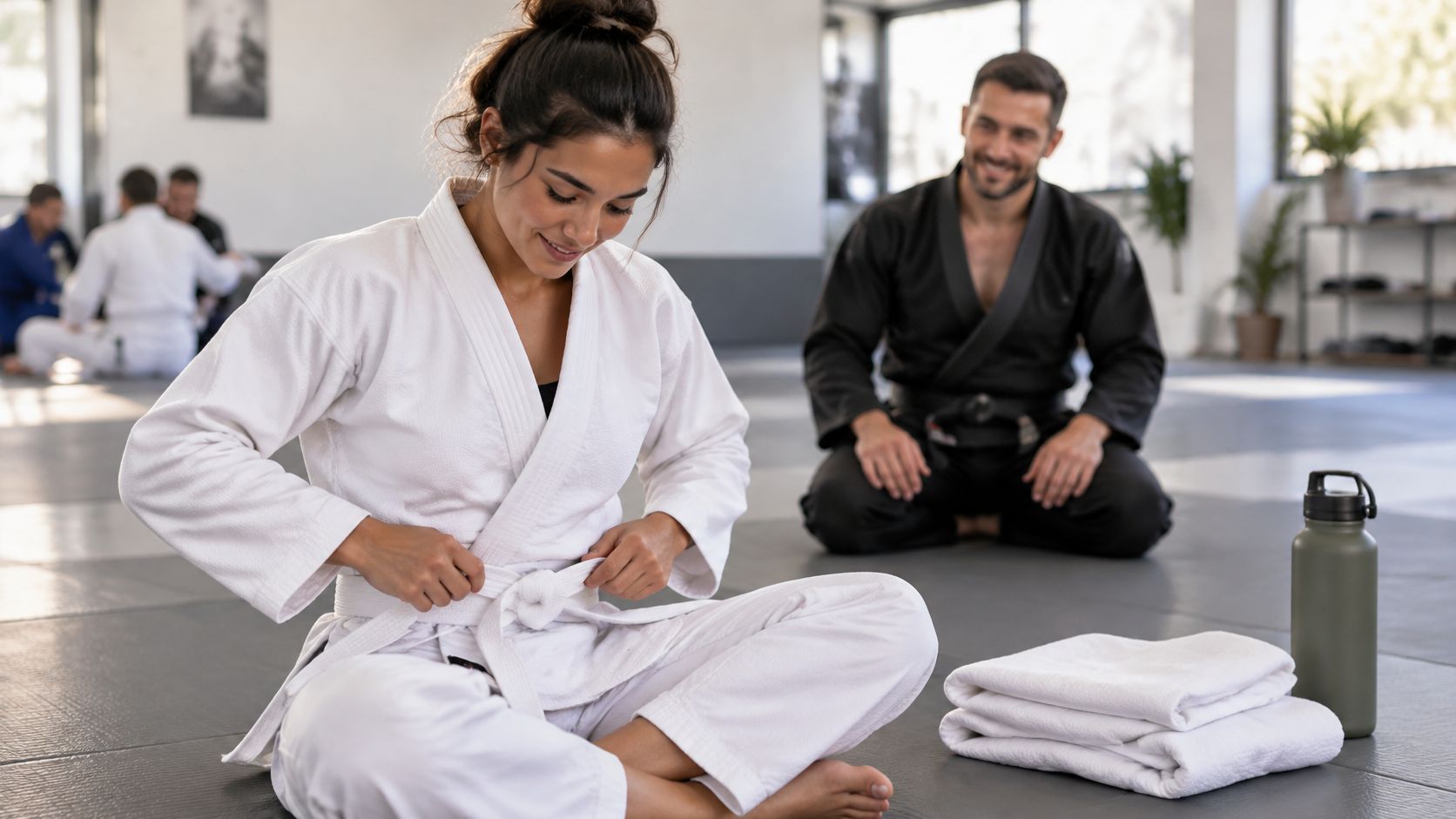
The loaner jacket they handed you at the front desk is already a size off. The sleeves stop halfway up your forearm, the pants drag on the mat, and the spare belt doesn't match anything. You still have to decide whether to buy your own uniform before the next class, and every product page is shouting about weaves and "competition legal" tags you don't understand yet.
A first gi is training equipment with a job. It has to survive grips, stay comfortable through squats and hip escapes, and meet the color rules your academy enforces. It isn't a safety device, and it isn't a personality.
The purchase that works is the one that fits after a wash, dries before the next session, and doesn't fight your shoulders.
Table of Contents
- What a Beginner Jiu Jitsu Gi Is and Why It Matters
- Gi Parts and Terms Every Beginner Should Know
- Choosing the Right Weave and Weight for Your Training
- Budget, Durability, and Academy Rules Before You Buy
- Breaking In and Caring for Your First Gi
- Kids Gis and Finding the Right Local Academy
- Your First Class Checklist and Next Steps
What a Beginner Jiu Jitsu Gi Is and Why It Matters
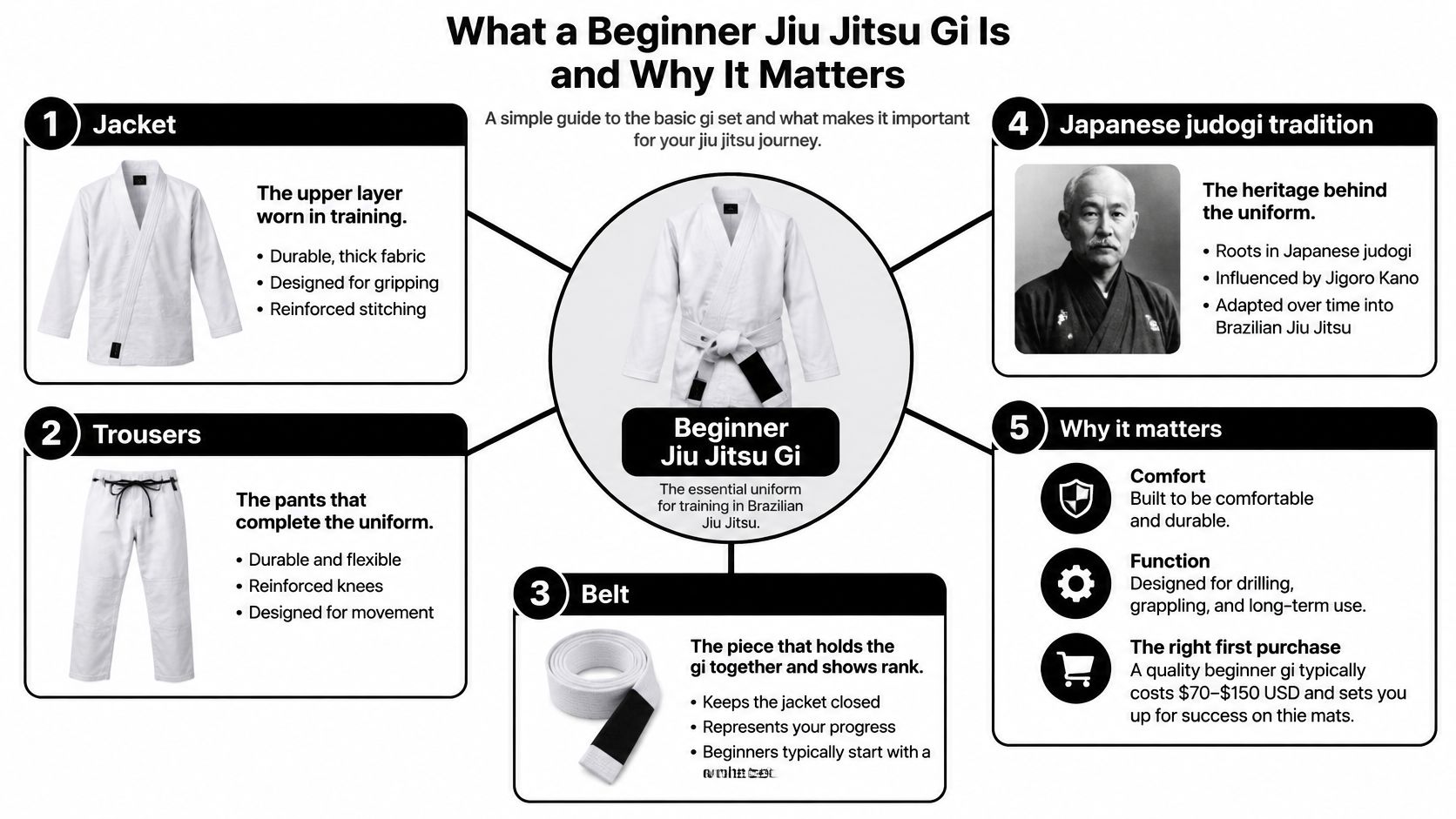
Your first gi class starts with a partner gripping your sleeve and collar. That uniform is a beginner jiu jitsu gi, a jacket, trousers, and belt made for grappling. It gives partners fabric to grip, while the cut and reinforced construction handle the pulling and movement that ordinary workout clothes are not designed for.
The gi comes from the Japanese judogi, rather than a recent sportswear trend. The history of Brazilian jiu-jitsu traces the art's roots through judo: Kanō Jigorō introduced formal belts and the gi into martial-arts training, and his student Mitsuyo Maeda brought judo to Brazil. Maeda's demonstrations and instruction contributed to the technical lineage that developed into Brazilian jiu-jitsu. The Gracie family shaped its own system, with the art generally traced to their work around 1925.
That history explains why the uniform remains useful on the mat. Jacket cloth gives training partners grips, and the fabric covers your skin against the mat. The belt keeps the jacket closed and marks rank. None of those features makes a gi an injury-prevention device. Fit, clean gear, and how often you train matter more to your day-to-day experience than choosing gi over no-gi.
What the three pieces actually do
Jacket. Partners grip the lapel, collar, and sleeves, so the jacket needs construction suited to repeated pulling. A karate gi is a poor substitute because it is not made for jiu-jitsu grips and can fail where those grips put stress on the fabric.
Trousers. They need enough room for hip escapes and knee movement, without loose fabric that catches easily when a partner controls your leg.
Belt. It closes the jacket and shows rank. Beginners start at white.
Gi classes use clothing grips; no-gi classes use a rash guard and shorts instead. Check which class you booked before buying. This gi versus no-gi comparison explains how the uniform changes the grips and feel of a round. Neither format makes training automatically safer. Choose clothes that fit the class, follow your academy's uniform rules, and keep them clean.
A first gi should hold up to grips and let you move freely. Leave fashion decisions until you know what your academy allows.
Gi Parts and Terms Every Beginner Should Know
You don't need a glossary the size of a rulebook. You need the words people use while they tug your sleeves on the mat.
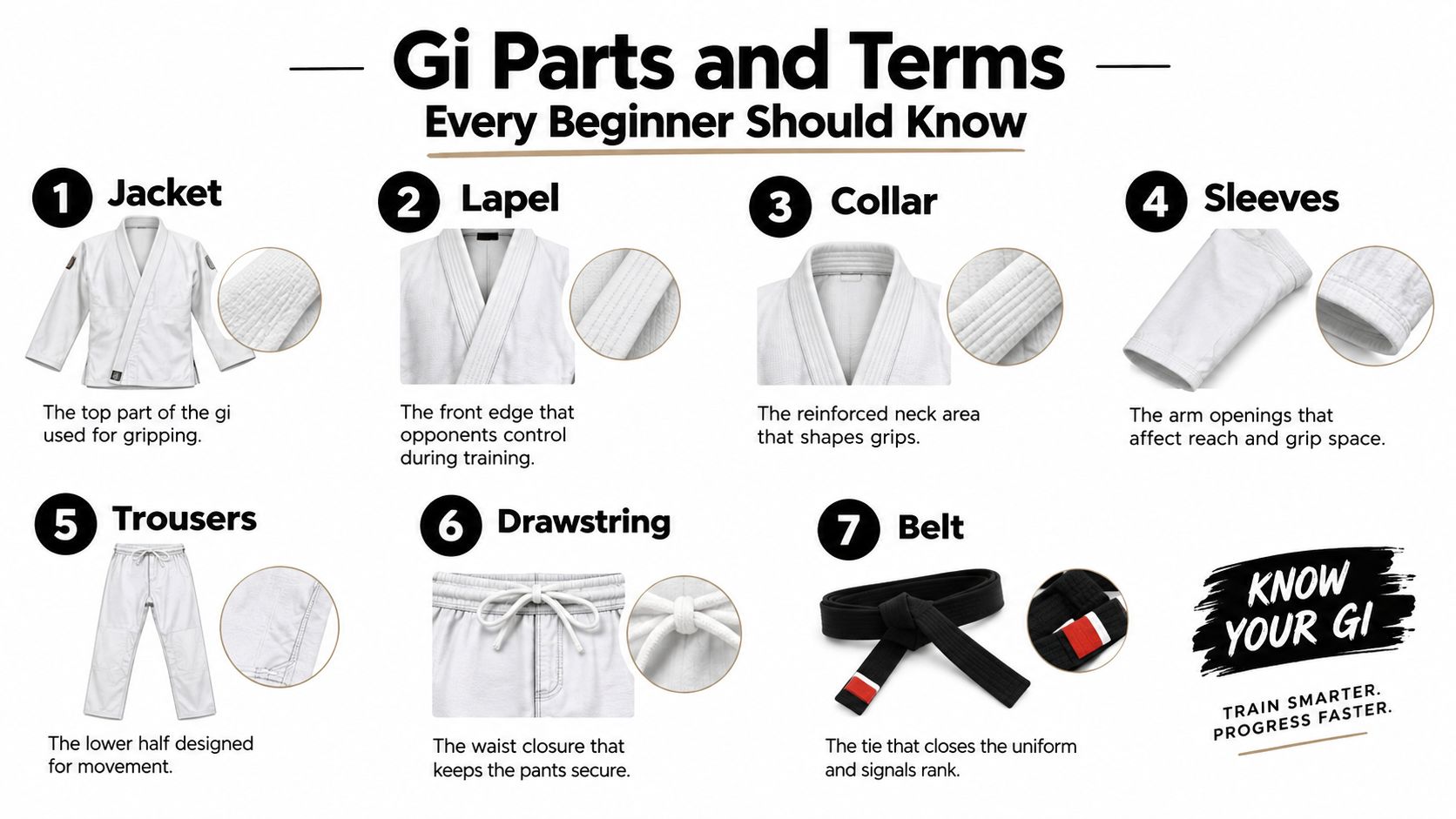
The jacket is the top. The lapel is the front edge partners control. The collar is the reinforced band around the neck that shapes those grips. Sleeves are the arm tubes, and the opening decides how much cloth someone can grab. Trousers are the pants. The drawstring keeps the waist from sliding when you bridge. The belt ties the jacket and signals rank. Patches are sewn badges. Your academy may require one, limit the size, or ban sponsor logos. Ask before you stitch anything on.
Measurements that replace a shirt size
If you might compete later, the IBJJF uniform standards are a useful baseline even for ordinary academy training.
- Fabric: cotton or a cotton-like weave, and not so thick or hard that it blocks an opponent's grips.
- Jacket length: the jacket should extend to the thigh.
- Sleeves: with the arms extended parallel to the ground, sleeves end no more than 2 centimeters from the wrist.
- Trousers: they reach to within no more than 2 centimeters above the ankle bone.
- Lapel: no thicker than 1.3 centimeters.
- Collar: 5 centimeters wide.
- Sleeve opening: 7 centimeters at full extension.
Those numbers are stricter than "it feels like my hoodie size." Academy classes often allow extra colors and designs. If an IBJJF-style event is even a maybe, stick with a conservative white, blue, or black gi and skip the heavy embroidery.
A mobility test before you pay
BJJ brands use labels like A0, A1, and A2, and those labels don't match across makers. Try the gi, or order from a brand with a real return window, and run this check.
- Squat deep. The trousers shouldn't bind the hips or the knees.
- Hip escape to each side. The jacket shouldn't ride up and stay bunched at your ribs.
- Do a technical stand-up, then pull your arms back in. Stop if a cuff restricts circulation, movement, or getting a grip back.
- Wash the gi once and recheck sleeve and trouser length. Cotton shrinks, and a cuff that was fine in the store can fail after the first cycle.
Practical rule: The gi should stay on during bridging and rolling and still let the shoulder, hip, and knee move freely. If it only looks right while you stand still in the mirror, it doesn't fit.
Choosing the Right Weave and Weight for Your Training
You finish class, pack your gi into a small apartment bag, and realize it will need to dry before your next session. Weave and weight matter most in that moment, and in how much heat and wear your training schedule brings.
Single weave is lighter and often dries overnight, a practical choice for twice-a-week training when airflow at home is limited. It can wear faster at the knees with frequent drilling, so check those panels regularly.
Double weave is thicker and tends to hold up better against hard gripping. It also traps more heat and takes longer to dry. In a warm academy, that extra weight can feel restrictive to a beginner. It makes more sense in a cooler room or for someone already training often.
Pearl weave usually lands between the two. It offers a balance of weight and durability without feeling like a winter coat, which suits many beginners who train regularly.
Fit still matters more than the weave label. Choose a gi that lets your shoulders, hips, and knees move freely without excess cloth to catch on grips. If standard clothing sizes have never been a reliable guide, start with sizing for clothes explained, then check the specific brand's measurements against a BJJ gi size chart. A size label alone is not a reliable comparison between brands.
How the common weaves compare
| Weave Type | Durability | Breathability | Drying Time | Best For |
|---|---|---|---|---|
| Single weave | Lighter wear life | High | Often overnight | Twice-a-week beginners |
| Double weave | Higher under hard grips | Lower | Longer | Frequent training in cooler rooms |
| Pearl weave | Balanced | Moderate | Moderate | Most regular beginner schedules |
What the gi does not prevent
A heavier jacket is not injury protection. A six-month study found that 59.2% of practitioners reported at least one injury, and the analysis found no predictive effect from gi preference or participation in a structured beginner program. Training frequency was positively associated with injury incidence, according to research tracked by Weill Cornell.
Choose a comfortable gi, keep your movement free, and wash it after every session. Those habits matter more than treating gi or no-gi as a safety plan. Build up training gradually and tap early. A thick collar cannot do that for you.
Budget, Durability, and Academy Rules Before You Buy
Price shows up in stitching and reinforcement, not in how serious you look in photos.
Where cheap construction fails
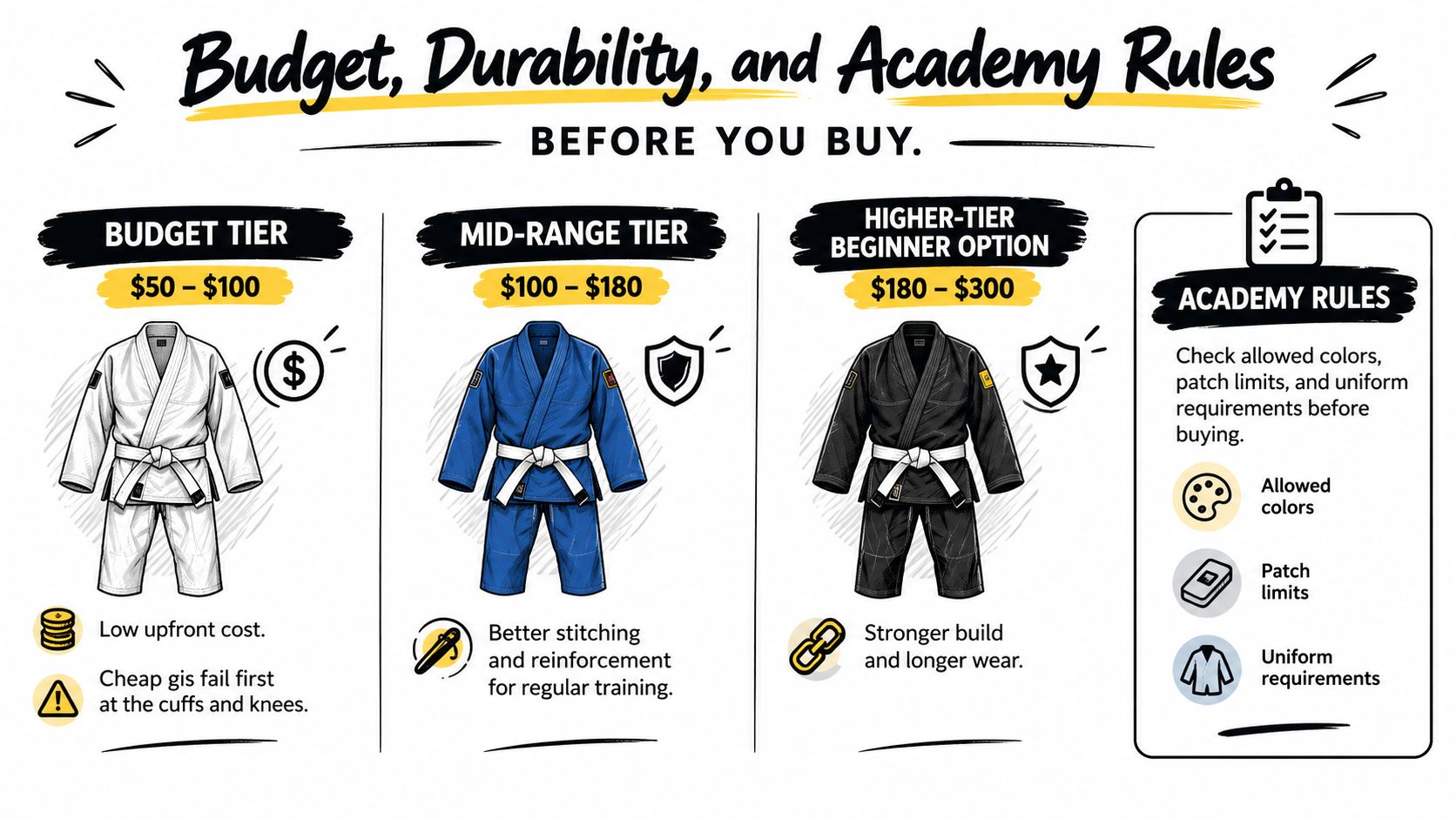
A budget gi gets you on the mat. The usual failure is the cuff or the knee, where grips and kneeling chew a thin seam first. That's acceptable for a trial month. It's frustrating when it's your only gi and you're already training several days a week.
A mid-range gi puts more thread into the collar, the sleeve openings, and the knee panels. Once you've decided to stay, this is the tier that usually survives a real schedule without turning into a repair project.
A higher-priced beginner gi adds a heavier build, sometimes with a cut aimed at competitors. You don't need that on week one unless the academy requires a specific model. Extra money doesn't buy injury protection, and it doesn't fix a bad size.
If the knee panel is a single layer of thin cloth, you'll be shopping again before your movement feels natural.
Rules to confirm before you order
Call or email the front desk. Three answers save a return shipment.
- Color policy. Some schools want white for white belts. Others allow blue and black from the first week. Unusual colors are the ones people regret.
- Patch rules. Required school patch, a size limit, or a ban on sponsor logos. Sew nothing until you know.
- Loaner policy. A single trial in a borrowed gi is smarter than buying blind, then discovering the schedule doesn't fit your life.
Once you own the gi, look at seams and reinforced knee panels every week. Replace it when cuffs or knees go loose. A small tear at the sleeve opening grows the first time someone grips hard, and a snag is a problem for your partner as well as for you.
If you want to see how a properly built uniform should sit before you click buy, this short walkthrough is worth the time:
The other cheap mistakes are owning one gi for back-to-back days and leaving it wet in a closed bag. Those habits cost more than the gap between a budget gi and a mid-range one.
Breaking In and Caring for Your First Gi
A new gi feels like cardboard. Don't soften it by yanking the collar in the parking lot. Wash it, train in it, and wash it again. Cotton relaxes with cycles, not with force.
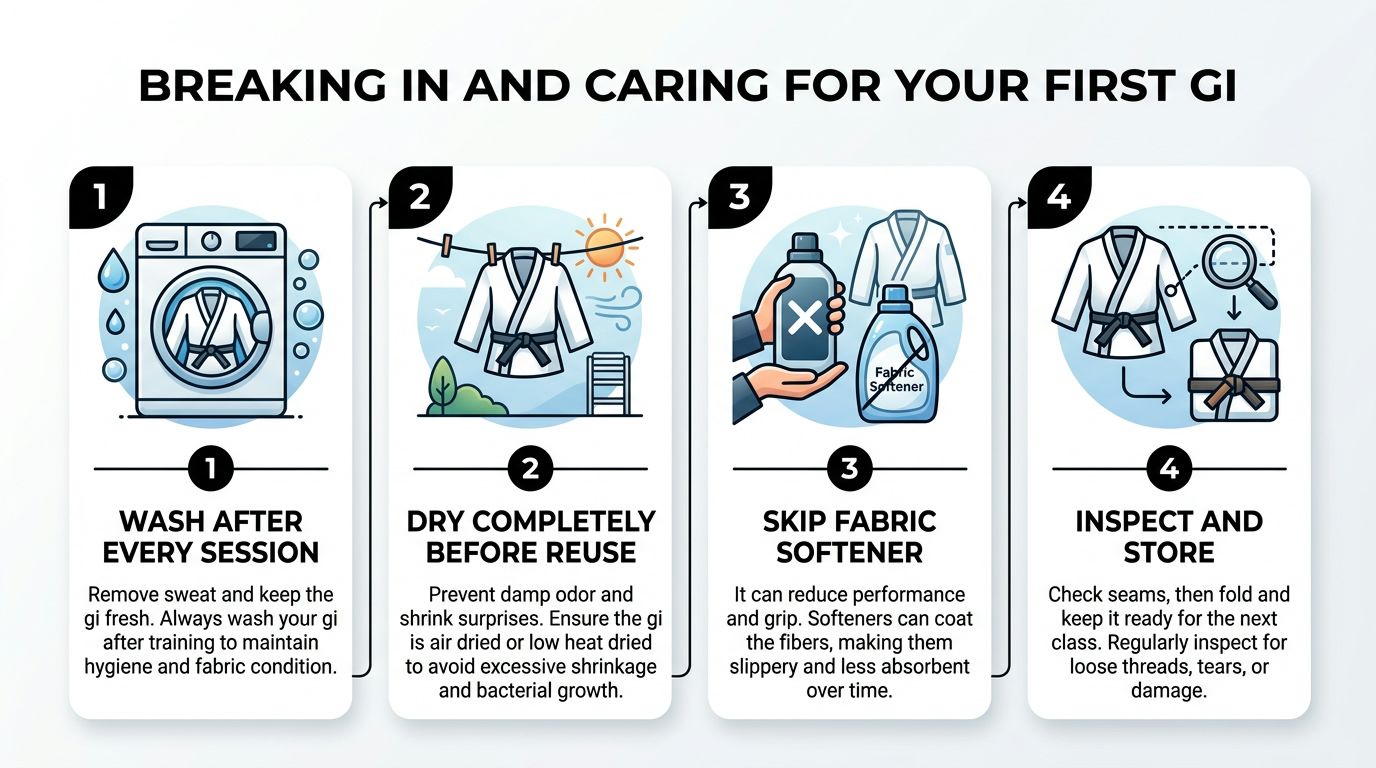
The cycle that keeps you mat-ready
Wash after every session. Sweat sits in the collar and the pants, and your partner is gripping that cloth an inch from their face.
Dry it completely before you reuse it. Hang the jacket with space around the lapel so the thick part dries. A closed bag is how odor starts.
Skip fabric softener. It can reduce fiber performance and change how the collar feels in a grip. Detergent is enough.
Inspect, then store it dry. Check seams, fold the gi, and keep it out of the same pocket as wet rash guards.
Anyone training on consecutive days needs a second gi. Damp equipment should never go back on the mat. The same bag problem shows up in other gear-heavy sports, and a practical guide to keeping hockey gear fresh and organized is a useful parallel if your gym bag already smells like last Tuesday.
Why the routine isn't optional
Injury studies don't measure bacteria, but they do show how much contact this sport involves. One study reported that 91% of participants had sustained at least one training injury. Another large survey recorded 1,052 injuries among 784 athletes, an incidence of 308 injuries per 1,000 athletes per year, in work indexed through this sports-medicine review. Clean, dry cloth and intact stitching won't erase that risk. They do cut avoidable friction, snags, and hygiene problems while the jacket still has its shape.
Loose cuffs, thinning knees, and a fraying lapel are replacement signs. They aren't "one more month" signs.
Kids Gis and Finding the Right Local Academy
A child should be able to squat and reach overhead without the gi pulling tight or hanging loose. Parents and adults choosing a new academy face a similar practical test: find a uniform that fits the person training, and a room that gives beginners time to learn.
Gis for growing athletes
For kids, size the gi to their current build. Long, loose sleeves give training partners extra fabric to grip, while tight cuffs can restrict movement. A slightly roomy fit is useful, but an oversized gi that trips a child is not. Check the fit as they move, not just while they stand still.
The hygiene routine is straightforward: wash the gi after class, keep nails short, and leave jewelry at home. Ask whether the academy lends uniforms and how those gis are cleaned between students. A clean, properly fitting loaner is a better first experience than a damp shared jacket.
Ask what a children's class includes. Look for a warm-up, coached drilling, and a clear explanation of whether live rounds are appropriate for that age group. Beginners should have instruction suited to their experience, not be dropped into an unstructured open mat.
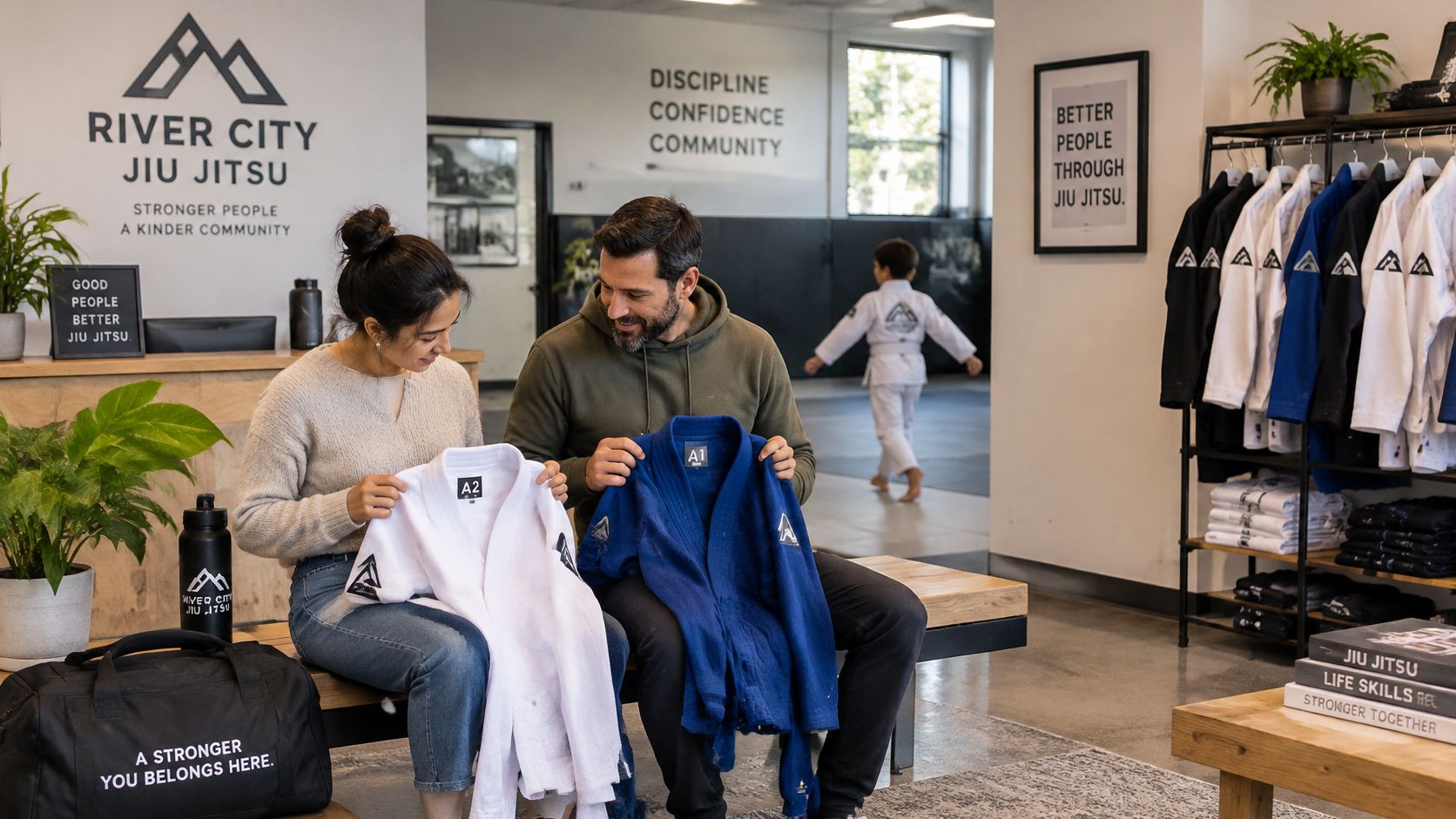
What adult beginners should ask
A systematic review of 2,847 jiu-jitsu practitioners found a high prevalence of musculoskeletal injuries. The knee, chest and rib region, and shoulder were among the areas most often affected, and injuries were reported more commonly among beginners, according to this orthopedic review. That evidence is a reason to ask about coaching and pace, not to treat a gi as protection.
Ask when beginners start live rounds, how coaches manage intensity, and what the academy does when someone gets hurt. The gi changes how partners grip and control each other. It does not prevent injury. Fit, clean training clothes and an academy that matches the pace to your experience matter more than choosing gi over no-gi.
Cost and convenience belong in the same decision. Use compare gym membership costs to assess the recurring fee, then check whether the class schedule fits your week. A lower price is little help if you cannot attend.
Brazilian Jiu-Jitsu Academy Finder offers academy listings to help you compare local options. Use jiu jitsu for beginners near you to build a shortlist, then contact schools directly about beginner classes, uniform rules, and suitable training times.
Your First Class Checklist and Next Steps
The front desk says you can borrow a gi for class, but you are unsure what to bring or what to ask. Keep it simple: arrive clean, follow the academy's trial rules, and check uniform requirements before buying. A gi does not prevent injuries. Fit, hygiene, and a training pace you can recover from matter more than gi versus no-gi.
What to pack
- A clean, dry gi, if the academy requires one. For a trial, ask whether athletic clothes are acceptable.
- A water bottle. You will want it after drilling and rounds.
- Flip-flops for walking off the mat. Keep bare feet on the mats, not in the bathroom.
- Short nails and no jewelry. Nails can scratch, and jewelry can catch during grips.
- A willingness to tap early. Tap when a joint lock or choke is on. Protecting your body matters more than trying to tough it out.
What to ask at the desk
Check which patches and colors are allowed, whether beginner classes are separated from advanced rounds, and when new students start sparring. If you are enrolling a child, ask whether the academy has a kids' track. For your first gi, ask staff to check the fit against the uniform rules used at that academy, including any IBJJF requirements if you plan to compete. Sleeve and pant length matter more than a brand name.
Choose a schedule you can keep, and make sure you can wash your gi between sessions. Two or three classes a week is a reasonable starting point for many beginners. Add sessions only when you are recovering well.
Pick one academy this week and contact the front desk. Ask about a trial class and uniform rules before you buy. A clean borrowed gi is better than delaying training for the perfect one.
Share this article