
7 Benefits of Cross-Training in BJJ
Boost endurance, strength, mobility, and fight IQ while reducing injuries and plateaus by cross-training BJJ with wrestling or Muay Thai.
Written by BJJ Academy Finder Editorial Team
7 Benefits of Cross-Training in BJJ
Cross-training in Brazilian Jiu-Jitsu (BJJ) means practicing other martial arts like Muay Thai or Wrestling or training at different gyms to improve your skills. This approach helps you become a better-rounded martial artist by addressing weaknesses and expanding your capabilities. Here's what you'll gain:
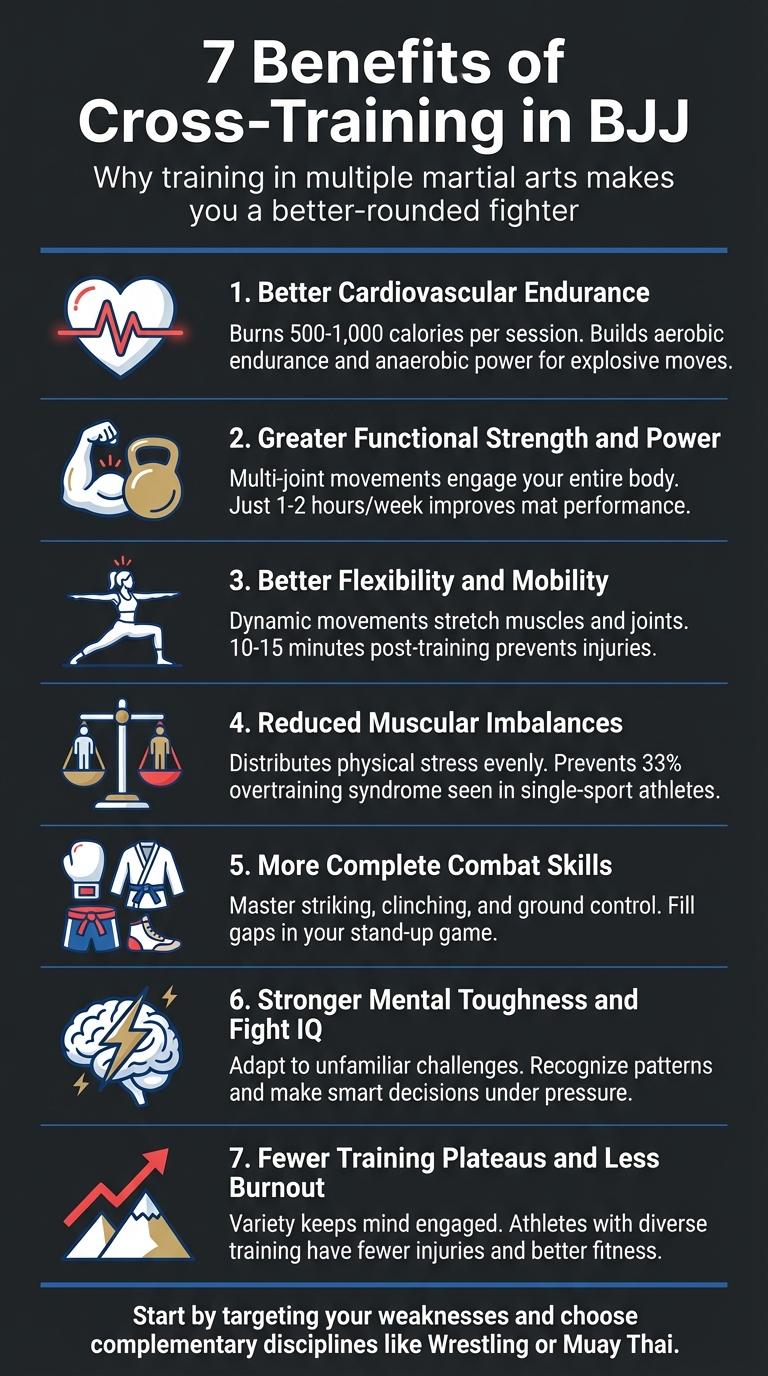
- Improved Endurance: Boost your aerobic and anaerobic capacity for longer, more intense matches.
- Functional Strength: Develop full-body power through multi-joint movements useful in combat.
- Flexibility and Mobility: Enhance joint health and range of motion with diverse motion patterns.
- Balanced Muscles: Avoid overuse injuries by working underused muscle groups.
- Combat Skills: Learn striking, takedowns, and clinching to complement ground fighting.
- Mental Toughness: Build resilience and quick decision-making under pressure.
- Avoid Plateaus: Stay motivated and prevent burnout with varied training styles.
To get started, focus on your weak areas, choose disciplines that complement BJJ, and ensure proper recovery. By doing so, you'll sharpen your skills and become more effective in both training and competition.
7 Key Benefits of Cross-Training in Brazilian Jiu-Jitsu
Benefits of Cross Training At Other BJJ Gyms Ft. BJJ Brown Belt Drea Santos
sbb-itb-d583f1e
1. Better Cardiovascular Endurance
Brazilian Jiu-Jitsu (BJJ) pushes your cardiovascular system to its limits, demanding both aerobic endurance for long matches and anaerobic power for explosive moves like sweeps and submissions. A single BJJ training session can burn anywhere from 500 to 1,000 calories, depending on the intensity, making it one of the most physically demanding martial arts around [3]. By combining different types of training, you can develop a well-rounded cardiovascular system capable of handling varied energy demands.
Adding other martial arts to your routine can amplify these benefits. For instance, Muay Thai enhances rhythmic endurance and clinch stamina, while Wrestling builds explosive anaerobic strength through repeated takedown attempts [1]. This mix of training styles forces your body to adapt to different intensity levels, improving your overall conditioning.
The stop-and-go nature of grappling also improves heart rate variability (HRV), which helps you recover faster and perform better during long training sessions [3].
To meet the energy demands of BJJ, consider incorporating high-intensity interval training (HIIT) with 30-second sprints and steady-state cardio like swimming or cycling for 30–60 minutes. These exercises mimic the intensity of matches [3][5]. For a sport-specific challenge, try "Shark Tank" drills - rolling with fresh partners while fatigued. This method builds endurance and keeps you sharp under pressure [3][5].
Additionally, practicing nasal breathing and swimming can help improve your lung capacity, keeping you calm and controlled, even in high-stress situations [3][4].
2. Greater Functional Strength and Power
Brazilian Jiu-Jitsu (BJJ) isn’t about isolated movements like those you might find in traditional gym exercises. Instead, it thrives on integrated, multi-joint actions that engage your entire body. From explosive takedowns to controlling scrambles, BJJ demands dynamic, full-body engagement. Cross-training in disciplines like wrestling and judo complements this perfectly, as both focus on building strength and power through similar whole-body movements.
"Wrestling focuses on takedowns, control, and maintaining a dominant position. It's instrumental in developing strength, explosiveness, and the ability to dictate where the fight takes place." - Bendu Academy [1]
Functional training stands out because it mirrors real-life and combat scenarios. Unlike traditional weightlifting, which isolates specific muscles, functional training emphasizes multi-directional movements like twisting, lateral shifts, and dynamic transitions. These mimic the unpredictable nature of a live roll. For example, Danny Clark, who earned a bronze medal while representing Team USA at the UWW World Grappling Championships in 2012, credited his success to a strength program centered on four key movements: hinge (deadlifts), squat (front squats), press (overhead press), and pull (weighted pull-ups) [8].
Even dedicating just one to two hours a week to functional strength training can lead to noticeable improvements on the mat [7][8]. Exercises that target hip power, such as kettlebell swings and deadlifts, are particularly effective since the hips drive many BJJ techniques, from sweeps to escapes. For grip strength, which is essential for controlling opponents, try Gi pull-ups (using a Gi draped over a pull-up bar), farmer's carries, and rope climbs [8][9].
Research backs this up. A 2021 systematic review found that functional training enhances speed, strength, power, balance, and agility [6]. The secret lies in training movements rather than isolating muscles. Incorporating exercises like farmer’s walks or sandbag carries helps build stabilizing strength for controlling opponents. Adding sprint intervals under 30 seconds can develop the explosiveness needed for transitions and takedowns [7].
Ultimately, this type of functional strength is what fuels your performance in live rolls and prepares you for the unpredictable nature of combat. It’s a cornerstone of BJJ success and lays the groundwork for reaping even more benefits from cross-training.
3. Better Flexibility and Mobility
Brazilian Jiu-Jitsu (BJJ) takes your body through movements that most traditional workouts simply don’t mimic. It involves twisting, extending, and engaging your hips, shoulders, and spine in ways that challenge both flexibility and mobility. While flexibility is about how far your muscles can stretch, mobility focuses on how smoothly your joints move through their range. BJJ enhances both by using dynamic, flowing movements rather than static holds. Cross-training builds on this by introducing even more diverse motion patterns.
One of the great things about cross-training is how it spreads physical stress across your body. By mixing in activities like wrestling or Muay Thai, you avoid repetitive strain from doing the same motions week after week. This variety doesn’t just keep your training fresh - it also lowers the risk of overuse injuries. According to research published in the Journal of Strength and Conditioning Research, athletes who practice multiple sports tend to have better overall fitness and fewer injuries compared to those who stick to just one discipline [1].
"Yoga emphasizes static stretches, whereas BJJ uses dynamic movements that naturally stretch muscles and joints for real-life activity." - Hamptons Jiu-Jitsu [10]
The American College of Sports Medicine recommends doing flexibility exercises two to three times per week to maintain healthy joints [10]. In BJJ, movements like guard retention stretches work your hamstrings, hip escapes improve joint mobility, and defending armbars enhances shoulder flexibility. Even bridging exercises engage your core while increasing flexibility in your hips and lower back.
Adding cross-training to your routine can take these benefits even further. For instance, incorporating yoga provides focused recovery and deep stretching, which complements the dynamic resistance training in BJJ. The key is staying consistent, not pushing too hard. Spend 10 to 15 minutes after class on targeted stretches like the butterfly stretch for your hip flexors or lying spinal twists for your lower back [11]. If you’re introducing a new activity, ease into it gradually to give your joints time to adjust without risking overload.
4. Reduced Muscular Imbalances
Once you’ve worked on endurance, strength, and mobility, it’s time to tackle muscular imbalances, which can significantly affect your overall performance. Brazilian Jiu-Jitsu (BJJ) often leads to these imbalances because of repetitive grips and pressing motions. For example, your chest, shoulders, and hip flexors can become overly tight and strong, while the muscles in your posterior chain - like your back and glutes - may lag behind. This imbalance not only limits your performance but also increases your risk of injury.
"By engaging in multiple disciplines, practitioners distribute physical stress more evenly across their bodies, reducing the risk of overuse injuries commonly seen in athletes who only train in a single sport." - Bendu Academy [1]
Adding complementary disciplines like wrestling and Muay Thai can help offset these imbalances by introducing new movement patterns. Wrestling emphasizes explosive takedowns and gripping positions that differ from BJJ. Muay Thai incorporates striking mechanics and clinch work, which activate muscles from unique angles. Strength training is another key tool - it acts as "loaded stretching", helping to lengthen and strengthen muscles under resistance. To counteract BJJ's pressing-heavy movements, include pulling exercises like rows to build a stronger upper back [8].
Chelsea Neal, an Ironman Triathlete, highlights the importance of balanced training:
"The knowledge and instruction from the trainers is a huge necessity to incorporate into my training plan to improve my strength, power, mobility, and to prevent muscular imbalances and/or injuries" [12]
Overtraining is a common issue, with studies showing that about 33% of elite athletes experience overtraining syndrome from repeatedly stressing the same muscle groups [13]. To avoid this, focus on functional movement patterns - movements that mimic real-life or sport-specific actions. Prioritize exercises like deadlifts, squats, pushes, and pulls. Incorporate unilateral movements, such as single-leg squats or single-arm rows, to ensure both sides of your body are equally strong and no side is overcompensating.
A smart approach is to schedule strength sessions on the same days as intense BJJ training. This allows you to fully recover on rest days, preventing chronic fatigue while maintaining muscular balance. By integrating these functional movements and cross-training methods, you’ll build a more balanced and resilient body, ready to handle the demands of BJJ and beyond [8][14].
5. More Complete Combat Skills
While Brazilian Jiu-Jitsu (BJJ) excels in ground fighting, most real-life confrontations start on your feet. Cross-training in other disciplines helps you become skilled in striking, clinching, and ground control. Wrestling equips you with dynamic takedowns to control where the fight goes, while Muay Thai or boxing sharpens your stand-up game and clinch techniques. This combination shapes you into a versatile martial artist, blending theoretical knowledge with real-world application [1].
Another key lesson from cross-training is understanding how strikes change the game. Positions that feel secure in sport BJJ can quickly become dangerous when punches are introduced. Henry Akins, a BJJ black belt, highlights this:
"BJJ should be trained at least once a week with strikes to make fighters aware of dangerous positions" [2].
This kind of training helps weed out flashy techniques that might work in a controlled setting but leave you exposed in a real self-defense situation.
Cross-training also sharpens positional awareness and hones your submissions under pressure. Facing aggressive opponents teaches you which moves hold up against resistance. For example, chokes are often more dependable than joint locks when dealing with someone who can endure pain to escape.
The blend of disciplines creates a powerful synergy. A wrestler who learns BJJ gains the tools to finish a fight after a takedown. On the flip side, a BJJ practitioner who trains in wrestling develops the strength and technique to secure takedowns in the first place. As Bendu Academy aptly states:
"The more you know, the less you fear" [1].
6. Stronger Mental Toughness and Fight IQ
Cross-training doesn't just enhance your physical abilities - it also strengthens your mental game, which is crucial in unpredictable combat situations. Stepping into new disciplines like boxing or wrestling forces you to adapt to unfamiliar challenges. Whether you're figuring out how to handle a jab or defend against a takedown, you're constantly pushed to stay composed under pressure. This repeated exposure builds the mental resilience you need to keep pushing forward, even when your submissions are countered or your takedowns fail [2][15].
Beyond resilience, cross-training sharpens your ability to think tactically. It helps you spot patterns and openings more quickly by exposing you to a variety of strategies from different opponents. As Fightstyle explains:
"Fight IQ is about recognizing patterns and making smart decisions under pressure." [15]
This ability to recognize patterns turns you from someone who relies on specific techniques into a fighter who can adapt to any situation [15].
Another benefit of cross-training is that it reveals what truly works in high-pressure scenarios. Mixing Brazilian Jiu-Jitsu (BJJ) with striking or facing aggressive opponents forces you to test techniques under realistic conditions. This process helps you identify which moves are reliable and which ones might leave you exposed. It also fosters "mat aggression" - the relentless determination to pursue submissions, even when faced with setbacks [2]. Over time, this trial-and-error approach boosts your overall cognitive sharpness.
On top of that, learning new systems keeps your mind engaged and helps you avoid training plateaus. Studies show that athletes who participate in a variety of sports tend to have stronger cognitive skills than those who stick to just one [1]. In short, cross-training not only toughens you up but also fine-tunes your ability to make smart, real-time decisions.
7. Fewer Training Plateaus and Less Burnout
Sticking to just one discipline can lead to mental fatigue and physical exhaustion. Cross-training shakes things up by adding variety that keeps your mind engaged and eager to learn. This variety is key to staying motivated over the long haul. By incorporating movements and strategies from disciplines like wrestling, you avoid the repetitive grind that often causes plateaus. Instead, your brain stays sharp and curious, fueling consistent progress.
"The variety introduced through cross-training keeps the mind engaged and learning, which is essential for long-term development and enthusiasm in martial arts." - Bendu Academy [1]
Another benefit? Cross-training helps reduce overuse injuries. A study in the Journal of Strength and Conditioning Research found that athletes who diversify their training have fewer injuries and better overall fitness than those who specialize in just one sport [1]. By mixing up movement patterns, you give overworked muscles and joints a break, which helps you maintain steady progress without setbacks.
On top of that, cross-training is a great way to break through skill plateaus. It equips you with fresh tools to tackle old challenges. For example, if you're struggling with ground transitions in Brazilian Jiu-Jitsu (BJJ), adding wrestling to your routine can introduce new approaches. Wrestling’s focus on top control and explosive takedowns might be just what your BJJ game needs. Training with practitioners from other disciplines - like MMA fighters or judoka - pushes you out of your comfort zone and tests your techniques under pressure [2].
To fully reap the benefits of cross-training without risking burnout, ease into new disciplines gradually and make recovery a priority. Target specific weaknesses, such as takedowns or stand-up defense, and allocate your cross-training time accordingly. While cross-training is demanding, balancing it with proper rest ensures it remains a tool for growth rather than a source of exhaustion [1].
How to Get the Most from Cross-Training
Approaching cross-training with a clear plan is key. Start by identifying your weakest areas. If takedowns are your Achilles' heel, focus on wrestling. If your stand-up defense feels shaky, Muay Thai can sharpen your striking and clinch game. Wrestling adds the takedowns and control that Brazilian Jiu-Jitsu (BJJ) sometimes lacks, while Muay Thai - dubbed the "Art of Eight Limbs" - teaches punches, kicks, elbows, and knees, which flow naturally into grappling situations.
Introduce one new discipline at a time to complement your BJJ training. Dedicate specific days to this additional training while keeping your recovery in mind to avoid overtraining. Pay attention to how your body feels and adjust the intensity of your sessions as needed.
Choosing the right gym is crucial. Seek out facilities that offer multiple disciplines under one roof and have instructors who understand how to blend different styles effectively. Tools like the Brazilian Jiu-Jitsu Gyms Directory can help you locate academies by program and location, making it easier to find places that offer wrestling, Muay Thai, or MMA alongside BJJ. Before committing, verify instructor credentials - ask about their black belt lineage and check for IBJJF affiliation to ensure rank legitimacy. Many gyms offer trial periods (ranging from a single class to a full month), so take advantage of these opportunities to gauge the environment and fit.
Once your cross-training routine is in place, test your skills in realistic scenarios. Incorporate light striking into training to identify vulnerabilities and refine your techniques for practical use. Training with MMA practitioners can also prepare you for higher-pressure situations, helping you build endurance and adapt to fast-paced scrambles. This method ensures that new skills integrate smoothly into your BJJ game.
Finally, focus on specific skill gaps during your sessions. For instance, if your takedown defense needs improvement, dedicate two days a week to wrestling while maintaining your regular BJJ schedule. If flexibility is a limiting factor for your guard retention, consider yoga sessions aimed at hip mobility and recovery. By targeting these areas, cross-training becomes a powerful tool to enhance your BJJ practice without draining your time or energy.
Conclusion
Cross-training can take your BJJ skills to the next level. By improving endurance, strength, and mobility, it helps reduce the risk of injuries. Research even suggests that athletes who engage in diverse training are less likely to suffer overuse injuries compared to those who focus on just one sport [1].
But the benefits don’t stop at the physical level. Cross-training sharpens your mental edge too. Incorporating disciplines like wrestling or Muay Thai can help you address weak spots in your takedowns or stand-up defense. Plus, the variety of training styles and unpredictable scenarios build mental toughness. Learning new techniques and strategies keeps your mind engaged, helping you break through plateaus and avoid burnout.
As Bendu Academy wisely notes:
"The more you know, the less you fear. In the journey of martial arts, knowledge is not just power - it's also protection, skill, and wisdom" [1].
Start by adding a discipline that complements your weaknesses and ensure you prioritize recovery. Over time, both your body and mind will adapt, making you a more well-rounded and resilient martial artist. If you're looking for academies that offer this type of well-rounded training, check out the Brazilian Jiu-Jitsu Gyms Directory.
FAQs
How often should I cross-train without overtraining?
To keep from overtraining, try cross-training about 3–4 times per week, making sure to prioritize rest and recovery. Pay attention to how your body feels - this can help you avoid injuries and burnout. Striking the right balance between intense workouts and downtime is crucial for staying on track with your goals and supporting your overall health.
Which discipline best complements my BJJ weaknesses?
Wrestling pairs perfectly with Brazilian Jiu-Jitsu (BJJ) by sharpening explosive takedowns and boosting top control. These abilities tackle common challenges in BJJ, like starting takedowns effectively and holding dominant positions.
How do I choose a legit cross-training gym in the U.S.?
To find a trustworthy cross-training gym, start by looking for one that offers a variety of martial arts, such as Brazilian Jiu-Jitsu (BJJ), Muay Thai, or wrestling. Pay close attention to the instructors' credentials - experienced and qualified coaches make all the difference. Online reviews and the gym's overall reputation can also provide valuable insights.
Take the time to visit the gym in person. Watch a class, chat with the instructors, and get a feel for the environment. It's crucial that the location, schedule, and atmosphere align with your personal goals and needs.
For a more streamlined search, you can use resources like the Brazilian Jiu-Jitsu Gyms Directory, which lists reputable gyms across the United States.
Related articles
Share this article