
BJJ Rules and Scoring: Ultimate Guide
Compare IBJJF, ADCC, and NAGA rules, scoring, penalties, and match lengths to tailor your competition strategy.
Written by BJJ Academy Finder Editorial Team
BJJ Rules and Scoring: Ultimate Guide
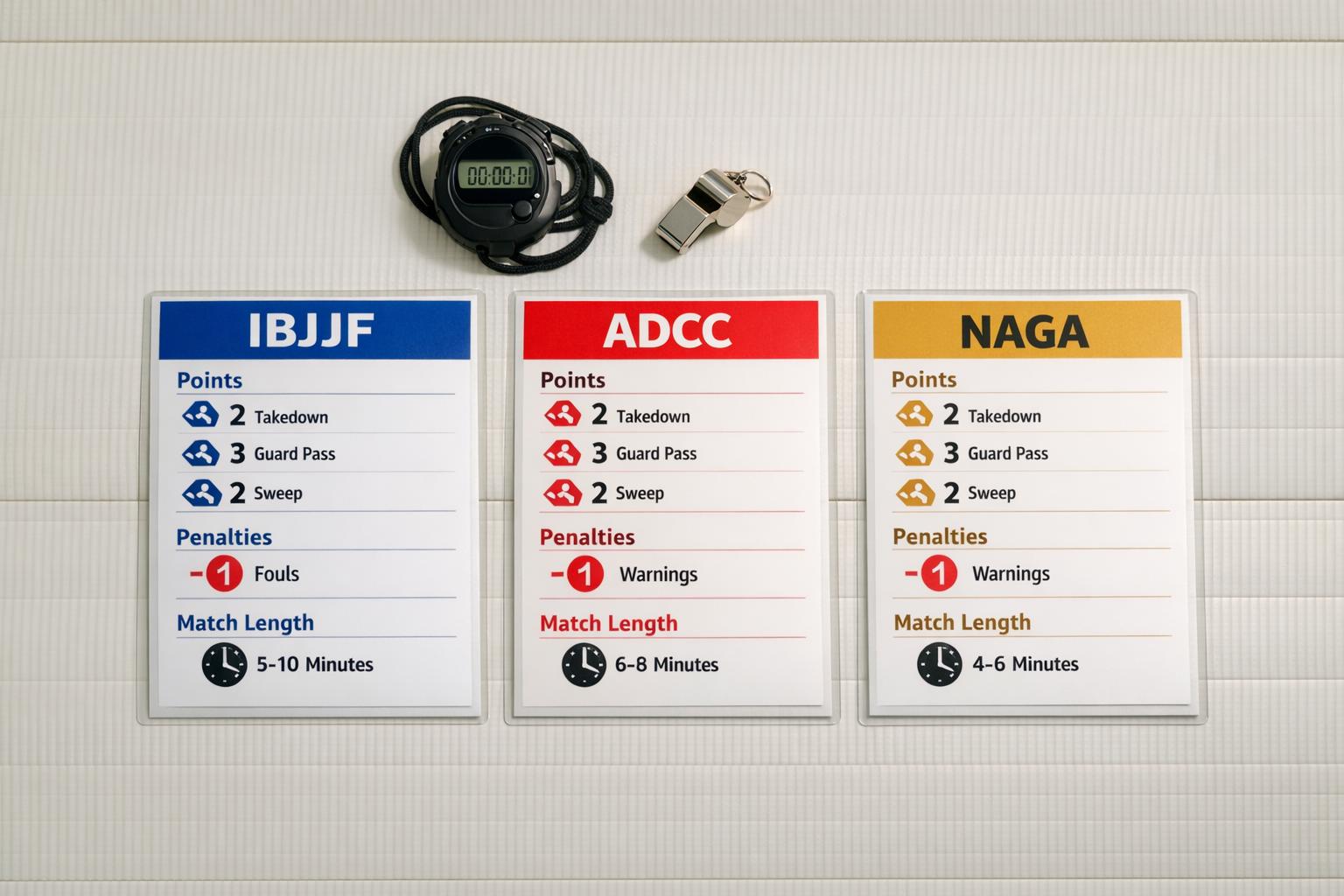
Understanding Brazilian Jiu-Jitsu (BJJ) rules and scoring is crucial for competing effectively. Whether you're aiming for submissions or accumulating points, knowing the nuances of different competition formats can give you a clear edge. Here's what you need to know:
- Winning Methods: Matches can be won by submission, points, or referee decisions.
- Scoring Basics: Points are awarded for dominant positions (e.g., mount, back control) and actions like takedowns, sweeps, and guard passes.
- Key Organizations:
Each organization has unique rules for penalties, illegal moves, and match durations, so preparation is essential. For example, IBJJF matches emphasize stability, while ADCC encourages aggressive submissions. Success often depends on balancing control with submission attempts.
Quick Tip: Always review the specific ruleset of the tournament you're entering and train accordingly. If you're looking for a place to practice these rules, find a BJJ gym nearby to start your training. Missteps like failing to hold positions for 3 seconds or pulling guard improperly can cost you points or even the match.
IBJJF Rules Explained: How Points, Penalties, and Progression Really Work in BJJ by Fabiano Papel
sbb-itb-d583f1e
IBJJF Rules and Scoring System
The International Brazilian Jiu-Jitsu Federation (IBJJF) sets the benchmark for BJJ competitions worldwide. Their rules focus on positional control and technical precision, rewarding athletes who maintain dominant positions while creating opportunities for submissions.
How Points Are Awarded
Points in IBJJF matches are based on the level of control achieved during the fight. The most dominant positions, back control and full mount, earn 4 points each because they offer the highest potential for submissions. Guard passes are worth 3 points, while takedowns, sweeps, and knee on belly each award 2 points.
To score, competitors must hold the position for at least three seconds (the 3-second rule). For back control, both heels must be inside the opponent’s thighs (hooks) or a body triangle must be secured. For mount, both knees must be on the mat while sitting on the opponent's torso.
One key rule is the point reset rule: you cannot score for the same position twice in a row without transitioning or losing the position first. Additionally, if you secure a scoring position while caught in a submission - like mounting an opponent who has you in a guillotine - points are awarded only after you escape the submission threat.
Alongside scoring, competitors must adhere to the IBJJF’s guidelines for legal techniques.
Penalties and Illegal Moves
The IBJJF enforces a four-step penalty system: (1) a verbal warning, (2) an advantage awarded to the opponent, (3) 2 points to the opponent, and (4) immediate disqualification, regardless of the match score or time remaining.
Common penalties include:
- Stalling: Holding a position without attempting to advance for over 20 seconds.
- Illegal grips: Grabbing inside the opponent’s gi sleeve or pant leg.
- Fleeing the mat: Intentionally leaving the fighting area to avoid a technique.
- Guard pulling without a grip: Dropping to guard without first securing a grip on the opponent.
If the referee signals "LUTE" (fight), it’s a warning to remain active. Competitors must engage visibly within 20 seconds or risk a penalty.
Certain actions result in immediate disqualification, such as slams, striking, neck cranks, scissor takedowns, and unsportsmanlike behavior. Youth divisions have stricter rules - techniques like heel hooks, leg reaping, and some guillotine variations are banned and lead to instant disqualification.
Match Length by Belt Level
Match durations vary depending on the competitor’s belt level. For adults:
- White belts: 5 minutes
- Blue belts: 6 minutes
- Purple belts: 7 minutes
- Brown belts: 8 minutes
- Black belts: 10 minutes
Youth matches are shorter, typically lasting 2 to 5 minutes based on age and belt level.
Matches can end early through submission, referee stoppage for safety, or disqualification. In cases where points are tied, advantages - awarded for near-successful moves like almost completing a sweep or forcing a strong defensive reaction - serve as the tiebreaker.
ADCC Rules and Scoring System

The Abu Dhabi Combat Club (ADCC) takes a distinctive approach to grappling competitions, emphasizing submissions over positional control. Unlike the IBJJF, which rewards positional dominance, ADCC's ruleset is designed to level the playing field for practitioners of various grappling styles, including Brazilian Jiu-Jitsu, wrestling, judo, and sambo.
ADCC Point System
ADCC matches are divided into two phases, creating unique strategic dynamics. In the first half of the match, no points are awarded - only submissions matter. This phase encourages competitors to take risks and attempt finishes without fear of losing points for failed transitions. Once the second half begins, the standard point system is applied:
- 3 points for passing guard or achieving back mount.
- 2 points for mount, knee-on-stomach, takedowns, and sweeps.
- 4 points for clean takedowns or sweeps that result in pinning the opponent.
To earn points, competitors must maintain positions according to ADCC's timing rules. Instead of awarding advantages, ADCC penalizes passivity with negative points. For example, pulling guard during the second half or fleeing the mat results in a -1 point deduction, with further penalties for stalling or avoiding engagement. If a match ends in a tie, it goes to sudden-death overtime, where the first point or submission decides the winner.
In ADCC World Championship finals, matches last 20 minutes, with the first 10 minutes operating under the no-points rule.
"Submission is king. It does not matter how many points your opponent is ahead of you, you make them tap - you win." - Rational Badger [3]
ADCC Penalties and Banned Techniques
ADCC enforces penalties to keep the action aggressive and dynamic. The most common penalty is the -1 for guard pulling, which only applies during the second half when points are in play. If you plan to pull guard, it’s best to do so in the point-free first half to avoid deductions.
ADCC also stands out by allowing slamming, but only to escape a locked submission. Slamming as a takedown or to gain position is not permitted. Additionally, ADCC allows techniques like heel hooks and twisters at the Professional and Advanced levels, making it more permissive with leg locks compared to IBJJF rules. However, certain moves remain illegal across all divisions, including:
- Neck cranks that trap both shoulders.
- Full Nelsons and crucifixes.
- Spiking opponents on their heads during takedowns.
- Grabbing fewer than four fingers or five toes.
ADCC also prohibits "close outs" (where teammates agree not to fight) and "sandbagging" (competing below one’s skill level), violations that can result in lifetime bans. Match durations vary by division: adults compete for 6 minutes, Masters and Teens for 5 minutes, and Kids (ages 4–12) for 4 minutes.
NAGA and Regional Tournament Rules
Regional tournaments often bring their own flavor to grappling competitions, and NAGA is no exception. Unlike the IBJJF's belt-based divisions, NAGA uses a skill-based division system. Competitors are classified as Beginner (less than 1 year of experience), Novice (1–2 years), Intermediate (2–4 years), or Expert (4+ years). This approach opens the door for wrestlers, judoka, and other grapplers who may not hold a Brazilian Jiu-Jitsu belt to compete on equal footing [4]. The system also adjusts scoring and competition rules to accommodate a broader range of grappling styles.
NAGA Scoring System
NAGA's scoring system mirrors IBJJF's in many ways:
- 2 points for takedowns, sweeps, and knee-on-belly
- 3 points for guard passes
- 4 points for mount and back control
However, tie-breakers work differently. Instead of using advantages like the IBJJF, NAGA uses the "most recent scoring action" rule - meaning whoever scored last wins the tie [1]. This encourages competitors to stay aggressive until the very end. Positions must still be held for 3 seconds to earn points, similar to IBJJF rules [1][4].
Match durations vary depending on skill level:
- Beginner and Novice divisions: 5 minutes
- Intermediate divisions: 6 minutes
- Expert divisions: 7 minutes [4]
NAGA's Expert no-gi divisions are notably more lenient with techniques. Moves like heel hooks and knee reaping, which are prohibited in most IBJJF divisions, are allowed here [4]. These differences highlight the importance of understanding the specific rules of each tournament you enter.
Preparing for Different Tournament Rules
Before stepping onto the mat, make sure you’re familiar with the tournament’s ruleset. NAGA requires registration for each event, and you can often take advantage of early-bird pricing or discounts for entering multiple divisions [4]. Work with your coach to choose the right skill division - competing below your actual level (known as sandbagging) could lead to disqualification [4].
For no-gi matches, your attire matters. Wear a snug rash guard and board shorts without pockets, zippers, or buttons to meet NAGA’s uniform requirements [4]. These small details can make a big difference when preparing for competition.
Advantages, Penalties, and Disqualifications
Understanding Advantages
In Brazilian Jiu-Jitsu (BJJ), advantages serve as secondary scoring units. They’re awarded when a competitor comes close to completing a move, like a guard pass or submission, but doesn’t fully stabilize the position. For instance, if you force your opponent to defend a near-successful move, the referee might award an advantage. This is signaled by the referee tapping their wrist.
Unlike points, advantages don’t contribute to the overall score. Instead, they act as a tiebreaker. If the match ends with equal points, the competitor with more advantages wins. This system is commonly used in IBJJF and AGF competitions, but organizations like NAGA and JJWL skip advantages altogether.
It’s also worth noting that positions need to be held for at least 3 seconds to earn points. If the control isn’t maintained long enough, only an advantage may be awarded.
Penalty and Disqualification Rules
While advantages reward near-miss techniques, penalties address rule violations and unsportsmanlike behavior. The IBJJF uses a structured four-step approach to handle infractions:
- A verbal warning for the first offense.
- An advantage awarded to the opponent for the second.
- Two points given to the opponent for the third.
- Immediate disqualification for the fourth offense.
Stalling - such as holding a dominant position without attempting to progress - is one of the most common reasons for penalties. Other infractions include grabbing inside the opponent’s gi sleeve or pant leg and deliberately stepping off the mat to avoid engagement.
Some actions, however, result in instant disqualification without following the escalation process. These include slamming, striking, scissor takedowns, neck cranks, and heel hooks in youth or lower belt divisions. Unsportsmanlike conduct also falls under this category.
| Infraction Level | Penalty Consequence |
|---|---|
| 1st Infraction | Verbal Warning |
| 2nd Infraction | Advantage awarded to opponent |
| 3rd Infraction | 2 Points awarded to opponent |
| 4th Infraction | Immediate Disqualification |
Scoring Comparison: IBJJF vs ADCC vs NAGA
BJJ Scoring Comparison: IBJJF vs ADCC vs NAGA Rules
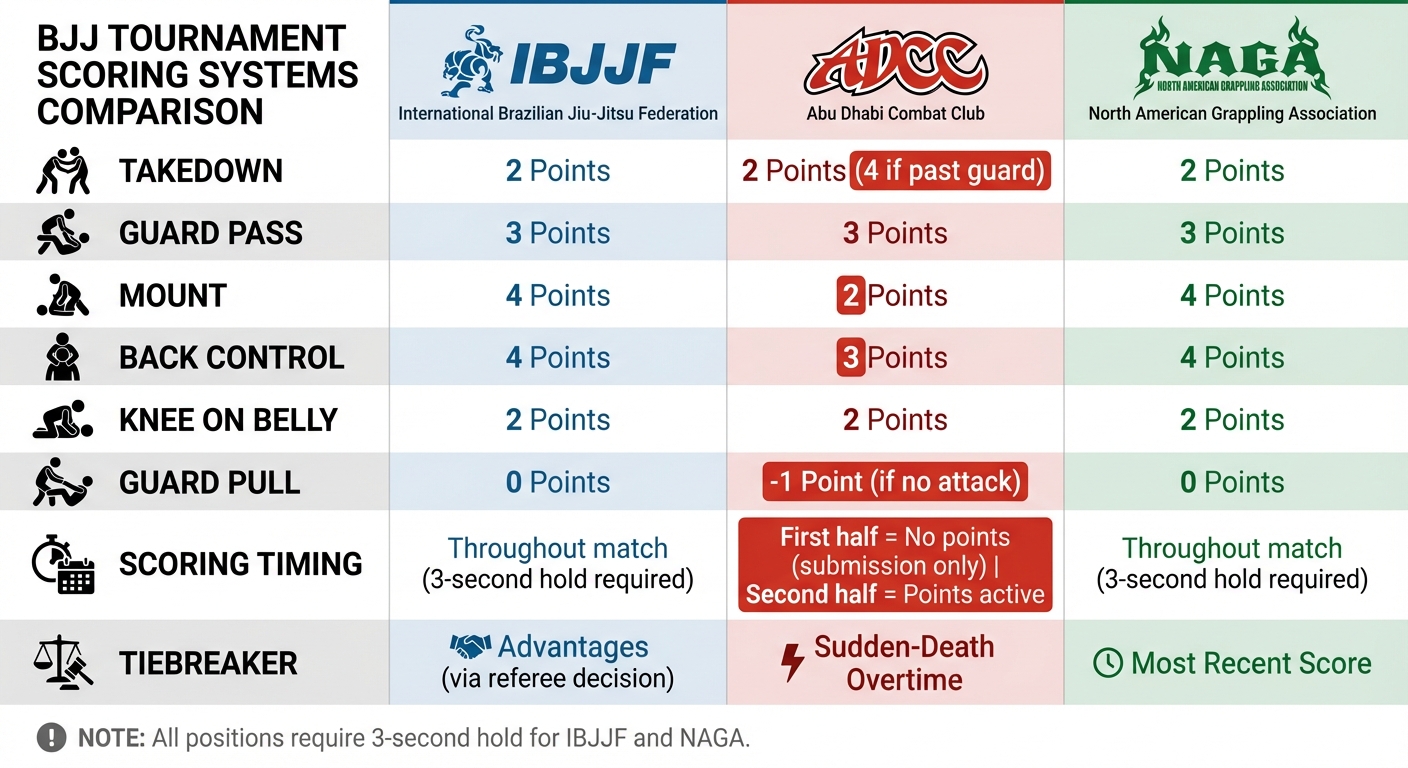
Each grappling organization - IBJJF, ADCC, and NAGA - has its own scoring system, and these differences can significantly influence how competitors approach their matches. While IBJJF and NAGA align closely in point values for most positions, ADCC adopts a system that prioritizes aggressive, submission-driven grappling.
One of the most noticeable differences is timing. In IBJJF and NAGA, points are awarded throughout the match, provided positions are held for at least 3 seconds. ADCC, however, divides matches into two phases: the first half is submission-only, with no points awarded, while the second half introduces scoring. This structure encourages athletes to focus on submissions early on.
Another key distinction lies in guard pulling. Both IBJJF and NAGA treat it as a neutral action with no points gained or lost. In contrast, ADCC penalizes guard pulling with a –1 point deduction unless it leads to an immediate attack.
The tiebreaker systems also reflect the philosophies of each organization. IBJJF uses advantages - essentially near-successes - as the deciding factor, emphasizing technical precision. NAGA skips advantages altogether and resolves ties by awarding victory to the competitor who scored most recently, promoting a more aggressive finish. ADCC takes a different route with sudden-death overtime, where the first point or submission secures the win.
Here’s a quick comparison of scoring across the three organizations:
| Position / Action | IBJJF | NAGA | ADCC |
|---|---|---|---|
| Takedown | 2 Points | 2 Points | 2 Points (4 if past guard) |
| Guard Pass | 3 Points | 3 Points | 3 Points |
| Mount | 4 Points | 4 Points | 2 Points |
| Back Control | 4 Points | 4 Points | 3 Points |
| Knee on Belly | 2 Points | 2 Points | 2 Points |
| Guard Pull | 0 Points | 0 Points | –1 Point (if no attack) |
| Tiebreaker | Advantages (via referee decision) | Most Recent Score | Sudden-Death Overtime |
These scoring differences shape strategies, rewarding everything from technical precision to relentless aggression, depending on the organization.
Finding a BJJ Academy for Competition Training
Using the Brazilian Jiu-Jitsu Gyms Directory

The Brazilian Jiu-Jitsu Gyms Directory is a powerful tool, listing 17,139 verified academies across the country. It simplifies the search for competition-focused training by allowing you to filter results based on factors like instructor credentials, lineage, and whether the gym offers gi or no-gi programs. This can be especially helpful if you're planning to compete in different organizations like IBJJF or ADCC [6].
When browsing the directory, pay close attention to academies that highlight "competition programs" or "competition classes." These offerings often indicate a focus on tournament preparation. It's also smart to check the instructor's credentials, lineage, and competition history, as these are strong indicators of their familiarity with current tournament rules and strategies [6]. Gyms with competition experience can help you avoid common mistakes, such as stalling or pulling guard without establishing a grip, which can cost you points [1].
The directory also includes reviews and ratings, which can give you insight into whether an academy has an active competition team. Training alongside competitive teammates can accelerate your progress, as the collective focus on tournaments fosters a faster learning environment [5]. Additionally, the directory’s interactive map feature allows you to locate nearby gyms and cross-reference their names on tournament platforms to verify their competition results and rankings [7].
By using these tools, you can build a solid shortlist of academies that align with your competition goals. From there, focus on those with a proven track record in preparing athletes for tournaments.
Choosing an Academy with Competition Experience
Once you've narrowed down your options, it's time to evaluate which academies truly excel in competition training. Just as understanding the rules is crucial for success, training at a gym that prioritizes competitive strategy can make all the difference. A competition-focused academy will prepare you for both the mental and physical challenges of tournament day. As BJJ coach Steve wisely says:
"If your coach doesn't brief you on this type of information [rules] before your match, you're going to need a new coach!" [5]
The right gym will teach you to interpret referee signals, execute match strategies, and drill sequences like "stabilize, then attack" to ensure you consistently earn points [1][5].
Competition training typically operates at a higher intensity than regular classes. You can expect fast-paced drills, scrambles, and scenarios designed to mimic real match conditions [5]. The best academies also provide a variety of training partners - different body types, styles, and skill levels - to help you adapt to unfamiliar techniques during tournaments [5]. Look for gyms where coaches actively support their athletes at local tournaments and ensure they stay updated on rule changes and techniques across formats like IBJJF, ADCC, and NAGA [5][1].
Conclusion
Grasping the rules and scoring system in BJJ is a critical step toward success in competition. Victory often hinges on understanding when to stabilize a position for three seconds to secure points or when to take a calculated risk with a submission attempt [1]. If you're leading on points, holding your position is usually the wisest move. On the other hand, if you're trailing, you'll need to carefully weigh your chances and take risks to turn the match around [1].
Each tournament has its own unique strategies. For example, in IBJJF events, advantages play a key role as tiebreakers, meaning even close submission attempts can tip the scales. NAGA, however, resolves ties based on the most recent score. ADCC brings an entirely different dynamic, with points only counting in the second half of the match, requiring competitors to manage their energy differently [2]. Assuming all tournaments operate under the same rules is a recipe for frustration.
The impact of these rule variations is evident in match outcomes. At the grey belt level, nearly 60% of matches that don’t end in a draw are decided by submission [2]. Submission rates climb steadily as skill levels increase - rising from 48.0% at white belt to 61.8% at yellow belt. While technical ability and submission proficiency grow, maintaining solid positional control remains just as important. Success depends on striking the right balance between controlling positions and attacking submissions.
Before stepping onto the mat at any tournament, make it a priority to review the specific ruleset. Practice sequences like "stabilize, then attack", and stay alert to referee hand signals, as electronic scoreboards can sometimes lag behind [1]. Avoid common errors, such as pulling guard without establishing control or rushing through positions without securing points.
Finally, your training environment plays a big role in your preparation. Look for an academy that keeps you up to date on rule changes across IBJJF, ADCC, and NAGA, while equipping you with strategies to perform confidently under pressure.
FAQs
How do refs decide if a position is “stable” enough to score?
Referees decide whether a position is "stable" enough to score by observing if the athlete maintains control for approximately 3 seconds. This stability must come from proper execution, starting from a standing position. The referee ensures that both the transition into the position and the final stance demonstrate clear dominance.
What’s the best way to change strategy between IBJJF, ADCC, and NAGA rules?
To tailor your approach for IBJJF, ADCC, and NAGA competitions, it’s essential to understand their unique scoring systems and priorities:
- IBJJF places a strong emphasis on dominant positions. Points are awarded for holding these positions for at least 3 seconds, and advantages can serve as tiebreakers. Strategy here should focus on maintaining control and racking up points through positional dominance.
- ADCC shifts the spotlight to submissions. While positional control is still important, the rules are stricter on stalling or passive behavior, encouraging aggressive attempts to finish the match. Be prepared to stay active and constantly look for submission opportunities.
- NAGA shares similarities with IBJJF but can vary in how penalties are applied and how the match flows. Understanding these nuances is critical to avoid unnecessary deductions and to maximize your scoring chances.
To succeed, adapt your game plan to align with each organization’s scoring focus - whether it’s positional control, submission attempts, or a mix of both.
What moves can get you disqualified at lower belts or in youth divisions?
Certain moves, like heel hooks, slams, and spinal locks, are considered highly dangerous and are often banned in youth and lower belt divisions. These restrictions are in place across many competitions to prioritize safety and reduce the risk of severe injuries.
Related articles
Share this article