
Why BJJ Works for Women's Self-Defense
BJJ empowers women to neutralize larger attackers through leverage, ground control, and realistic sparring that builds confidence.
Written by BJJ Academy Finder Editorial Team
Why BJJ Works for Women's Self-Defense
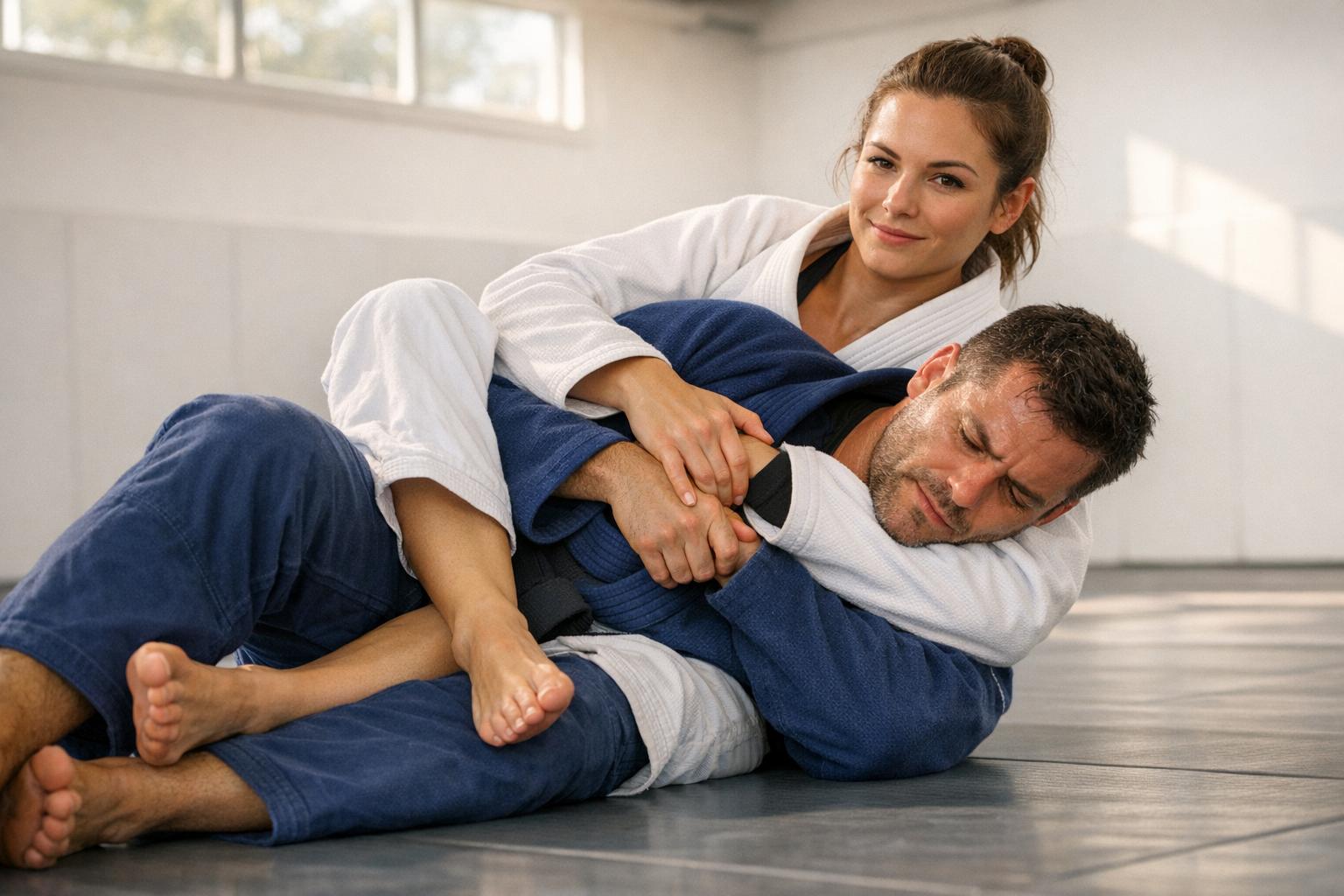
Brazilian Jiu-Jitsu (BJJ) is a practical self-defense system for women, focusing on leverage and technique rather than strength. Unlike striking-based martial arts, BJJ prepares women for close-contact situations like being grabbed or pinned, which are common in assaults. By practicing techniques such as joint locks, chokes, and escapes, women can neutralize larger attackers.
Key benefits include:
- Close-Quarters Defense: Effective in situations where an attacker is already in physical contact.
- Leverage Over Strength: Uses body mechanics to overcome size and strength disparities.
- Realistic Training: Live sparring builds reflexes and reduces the "freeze" response under stress.
- Mental Preparedness: Boosts confidence and equips women to stay calm in high-pressure situations.
Eve Torres Gracie’s story highlights how BJJ empowers women by teaching them to handle threatening encounters effectively. To start training, look for a BJJ gym nearby with beginner-friendly programs, women-focused classes, and a supportive environment.
Self-Defense Challenges Women Face
Common Attack Scenarios Women Encounter
Assaults against women often happen in extremely close quarters. These situations usually involve being grabbed, pinned, or cornered in places like parking lots or gas stations, leaving little room to maneuver or escape[2].
The physical dynamics add another layer of difficulty. Attackers frequently rely on their size and strength to control their victim, using tactics like pinning them down or grabbing their wrists to limit movement[2]. What makes this even more troubling is that in many cases, the attacker is someone the woman knows[2]. This familiarity can make the situation even more complex and disorienting.
"Real-life assaults happen in close quarters - grabs, holds, someone pushing you to the ground. The attacker is often someone bigger, stronger, and maybe even someone you know."
– Angela R. Taylor, BJJ Coach[2]
On top of the physical challenges, the psychological aspect of such encounters is significant. High-stress situations often trigger a freeze response, especially in women who lack self-defense training[2]. Instead of reacting with a clear plan, many may freeze or panic when faced with violence. This highlights the importance of training that focuses on staying active and responsive under pressure[2].
These challenges reveal the weaknesses in many traditional self-defense approaches.
Limitations of Other Self-Defense Methods
Close-quarters attacks expose the limitations of striking-based martial arts like kickboxing or karate. These arts rely on maintaining distance to generate power for punches and kicks. But when an attacker closes the gap or pins someone down, executing those strikes becomes nearly impossible[2][7].
For women, limited striking power is another hurdle. Techniques like punching may not be effective against a larger, stronger attacker[5]. While some self-defense programs encourage targeting vulnerable areas like the eyes or neck, performing these moves during a chaotic and stressful situation is far more difficult than it seems[5].
Another major issue with many self-defense classes is cooperative training. In these settings, techniques are often practiced on partners who remain still and don’t resist. This creates a false sense of confidence because, in a real assault, the attacker will resist and fight back, making those rehearsed techniques much harder to execute[6][7].
These limitations underscore the need for more practical, realistic self-defense training tailored to the challenges women face.
sbb-itb-d583f1e
Women’s Self Defense When Pinned to Wall (BJJ Basics)
How Brazilian Jiu-Jitsu Solves Women's Self-Defense Problems
Brazilian Jiu-Jitsu (BJJ) tackles a major issue that often undermines other self-defense methods: how to respond when an attacker has already overpowered you. Unlike approaches that depend on striking or maintaining distance, BJJ is specifically designed for close-quarters situations where an assailant has pinned, grabbed, or forced you to the ground [2]. Its techniques focus on using leverage and precision to overcome physical strength.
Leverage Over Strength
The foundation of BJJ lies in leveraging body mechanics - using angles, joint manipulation, and positioning - to control opponents, even those significantly larger or stronger [7].
"Brazilian Jiu Jitsu is often called 'the gentle art' because it's built around leverage and technique, not strength."
– Angela R. Taylor, BJJ Coach [2]
Techniques like joint locks and chokes target vulnerable areas, requiring minimal strength to be effective [1]. For example, a rear-naked choke can incapacitate an attacker in seconds by restricting blood flow to the brain [7]. BJJ practitioners also rely on the power of their hips and legs to create space, shift an attacker's weight, and apply force more efficiently than using arm strength alone [2].
This focus on technique rather than brute force has provided many women with practical and empowering self-defense tools, showing that size and strength are not prerequisites for effective protection.
Mastering Ground Fighting
BJJ's emphasis on leverage extends into ground fighting, a critical skill for handling close-contact situations. Many real-life assaults involve being pushed, pinned, or grabbed - scenarios where BJJ techniques shine [2].
The guard position, for instance, allows someone to fight effectively from their back by using their legs to control an opponent's movements [4]. From this position, techniques like hip escapes create room to maneuver, sweeps turn disadvantage into a dominant position, and submissions neutralize threats [2].
What sets BJJ training apart is its use of live sparring with resisting partners, simulating real-life assault conditions [7]. Unlike static drills common in traditional self-defense classes, this dynamic practice builds the ability to stay calm and apply techniques under pressure. It also helps reduce the "freeze" response that can occur in high-stress situations [2].
Core BJJ Techniques for Women's Self-Defense
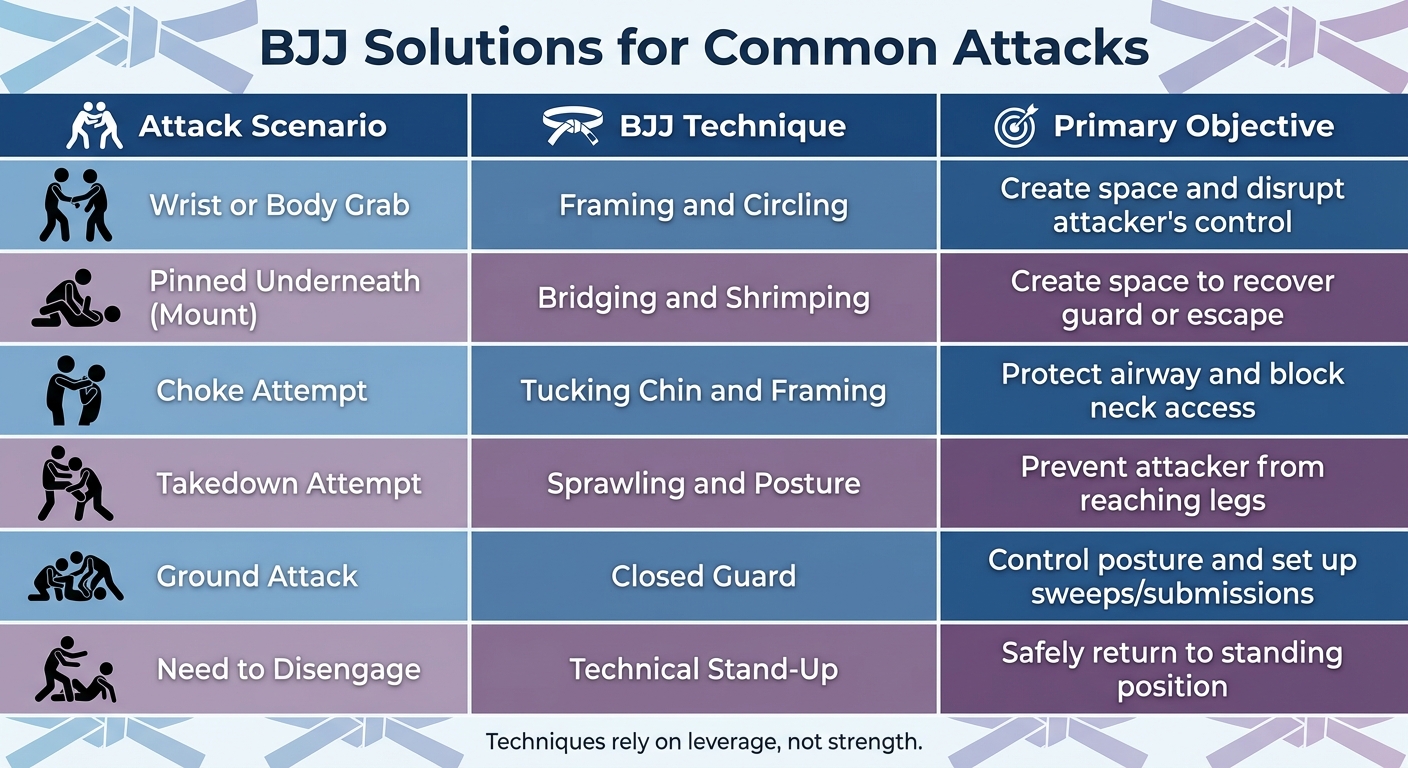
BJJ Defense Techniques for Common Attack Scenarios
Brazilian Jiu-Jitsu (BJJ) techniques are particularly effective for self-defense because they rely on mechanics and leverage rather than brute strength. This makes them especially practical for women, who generally have about 50–60% of men's upper body strength but retain 70–80% of men's lower body strength relative to body weight [8]. By focusing on these strengths, women can use BJJ to handle real-life attack scenarios with confidence.
Preventing and Escaping Takedowns
One of the first priorities in self-defense is avoiding or escaping takedowns. Sprawling is a key move to prevent an attacker from grabbing your legs - it involves shifting your hips back and spreading your weight to stop their forward momentum [8]. If you do end up pinned underneath, techniques like bridging and shrimping (also called hip escapes) help you shift an attacker's weight and regain control [8][2].
The technical stand-up is essential for safely getting off the ground during an altercation. This movement is so critical that it’s worth practicing until it becomes second nature [8].
Submission Techniques to Stop Attackers
If takedown defenses aren't enough to neutralize an attacker, submission techniques provide an effective way to regain control quickly.
The rear naked choke is one of the most effective submissions, cutting off blood flow to the brain in seconds [8][9]. Another powerful option is the front triangle choke, which uses leg strength to trap and strangle an attacker from the guard position - leveraging the lower body's natural strength advantage [8]. For situations where an attacker charges forward, the guillotine choke can be applied even while standing, offering a fast and decisive counter [8][9].
Joint locks, such as the Americana shoulder lock and armbar, are also invaluable. These techniques create intense pain, forcing an attacker to comply without necessarily causing permanent injury. They also allow you to maintain a dominant position while creating opportunities to escape [9].
BJJ Responses to Common Attacks
Different types of attacks call for specific responses, and BJJ offers a variety of tools to handle them. For instance, defensive framing - using your arms and legs as barriers - helps block punches and choke attempts while maintaining distance [8].
"Proper framing helps you block punches, defend chokes, and avoid being pinned down." – Jordan Patrick, BJJ Practitioner [8]
The closed guard position is another critical tactic, allowing you to use your legs to control an attacker’s hips and posture. This not only neutralizes their strength advantage but also sets you up for sweeps or submissions [8].
Here’s a quick breakdown of common attack scenarios and their corresponding BJJ solutions:
| Attack Scenario | BJJ Solution/Technique | Primary Objective |
|---|---|---|
| Wrist or Body Grab | Framing and Circling | Create space and disrupt the attacker's control [8] |
| Pinned Underneath (Mount) | Bridging and Shrimping | Create space to recover guard or escape [8][2] |
| Choke Attempt | Tucking Chin and Framing | Protect the airway and block access to the neck [8] |
| Takedown Attempt | Sprawling and Posture | Prevent the attacker from reaching your legs [8] |
| Ground Attack | Closed Guard | Control posture and set up sweeps or submissions [8] |
| Need to Disengage | Technical Stand-Up | Safely get back to a standing position [8] |
Mental and Physical Benefits of BJJ Training for Women
Confidence and Mental Strength
BJJ training doesn't create a sense of invincibility - it builds preparedness. Many women enter training with a lingering sense of vulnerability, often described as a "low-grade fear" when navigating public spaces. Through BJJ, that fear is replaced with practical skills and a powerful shift in mindset [2].
A great example of this transformation is Eve Torres Gracie. After a frightening encounter in 2007, she discovered how BJJ techniques, grounded in leverage and precision, could neutralize size and strength advantages. Her journey began at Gracie University, where she learned how to turn fear into capability [1].
The process of "rolling" (live sparring in BJJ) plays a key role in building mental resilience. It forces practitioners to solve problems in real time, even under pressure. This ability to stay composed when adrenaline surges can make all the difference in a real-life situation, helping women avoid freezing or panicking [2][10]. As BJJ coach Angela R. Taylor puts it:
"I'm not invincible. But I am prepared. And that changes how I carry myself every single day."
This mental toughness naturally complements the physical training, sharpening the body's reactions to stressful situations.
Faster Reflexes and Automatic Responses
Beyond mental strength, BJJ hones the body's reflexes. Sparring sessions demand quick adaptations as training partners actively resist and counter moves [6][7]. This kind of stress inoculation - experiencing being pinned, pressured, or controlled - teaches the body to react instinctively rather than freeze under threat [2][7].
As ONE Championship explains:
"This realistic training approach builds something that can't be taught in a weekend self-defense seminar: the ability to stay calm and think clearly when someone is trying to control or hurt you."
With consistent practice, these reflexes become second nature. Instead of succumbing to panic, women learn to respond with deliberate, purposeful actions when it matters most.
Choosing a BJJ Academy for Self-Defense Training
What to Look for in a BJJ Academy
Picking the right Brazilian Jiu-Jitsu (BJJ) academy can have a huge impact on your self-defense training experience. One of the clearest signs of a safe and welcoming environment is the presence of women actively training. A strong female community often reflects an academy's commitment to respect and inclusivity.
Pay close attention to how beginner programs are structured. Top-notch academies guide newcomers with clear, step-by-step instruction rather than throwing them into advanced sparring. Look for instructors who break down techniques in a way that works for all skill levels. It's worth noting that being a skilled fighter doesn’t automatically make someone a great coach - teaching requires a different skill set. The best instructors prioritize technique and leverage over raw strength, which is exactly why BJJ is such an effective self-defense tool for women.
Hygiene is another important factor. Clean mats and equipment show the academy values professionalism and safety. When visiting, take note of the atmosphere - do students support each other during training? Does the instructor encourage questions? As BJJ coach Angela R. Taylor wisely says:
"You deserve to feel safe and supported wherever you train" [2].
To make an informed decision, visit several academies. Watch classes, take trial sessions, and assess how they handle safety and overly aggressive training. A good academy will also offer flexible schedules, including fundamentals or women-only classes, which makes it easier to commit to training two or three times a week - an ideal frequency for building skills.
By carefully evaluating the environment and coaching, you can ensure the academy aligns with your self-defense goals.
Using Brazilian Jiu-Jitsu Gyms Directory to Find an Academy

The Brazilian Jiu-Jitsu Gyms Directory is a helpful tool for narrowing down your options. It allows you to filter academies by location and specific programs, like women-only classes or self-defense-focused training. You can even read reviews from other women to get a sense of the academy's culture before visiting.
The directory provides detailed information about each academy, including instructor credentials, program offerings, and contact details. Its interactive map feature makes it easy to see which academies are conveniently located near your home or workplace - critical for staying consistent with your training. With everything in one place, finding the right BJJ academy becomes a lot simpler.
Conclusion
Brazilian Jiu-Jitsu offers women an effective way to defend themselves by focusing on leverage, positioning, and body mechanics rather than brute strength. Through realistic live sparring, practitioners learn to stay composed under pressure and develop muscle memory that kicks in during real-life confrontations. As Adisa Banjoko, a BJJ Black Belt and Author, puts it:
"In BJJ one of the first things you learn is how not to be pinned. If a man cannot pin a woman he is much less likely to rape her" [3].
This foundational skill could potentially help reduce the rates of rape and murder of women by nearly 40% [3].
Beyond physical techniques, BJJ fosters confidence that extends into everyday life. You'll not only feel more prepared to handle physical threats but also carry yourself with assurance in professional and personal settings. The mental toughness built on the mats translates seamlessly into managing stress and challenges outside of training.
These techniques are tailored to address real-world scenarios women might face, making empowerment accessible to anyone willing to step onto the mats. To get started, use the Brazilian Jiu-Jitsu Gyms Directory to find a gym near you. Check reviews, explore programs, and attend trial classes to find a supportive and safe academy that fits your needs. You don’t need to be strong or athletic to begin - just show up ready to learn.
FAQs
How long does it take for BJJ to be useful for self-defense?
With regular practice, Brazilian Jiu-Jitsu can prove effective for self-defense in just a few months. Its emphasis on technique, leverage, and control equips practitioners to manage real-life situations confidently and efficiently in a short period.
Is BJJ safe for beginners who are nervous about sparring?
Brazilian Jiu-Jitsu (BJJ) is a great option for beginners, even for those who might feel uneasy about sparring. The emphasis is on technique, leverage, and control rather than brute strength or striking, which makes it accessible to people of all experience levels. Beginners are encouraged to progress at their own speed in a structured and safe environment, allowing them to build confidence and develop skills step by step without the stress of high-pressure physical encounters.
What should I look for in a women-friendly BJJ gym?
When picking a Brazilian Jiu-Jitsu (BJJ) gym that caters to women, look for gyms that offer women-only classes or programs. These sessions provide a safe and welcoming environment for women of all experience levels. They often emphasize building confidence, empowerment, and self-defense skills tailored specifically for women.
It's also important to consider the gym's community and instructors. A supportive group and coaches who understand and respect women's needs can make all the difference. Take time to assess the gym’s facilities, the way classes are structured, and online reviews to ensure it matches your personal goals and comfort level.
Related articles
Share this article