
How BJJ Belts Changed Over Decades
Trace the BJJ belt system from Judo origins to today's IBJJF rules, youth belts, and time-in-grade standards.
Written by BJJ Academy Finder Editorial Team
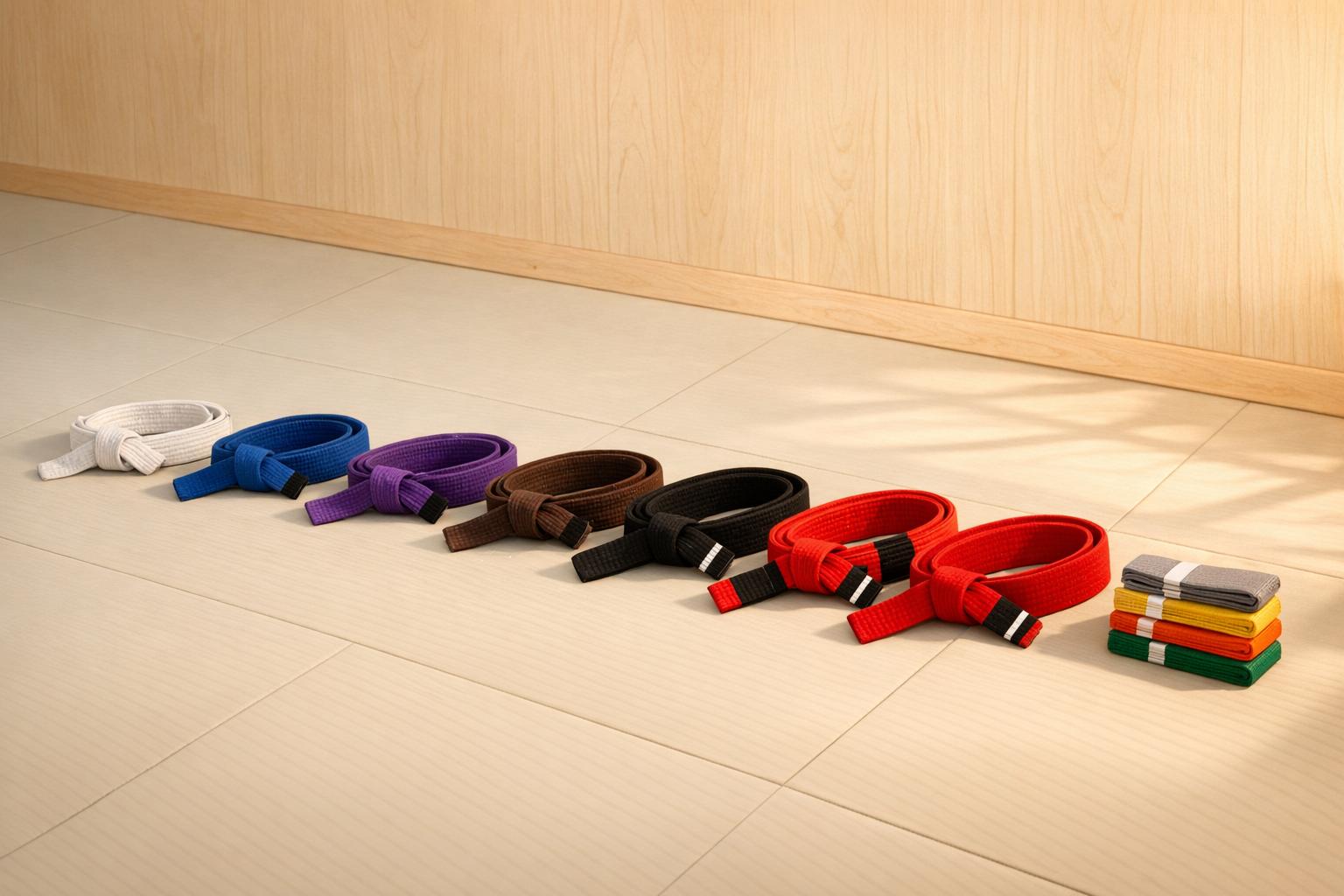
How BJJ Belts Changed Over Decades
The Brazilian Jiu-Jitsu (BJJ) belt system has evolved significantly since its inception, transitioning from a simple two-color structure to the modern multi-colored progression we see today. Here’s a quick overview of how it developed:
- 1880s–1910s (Judo Origins): Jigoro Kano introduced white and black belts to distinguish beginners from advanced practitioners.
- 1920s–1950s (Early BJJ): A three-color system (white, light blue, dark blue) was used in BJJ, focusing on roles rather than technical progress.
- 1960s–1970s (Formalization): The Jiu-Jitsu Federation of Guanabara established the modern five-color adult system (White, Blue, Purple, Brown, Black) with additional bars for instructors.
- 1980s–Present (Modern System): The IBJJF standardized belt progression globally, introduced youth belts, and added minimum time requirements for each rank.
Each phase reflects changes in teaching methods, competition, and student motivation. If you're ready to start your journey, you can find your perfect BJJ gym nearby to begin training. Today, earning a black belt typically takes 10–15 years, emphasizing skill, character, and dedication.
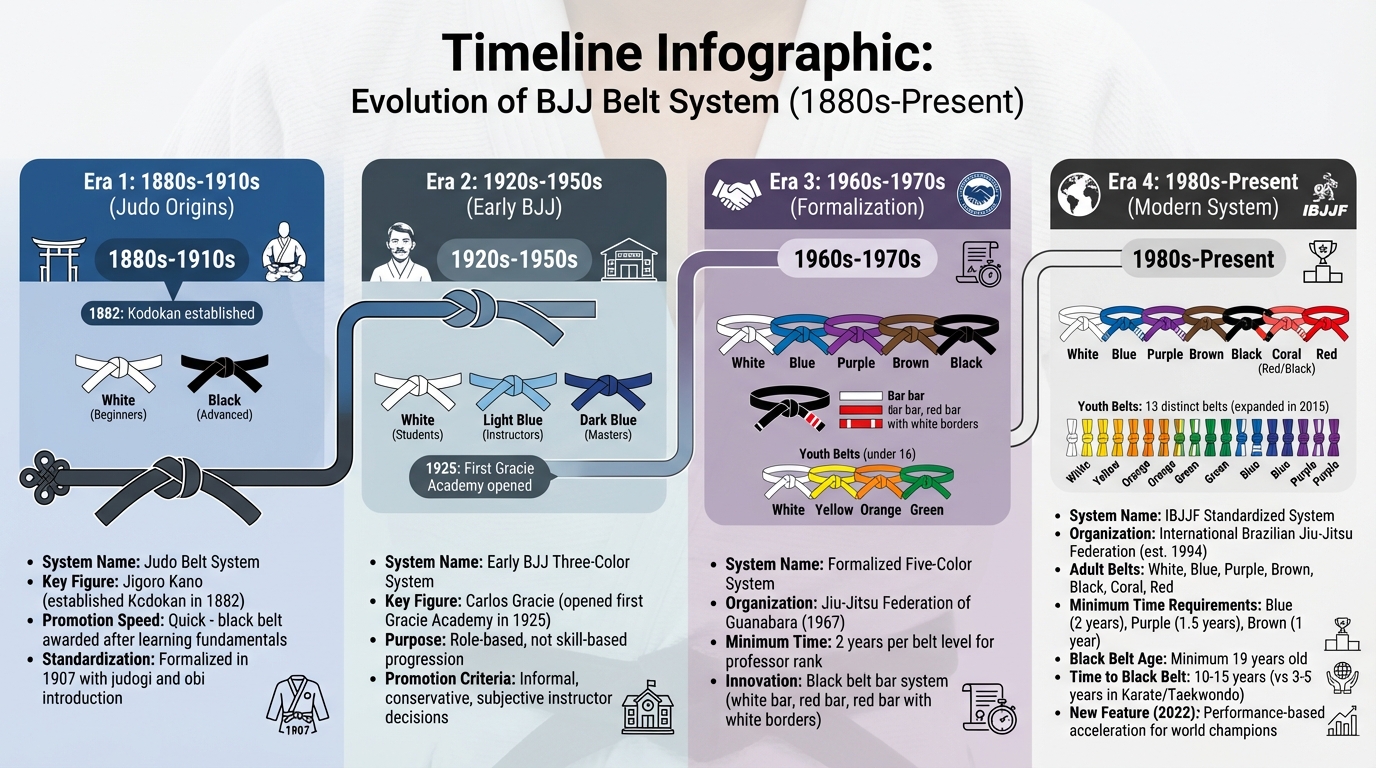
Evolution of BJJ Belt System from 1880s to Present
1. Judo Belt System (1880s-1910s)
Belt Colors and Structure
When Jigoro Kano established the Kodokan in 1882, he introduced a straightforward belt system with just two colors: white for beginners and black for those who had mastered the basics[5]. The white belt symbolized simplicity and a fresh start, while the black belt represented the skills and knowledge gained through dedicated practice[4]. This simple structure created a clear distinction between newcomers and experienced practitioners, serving as the foundation for more intricate ranking systems in other martial arts.
Promotion Criteria
In the early days of Judo, earning a black belt was a quicker process compared to modern standards. Practitioners were promoted to black belt status soon after they demonstrated a solid understanding of Judo fundamentals[5]. As Ronin Athletics Team explains:
Students began as white belts and were then awarded black belts after learning the fundamentals of judo[5].
Once awarded a black belt, practitioners could progress further by earning higher degrees (dan) as they showcased advanced techniques and deeper mastery of the art. This relatively rapid promotion system contrasts sharply with the lengthier progression timelines seen in Brazilian Jiu-Jitsu today.
Standardization Level
In 1907, Kano took steps to formalize Judo's ranking system. He introduced the judogi (training uniform) and obi (belt), which replaced the earlier practice of training in traditional kimonos. This move standardized Judo training and reinforced the use of the two-color belt system[1]. This approach not only unified Judo practices but also set the stage for the development of ranking systems in other martial arts, including Brazilian Jiu-Jitsu.
Cultural and Practical Influences
When Mitsuyo Maeda, one of Kano's students, brought Judo to Brazil in 1914, he introduced the two-color belt system as part of his teachings[1]. The simplicity of this system reflected the Japanese values of minimalism and clear hierarchies. Maeda's introduction of this approach in Brazil laid the foundation for Brazilian Jiu-Jitsu’s later evolution. Over time, BJJ adapted this structure into a more detailed ranking system, tailored to the specific needs of ground-fighting techniques and student progression.
sbb-itb-d583f1e
2. Early BJJ Belt System (1920s-1950s)
Belt Colors and Structure
When Carlos Gracie opened the first Gracie Academy in 1925, Brazilian Jiu-Jitsu used a straightforward three-color belt system that lasted until the late 1960s. The structure was simple: white belts were for students, light blue belts identified instructors, and dark blue belts were reserved for masters. Unlike today’s systems, these belt colors weren’t used to track technical progress. Instead, they defined roles within the academy. All students wore white belts, while the colored belts highlighted teaching authority.
Promotion Criteria
Promotions during this time were informal and conservative. There were no standardized tests or fixed timelines for advancement. Instead, instructors made subjective decisions based on a student’s readiness. The emphasis was on practical effectiveness rather than competition results. Students had to prove their techniques worked in self-defense scenarios, often against resisting opponents. They were also expected to show enough understanding to eventually teach others. Because of this rigorous focus, promotions were rare and carried significant weight.
Standardization Level
The early belt system was highly personalized, relying entirely on the judgment of individual academy leaders. There was no centralized organization or unified ranking system until 1967. While European Judo introduced a more complex multi-colored belt system in 1935 to encourage student retention, Brazilian Jiu-Jitsu stuck with its simpler structure for decades. The Gracie family believed their system was sufficient for distinguishing instructors from students without unnecessary complexity.
Cultural and Practical Influences
This three-color system reflected the close-knit, family-oriented nature of early Brazilian Jiu-Jitsu academies. With the Gracie family dominating instruction, the ranking system reinforced their authority. Notably, the 10th-degree red belt was exclusively reserved for the art’s pioneers - Carlos, Oswaldo, Gastão Jr., George, and Hélio Gracie. As a nod to this legacy, Royce Gracie today wears a navy blue belt without rank insignia, honoring his father Hélio and the original belt structure. This role-based system, deeply rooted in the family’s culture, laid the groundwork for later developments that would expand on skill and technique recognition.
3. Formalized BJJ Belt System (1960s-1970s)
Belt Colors and Structure
In 1967, the Jiu-Jitsu Federation of Guanabara introduced a formal belt system, reshaping how progress in Brazilian Jiu-Jitsu (BJJ) was recognized. This system introduced the five-color adult belt progression still used today: White, Blue, Purple, Brown, and Black belts. It replaced the older three-color system, which only differentiated between students and instructors.
A unique feature of this system was the black belt bar system, designed to set BJJ apart from other martial arts. A white bar indicated a practitioner or competitor who wasn't an instructor. A solid red bar denoted an instructor working toward professorship, while a red bar with white borders signified a "Professor" who had earned their teaching credentials. For children under 16, the system limited them to White, Yellow, Orange, and Green belts, reflecting a belief that they were not yet ready for the ethical responsibilities tied to adult ranks.
This structured approach laid the foundation for modern promotional practices in BJJ.
Promotion Criteria
Hélio Gracie emphasized that earning the rank of professor required at least two years at each belt level, along with a demonstration of moral virtues like honesty and courage. Pedro Valente of Valente Brothers highlighted this philosophy:
he believed in observing the person in different situations, and he felt that it took many years before you could actually see what the person is really made of inside.
The federation introduced point systems and standardized competition rules, moving away from the previous era when matches only ended through submission, knockout, or a draw. Despite these changes, promotion decisions remained in the hands of individual instructors, without rigid testing or mandatory timelines.
This approach balanced structure with flexibility, ensuring that promotions reflected both skill and character.
Standardization Level
The 1967 belt system was BJJ's first step toward standardization, though it maintained a degree of informality. While the federation provided a framework, individual academies retained autonomy over promotions. This created what is often referred to as BJJ's "conservative promotion" culture, where practitioners spent significant time at each rank to ensure they truly mastered the techniques before advancing.
This blend of structure and tradition preserved BJJ's practical roots while fostering its growing competitive nature.
Cultural and Practical Influences
Expanding the belt system addressed a key issue: keeping students motivated. Under the old three-color system, there were no clear milestones for students progressing from white belt to instructor. By introducing intermediate ranks, the new system rewarded progress and encouraged a competitive spirit, transforming BJJ from a self-defense practice into a sport. This approach, influenced by European Judo, also helped retain students by providing tangible goals.
Unlike the earlier role-based system, the new structure focused on technical skill and competition readiness. The federation's standardized rules allowed tournaments to thrive, creating an environment where practitioners could prove their abilities through competition rather than just teaching or self-defense scenarios. This shift toward competition became a defining feature of BJJ, shaping its evolution in the decades that followed.
4. Modern BJJ Belt System (1980s-Present)
Belt Colors and Structure
The structured reforms of the 1960s and 1970s laid the groundwork for what would become the modern Brazilian Jiu-Jitsu (BJJ) ranking system. With the establishment of the International Brazilian Jiu-Jitsu Federation (IBJJF) in 1994, a standardized framework was introduced to unify rankings as BJJ gained global popularity [3]. For adults (ages 16+), the system includes five main belt colors: White, Blue, Purple, Brown, and Black [3]. Beyond Black, there are advanced ranks such as the Red and Black Coral, Red and White Coral, and the prestigious Red belt, which is reserved for the most influential practitioners of the art [3][1].
In 2015, the IBJJF expanded the youth belt system to include 13 distinct belts for practitioners under 16. These belts are grouped into categories like Gray, Yellow, Orange, and Green, offering younger students more frequent milestones to celebrate their progress [1]. Additionally, many academies use a stripe system, where up to four white stripes can be added to a belt to signify incremental achievements between major ranks [3]. This structured approach ensures a clear and consistent path for students as they advance.
Promotion Criteria
BJJ promotions are based on a combination of factors, including technical skill, sparring ability, competition results, safe training habits, consistent attendance, and overall conduct [1][6]. The IBJJF enforces minimum time requirements for each belt: 2 years at Blue, 1.5 years at Purple, and 1 year at Brown. Practitioners must also be at least 19 years old to earn a Black belt [1][3].
In 2022, the IBJJF introduced a new option for performance-based acceleration. This allows coaches to waive the minimum time requirements for practitioners who win an adult world championship at their current belt rank [1]. As Sensei Sandy explains:
There is no global promotion calendar. Promotions are coach decisions based on readiness, safety, and consistency [6].
Standardization Level
While modern BJJ builds on the regulated system of earlier decades, it strikes a balance between standardized rules and academy-level flexibility. The IBJJF provides overarching guidelines, including minimum age and experience requirements for competition eligibility, but individual academies have the freedom to apply these rules as they see fit [3].
This trend toward formalization has led some academies, like Alliance and various Gracie Academies, to adopt systematic testing methods. In some cases, these evaluations even include online video submissions for belt promotions [1]. Such measures ensure consistency while allowing academies to maintain their unique approaches.
Cultural and Practical Influences
Earning a Black belt in BJJ is no small feat, often requiring 8–12 years of dedicated training. This is significantly longer than the 3–5 years typically needed for Black belts in arts like Karate or Taekwondo [3][2]. The extended timeline reflects BJJ’s focus on practical application and live sparring rather than memorizing forms or patterns.
Interestingly, the journey through BJJ ranks fosters more than just technical growth. Studies show that 100% of practitioners feel a sense of community, and 87.6% report increased confidence as they progress through the ranks [3].
The modern belt system balances tradition with contemporary needs. The expanded youth belt structure keeps younger students motivated, while performance-based acceleration recognizes and rewards elite competitors. As Paragon Elite Fight Group aptly puts it:
The BJJ belt system serves as both roadmap and reality check, guiding practitioners through measurable milestones while constantly reminding them that mastery is a horizon that recedes with each step forward [3].
History of Brazilian Jiu Jitsu Belts Explained
Pros and Cons of Each Belt System Era
Each phase in the development of the belt system in Brazilian Jiu-Jitsu (BJJ) brought its own set of strengths and challenges, reflecting the priorities and needs of the time. The original Judo system (1880s–1910s) kept things extremely straightforward with just white and black belts. This simplicity made it easy to differentiate beginners from experts. However, the lack of intermediate levels often left students without clear milestones, which likely impacted motivation and retention rates [2].
To address this, the colored belt system of the 1920s and 1930s introduced a more structured progression. According to historical accounts, Kawaishi believed:
a more structured system of colored belts would provide the student with visible rewards to show progress, increasing motivation and retention [2].
While this approach made martial arts training more engaging, it initially suffered from inconsistent standards between schools.
During the early BJJ era (1920s–1950s), a three-color system was used: white for students, light blue for instructors, and dark blue for masters. This system clearly defined teaching roles but didn’t offer much detail for tracking a student’s technical growth. The formalized system of the 1960s–1970s introduced a more refined progression (White, Blue, Purple, Brown, Black), rewarding skill development with intermediate goals. However, the lack of global oversight and standardized timelines made the criteria for advancement somewhat subjective.
The modern system (1980s–Present) has achieved a high level of standardization, thanks to the IBJJF. The introduction of the 13-belt system for youth practitioners has also helped keep younger students engaged. However, the lengthy journey to earning a black belt can discourage some students, and there are concerns about the potential commercialization of the sport [3].
| Era | Key Strengths | Key Weaknesses |
|---|---|---|
| Judo (1880s–1910s) | Simple; clear distinction between beginners and experts | No intermediate milestones; low retention rates |
| Colored Judo (1920s–1930s) | Added milestones boosted motivation and accessibility | Standards varied between schools and regions |
| Early BJJ (1920s–1950s) | Clear identification of teaching roles | Limited ability to track technical progress |
| Formalized BJJ (1960s–1970s) | Skill-based progression encouraged growth | Advancement criteria lacked consistency and global standards |
| Modern BJJ (1980s–Present) | Consistent global standards via IBJJF; youth-focused belt system; rewards for elite performance | Long path to black belt can lead to dropouts; concerns over commercialization |
Conclusion
The BJJ belt system has come a long way since its beginnings in the 1880s, evolving from Judo's straightforward white-and-black belts into the structured system we see today. Over time, it transitioned through stages - like the early three-color system - to the five-belt format officially outlined by the IBJJF in 1994. These changes introduced milestones and standardized criteria, addressing challenges while fostering growth within the art.
This evolution reflects the balance central to today's system, rooted in the philosophy of Hélio Gracie. As Pedro Valente from Valente Brothers explained:
He believed in observing the person in different situations, and he felt that it took many years before you could actually see what the person is really made of inside. [5]
Modern updates, such as minimum time-in-grade requirements and a broader youth belt system, ensure a mix of structure and accessibility [1][3]. From its simple origins in Judo to the current regulated framework, each phase added meaningful refinements.
Paragon Elite Fight Group captured the essence of this system perfectly:
The BJJ belt system serves as both roadmap and reality check, guiding practitioners through measurable milestones while constantly reminding them that mastery is a horizon that recedes with each step forward. [3]
Unlike many martial arts, where attaining a black belt can take only a few years, Brazilian Jiu-Jitsu demands a commitment of 10–15 years, emphasizing its rigorous standards [2].
These principles continue to shape the BJJ experience for students worldwide. If you're ready to begin your journey or want to find an academy that aligns with your goals, the Brazilian Jiu-Jitsu Gyms Directory (https://bjjacademyfinder.com) is an excellent tool. It allows you to search by location, explore programs, review instructor credentials, and understand specific belt requirements and affiliations, helping you find the perfect place to train.
FAQs
Why did BJJ add more belt colors over time?
The introduction of additional belt colors in Brazilian Jiu-Jitsu was designed to establish a clearer progression system and inspire practitioners to keep advancing. This idea traces back to Mikonosuke Kawaishi, who implemented colored belts in Judo as a way to recognize progress. By representing skill levels at various stages, this system motivates students to remain dedicated and work toward improvement as they move up the ranks.
What’s the difference between stripes, bars, and degrees in BJJ?
In Brazilian Jiu-Jitsu, stripes are small markers added to belts to represent progress within a specific belt level. They indicate how close a student is to earning their next promotion. Sometimes, bars are used in place of stripes, serving the same function. For black belts, degrees are awarded over time to acknowledge advanced expertise and years of experience. While stripes and bars highlight incremental growth, degrees reflect significant, long-term accomplishments.
Do IBJJF time requirements apply if my gym isn’t IBJJF-affiliated?
If your gym isn’t affiliated with the IBJJF, their time requirements for belt promotions don’t apply to you. Instead, promotions are determined by your instructor and the standards of your gym’s organization. It’s always best to consult your instructor to understand the specific guidelines for promotions at your gym.
Related articles
Share this article