
How to Fix Cauliflower Ear Safely and Prevent It in BJJ
Learn how to fix cauliflower ear safely, when to seek care, what doctors do to drain it, and how BJJ athletes prevent it with headgear and gym safety.
Written by BJJ Academy Finder Editorial Team
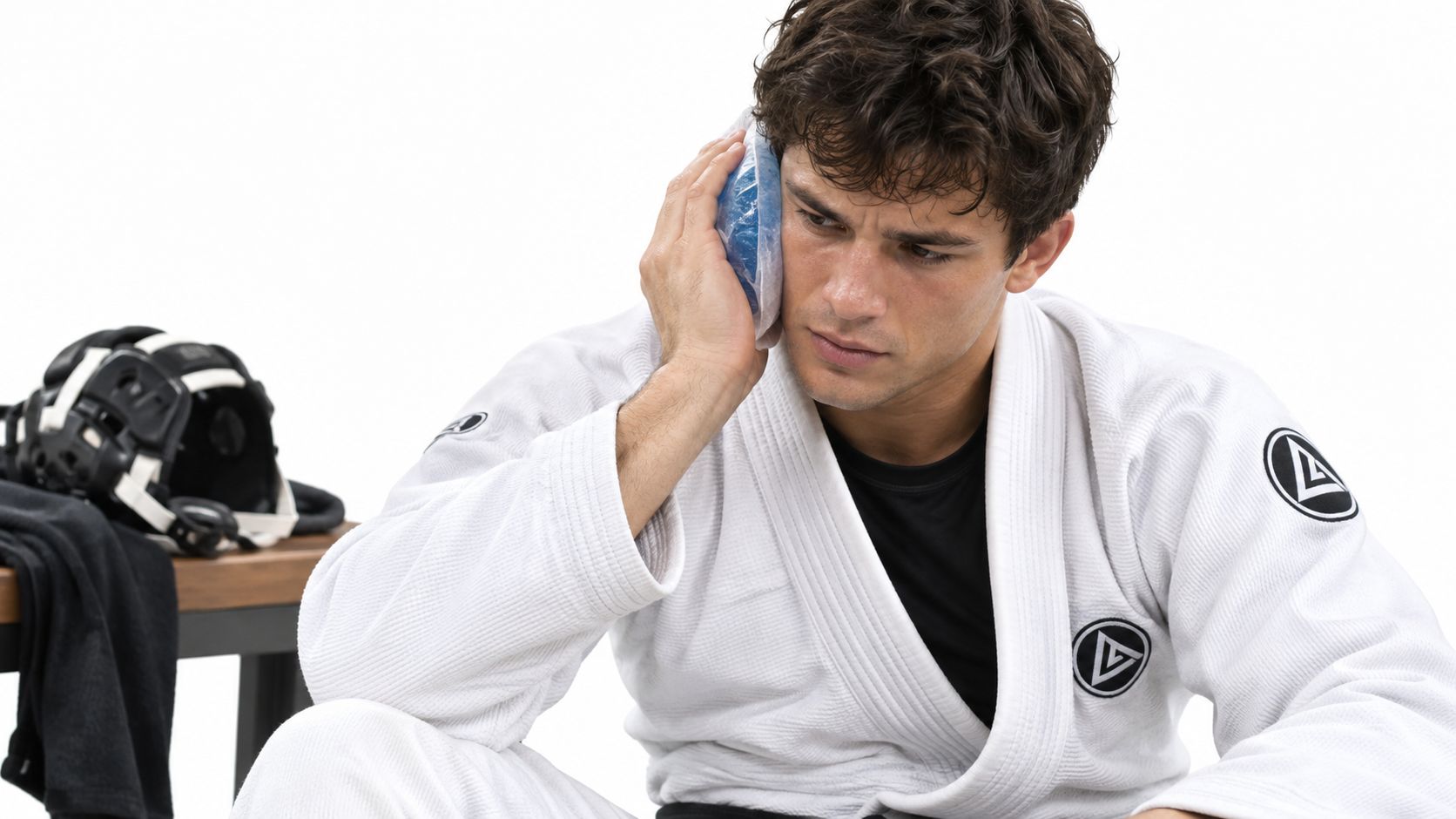
You finish a hard round, peel your headgear off, and one ear feels hot, puffy, and weirdly squishy. By the time you get to the locker room mirror, that small swelling looks more obvious. Most BJJ people have heard the same bad advice at this point: ice it, tough it out, maybe drain it yourself.
That's how a treatable mat injury turns into a permanent ear deformity.
If you're trying to learn how to fix cauliflower ear, start with one rule: you're usually not “fixing” the final ear shape at home. You're trying to treat an auricular hematoma early enough that the ear doesn't become cauliflower ear in the first place. Once the ear hardens and new tissue forms, home care won't reverse it.
Table of Contents
- What Cauliflower Ear Really Is and Why Quick Action Matters
- Immediate First Aid and When to Seek Professional Care
- How Timing and Size Determine Your Treatment Options
- What Doctors Do to Fix Cauliflower Ear and How Aftercare Prevents Recurrence
- How BJJ Athletes Prevent Cauliflower Ear on the Mat
- Finding Qualified Care and Choosing a Safer BJJ Academy
What Cauliflower Ear Really Is and Why Quick Action Matters
You finish a round, your ear feels warm and swollen, and by dinner it looks a little thicker than the other side. For a BJJ athlete, that is usually the start of a clock, not just a weird-looking ear.
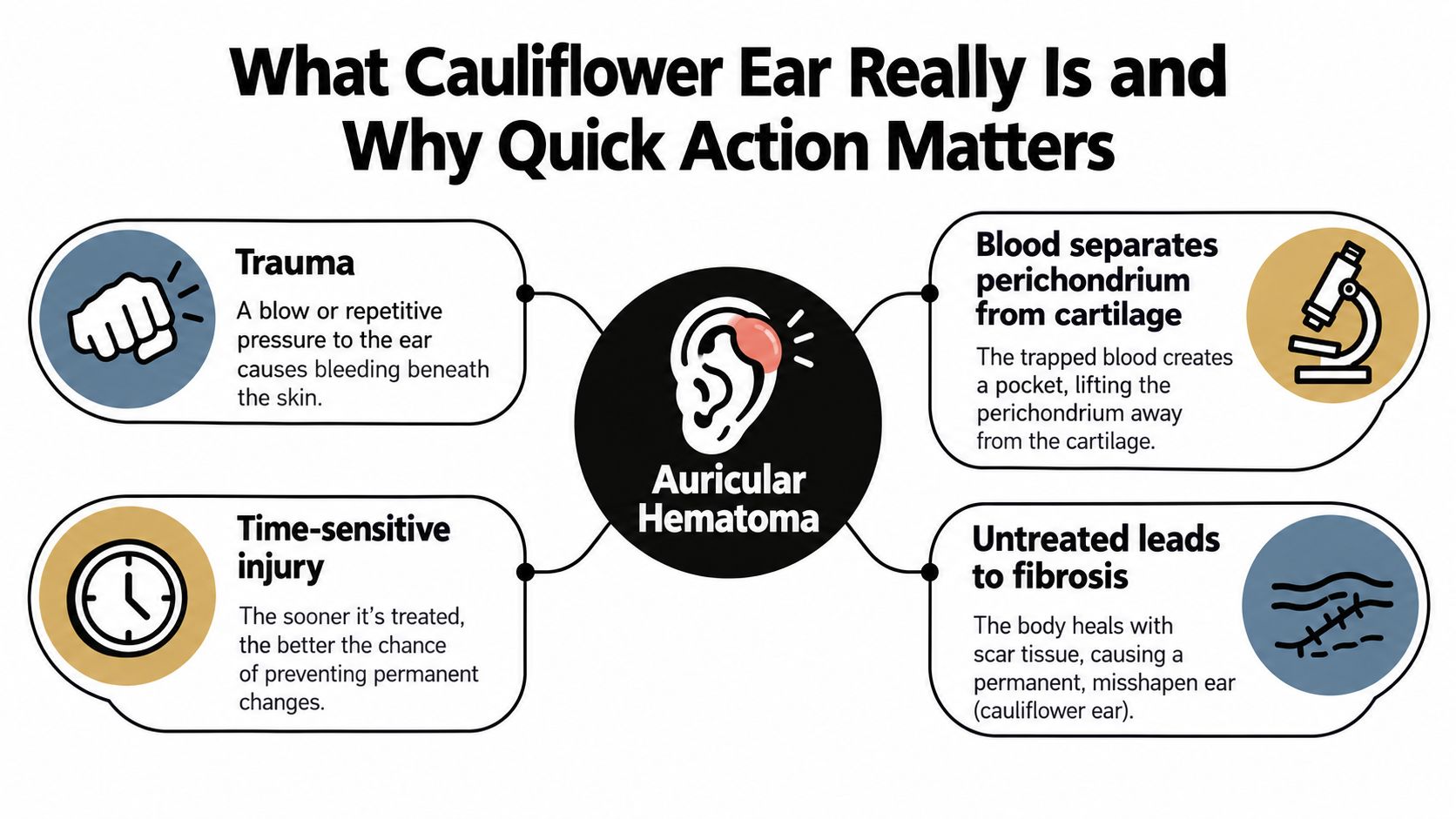
Cauliflower ear usually does not begin as “cauliflower ear.” It starts as an auricular hematoma. That means blood has collected between the ear cartilage and the thin tissue layer that feeds it. Standard medical references describe cauliflower ear as the result of an untreated auricular hematoma, with early drainage and compression used to reduce the chance of permanent deformity (StatPearls on auricular hematoma).
What's happening inside the ear
The outer ear is cartilage covered by a thin layer of tissue and skin. On the mat, repeated rubbing, folding, or a blunt hit can separate those layers, like lifting wallpaper just enough for fluid to collect underneath. Once blood fills that space, the cartilage loses close contact with the tissue that supports it.
That is why the early swelling often feels soft, springy, or fluid-filled. Later, it can feel thicker and firmer as the blood starts to organize and the body lays down scar tissue. Once that process gets going, the ear is more likely to keep a lumpy, hardened shape.
If you want more detail on what causes that shearing injury in grappling, this guide to the causes of cauliflower ear gives useful mat-specific examples.
Why the timeline matters
For BJJ athletes, it helps to use a simple decision tree.
Same day: fresh, soft swelling after training needs prompt medical assessment. This is the window where treatment is often most straightforward because the blood is still acting like a fluid pocket.
Within 48 hours: you may still have treatment options, but the collection can become harder to fully remove, and the ear may refill more easily if it is not managed well.
Around 7 days or later: the problem may be shifting from a drainable fluid collection to early scar and deformity. At that point, “fixing” the ear often means specialist evaluation rather than simple home care.
Those time windows are not magic cutoffs, but they are useful for making better decisions fast.
Why compression determines whether it comes back
A lot of athletes focus only on drainage. The bigger issue is what happens after the fluid comes out. If the skin and tissue are not pressed back evenly against the cartilage, that empty space can fill again, just like a pocket in a gi that keeps opening if you do not pin it flat.
That is why recurrence is so common after bad self-treatment. The goal is not just to remove blood. The goal is to remove it and keep the layers in contact while they heal. Poor compression, uneven pressure, continued training, or pressure points from sloppy dressings can all set up the same problem again.
One practical rule stays the same: soft swelling after ear trauma deserves medical attention early, before it turns into a shape problem instead of a fluid problem.
Immediate First Aid and When to Seek Professional Care
The first few hours matter. You don't need to panic, but you do need to act like this is an injury that can worsen if you keep training on it.
What to do right away
Start with the basics:
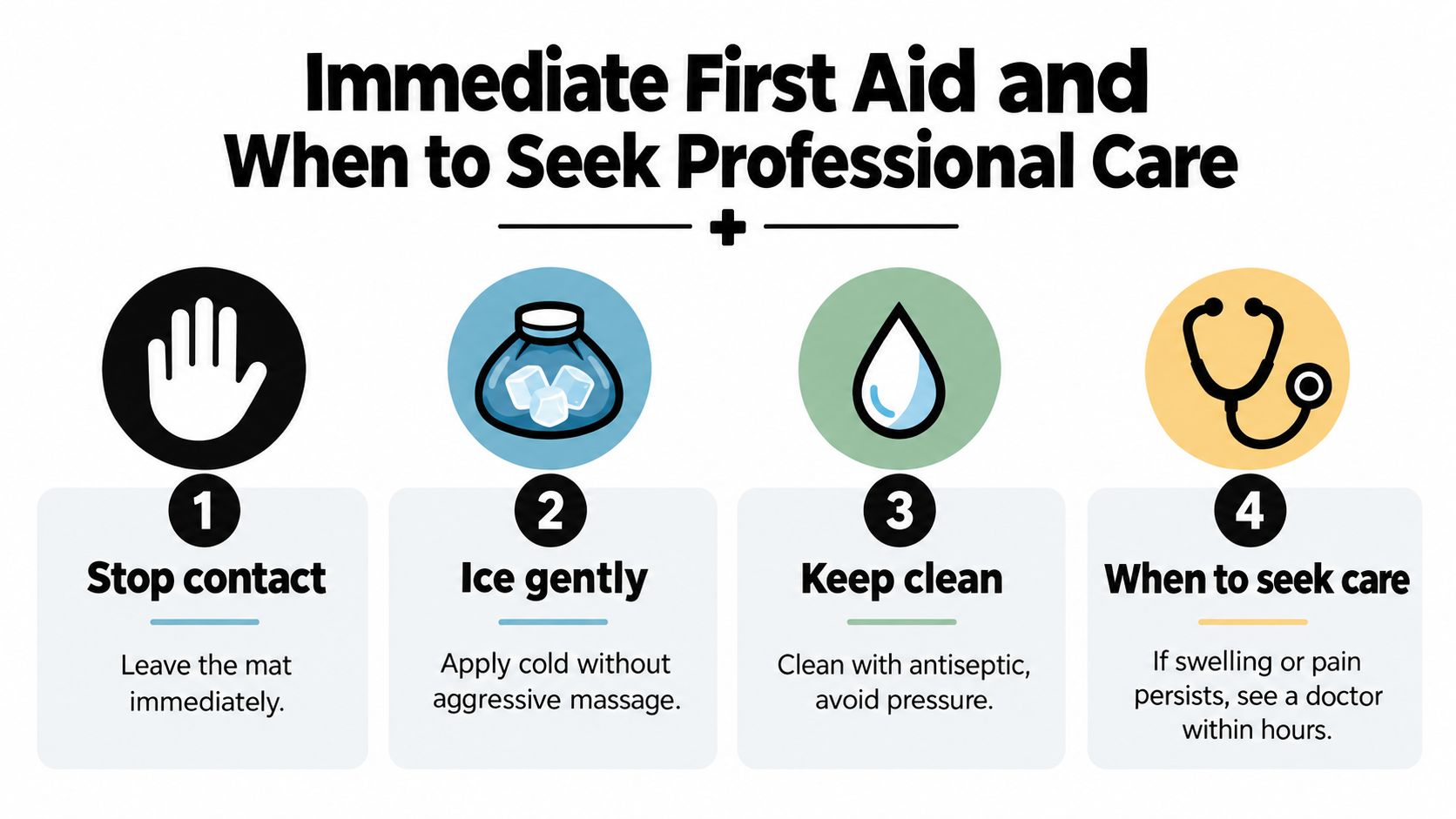
- Stop rolling immediately. More friction and pressure can enlarge the swelling.
- Use cold gently. An ice pack wrapped in cloth can help calm swelling. Don't grind the ice into the ear and don't massage it.
- Keep the area clean. If the skin is scraped, wash it gently. Don't put random gym tape, dirty gauze, or shared gear against it.
- Note the time of injury. A doctor will want to know when the swelling started and whether it's gotten bigger.
- Don't puncture it yourself. Self-drainage in a bathroom or locker room creates infection risk and often fails because the ear isn't properly compressed afterward.
For younger athletes, or for parents trying to make good decisions after practice, these youth sports physiotherapy tips from Vanta Sports are a solid reminder that early assessment and load management matter across sports injuries, not just knee and ankle problems.
How to recognize an auricular hematoma
People miss this because the ear may not look dramatic at first. Watch for:
- New swelling after training or impact
- Tenderness or warmth over part of the outer ear
- A soft, fluid-like feel rather than just soreness
- Increasing fullness over the next few hours
A bruise alone is different from a fluid collection. If the ear looks thicker and feels like something is trapped under the skin, that deserves professional assessment.
Same day urgent care or next day specialist
Here's the decision tree I give athletes.
| Situation | Best next step | Why |
|---|---|---|
| Fresh swelling that's soft and growing | Same-day urgent care, sports medicine, ENT, or emergency department | Early drainage may still be straightforward |
| Ear was injured recently but swelling is stable and you can get seen quickly | Call an ENT or plastic surgery office for the soonest visit | Some clinics can handle this with better follow-up options |
| Recurrent swelling after prior drainage | ENT or plastic surgery | Recurrence often means the ear needs better compression planning |
| Ear is hot, very painful, draining, or you feel unwell | Urgent medical evaluation | Infection needs prompt assessment |
If the ear is swelling after trauma, same-day care beats “let's see how it looks tomorrow.”
Red flags you shouldn't play through
Get prompt care if any of these show up:
- Rapid expansion of the swelling
- Severe pain that keeps building
- Skin color changes that worry you
- Fever, drainage, or spreading redness
- A very hard ear after swelling has been present for a while
- A return of swelling after someone already drained it
Bring useful information with you. Tell the clinician when it happened, whether the swelling stayed soft or turned firm, whether you've had prior cauliflower ear, and whether you have a tournament or contact training planned soon. That makes the treatment discussion much more practical.
How Timing and Size Determine Your Treatment Options
You finish the round, pull off your headgear, and your ear feels puffy instead of just sore. At that point, the clock matters almost as much as the swelling itself. A fresh, soft pocket of blood behaves differently from an older, firmer one, and that difference changes what a clinician can realistically do.
The practical treatment windows
For BJJ athletes, the easiest way to sort this out is by treatment window.
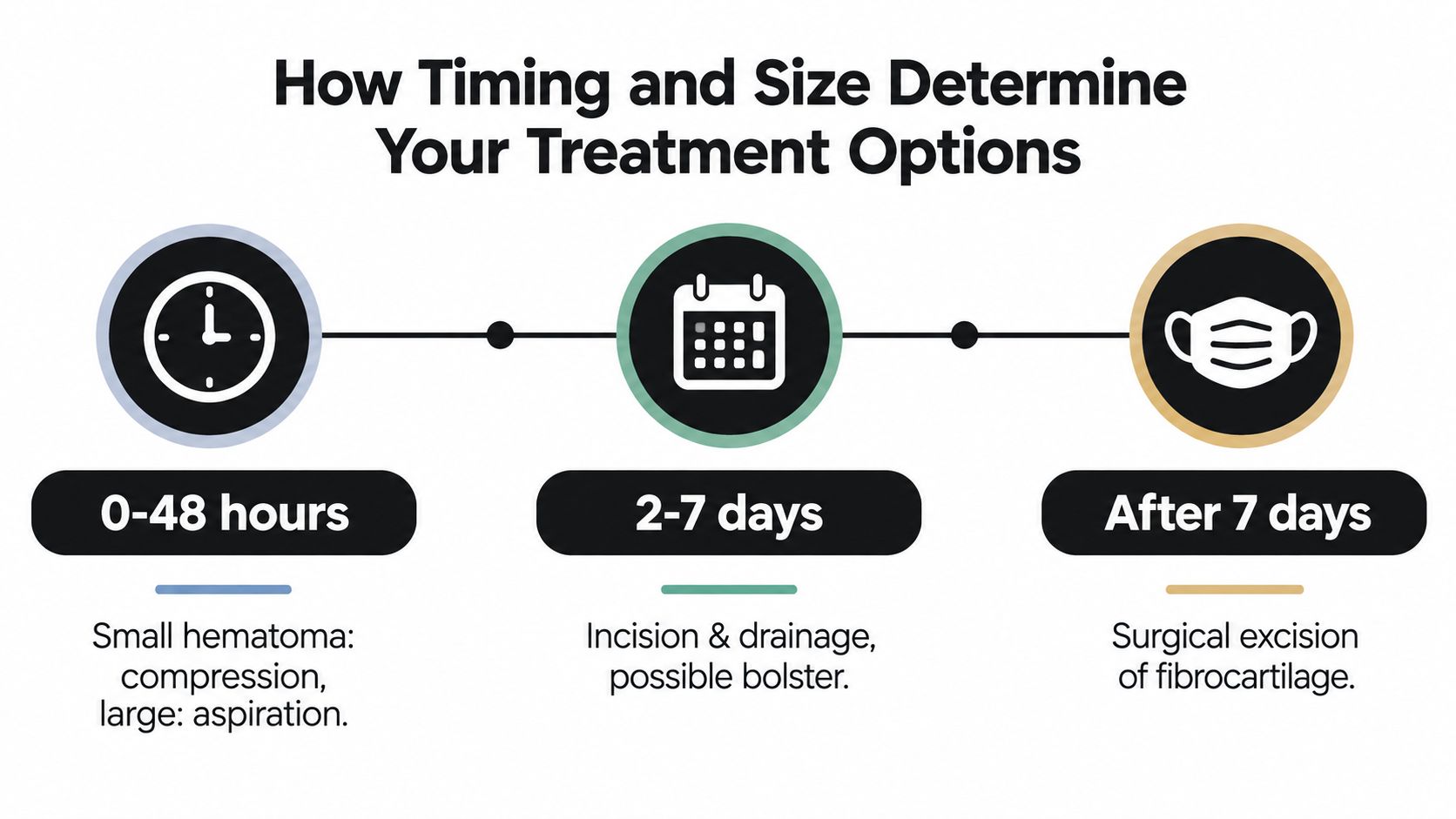
Same day to 48 hours: the swelling is more likely to still act like a fresh fluid collection. If it is small and clearly soft, a clinician may consider needle aspiration. If it is larger, under tension, or awkwardly shaped, a more controlled drainage approach may be a better fit.
48 hours to 7 days: the blood can start to thicken and cling to the tissue planes. That makes simple aspiration less predictable, even if the ear still looks swollen. A review in Cureus describes early drainage as the priority, with treatment ideally in the first 48 hours and within 7 days when possible, followed by several days of compression to limit reaccumulation (review of auricular hematoma management).
After 7 days: the conversation often changes. The ear may no longer contain a simple drainable pocket. It may feel firm, irregular, or partly set in place. At that stage, specialist assessment becomes more important because the problem is shifting from fresh blood under the skin to tissue change and cartilage distortion.
Why size changes the method
Size matters because a small pocket is easier to fully empty and compress than a broad one.
A small, recent swelling may respond to aspiration. A larger collection, a recurrent one, or a swelling that has started to organize often pushes clinicians toward incision and drainage instead. Sports medicine guidance from Nationwide Children's notes that larger hematomas and injuries that are not treated promptly can require more involved management to prevent deformity (auricular hematoma overview).
That pattern makes sense on the mat and in the clinic. A tiny bubble of fluid is one problem. A wide sheet of blood peeled away from the cartilage is another. The second one is harder to clear completely, and any blood left behind can collect again.
A simple decision tree for athletes
Use this as a practical guide, not a self-treatment plan:
| Time since injury | What the swelling feels like | What the doctor may consider |
|---|---|---|
| Same day | Soft, fluctuant, still expanding | Fast evaluation. Drainage method depends on size and shape |
| Within 48 hours | Still soft, maybe tense | Aspiration for selected small cases, incision and drainage for larger or less straightforward ones |
| 2 to 7 days | Less mobile, thicker, harder to fully empty | Drainage may still be possible, but simple aspiration is less reliable |
| After 7 days | Firm, uneven, partly set | ENT, plastics, or another experienced specialist is more likely to guide next steps |
Why recurrence often comes down to compression
Athletes usually focus on the drainage. Clinicians worry just as much about what happens right after.
The ear has very little room for error here. Once the blood is removed, the skin has to be pressed back down against the cartilage so the space cannot refill. Compression works like putting two wet surfaces back together so no pocket stays between them. If the pressure is uneven, too loose, or removed too early, the space can reopen and the ear can swell again.
That is why two athletes with the same injury can get very different results. One gets the collection evacuated and the ear is compressed evenly for the full aftercare period. The other gets fluid removed but has poor contour match, a shifting dressing, or no clear follow-up. Recurrence is much more likely in the second case.
A timing-focused discussion in the facial plastic surgery literature also points out that established cauliflower ear may require reconstruction rather than simple drainage, especially once cartilage changes are in place (discussion of delayed care and reconstruction).
If your ear is already hard and lumpy rather than soft and drainable, you are usually past the simple first-aid window.
A short walk-through helps if you want to hear a clinician explain common management points:
What Doctors Do to Fix Cauliflower Ear and How Aftercare Prevents Recurrence
You get your ear drained, feel the pressure drop, and assume the problem is handled. On the mat, that is often the moment people make the mistake. The procedure is only half the job. Keeping the skin pressed back onto the cartilage is what gives the ear a chance to heal flat instead of filling up again.
What happens in the clinic
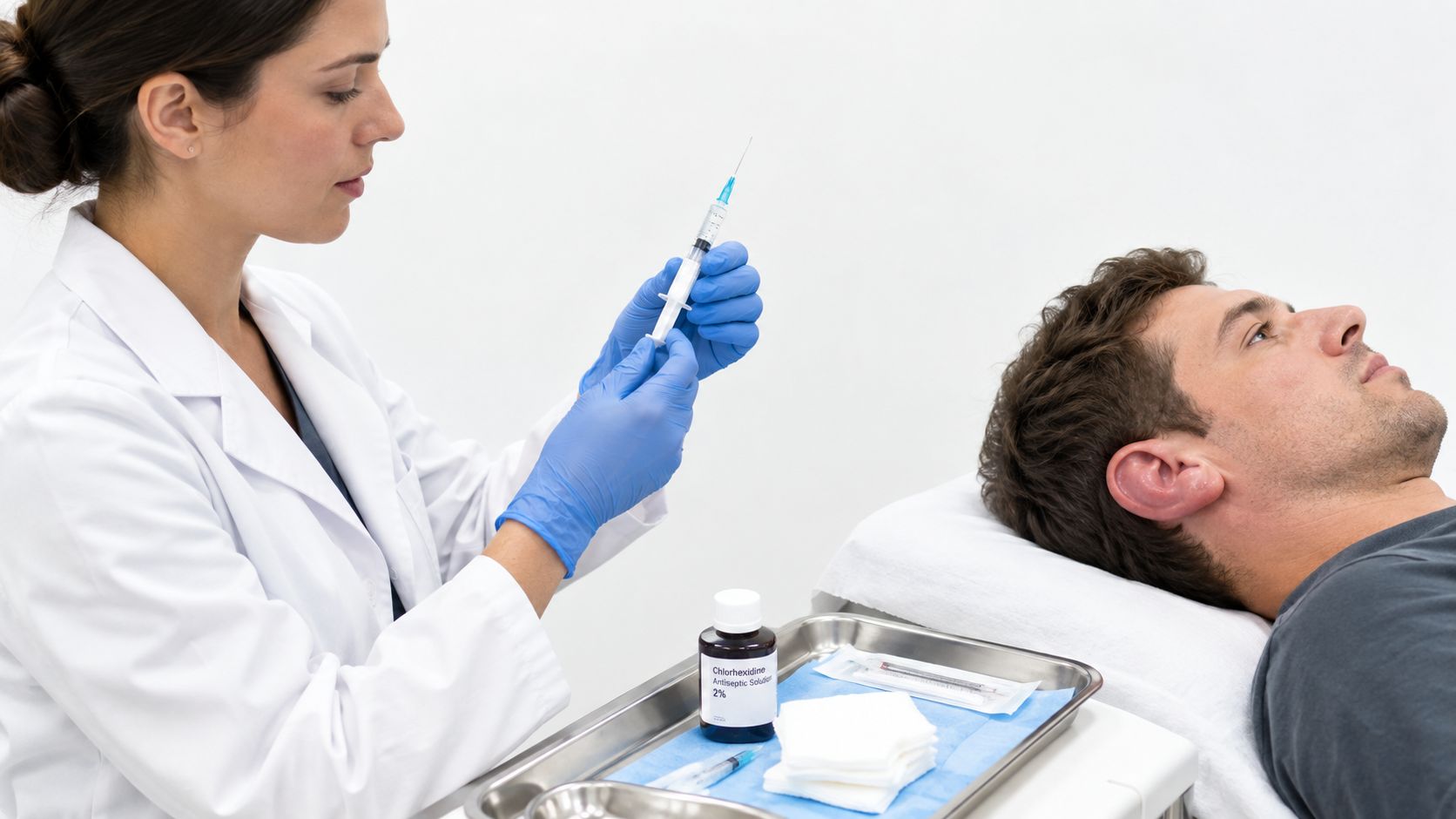
For a soft, recent swelling, the visit is usually straightforward. The clinician examines the ear, numbs it, removes the collected blood, and then applies a method to keep the layers of the ear from separating again. Small, early collections may be treated with a needle. Larger, older, or repeat swellings more often need a small incision so the pocket can be emptied more fully.
The part BJJ athletes tend to underestimate is the last step.
Doctors are not just removing fluid. They are trying to collapse a space. A drained ear without reliable compression is like closing a gi jacket without tying the belt. It may look fine for a minute, then everything shifts.
Why compression often decides whether it comes back
After drainage, the skin has to stay in contact with the cartilage long enough for that space to seal down. If pressure is uneven, if the dressing slides, or if the contour does not match the curves of the ear, blood can collect again.
That is why recurrence is often a technique problem, not just a timing problem. Good clinicians pay close attention to how the ear is compressed, what material is used, and when they want to see you back. Studies comparing post-drainage methods have found lower recurrence when the compression method is more secure and better matched to the ear's shape (comparison of drainage and compression approaches).
A smart question to ask before the procedure is simple: “How are you going to keep this compressed, and when do you want to recheck it?”
What aftercare usually looks like for a grappler
The same time-based decision tree still matters here.
In the same-day window, aftercare is about protecting a fresh repair. In the 48-hour window, it is about catching early reaccumulation before the ear hardens. By 7 days, the concern shifts toward whether the result is holding or whether you are dealing with a more established deformity that may need a different plan.
Your job after treatment is usually very plain:
- Keep the dressing in place unless the clinician gives different instructions.
- Go to the follow-up visit, even if the ear looks much better.
- Stay off contact training for the period your clinician recommends.
- Watch for red flags such as increasing pain, fever, drainage, foul odor, spreading redness, or new swelling under the dressing.
Some clinicians also prescribe antibiotics after drainage, especially when they are concerned about cartilage infection risk or skin injury. The exact plan varies by the ear, the procedure, and your exam.
If you train BJJ, ask a practical return-to-mat question before you leave: “What would make you tell me I am not ready to spar yet?” That usually gets a clearer answer than asking for a generic timeline.
When “fixing” means reconstruction
Once the ear is hard, lumpy, and no longer acting like a fluid pocket, simple drainage is often no longer the main conversation. At that stage, the goal may be to improve an established shape change rather than to empty a fresh hematoma.
If you are trying to understand what reconstructive options can involve, a patient-facing overview of Ideal Face & Body ear surgery can help you get oriented before you speak with an ENT or plastic surgeon.
Use that kind of page as background only. The decision depends on how old the injury is, how much cartilage change is present, whether the ear still has active swelling, and what result is realistically possible.
How BJJ Athletes Prevent Cauliflower Ear on the Mat
Treatment matters. Prevention is still easier.
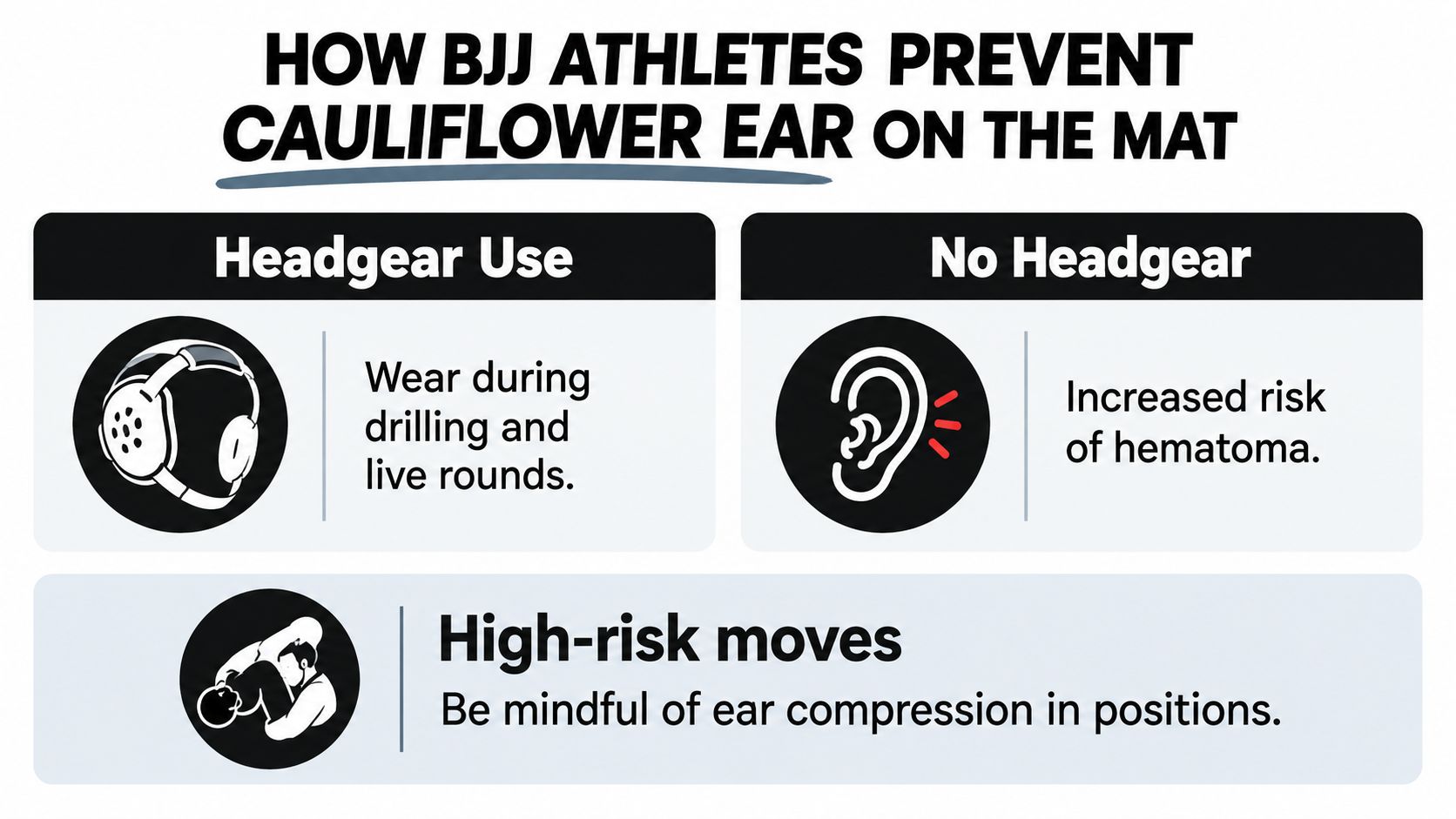
In wrestling populations, ear protection has been reported to cut auricular hematoma incidence to 50%, which is a strong reminder that protective habits can make a real difference before you ever need a doctor (StatPearls on auricular hematoma).
What works best in daily training
The athletes who preserve their ears usually do boring things consistently.
- Wear headgear for the right sessions. Hard wrestling rounds, heavy snap-down drilling, and scramble-heavy no-gi sessions are common times to use it.
- Get the fit right. Loose headgear shifts and creates its own friction. Overly tight gear can create pressure points.
- Change how you use your head. If you constantly post your ear on the mat or drive with poor head position, you're creating repeat trauma.
- Pause when the ear gets sore or puffy. Waiting for obvious deformity is late.
- Keep drained ears clean. Once the skin barrier has been disturbed, gym hygiene matters even more.
How to vet a safer academy
Some gyms produce more ear injuries than others. The issue isn't whether people train hard. It's whether the room has habits that reduce stupid damage.
Look for these signals:
| Gym signal | What it usually means |
|---|---|
| Coach stops reckless rounds | Less avoidable head and ear trauma |
| Beginners are taught to reset posture | Fewer wild scrambles and folded ears |
| Headgear is accepted, not mocked | Lower pressure to ignore early swelling |
| People stay home after drainage | Better injury culture and hygiene |
| Kids' classes are controlled, not chaotic | Safer for young ears and better supervision |
BJJ Cauliflower Ear Prevention Options Compared
| Prevention Method | When to Use | Key Benefit |
|---|---|---|
| Wrestling-style headgear | Hard drilling, takedown rounds, scramble-heavy sessions | Reduces direct friction and compression |
| Technical head positioning | Every class | Lowers repeated ear folding during common movements |
| Early rest after swelling | As soon as ear irritation starts | Prevents a minor issue from becoming a hematoma |
| Training partner selection | Open mat, comp class, travel training | Helps avoid reckless pace and unnecessary collisions |
| Academy safety policies | Before joining a gym | Shapes the whole injury environment |
If you want a grappling-specific overview of warning signs and prevention habits, this guide on cauliflower ear in BJJ is worth reading before your next hard week of training.
Finding Qualified Care and Choosing a Safer BJJ Academy
The cleanest plan is simple. If your ear is freshly swollen and feels drainable, seek same-day medical care. If the problem is delayed, recurrent, or already hard, look for ENT or plastic surgery input. When you call, ask direct questions: Do you treat auricular hematomas, what compression method do you use, and when is follow-up scheduled?
Those questions matter because technique and follow-up change outcomes. You're not being difficult. You're making sure the ear doesn't refill as soon as you walk out.
On the gym side, safety screening helps more than people think. If you're relocating, traveling, or helping a child start training, compare academies by whether they publish clear contact details, kids' program information, and reviews that mention coaching style and mat control. A directory can help you organize that search. In the article body, one practical option is the how to choose a BJJ gym guide, which lays out what to check before you commit to a school.
A good academy doesn't just build tough athletes. It builds athletes who report injuries early and get them handled properly.
The culture piece matters. If a room treats ear swelling as a joke, people delay care. If a coach tells athletes to get checked, wear headgear if needed, and sit out when the ear is vulnerable, fewer small injuries become permanent ones.
If you remember one thing, make it this: the safest way to fix cauliflower ear is usually to treat the hematoma before it becomes cauliflower ear.
Brazilian Jiu-Jitsu injuries get easier to manage when you train in the right environment and know where to look before problems start. Brazilian Jiu-Jitsu Academy Finder helps you compare U.S. academies by location, contact details, and community feedback so you can find a gym with the culture and structure that supports safer long-term training.
Tags
Share this article