
Ultimate Guide to Visualization in BJJ
Vivid mental rehearsal builds BJJ muscle memory—5–10 minutes daily of internal and external visualization sharpens technique, timing, and competition calm.
Written by BJJ Academy Finder Editorial Team
Ultimate Guide to Visualization in BJJ
Visualization in Brazilian Jiu-Jitsu (BJJ) is a mental practice where you rehearse techniques, transitions, and strategies in your mind to improve your skills. Here's why it works and how to use it:
- Why It Works: Visualization activates the same neural pathways as physical training, strengthening your muscle memory and coordination. Studies show it can improve performance even without physical movement.
- How to Do It: Focus on techniques you’ve practiced, break them into steps, and mentally rehearse them while engaging all your senses (feel, sound, and even smell). Use both first-person (internal) and third-person (external) perspectives for a complete mental picture.
- When to Practice: Right after training, before bed, or during injury recovery. Just 5–10 minutes daily can reinforce your skills.
- Advanced Tips: Visualize dynamic scenarios, like counters and transitions, and mentally prepare for competitions by simulating the entire experience.
Visualization doesn’t replace physical training but complements it, which you can do at a top-rated BJJ gym nearby, helping you refine your techniques, stay sharp during rest, and prepare for high-pressure situations.
Use The Force: Visualisation For BJJ
sbb-itb-d583f1e
The Science Behind Visualization in BJJ
Internal vs External Visualization Techniques in BJJ
How Visualization Activates Your Brain
Picture yourself locking in a triangle choke or pulling off a smooth sweep. Your brain isn't just indulging in idle thoughts - it’s engaging the same neural pathways that fire during actual training. This phenomenon, called functional equivalence, shows how imagined movements and real ones are surprisingly alike in how the brain processes them [5][6].
When you visualize, areas like the premotor cortex, supplementary motor area, and cerebellum spring into action. These regions are responsible for planning, sequencing, and refining movements. What's fascinating is that studies using EMG (electromyography) have shown low-level muscle activity during visualization. Essentially, your muscles are "practicing" even though you're not physically moving [5][6].
Take this as an example: in 2004, researchers at the Cleveland Clinic Foundation asked participants to mentally rehearse flexing their pinky fingers for 15 minutes a day, five days a week, over 12 weeks. The result? Their muscle strength increased by 35%, while a control group showed no gains [5]. This proves that mental rehearsal isn’t just in your head - it can lead to real physical improvement.
Visualization also engages the insula, a brain region tied to spatial awareness and proprioception (your sense of body position). This activation helps you become more aware of your movements and surroundings, which is crucial in BJJ.
By understanding how visualization works at a neurological level, you can see why different visualization techniques can sharpen both your technical skills and tactical awareness.
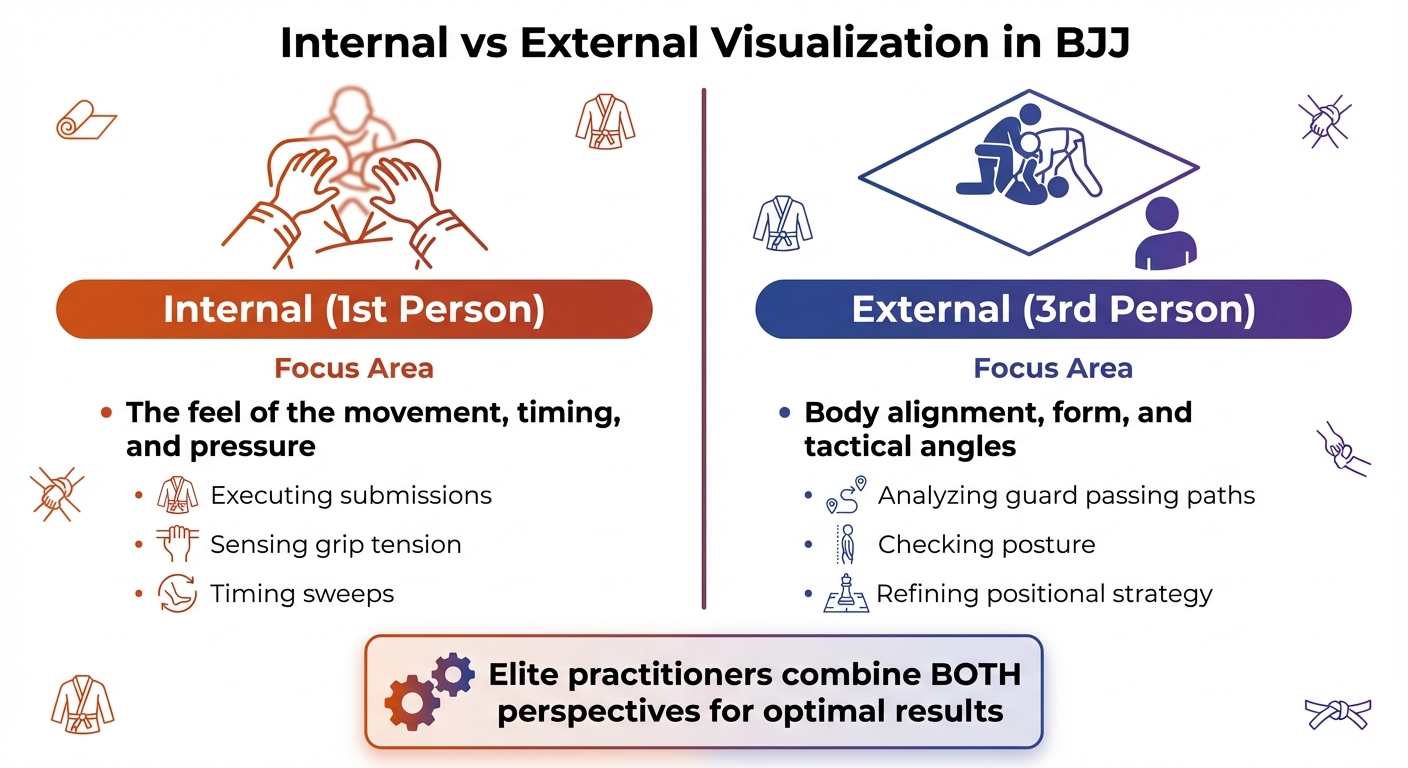
Internal vs. External Visualization
Visualization isn’t a one-size-fits-all technique. The perspective you take - internal (first-person) or external (third-person) - can shape the specific skills you develop.
Internal visualization puts you in the moment, seeing through your own eyes as if you’re performing the technique. This perspective emphasizes the feel of the movement: the texture of the gi, the pressure of your opponent, the tension in a submission. It’s perfect for mastering timing and physical sensations.
On the other hand, external visualization is like watching a video of yourself. This perspective helps you analyze your form, check body alignment, and understand tactical positioning. It’s especially useful for spotting technical mistakes, like misaligned hips during a guard pass or improper elbow positioning.
| Perspective | Focus | Best BJJ Applications |
|---|---|---|
| Internal (1st Person) | The feel of the movement, timing, and pressure | Executing submissions, sensing grip tension, timing sweeps |
| External (3rd Person) | Body alignment, form, and tactical angles | Analyzing guard passing paths, checking posture, refining positional strategy |
Elite BJJ practitioners often combine both perspectives. They use internal visualization to perfect the kinesthetic feel of a technique and external visualization to critique their form and strategy. This blend creates a solid mental blueprint, speeding up the learning process [5].
Visualization Techniques for Beginners
When it comes to mental rehearsal, starting with the basics can make a big difference. These beginner-friendly techniques are designed to help you ease into visualization while reinforcing what your body already knows.
How to Start Visualizing Techniques
Begin by focusing on techniques you’ve already practiced. Visualization works best when it builds on movements your body is familiar with. Find a quiet spot where you can sit or lie down comfortably, and take a few deep breaths to clear your mind.
Pick a technique you’ve recently drilled - something like an armbar or a triangle choke. Break it down into smaller steps: the initial grip, shifting your hips, adjusting your angle, and finally, executing the move. This step-by-step focus helps you create a clear mental image of the process.
Engage all your senses to make the visualization feel real. Imagine the texture of the gi, the weight of your opponent, and even the friction of the mat beneath you. Picture the sound of steady breathing and the familiar smells of your training space. Start by visualizing the technique at full speed to simulate reaction time, then slow it down to focus on refining each detail. Don’t just picture everything going perfectly - practice mentally recovering from mistakes or responding to counters. This prepares you for the unpredictability of live sparring.
Building a Daily Visualization Practice
The secret to effective visualization is consistency. Instead of long, occasional sessions, aim for 5–10 minutes of focused practice every day. You can easily weave this into your routine, like right after training or before bed, to reinforce what you’ve learned and improve memory retention.
The best times to visualize are right after class, while the details are fresh, or just before sleep, when your mind is relaxed and ready to process new information. After class, mental rehearsal helps solidify the day’s lessons, while bedtime visualization can aid in memory consolidation. As you progress, adjust your mental practice to include more advanced transitions and scenarios. This ensures your visualization evolves alongside your skills on the mat.
Advanced Visualization Strategies
Once you've mastered basic visualization, it's time to tackle more complex scenarios that mirror the unpredictability of real matches. These advanced strategies emphasize dynamic problem-solving, helping you prepare for the unexpected and adapt quickly under pressure.
Visualizing Dynamic Scenarios
What sets advanced visualization apart is how you prepare for uncertainty. Instead of only imagining flawless technique execution, focus on mental rehearsals that include "if-then" scenarios - what you'll do if your opponent counters, defends, or escapes. This type of mental training sharpens your ability to recognize patterns and react instinctively during actual matches [8][3].
Start by visualizing how opponents might defend against your favorite techniques. For instance, if you're setting up an armbar from guard, picture your opponent countering. Then, mentally rehearse your follow-ups: transitioning to a triangle, switching to an omoplata, or sweeping to mount. Research indicates that mental imagery activates the same neural pathways as physical movement, which strengthens your timing and execution [8][4].
Another effective tactic is to focus on submissions during transitions, rather than waiting for stable positions. Imagine securing a choke while your opponent is busy defending hooks during a back take. This approach can leave you in a dominant position with most of the submission already locked in [9]. To make this practice even more effective, visualize these moments at real-time speed - studies show that rehearsing at competition tempo is more likely to translate into live performance than slow-motion mental practice [5].
When mistakes happen during visualization, don't restart the scenario. Instead, practice recovering from those errors. This builds the adaptability you'll need when things don't go as planned in sparring or competition. Once you're comfortable with these dynamic rehearsals, you can expand them into full mental simulations of competition settings.
Mental Preparation for Competitions
Dynamic visualization is a stepping stone to preparing mentally for the intensity of competition. This goes beyond techniques - it's about simulating the entire experience, from stepping onto the mat to the final moments of the match.
Picture yourself entering the competition area: feel the texture of your gi, hear the sounds of the crowd and referee, and take in the atmosphere of the event. Use box breathing (inhale for 4 seconds, hold for 4, exhale for 4, pause for 4) to stay calm and focused under pressure. Incorporating these sensory details makes your mental rehearsal feel more real, priming your mind and body for the actual event [7][4].
Walk through your match strategy in your mind. Visualize the grip fight, your preferred takedown or guard pull, and how you'll stay composed if you fall behind on points. Imagine using tactical breathing to maintain focus during high-pressure exchanges [7].
In the week leading up to a tournament, you might want to increase your mental rehearsal while scaling back physical training. This allows you to stay sharp without risking injury or fatigue [7]. While physical preparation is essential, consistent mental practice can make a noticeable difference in your performance.
Adding Visualization to Your Training Routine
Incorporating visualization into your training routine can have a lasting impact when done consistently. The timing of these sessions is just as important as the techniques themselves. Short, regular practice helps reinforce neural pathways and supports skill retention [5].
When to Practice Visualization
Right after class is one of the best times to visualize. Your body is still warm, and the techniques you just practiced are fresh in your mind. Mentally rehearsing these moves for a few extra repetitions strengthens muscle memory and locks in what you’ve learned [1].
Before sleep and upon waking are also excellent moments for focused visualization. Studies suggest that mental rehearsal during these states helps solidify motor patterns [5].
Before training or competition, you can use visualization to mentally rehearse strategies, which helps prepare your body and ease pre-performance anxiety [5].
During injury recovery or overtraining, visualization becomes a powerful tool for maintaining muscle memory while your body takes the time it needs to heal [3].
By practicing visualization during these key moments, you can seamlessly connect mental rehearsal with your physical training, making it a valuable part of your development.
Common Visualization Mistakes to Avoid
One of the most common mistakes is being too vague. Instead of imagining yourself simply "winning" or "doing well", focus on specific details - like grip placement, hip positioning, or the timing of a sweep. Visualization is most effective when it reinforces movements you’ve already practiced on the mat [4]. Beginners often struggle with visualizing techniques they haven’t physically drilled, which can limit its effectiveness.
Rushing through sequences is another pitfall. Visualization works best when you take your time to carefully picture each movement in detail [4]. Additionally, only imagining perfect outcomes can leave you unprepared for the unpredictable nature of live training. Rehearsing challenging scenarios - like escaping submissions, recovering from a bad position, or adapting to a missed opportunity - helps build resilience and adaptability [5].
Another issue is treating visualization as a substitute for physical training. As RollBliss explains:
Visualization complements but does not replace physical training. It strengthens mental pathways, but live drilling and rolling are still necessary [1].
Finally, inconsistency can derail progress. Making visualization a daily habit, even for just 5 minutes, is far more effective than doing a single 30-minute session once a week [1]. Regular practice ensures steady improvement and greater integration with your overall training.
Conclusion
Visualization taps into the brain's pathways for physical movement, strengthening the neural connections tied to timing, positioning, and coordination [1][4]. And when it comes to progress, consistency wins every time over sporadic effort.
You don’t need hour-long sessions to see results. Short, focused sessions - just 5–10 minutes a day - are far more effective than occasional marathon practices. With regularity, you’ll notice smoother transitions and quicker reactions in just a matter of weeks [5][4]. The brain treats vivid mental practice as if it were physical repetition, reinforcing muscle memory along the way.
The best visualization techniques go beyond just seeing the moves. Engage all your senses and emotions. Picture the texture of your gi, hear the rhythm of your breathing, and even feel the nerves you might experience during competition [2]. Don’t just imagine flawless victories - mentally rehearse how you’d recover from tough spots or missed chances [5]. This balanced approach ensures that your mental training aligns with the realities of the mat.
While physical drilling is irreplaceable, mental rehearsal offers a way to keep sharpening your skills during rest, recovery, or even injury. As RollBliss puts it:
Visualization activates the brain similarly to physical practice, reinforcing technique and timing. [1]
FAQs
How do I know if I’m visualizing correctly?
To make your visualization practice more effective, find a quiet spot where you can concentrate without interruptions. Aim to create mental images that are clear and detailed, focusing on specific techniques or movements. Adding elements of motion and emotion can make these visualizations feel more lifelike and engaging. The key to improving lies in consistency - regular practice will sharpen both the accuracy and impact of your mental imagery.
What techniques should I visualize first as a beginner?
As someone new to Brazilian Jiu-Jitsu, it’s helpful to focus on breaking techniques into smaller, manageable steps. Visualize each movement and position carefully, going step by step in your mind. Start with the basics - positions like the guard, mount, and side control. By mentally rehearsing these foundational moves, you’ll not only understand them better but also improve your execution over time. This method lays the groundwork for your progress in BJJ.
How can I use visualization to handle competition nerves?
Visualization can be a game-changer when it comes to managing competition nerves in Brazilian Jiu-Jitsu. Find a quiet spot, close your eyes, and picture yourself executing techniques flawlessly. Imagine staying calm under pressure and confidently navigating tough competition scenarios. Practicing this kind of mental rehearsal regularly can help ease anxiety, sharpen your focus, and leave you feeling more prepared and self-assured when it’s time to compete.
Related articles
Share this article