
5 Tips for Choosing the Right BJJ Class Schedule
Choose a BJJ schedule that fits your life and goals to build consistency and real progress in training.
Written by BJJ Academy Finder Editorial Team
5 Tips for Choosing the Right BJJ Class Schedule
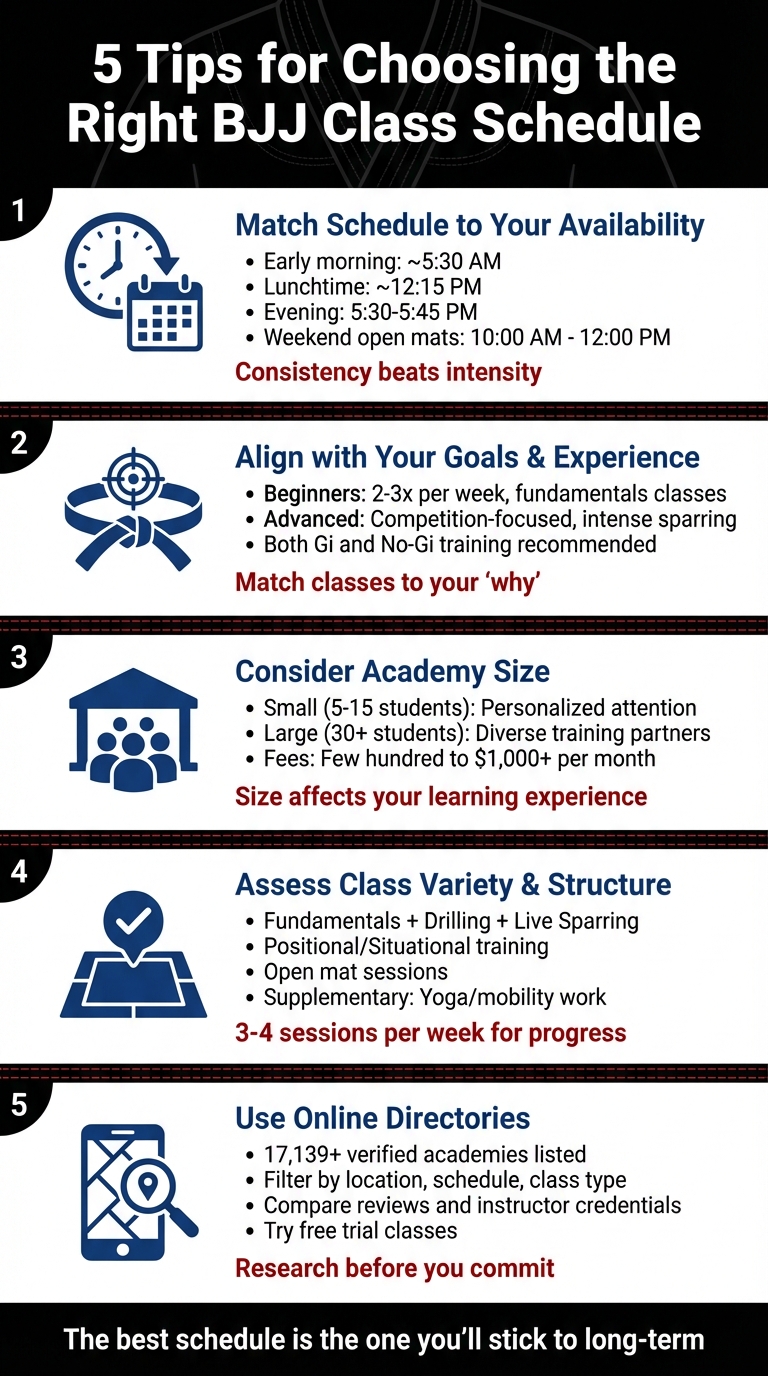
Finding the right Brazilian Jiu-Jitsu (BJJ) class schedule is all about balancing your goals, daily life, and training consistency. The key is to pick a schedule that works for you long-term, not just for a few weeks. Here’s a quick breakdown of the five tips to help you decide:
- Match the schedule to your availability: Choose class times that fit into your routine without disrupting work or family commitments. Early morning, lunchtime, or evening options can help you stay consistent.
- Align with your goals: Beginners should focus on foundational classes, while advanced students or competitors may need sparring-heavy or specialized sessions.
- Consider academy size: Smaller gyms offer personalized attention, while larger ones provide more training partners and diverse programs.
- Check class variety and structure: Look for a mix of drills, sparring, and situational training. Balance gi and no-gi sessions for skill development.
- Use online directories: Tools like the Brazilian Jiu-Jitsu Gyms Directory make comparing schedules, programs, and reviews easier.
Consistency is the secret to progress in BJJ. Choose a schedule that fits your lifestyle and motivates you to keep showing up.
5 Tips for Choosing the Right BJJ Class Schedule
The Perfect BJJ Training Schedule for Beginners
sbb-itb-d583f1e
1. Match the Schedule to Your Personal Availability
Your training schedule should fit seamlessly into your life, avoiding the need for drastic adjustments. The most consistent Brazilian Jiu-Jitsu (BJJ) students aren't always the most skilled - they're the ones who attend regularly because their class times align with their daily routines.
Look for academies that offer a variety of class times, such as early mornings (around 5:30 AM), lunchtime sessions (about 12:15 PM), and evening classes (typically between 5:30–5:45 PM) [6]. Having multiple options makes it easier to adapt when plans change, ensuring you can stick with your training long-term.
For parents, academies with overlapping schedules for kids and adults can be a game-changer. For instance, kids' classes starting at 5:30 PM followed by adult sessions at 5:45 PM [5] eliminate the need for separate trips, making it much easier to manage family commitments. Weekend open mat sessions - often held on Saturdays from 10:00 AM to 12:00 PM - are another great way to supplement your weekday training when you're pressed for time [6]. These thoughtful scheduling options show that some academies are designed to accommodate diverse lifestyles.
"Driving an extra 30 minutes or more to a school with superior instruction, and facility isn't a hassle, it's an investment in your future." - Chad Keel, Eleven Elevation Jiu Jitsu Academy [3]
Before choosing a school, try attending a class at the time you'd typically train to see how it fits your routine [3]. Test the commute during your usual training hours and evaluate your energy levels. A class that feels exhausting after a long workday may not support consistent progress. If group sessions don't work for you, ask about semi-private lessons [7]. The key is finding a schedule you can stick to for the long haul, not just for a few weeks.
2. Align Classes with Your Training Goals and Experience Level
BJJ classes cater to a variety of training goals, so it's important to pick the right one based on what you want to achieve.
Beginners should start with classes labeled as "Fighting Foundations", "Fundamentals", or "Intro to BJJ." These sessions focus on essential movements like shrimping, bridging, and guard retention, combined with partner drills. Training two to three times a week is a good pace to build muscle memory without overdoing it [8][9]. If self-defense is your main reason for training, foundational classes are ideal - they prioritize escapes and positions meant for practical, real-world situations rather than sport-specific techniques [4][10]. As you grow more confident, you can gradually move on to classes that teach advanced techniques and competitive strategies.
For those at an intermediate or advanced level, it's essential to find classes that push your limits. Look for sessions labeled "Beyond the Basics" or "Advanced", which focus on intricate techniques and more intense sparring [9]. If you're aiming to compete, prioritize schedules that include sparring or "Live Rolling" sessions. Additionally, training under instructors from competition-proven lineages like Atos, Checkmat, or Ribeiro can make a difference [10][3]. For example, Mark Zuckerberg earned his BJJ Blue Belt in July 2023 after 12–36 months of consistent training in both Gi and No-Gi formats, alongside competing [1].
"Figure out your reason 'why' and move from there. Do you want this for yourself and your confidence, or is it for weight loss? Only you know." - Stoic Brazilian Jiu Jitsu [10]
Exploring beyond traditional Gi classes can also enhance your skills and adaptability. No-Gi sessions, which use athletic shorts and rash guards instead of the traditional kimono, offer a faster-paced training environment. These classes emphasize body control over grips, making them perfect for diversifying your skills or preparing for submission wrestling competitions [9]. Many academies also host "Open Mat" sessions - unstructured practice times where students of all levels can spar, drill, or refine techniques in a laid-back, community-driven setting [9]. Before committing to a class, take advantage of trial periods to ensure the sparring intensity and class atmosphere align with your goals [4][10].
3. Consider Academy Size and Optimal Class Size
When choosing an academy, its size plays a crucial role in shaping your learning experience. It affects everything from the level of personalized coaching you receive to the variety of sparring partners available.
Smaller academies, generally with fewer than 50 active members and class sizes of 5 to 15 students, are ideal for those seeking individualized attention. In these settings, instructors often have the time to provide tailored feedback and adjust techniques to suit the needs of each student. This approach can speed up your technical development[12].
"With fewer students, small academies may offer flexibility in training formats and schedules. Depending on who is on the mat at any given time, the instructor will be able to tailor techniques for the day."
– Heather Raftery, Kingz[11]
On the other hand, larger academies, which boast 100+ active members and multiple black belt instructors, offer a greater variety of training partners. This diversity - different body types, sizes, and skill levels - is essential for building a versatile skill set. Heather Raftery highlights this benefit:
"The bigger the academy, the more training partners you'll have in any given class. More often than not, you'll get to pick and choose your partners at will."
– Heather Raftery, Kingz[11]
Large gyms often provide additional perks such as women-only classes, competition-focused camps, and strength and conditioning programs[12]. However, they can come with drawbacks, such as crowded classes with 30 or more students, which may make it harder to get individual attention from instructors. Smaller academies, while fostering a close-knit community and consistent training partners, might limit your exposure to different grappling styles. If your priority is high-intensity training with a wide range of opponents, a larger academy might be the right fit. But if direct access to instructors and personalized guidance is what you value most, a smaller gym could be the better choice.
As Marten Tamm from Jitsmagazine wisely points out:
"The 'best' gym is the one you'll actually go to. Don't pick a place that's across town if you know you'll skip classes. Also, check the timetable. Are there enough class times that work for you?"[4]
Trial classes are a great way to gauge the instructor-to-student ratio and the overall atmosphere. Keep in mind that membership fees can range from a few hundred dollars to over $1,000 per month, depending on location and program offerings. Make sure the class size and schedule align with your goals and justify the cost[13].
4. Assess Class Variety and Structure
When choosing a BJJ academy, it’s not just about finding classes that fit your schedule - what those classes offer is equally important. A well-rounded program ensures balanced skill development by including a mix of fundamentals, drilling, live sparring, and specialty sessions. This diversity separates academies that genuinely develop skills from those that simply fill time slots.
Fundamentals classes focus on the building blocks of grappling: escapes, positional control, and basic submissions. These core movements form the foundation of your game, no matter your experience level. Drilling sessions, on the other hand, emphasize repeating specific techniques to refine precision and improve execution. As RollBliss highlights:
"Sparring gets most of the attention, but focused drilling is where technical improvement happens" [2].
Sparring (live rolls) is where theory meets practice. It allows you to test techniques under resistance, sharpening your timing and ability to adapt in real-time scenarios.
Some academies go beyond the basics with positional or situational drilling, which focuses on specific scenarios like escaping side control or defending against back attacks. These targeted sessions help address weak spots in your game. Additionally, open mat sessions offer unstructured time to roll, experiment, or drill at your own pace with various partners. Many academies also include supplementary training like yoga or mobility work, which can be game-changers for injury prevention and overall performance. As Danny Clark, a strength and conditioning expert, explains:
"BJJ rewards a degree of flexibility beyond the average grappling art" [14].
Another factor to consider is the difference between gi and no-gi training. Gi sessions focus on grips and leverage using the uniform, while no-gi training is faster-paced and relies more on body mechanics. Training in both styles develops adaptability and broadens your skill set.
For noticeable progress, most practitioners find that attending three to four sessions per week hits the sweet spot [2]. However, the quality and structure of those sessions are just as important as the frequency. Check if classes follow a logical progression - starting with warm-ups, transitioning to technical instruction, drilling, and finishing with sparring. This structure ensures purposeful training and steady improvement.
Striking the right balance between hard sparring, technical work, and recovery is essential to avoid burnout and maintain consistent growth in your BJJ journey [13].
5. Use Directories to Compare Schedules Across Academies
Finding the right Brazilian Jiu-Jitsu (BJJ) academy used to mean hopping between websites or making a bunch of phone calls. Now, online directories have streamlined this process by putting all the information you need in one place. These tools let you easily compare class schedules from local gyms without the hassle of constant back-and-forth.
Take the Brazilian Jiu-Jitsu Gyms Directory, for example - it features over 17,139 verified academies across all 50 U.S. states [15]. You can search by location, state, or zip code to find gyms nearby. Plus, you can filter options based on what matters most to you: schedule flexibility, gi or no-gi classes, or beginner-friendly programs. Each gym profile typically includes details like instructor qualifications, student-to-teacher ratios, and the range of disciplines offered.
From the comfort of your desk, you can check if an academy offers morning classes that fit your work schedule or weekend open mat sessions. You can also cross-check this info with reviews to see if classes actually run on time and stay consistent. Some directories even highlight gyms that offer free trial classes, giving you a chance to test the commute and timing before committing. Once you've narrowed down your choices, visit the academy’s social media pages for the latest updates on schedules or holiday closures. Matching your schedule to your training goals has never been easier.
Conclusion
Picking the right Brazilian Jiu-Jitsu (BJJ) schedule comes down to consistency, practicality, and how well it fits into your life. The best schedule isn’t necessarily the most intense or prestigious - it’s the one you can stick to over the long haul. Treat your training sessions like firm appointments on your calendar, whether that’s early morning open mats, weekend drills, or evening classes.
A steady routine helps you align your training with your goals. For competitors, this might mean prioritizing live rolling sessions and advanced techniques. If you’re training for fitness or self-defense, look for a program with a balanced mix of gi and no-gi classes, supported by clear instruction.
To simplify the process, the Brazilian Jiu-Jitsu Gyms Directory offers a centralized way to explore academy schedules and reviews. You can filter by location, class type, and beginner-friendly options, then verify details like punctuality and class availability through reviews. With most academies sharing their full schedules and pricing online, you can narrow your choices before stepping onto the mats.
Take advantage of free trial classes to evaluate the instructor’s teaching style, class structure, and the overall community vibe. Pay attention to factors like student-to-instructor ratios, cleanliness, and the atmosphere. Ultimately, the right schedule isn’t just about timing - it’s about finding a place where you’re motivated to keep showing up, week after week. A well-suited schedule supports the discipline and growth that make BJJ such a rewarding journey.
FAQs
How many BJJ classes per week should I train?
The number of Brazilian Jiu-Jitsu (BJJ) classes you should attend each week really comes down to your personal goals and how much time you can commit. For most people, training 2-3 times a week strikes a good balance, allowing steady improvement without overwhelming your schedule.
If you're aiming for more advanced skills or preparing for competitions, you might consider ramping up to 4-5 sessions weekly. However, it's important to listen to your body and ensure you're not overtraining. Ultimately, the sweet spot lies in aligning your fitness level, goals, and availability, with 2-3 classes per week being a practical choice for most.
Should I choose gi, no-gi, or both?
Choosing between gi, no-gi, or a mix of both comes down to your personal goals and what you enjoy. Training in the gi focuses on grips, control, and traditional techniques, making it highly effective for self-defense and competitions. On the other hand, no-gi tends to align more with MMA and real-world situations. While many practitioners choose to train in both for a balanced skill set, starting with one style can be a smart move depending on what you aim to achieve.
How do I know if a gym’s schedule will work long-term?
To figure out if a gym’s schedule will work for you in the long run, see if the training frequency lines up with your goals and daily routine. Consistency is key - working out 2-3 times a week is a good starting point for most people. Also, check if the class times fit into your schedule without clashing with other commitments.
It’s a good idea to periodically review your progress and how well you’re sticking to the plan. This helps ensure the schedule still supports your goals, whether you’re aiming to boost your fitness, connect with others, or prepare for competitions.
Related articles
Share this article