
BJJ Classes for Beginners: How to Choose and Start
Find the right BJJ classes for beginners: compare class formats, vet academies for safety, and plan your first 90 days of training with confidence.
Written by BJJ Academy Finder Editorial Team
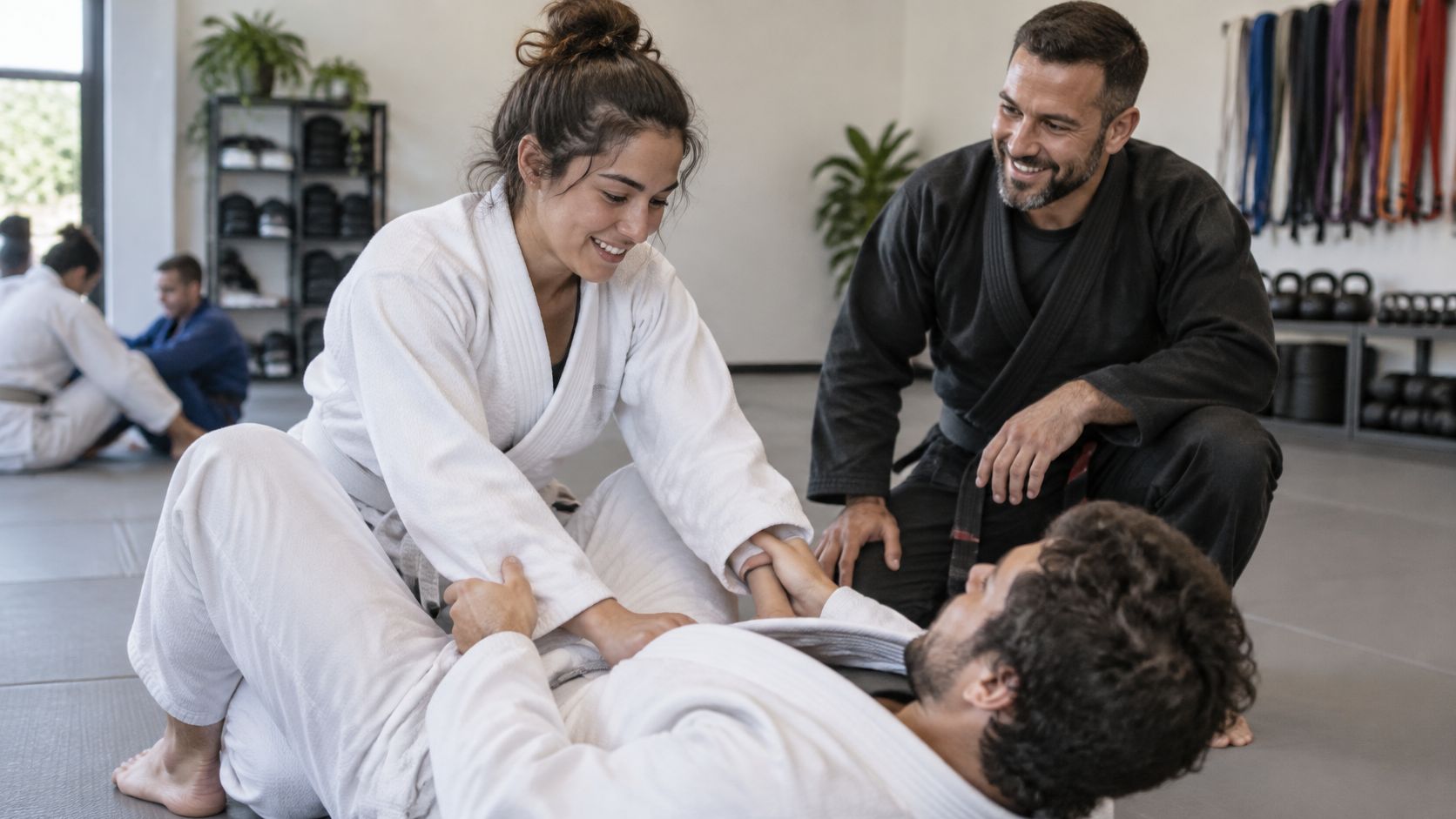
You found three gyms within a short drive, the prices look close, and one of them has a fundamentals class right after work. That is the moment you can pick the wrong room. A cheap membership you quit after three sore weeks costs more than a slightly farther gym you keep. A class that lets partners crank a submission costs more than either of them.
Treat the academy as a safety and retention decision, and check it live on a trial visit before you sort by price or pin. I would rather watch how a coach pairs a nervous newcomer than trust a five-star review written by a competitor. BJJ classes for beginners only pay off when the room is built for people who do not yet know how to fall, tap, or say no.
Table of Contents
- Beginner Class Formats Compared
- Finding and Shortlisting Academies Near You
- Judging Safety and Beginner Onboarding
- What to Bring and How to Act on the Mat
- What Happens in Your First Class
- Your First 90 Days of Training
- Book Your First Trial Class This Week
Beginner Class Formats Compared
| Format | Best for | What you practice first | Typical length |
|---|---|---|---|
| Gi fundamentals | Students who want grip-based technique and traditional etiquette | Collar and sleeve grips, guard retention, escapes | 60-90 minutes |
| No-gi fundamentals | Students who want faster, grip-light movement | Body positioning, hip movement, back control basics | 60-90 minutes |
| Beginner-only class | Complete newcomers who want a slower pace | Breakfalls, tapping, safe partner drilling | 60-90 minutes |
| Women-only class | Women who want same-gender partners from the start | Core positions and escapes at beginner intensity | 60-90 minutes |
| Kids program | Children, usually grouped by age | Balance, safety, games and basic positions | 45-60 minutes |
Most of those adult sessions run 60 to 90 minutes, warm-up included. A class labelled open mat is usually free training for people who already know the positions. Skip it until you can fall, frame, and tap without being told.
Gi or no-gi
The first choice is the uniform. A gi is a two-piece jacket and pants. Grips on the collar and sleeve slow the exchange down, so you spend the first month on guard retention and escapes instead of scrambling. No-gi uses a rash guard and shorts. Movement is faster and grips are lighter, so the early work is body position, hip movement, and basic back control. I would start in whichever format the gym runs as a true fundamentals class, not the one that sounds tougher.
Who shares the mat
The second choice is the room. A mixed class puts you next to blue belts who can coach you through a drill, which helps if the coach is watching. A beginner-only or women-only session keeps the pace slower and the partners closer to your experience. Kids' programs are a separate track, grouped by age, built around balance, games, and basic positions in a shorter block.
Practical rule: Pick the beginner class offered most often on your free weekday, then attend that same slot every week.
Membership math comes after you know you will stay. A plain breakdown of what BJJ classes cost is useful once the schedule fits your life.
Finding and Shortlisting Academies Near You
Price and a famous coach name can wait. Fit is hard to judge from one listing, so build a short list you can visit.
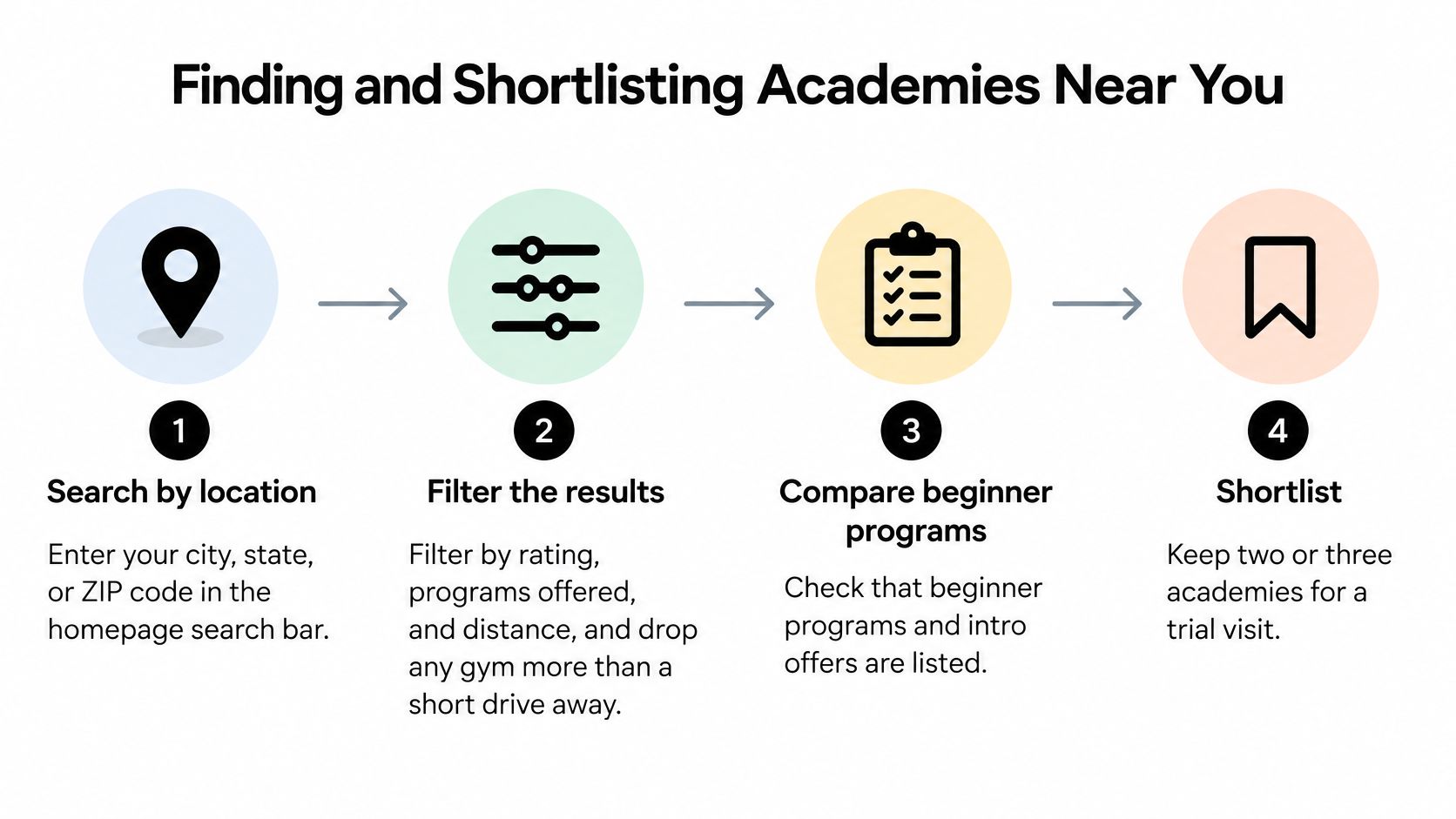
- Search by place. On our homepage search bar, enter a city, state, or ZIP code. Listings cover academies across the United States, including browse-by-state pages for all 50 states and the District of Columbia.
- Filter hard. Search results let you filter by rating, programs offered, and distance. I would drop any gym more than about a 20-minute drive from home or work. Commute, not the logo, decides whether you show up on a tired Tuesday.
- Open Programs Offered. Each listing has a Programs Offered section with classes, schedules, and training styles. Confirm a real beginner class, the weekly times, and whether it runs gi, no-gi, or both.
- Read the new-student reviews. Each listing shows aggregated ratings from Google and other platforms. Skim comments that mention first classes, not only the head coach's competition record.
- Keep three to five names. Note the address, phone number, and website shown with the map. Each listing also includes an interactive map of the exact location, plus social links, so you are not hunting for a front desk number later.
One trial is a coin flip. Most newcomers should visit at least two academies before they pay for a month. A gym that looks perfect online can feel reckless once you are on the mat, and a plain storefront can run the cleaner beginner hour.
Judging Safety and Beginner Onboarding
The first check is the tap. A serious academy teaches an explicit tap protocol, makes partners release the instant they feel it, and bans cranking submissions on newcomers. If you cannot see that rule in the first fifteen minutes of a trial, leave. Everything else on the checklist is secondary.
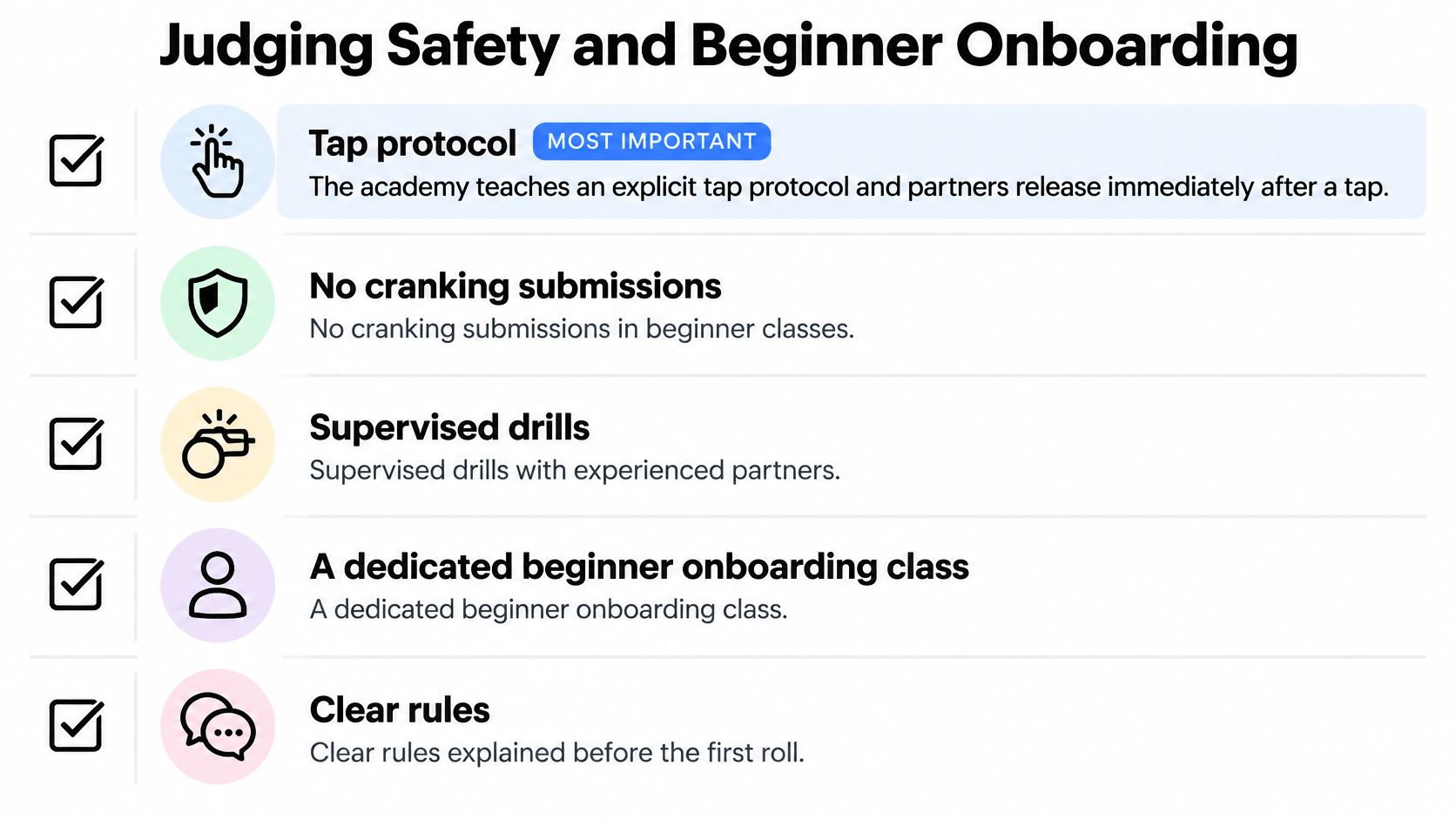
On that same visit, confirm four more habits. Drilling should be separate from live rounds. Mats should be clean. A coach should step in when a round gets sloppy. New students should drill with controlled partners, not with whoever happens to be the same size.
What the injury picture is actually saying
Safety is an academy-quality measure, not a waiver sentence. In one survey of BJJ athletes, 68.8% reported at least one injury causing a two-week training absence within three years, while another study found 59.2% reporting an injury during a six-month period. Those figures are not a guaranteed outcome for you. They flag the usual failure modes: too many days per week, uncontrolled intensity, poor partner choice, late taps, and training through joint pain. Knees, shoulders, elbows, necks, and fingers are the complaints coaches should be tracking.
Stop live rolling when pain changes your grip, range of motion, gait, or defence. Resume only when that movement is normal and the symptom does not climb.
Before you enroll, ask the head coach three questions. How are new students paired? Who drills with them in week one? What happens after someone reports an injury? Disclose old injuries yourself, and skip maximal resistance in the first weeks. Academies that take this seriously can track injuries per 1,000 training hours, missed sessions, and whether beginners are still training at 30 and 90 days.
What to Bring and How to Act on the Mat
| Item | Needed for | Notes |
|---|---|---|
| Gi (two-piece uniform) | Gi classes | Many gyms lend a loaner for the first weeks; buy once you know you will stay |
| Rash guard and grappling shorts | No-gi classes | Choose a fitted cut with no zippers or buttons |
| Mouthguard | All classes | A boil-and-bite model is fine to start |
| Water bottle and small towel | All classes | Hydration and sweat control between rounds |
| Trimmed nails | All classes | Protects your partners and your fingers |
Do not buy a closet of gear before the second week. A loaner gi is enough while you decide. When you do buy, a plain starter jacket is plenty. Our guide to a beginner jiu-jitsu gi covers fit and fabric without the boutique markup.
How to behave once you step on
Arrive about 10 minutes early, bow or follow whatever entry the gym uses, and ask a partner before you start a drill. Tap early and out loud, with a hand or a foot, not after the joint already hurts. Shower before class when you can, wash the gi after every session, and stay until the coach closes the line. Leaving mid-bow reads as rude even when you are exhausted.
Whether the room fits you
Schedule is only half of fit. A 2024 U.S. case study of 23 female BJJ athletes named male dominance, gender norms, and constant close contact as recurring problems. Those athletes recommended women-only classes or seminars, stronger support for new women, and trying more than one gym. "Just show up and tough it out" is a bad plan if the room itself is the problem.
On a trial, check whether women-only or beginner-only hours exist, whether you may request a partner, and how a coach handles unwanted contact or a mismatched round. Watch the warm-up. A respectful culture shows up in how people greet the newest body in the room, usually inside a single class.
What Happens in Your First Class
A normal first hour is structured, not a fight. Locals Jiu Jitsu Alexandria starter advice walks adults through that same first step: show up, learn the room, and let the coach set the pace.
- Check in and say you are new. The front desk should know before you step on the mat.
- Sign the waiver. Ask what a trial costs and what a membership includes. Those terms change by academy, so get them in writing there, not from a generic price list.
- Join the warm-up. Watch how the coach shows the day's move, and copy the person beside you if the words are new.
- Drill falls and stand-ups. Partners should rotate. You should not spend the hour only with someone your size.
- Practise the tap until it is automatic. You tap, they let go, you reset.
- Take a light positional round, or just watch. Say your intensity cap before you start. Sitting out is allowed.
- Ask what to work next time. One focus is enough. Guard posture, or a hip escape, not five techniques.
Expect to be sore the next day. That is normal. Joint pain that changes how you move is not. Tell the coach before the next session, and stay off live rounds until the movement feels ordinary again.
Your First 90 Days of Training
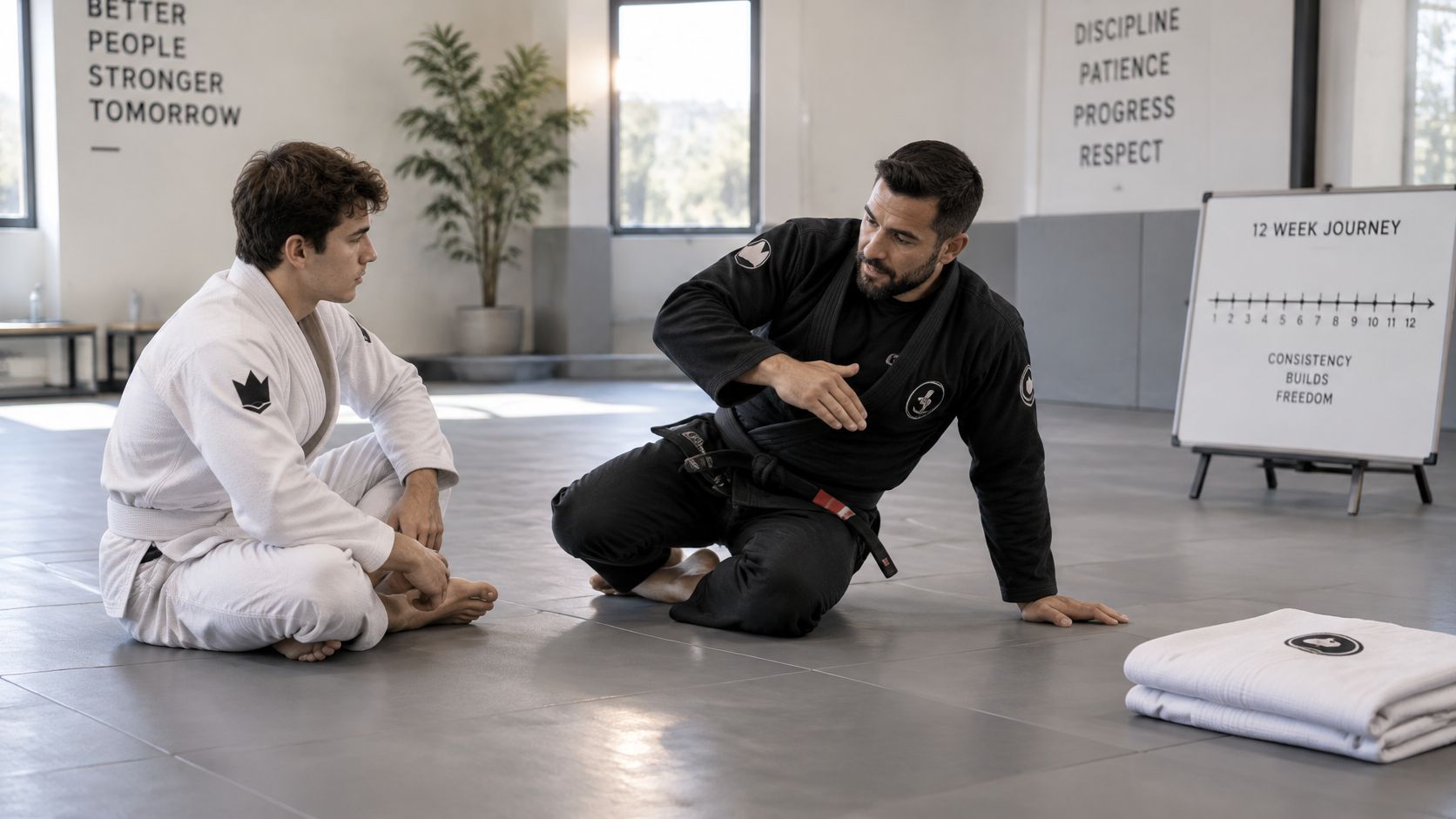
The goal for these twelve weeks is safe repetition, not a stack of submissions. You should be able to name the position, keep breathing, protect your neck and joints, and tap before pain.
| Phase | Sessions per week | Focus | Intensity cap |
|---|---|---|---|
| Weeks 1-4 | 2 supervised sessions | Breakfalls, stand-ups, framing, tap drills | Drilling only, no maximal resistance |
| Weeks 5-8 | 2-3 sessions | Short positional rounds, hip movement, escapes | Stated cap agreed with coach, rest day between hard sessions |
| Weeks 9-12 | Up to 3 sessions | Controlled live rolling with experienced partners | Live rounds only when movement is consistent, stop on pain |
Why the ramp is slow
Lower-belt athletes carry more training risk than the highlight reels suggest. A recent epidemiological study reported 5.5 injuries per 1,000 training hours overall, compared with 55.9 per 1,000 match exposures. The same body of survey work tied higher injury incidence to more training days per week, and less-experienced athletes more often reported head, upper-extremity, and elbow injuries. Adding a fourth class because you feel hooked is how week six turns into a month off.
Drill in short blocks, about three to five minutes per technique, then cooperative reps. Coaches should pair you with experienced, controlled partners, not just the person closest to your weight. Keep a rest day between harder sessions. Competition-style sparring waits until your defence is consistent. If you want a longer view of weekly volume, read how often to train after this first quarter, not before.
A short clip of fundamental movement is worth watching once, then copying under a coach rather than from your living room.
After a niggle
Rest one or two sessions. Come back for light drilling only. Add positional work when the joint moves normally and the ache does not spike. Keep a one-line log: date, what you drilled, soreness the next morning, and who you trained with. That log tells you whether the plan is working long before a belt does.
Book Your First Trial Class This Week
Next Tuesday is open. Book the trial before you compare price or drive time.
A bad partner culture costs attendance. Watch whether people honor the tap, who beginners roll with, and whether you would come back on a tired week. I would not pay a membership until that live class looks safe.
- Pick the top two academies from the short list, not five.
- Call from the listing. Each listing shows a phone number and website, so you can reach the academy without a second search.
- Ask four things: beginner class times, the tap rule, how partners are matched, and whether a women-only or beginner-only hour exists.
- Sit two trials on different nights. You want the same coaches and a different mix of students.
- Decide after four weeks on three signals: you are still showing up, pain has not changed how you move, and coaches treat new people the way they treated you on night one.
Brazilian Jiu-Jitsu Academy Finder is a U.S. directory for comparing academies by city, schedule, and beginner programs before you pay a membership. Use it to shortlist gyms that run a fundamentals class on a night you can keep, then book the trials. Start at Brazilian Jiu-Jitsu Academy Finder and put two classes on the calendar this week.
Share this article