
Ego vs. Humility: Key Lessons from BJJ
Why ego stalls BJJ progress and humility accelerates it—tap early, prioritize technique, train safely, and support your team.
Written by BJJ Academy Finder Editorial Team

Ego vs. Humility: Key Lessons from BJJ
In Brazilian Jiu-Jitsu (BJJ), the balance between ego and humility plays a major role in your growth as a practitioner. Ego can slow your progress, increase injury risk, and harm relationships with training partners. On the other hand, humility fosters learning, safe training, and stronger connections.
Key takeaways:
- Ego in BJJ: Focuses on winning, relies on strength, and ties identity to status or rank. Signs include delaying taps, avoiding challenges, and fearing failure.
- Humility in BJJ: Prioritizes technique, values learning from mistakes, and treats training as a collaborative effort. It leads to better skill development and deeper relationships.
- Tapping is Growth: Tapping is not losing; it’s a learning tool to improve technique and avoid injury.
- Team Success Matters: Supporting your training partners helps everyone improve, including you.
- Educate Your Ego: Ego isn’t the enemy - it can drive resilience when channeled toward learning and self-improvement.
Focus on refining your skills, respecting your partners, and treating every roll as a chance to grow. It’s not about proving yourself; it’s about improving yourself. If you're ready to start your journey, find a BJJ gym nearby that prioritizes a healthy training environment.
Why You Need Ego in Jiu Jitsu
sbb-itb-d583f1e
What Ego Looks Like in BJJ
Ego in Brazilian Jiu-Jitsu (BJJ) isn't about confidence - it’s when the desire to succeed in training overshadows the purpose of learning. Instead of treating each roll as a chance to grow, ego turns it into a contest to win. Nick Bilton captures this idea perfectly:
"Ego generally refers to a persons self-esteem or confidence, however in the context of BJJ, it is often synonymous with the part of a person self-esteem that desires success in the training room (sometimes above all else)." [3]
This mindset builds an identity tied to possessions like belts, strength, or rank, rather than focusing on personal growth. As Doa Karan explains:
"Ego-identity is built on what you have. My belt. My strength. My record. My rank. But real identity isn't a possession. It's not what you hold onto. It's what you express through action." [2]
This fragile foundation can crumble under pressure, turning a simple tap - a vital safety measure - into a personal failure. These behaviors highlight how ego can interfere with your training and development.
Common Signs of Ego on the Mats
Spotting ego in your training is essential for improvement. Here are some telltale signs:
- Seeing a tap as a blow to your pride instead of acknowledging your partner's technique. This can lead to delaying taps, increasing the risk of injury.
- Relying on brute strength over proper technique during rolls.
- Avoiding challenging partners and only rolling with those you feel confident dominating.
- Obsessing over losses or viewing submissions as attacks on your identity, whether it’s being the "strong one" or the "technical one."
These patterns can block your ability to learn and grow, keeping you stuck in a cycle of frustration.
How Ego Hurts Your Progress
When ego takes over, it stunts your technical development. Instead of focusing on refining your skills, you become preoccupied with protecting an image. This not only raises your risk of injury but also limits your time on the mats. True progress requires humility - a willingness to learn from mistakes and embrace challenges.
Ego also impacts the gym atmosphere. It can make you see training partners as rivals rather than teammates, preventing meaningful connections. Even worse, it keeps you from entering a flow state - the mental zone where learning and creativity thrive. As Doa Karan wisely notes:
"The ego doesn't like flow. It wants predictability. It wants credit. But flow is what happens when you stop clinging and start engaging." [2]
What Humility Looks Like in BJJ
In Brazilian Jiu-Jitsu (BJJ), humility plays a central role in growth and learning. It’s not about being submissive or weak; it’s about keeping an open mind, regardless of how experienced or skilled you are. Coach Don from Emerge BJJ sums it up well:
"Humility means keeping an open heart to learn, embracing challenges, and accepting failure as a step to progress." [5]
This perspective allows practitioners to continually improve, no matter their belt rank or how long they’ve been training. Instead of clinging to titles, strength, or past achievements, humility shifts the focus to how you approach training and interactions on the mats. As Doa Karan puts it, your true identity in BJJ is defined by your actions, not by accolades or external recognition [2].
Characteristics of Humility in Training
Humility in BJJ shows up in specific ways during training. Practitioners who embody this mindset stand out through their behavior:
- They tap early and often, seeing it not as defeat but as part of the learning process.
- They prioritize technique over brute force, focusing on timing, leverage, and precision rather than overpowering their partner.
- They treat training partners as collaborators, not opponents, embracing the philosophy of "iron sharpening iron."
Respect is another hallmark of humility. Humble practitioners understand that valuable lessons can come from anyone - whether it’s a seasoned black belt or a brand-new white belt. They actively seek feedback, asking questions to correct mistakes and refine their skills. And when their teammates achieve success, they genuinely celebrate those victories.
Shihan Warren Lamb describes this mindset as an "honest and modest sense of oneself, completely lacking in self-pride, self-righteousness, egotism, arrogance and selfishness" [5]. This approach not only fosters personal growth but also speeds up technical improvement.
How Humility Helps Your Progress
Adopting humility in BJJ removes the mental roadblocks that ego can create. When you let go of self-image, you allow yourself to fully engage in the learning process. This openness makes it easier to attempt challenging techniques, embrace failure, and gather valuable insights without being weighed down by frustration or pride.
Humility also builds resilience. Practitioners with this mindset don’t dread being outmatched or feeling awkward; instead, they see these moments as essential steps in their journey. The gym becomes a space for exploration, not a stage for proving dominance. This attitude fosters deeper relationships with training partners and transforms sparring into a shared opportunity for growth.
Ego vs. Humility: Side-by-Side Comparison
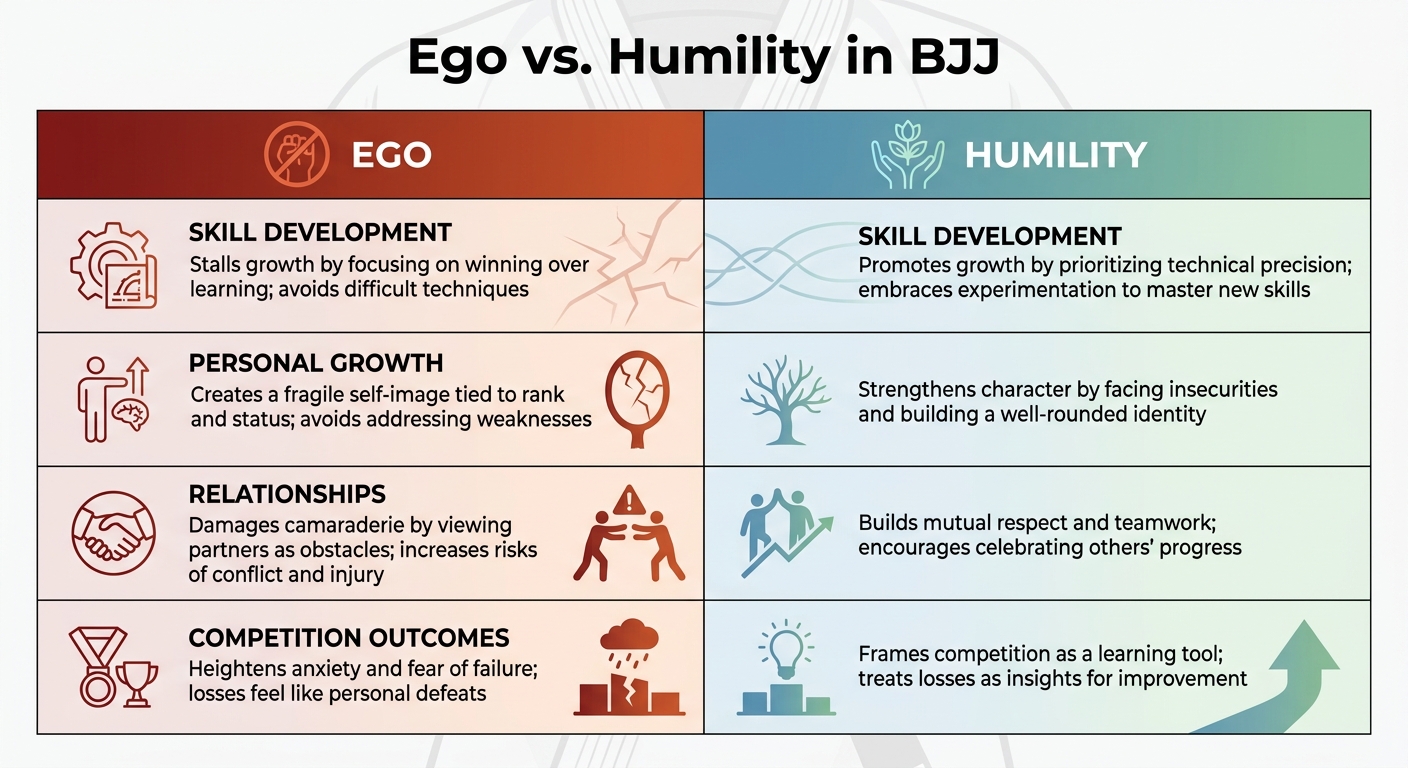
Ego vs Humility in Brazilian Jiu-Jitsu: Key Differences
Looking at ego and humility side by side, it’s clear how these mindsets play out on the mats, shaping technique, mindset, and relationships in distinct ways.
Practitioners driven by ego often approach each roll as a battle for dominance. They lean heavily on physical strength to prove themselves and shy away from trying unfamiliar or challenging techniques that might highlight their weaknesses. On the flip side, those with humility focus on refining their techniques and treat every session as a chance to learn, experiment, and grow. As Doa Karan explains, an ego-centered identity is often tied to external markers like rank, strength, or achievements, whereas true identity shines through in your actions [2].
The impact of these mindsets isn’t limited to technical skills. Relationships on the mats also reflect this divide. Ego-driven attitudes can strain connections with training partners, treating them as rivals rather than collaborators. This can lead to unnecessary conflicts and even injuries. In contrast, humility nurtures respect and teamwork, fostering a culture where everyone’s progress is celebrated. Renzo Gracie captures this sentiment perfectly:
"I'm not in the business of selling martial arts, but of selling confidence." [3]
Here’s a snapshot of how ego and humility compare:
Comparison Table: Ego vs. Humility
| Category | Ego Effects | Humility Effects |
|---|---|---|
| Skill Development | Stalls growth by focusing on winning over learning; avoids difficult techniques. | Promotes growth by prioritizing technical precision; embraces experimentation to master new skills. |
| Personal Growth | Creates a fragile self-image tied to rank and status; avoids addressing weaknesses. | Strengthens character by facing insecurities and building a well-rounded identity. |
| Relationships | Damages camaraderie by viewing partners as obstacles; increases risks of conflict and injury. | Builds mutual respect and teamwork; encourages celebrating others' progress. |
| Competition Outcomes | Heightens anxiety and fear of failure; losses feel like personal defeats. | Frames competition as a learning tool; treats losses as insights for improvement. |
This contrast is especially obvious in competition. Ego tends to amplify pressure and fear of failure, while humility reframes setbacks as opportunities to learn and improve. The goal isn’t to eliminate ego entirely but to guide it - channeling its energy into growth rather than seeking validation.
Key Lessons: Building Humility and Managing Ego
Building on our discussion of ego and humility, here are practical steps to refine your mindset. It's one thing to understand the difference between the two, but applying that understanding is where the real work begins. These lessons provide actionable ways to cultivate humility while keeping ego in check, reshaping how you approach your training.
Lesson 1: Tapping as a Tool for Growth
Tapping isn’t failure - it’s feedback. As Infinity BJJ explains:
"The tap is not a sign of weakness; it's a gesture of humility and recognition of a well-executed technique." [1]
Each tap is an opportunity to learn. Was it a matter of timing? Positioning? A setup you didn’t see coming? By analyzing what led to the tap, you can pinpoint areas for improvement. This mindset shift transforms the experience into a stepping stone for growth instead of a hit to your pride. Focusing on long-term development rather than short-term wins ensures you're training consistently and safely, which is key to staying on the mats for years to come.
Lesson 2: Confidence Through Action, Not Assumption
Real confidence isn’t built on assumptions - it’s forged through practice and mastery. Nick Bilton from Academy Four Eleven puts it succinctly:
"A healthy ego should focus solely on what really matters in training - the mastery of grappling in a safe environment." [3]
Instead of relying on brute strength or trying to dominate, aim for technical precision. Mastering leverage, timing, and proper execution not only builds genuine confidence but also minimizes injury risks. This approach allows you to train effectively with partners of varying sizes and skill levels. As your skills grow, so will your confidence, but remember: your progress is tied to the strength of your team.
Lesson 3: Team Growth Over Individual Ego
In Brazilian Jiu-Jitsu, personal success is deeply connected to the growth of your teammates. When your training partners improve, the entire gym benefits. Celebrate their achievements - it creates a supportive environment that helps everyone, including you, navigate the tough phases of the journey.
Humility plays a big role here. Stay open to learning from everyone, regardless of their belt rank. As Jocko Willink wisely points out:
"The more you realize that you don't know everything, the more it humbles you." [4]
Seek guidance from higher belts, but don’t overlook the insights that less experienced practitioners can offer. Everyone brings something unique to the table, and staying receptive to their perspectives will only enhance your growth.
Balancing Ego and Humility for Long-Term Success
The aim isn’t to eliminate ego entirely - it’s to educate it. As Doa Karan from Blue Mountains Jiu Jitsu Academy puts it:
"Ego isn't the problem. Ego is what holds someone together when things get hard. It's what helps them walk back onto the mat after being submitted ten times. You don't need to kill the ego. You need to educate it." [2]
A well-managed ego provides the resilience to bounce back after setbacks. The trick lies in redefining how your ego measures success. Instead of focusing on dominating training partners or avoiding submissions, channel that drive into improving your technique. This shift turns ego into a supportive tool for long-term growth. It also ties back to earlier lessons about using setbacks as opportunities to refine your skills. With this in mind, here are some ways to cultivate humility.
Tips for Developing Humility
- Be vulnerable and open to feedback. Every training session, no matter your partner’s rank, offers a chance to learn. Actively seek feedback, even if it feels uncomfortable. Ask your training partners what they observed during your rolls and genuinely consider their input.
- Focus on the process, not external validation. Stay grounded in the moment by shifting from a results-driven mindset to one of adaptability and presence [2].
- Train with a playful attitude. Approaching rolls with a sense of play rather than intense competition helps ease your ego. This relaxed mindset makes it easier to enter flow states, where true learning happens [2].
These personal practices are most effective when paired with a training environment that aligns with your values.
Finding the Right Gym Environment
While your mindset is key, the culture of your gym plays a huge role in reinforcing these principles. Seek out academies where instructors emphasize technical precision and safety over winning at all costs. Nick Bilton from Academy Four Eleven highlights this point:
"The mastery of grappling in a safe environment" should be the focus of a healthy training culture [3].
Gyms that encourage collaboration over ego-driven competition provide the foundation for steady progress.
If you’re unsure where to start, the Brazilian Jiu-Jitsu Gyms Directory (https://bjjacademyfinder.com) can help you locate quality academies across the U.S. The platform offers detailed information about programs, instructor credentials, and user reviews, making it easier to find a gym that prioritizes respect, community, and technical growth. The right gym isn’t just about learning techniques - it’s about offering the support and culture you need to navigate the challenges of your BJJ journey.
Conclusion
In your Brazilian Jiu-Jitsu (BJJ) journey, finding the balance between ego and humility is key to ongoing progress. BJJ teaches that humility isn't about lowering yourself - it's about opening the door to growth. When you shift your focus from defending an image to embracing the process, every roll becomes an opportunity to refine your skills. Tapping stops being a sign of defeat and starts becoming a tool for learning, while setbacks turn into valuable lessons. Training partners become collaborators in your development.
Instead of letting ego push you toward domination, channel that drive into improving your technique and ensuring safety. When success is measured by what you learn rather than by how often you win, your resilience grows. This perspective helps sustain your training for the long haul, keeping you engaged for years rather than burning out after a few months.
Humility also strengthens the bonds that keep you coming back to the mats. It fosters a community where everyone benefits from mutual support. As Infinity BJJ wisely puts it:
"The tap is not a sign of weakness; it's a gesture of humility and recognition of a well-executed technique." [1]
This mindset goes beyond submissions - it shapes every interaction you have in the gym.
Take a moment to consider your own approach. Are you training to prove something, or are you training to improve? Are you holding tightly to your rank, strength, or record, or are you focusing on what you express through your actions? The answers to these questions influence not just your progress in BJJ but also the kind of person and practitioner you become.
The mats have a way of revealing the truth about us. If you let humility guide you, growth will follow naturally. So, reflect on your journey - are you allowing your ego to evolve and embracing humility to maximize your potential?
FAQs
How can I tell if my 'hard training' is actually ego?
When you step onto the mat, take a moment to consider what truly drives you. Is it the desire to always come out on top, avoid failure, or gain validation from others? These tendencies often stem from ego, which can cloud your progress and limit your potential.
The essence of hard, meaningful training lies in humility. It’s about being open to learning, accepting losses as part of the process, and showing respect to your training partners. Every roll, every mistake, and every tap is an opportunity to grow - not just as a practitioner but as a person.
So, ask yourself honestly: Are you training to genuinely improve and learn, or are you chasing a boost to your ego? Understanding your true motivations can help you align with Brazilian Jiu-Jitsu’s deeper values - humility, respect, and continuous growth.
What should I do right after I tap to learn faster?
After tapping, approach the experience with humility and view it as a chance to grow. Take a moment to reflect on what caused the tap, pinpoint areas where you can improve, and work on sharpening your technique. Don’t let pride get in the way - progress comes from learning, adjusting, and moving forward.
How can I roll competitively without hurting my teammates?
To spar effectively and safely, it's essential to prioritize control and respect. Focus on refining your technique and learning, rather than just aiming to "win" every roll. Keep your ego in check - tapping is a natural part of the process and an opportunity to grow. By maintaining the right intensity, you'll create a safer environment, lower the risk of injuries, and build stronger bonds with your training partners. Sparring is about improving skills, not proving dominance.
Related articles
Share this article