
Why NFL Teams Use BJJ for Tackling Skills
Brazilian Jiu-Jitsu trains NFL players to fall safely, improve tackling mechanics, reduce concussions, and build core control.
Written by BJJ Academy Finder Editorial Team
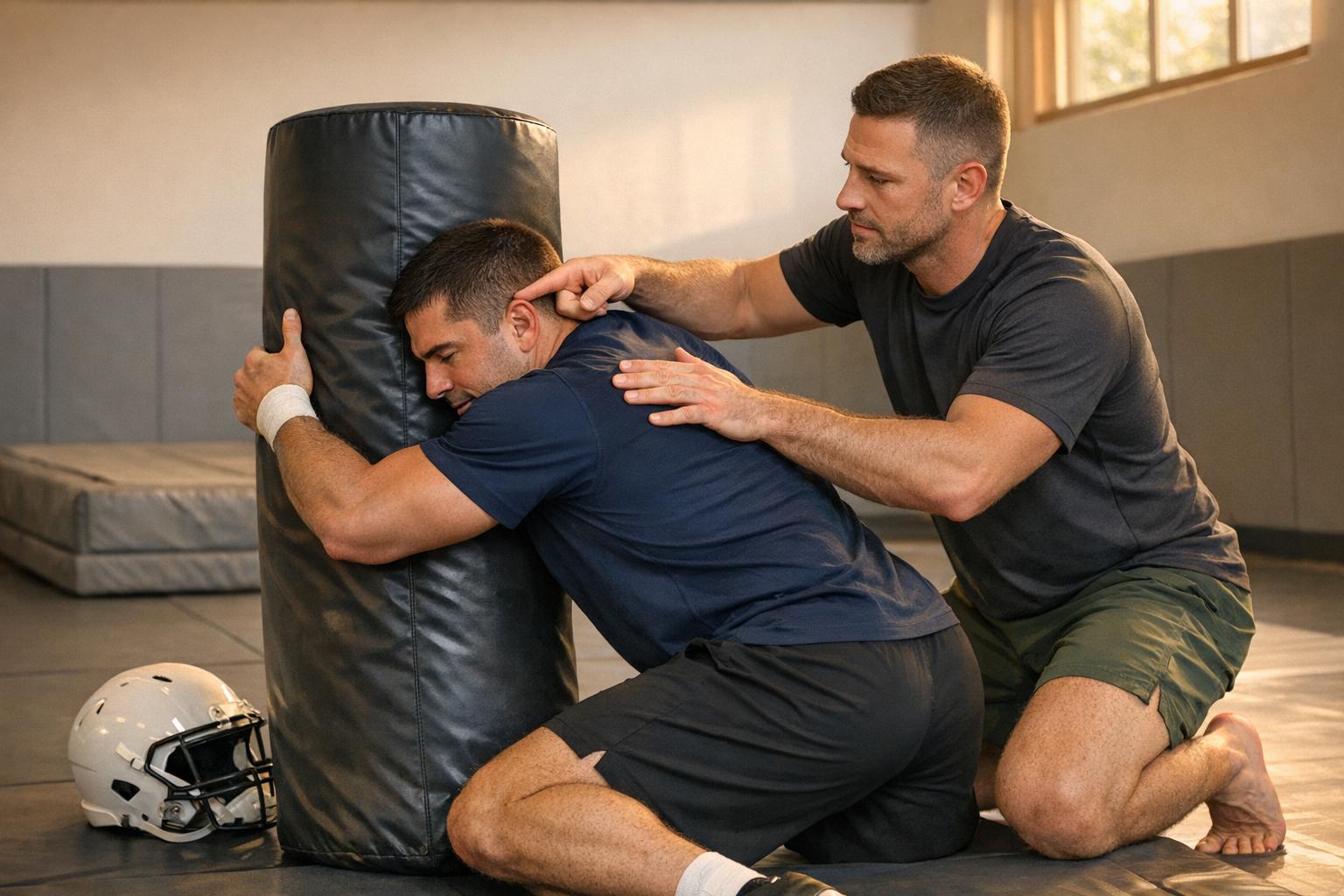
Why NFL Teams Use BJJ for Tackling Skills
NFL teams are turning to Brazilian Jiu-Jitsu (BJJ) to improve tackling techniques and reduce injuries. This martial art teaches players how to fall safely, manage momentum, and protect their heads during collisions. The results? Fewer injuries, better performance, and smarter energy use on the field.
Key Points:
- Player Safety: BJJ helps prevent concussions and other injuries by teaching safer falling techniques.
- Improved Tackling: Focuses on leverage, angles, and body control for more effective tackles.
- Notable Success: Miami Dolphins' Tua Tagovailoa used BJJ to avoid hard hits, improving his performance and reducing injury risks.
- Core Strength: Builds stability and balance, critical for safe and controlled tackles.
NFL teams like the Dolphins and Buccaneers have integrated BJJ into training, with players reporting better performance and fewer missed tackles. By prioritizing technique over brute force, BJJ is reshaping how football players approach tackling.
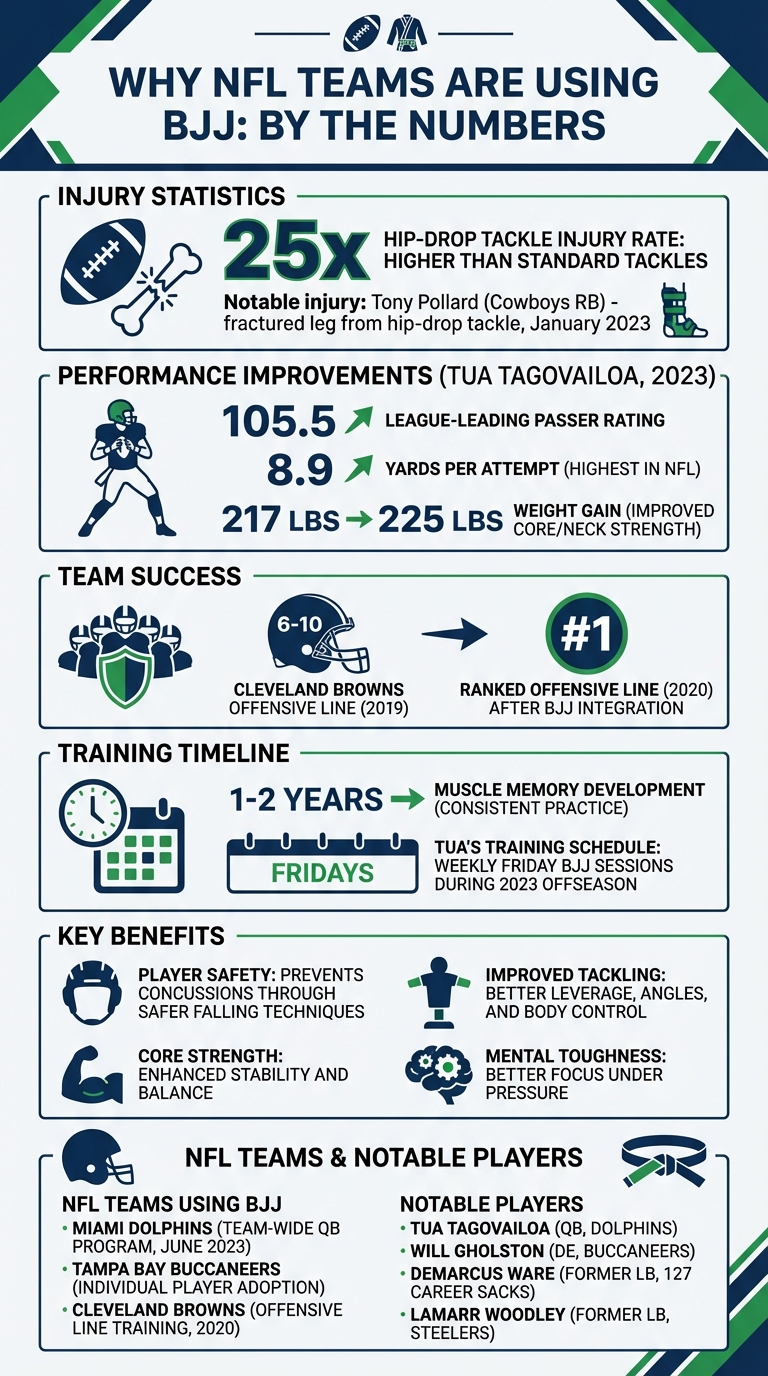
NFL BJJ Training Benefits: Key Statistics and Performance Improvements
Tackling Challenges in the NFL
Injuries from Poor Tackling Form
Bad tackling technique doesn't just hurt the game - it puts players at serious risk. Take the "hip-drop" tackle, for example. This move, where a defender wraps up a runner and pulls their weight down onto the runner’s legs, has an injury rate that's 25 times higher than a standard tackle [4][5]. A striking example occurred in January 2023, when Dallas Cowboys running back Tony Pollard fractured his leg during a playoff game against the San Francisco 49ers. This injury, caused by a hip-drop tackle, left a noticeable gap in the Cowboys’ offense [4].
Head injuries are another major concern. When players don't know how to fall correctly, their heads often snap back and hit the ground with force, leading to concussions or even more severe brain injuries [1]. Interestingly, the initial hit isn't always the problem - it’s the aftermath that causes the most damage.
"The defender's encircling, tackling the runner, and then swinging their weight and falling on the side of their other leg, which is their ankle or their knee... the runner becomes defenseless." - Rich McKay, Competition Committee Chair, NFL [4]
Beyond the physical toll, poor tackling technique also leads to missed tackles, a fundamental issue that BJJ training helps address.
Missed Tackles from Weak Technique
Tackling isn’t just about brute force - it’s about precision. Players who rely solely on power without understanding leverage or positioning often fail in critical moments. Instead of dispersing energy efficiently, they focus all their effort on a single point of impact, which weakens the overall tackle [2]. NFL lineman Will Gholston credits BJJ for teaching him how to control opponents better, saying it’s "harder than football practice" but has dramatically improved his performance [3].
The challenge goes beyond just making contact. Without the right technique, players struggle to make split-second decisions that determine whether they secure the tackle or let it slip away [1]. Skills like hand placement, weight distribution, and approach angles are crucial - and these are exactly the areas where BJJ training shines.
Strength Over Technique
Relying on strength alone doesn’t just lead to missed tackles - it increases injury risks and drains energy. Players who prioritize power over technique often suffer from torso instability, making them more vulnerable to injuries, even in legal plays [2]. Plus, this approach is exhausting. Without proper technique, players burn through energy faster as they try to overpower their opponents [3].
"By and large, you find out that core strength is very much important when you're talking about the transfer of energy of the human body going to the ground... so that when you're going to the ground, the top of your torso isn't just a leverage whipping device." - Mike McDaniel, Head Coach, Miami Dolphins [2]
The NFL is taking these risks seriously. The league is working to ban the hip-drop tackle, likening it to the already-banned horse-collar tackle [4][5]. As Jeff Miller, Executive Vice President of the NFL, put it: "It is an unforgiving behavior, and one that we need to try to define and get out of the game" [4]. These challenges highlight why more teams are turning to BJJ to help players master safer and more effective tackling techniques.
sbb-itb-d583f1e
How BJJ Improves Tackling
Leverage and Angles
Brazilian Jiu-Jitsu (BJJ) emphasizes using body mechanics rather than brute strength. Instead of relying on a running start - which can increase the chance of helmet-to-helmet collisions - BJJ focuses on grappling techniques and precise body positioning to bring opponents down safely. This approach redistributes weight and momentum, allowing for effective tackles that require less energy [1]. While traditional tackling often concentrates force at a single point, BJJ teaches athletes to spread the impact across their bodies, reducing collision severity and lowering the risk of injuries.
Better Body Control and Balance
BJJ training places a strong emphasis on core strength, which is essential for controlled and safe tackling. A solid core enables players to better manage the energy transfer during a tackle, preventing uncontrolled upper body movement and decreasing the likelihood of injuries [6]. Training routines include techniques like breakfalls (using arms to absorb impact), chin tucking (to prevent the head from snapping backward), and controlled rolls. These drills build muscle memory, helping players instinctively respond to high-speed collisions during games.
"If we can do some of these things without thinking, if our body just reacts, that's the place we're trying to get" - Skyler Thompson, Quarterback, Miami Dolphins [1]
By mastering core control, players can enhance their ability to manage energy transfer during tackles, making their movements both safer and more effective.
Less Force, Better Results
BJJ's focus on strategic falling teaches athletes to distribute impact energy across their bodies rather than absorbing it all in one spot. This is critical, as tackling decisions happen in milliseconds, leaving no time for conscious adjustments [1][2]. The effectiveness of this method is clear: after incorporating BJJ training during his recovery in 2022, Tua Tagovailoa ended the season with a league-leading passer rating of 105.5 and the highest yards-per-attempt at 8.9 [1]. He also increased his weight from 217 to 225 pounds, improving his neck and core strength while maintaining his agility [2].
"With jiu-jitsu, I've been thrown airborne, I've been put in many uncomfortable positions for me to learn how to fall and try to react throughout those positions that I'm getting thrown around in" - Tua Tagovailoa, Quarterback, Miami Dolphins [2]
NFL Teams Using BJJ
Miami Dolphins and Tampa Bay Buccaneers

Some NFL teams have started incorporating Brazilian Jiu-Jitsu (BJJ) into their training routines, but the Miami Dolphins and Tampa Bay Buccaneers have taken particularly notable steps in this direction. In June 2023, the Miami Dolphins officially added BJJ techniques to their quarterback training program. This decision came after all three of their quarterbacks suffered injuries during the 2022 season. Head coach Mike McDaniel and quarterbacks coach Darrell Bevell spearheaded the effort, focusing on teaching players how to fall strategically. By analyzing game film, they developed techniques to help players spread the force of impact across their bodies, reducing the risk of injury.
"It's a lot of strategic falling that is patterned after things that happened to our quarterbacks during the season... how to transfer energy to disperse it and not have a central impact focus." - Mike McDaniel, Head Coach, Miami Dolphins [2]
The Tampa Bay Buccaneers approached BJJ differently, with individual players adopting the training. Defensive end Will Gholston began incorporating BJJ into his offseason workouts in December 2021. Gholston highlighted how the martial art's emphasis on leverage and hand-to-hand combat directly improved his performance on the defensive line. He also credited BJJ with boosting his endurance and enhancing his ability to dominate offensive linemen through precise holds and positioning [3].
These efforts, whether team-wide or individual, have allowed players to refine their skills and improve their performance both on and off the field.
Players Who Benefited from BJJ
Beyond team initiatives, several NFL players have seen clear benefits from incorporating BJJ into their training routines. For instance, Miami Dolphins quarterback Tua Tagovailoa used weekly BJJ sessions to improve his game. The results? He led the league with a passer rating of 105.5 and averaged 8.9 yards per attempt, the highest in the NFL [1][2].
DeMarcus Ware, a former NFL star with 127 career sacks, also credited martial arts training - including BJJ - for much of his success. As a pass rusher, Ware often faced offensive linemen who outweighed him by 75 to 100 pounds. By applying BJJ principles, such as advanced hand-fighting techniques and leveraging his opponent's movements, Ware was able to overcome these size disadvantages. He moved beyond basic moves like the "dip-and-rip" to more advanced grappling strategies, giving him a significant edge on the field [8].
Additional Benefits of BJJ for NFL Players
Mental Toughness and Focus
Brazilian Jiu-Jitsu (BJJ) pushes athletes to stay composed and think clearly, even in high-pressure situations. On the mat, players face constant challenges - being thrown, pinned, or placed in vulnerable positions. Over time, this teaches them how to stay calm and make logical decisions, skills that directly translate to handling aggressive defenders or bouncing back from hard hits on the football field.
The mental demands of BJJ are intense, often surpassing those of football practice. Tampa Bay Buccaneers defensive end Will Gholston highlighted this, saying, "It's harder than football practice" [3]. The rigorous training sharpens focus and builds a mental edge that players carry into games.
Additionally, BJJ emphasizes instinctive decision-making through repetition. Miami Dolphins quarterback Skyler Thompson explained the value of this: "If we can do some of these things without thinking, if our body just reacts, that's the place we're trying to get" [1]. By ingraining techniques until they become second nature, athletes can dedicate their mental energy to reading defenses and executing plays, while their bodies automatically handle physical challenges. This combination of mental strength and physical awareness enhances both safety and performance on the field.
Better Body Awareness and Recovery
BJJ also improves body awareness, which helps players execute safer and more controlled tackles. It enhances proprioception - the ability to sense body position and movement. This heightened awareness enables athletes to react quickly and safely, even during unpredictable moments like mid-air collisions or losing balance during a tackle. Many players report that this training has improved their ability to adjust their weight and momentum during falls, minimizing the risk of injury and reducing the impact of hits.
Two-time Olympic Gold Medalist in Judo Kayla Harrison underscored this benefit, saying, "In the offseason, to train and use your brain in a different way, to use different muscles is I think super beneficial to athletes, and I think science shows that as well" [2]. By incorporating BJJ into their routines, players engage muscles that aren’t typically used in football, reducing repetitive strain and wear-and-tear. This not only helps prevent injuries but also extends their playing careers by supporting overall physical balance and recovery.
How to Add BJJ to NFL Training Programs
Work with BJJ Coaches or Academies
Collaborating with experienced BJJ coaches is key to tailoring techniques for football players. Ideally, teams should seek out master-level black belts or former world champions who have worked with professional athletes. For instance, in 2023, Miami Dolphins head coach Mike McDaniel teamed up with a BJJ master to analyze game footage and create drills specifically for quarterback falls [2]. This involved reviewing footage of Tua Tagovailoa's 2022 injury to simulate tackling scenarios and design drills that addressed real in-game challenges. By integrating film analysis, BJJ training becomes highly relevant to the demands of football.
Former Pittsburgh Steelers linebacker LaMarr Woodley also highlighted the value of this approach. He trained with master black belt Ricardo Liborio and found the sessions so beneficial that he bought a home near Liborio's studio to continue training during the offseason [1]. Teams looking for qualified academies can consider facilities with a history of working with elite athletes, such as American Top Team in Florida [2].
Once expert guidance is secured, the next step is to ensure these techniques are consistently practiced as part of the team's overall training plan.
Schedule Regular BJJ Sessions
Consistency is more important than intensity when it comes to mastering BJJ techniques. Building muscle memory can take 1–2 years [1]. During the 2023 offseason, Tua Tagovailoa committed to attending BJJ classes every Friday, focusing on techniques to redistribute weight and protect his head when falling [1].
To stay compliant with NFLPA rules, which limit workouts to four days per week with no weekend sessions, teams should plan BJJ training during the offseason [7]. Cleveland Browns Offensive Line Coach Scott Peters demonstrated how integrating BJJ into regular training can yield results. In 2020, he emphasized hand placement, hip movement, and leverage in his drills. The result? The Browns' offensive line improved from a 6-10 record in 2019 to being the league’s top-ranked offensive line in 2020 [9].
It's crucial to prioritize technical drills over full-contact sparring to prevent fatigue. Tampa Bay Buccaneers defensive end Will Gholston even remarked, "It's harder than football practice, to be honest with you" [3]. Consistent practice ensures players can refine the tackling techniques necessary for peak performance on the field.
Find Local BJJ Academies
Access to quality instruction is essential for implementing BJJ into NFL training programs. Teams can use resources like the Brazilian Jiu-Jitsu Gyms Directory (https://bjjacademyfinder.com) to locate academies with proven expertise in training elite athletes. This platform provides detailed program descriptions, instructor credentials, and reviews, making it easier to find the right fit. By searching for academies near their training facilities, teams can ensure players maintain regular attendance during the offseason without unnecessary travel.
D1 Football Player vs No Gi World Champion
Conclusion
Brazilian Jiu-Jitsu (BJJ) has proven to be a game-changer for NFL teams, improving tackling techniques and reducing injury risks. Take the Cleveland Browns, for example - they ended the 2020 season with the league's top-ranked offensive line after integrating BJJ drills into their training routines [9]. Similarly, Miami Dolphins quarterback Tua Tagovailoa showcased enhanced body control during the 2023 preseason, a testament to the benefits of this training method [1]. These cases highlight how BJJ can directly influence performance on the field.
What makes BJJ so effective? It prioritizes precision and technique over brute strength. Safer tackling and better performance stem from drills that refine body mechanics and train players to react instinctively. Dr. Walavan Sivakumar, Director of Neurovascular Surgery at Pacific Neuroscience Institute, explains it best:
"There is absolutely something to the idea of using your body mechanics to help you in those situations instead of hurt you. Yes, you can lessen the impact" [1].
To fully harness these benefits, teams can integrate BJJ into their training programs with ease. Partnering with experienced instructors who understand football's unique demands is key. Scheduling regular offseason sessions and focusing on technique rather than intensity can yield significant results. As Ricardo Liborio noted:
"In my opinion, 100 percent, this can save his career" [1].
Finding the right BJJ academy is an essential first step. Platforms like the Brazilian Jiu-Jitsu Gyms Directory (https://bjjacademyfinder.com) make it simple for teams and players to locate qualified instructors near their facilities. This resource provides details on programs, instructor credentials, and reviews, ensuring players connect with academies equipped to train elite athletes.
For coaches and players, BJJ offers practical techniques that directly translate to football. It can be the difference between a career-ending injury and long-term success. By collaborating with skilled instructors, committing to consistent training, and leveraging tools like the Brazilian Jiu-Jitsu Gyms Directory, teams can take their performance to the next level.
FAQs
Which BJJ moves help with tackling?
BJJ techniques that emphasize hand placement, hip movement, and body control can significantly improve tackling skills. These abilities help athletes develop better grip, balance, and leverage, leading to more efficient and controlled tackles. Notably, NFL players such as Scott Peters and Tua Tagovailoa have integrated BJJ into their training routines, using it to sharpen these specific techniques and elevate their on-field performance.
Does BJJ training lower concussion risk in football?
Yes, Brazilian Jiu-Jitsu (BJJ) training can play a role in reducing concussion risks for football players. One of its key benefits is teaching athletes how to fall safely while protecting their heads. A great example of this is Tua Tagovailoa, who incorporated BJJ into his training to refine his falling techniques and reduce the likelihood of head injuries. By focusing on proper body mechanics, BJJ offers players tools to improve safety during intense gameplay situations.
How often should NFL players train BJJ in the offseason?
NFL players, including Tua Tagovailoa, are often advised to train in Brazilian Jiu-Jitsu around once a week during the offseason. This practice sharpens their tackling skills and lowers the chance of injuries, making it an important part of their training regimen.
Related articles
Share this article