
How to Transition Guard to Mount in BJJ
Master guard-to-mount transitions in BJJ with knee cut, leg drag and torreando passes, escape counters, and drills to build control and timing.
Written by BJJ Academy Finder Editorial Team
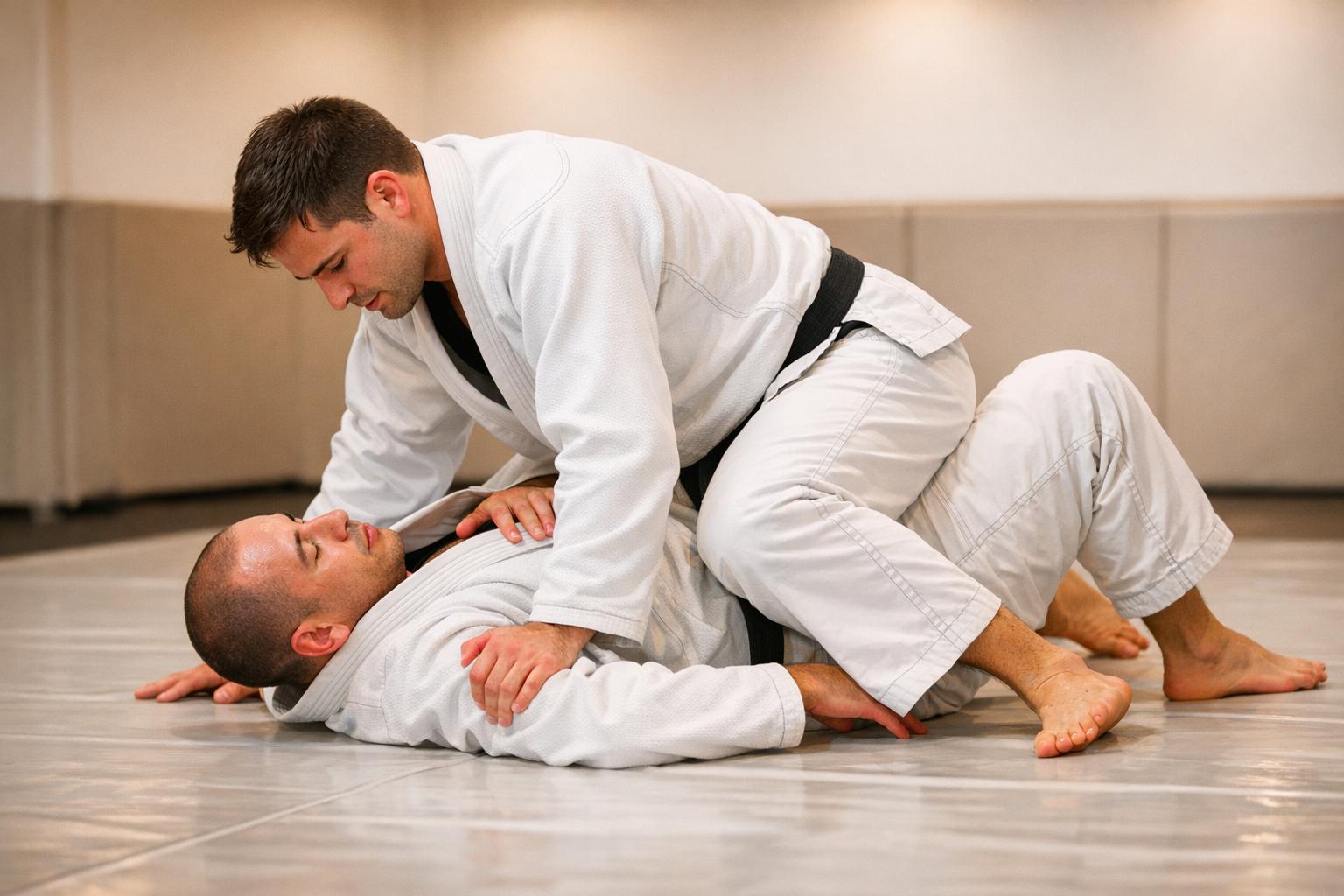
How to Transition Guard to Mount in BJJ
The transition from guard to mount in Brazilian Jiu-Jitsu (BJJ) is a game-changing move. It shifts you from a defensive position to an offensive one, earning you 4 points in competition and giving you control over your opponent. This dominant position opens up opportunities for submissions like chokes, armbars, and triangles. To execute this effectively, you need skills like grip fighting, hip mobility, and guard control, along with techniques such as the knee cut, leg drag, and torreando passes.
Key Points:
- Why It Matters: Mount earns points and gives you control.
- Essential Skills: Guard control, hip mobility, and grip fighting.
- Techniques: Knee cut, leg drag, and torreando passes.
- Common Counters: Bridge and elbow escapes, which can be neutralized by adjusting position and applying pressure.
- Practice Tips: Use static drills and positional sparring to refine transitions.
Mastering these transitions takes consistent practice and attention to detail, but it can significantly improve your BJJ game. Let’s dive into the techniques and strategies to help you succeed.
Basic Guard Passing to Mount Technique | American Top Team Miramar

Step-by-Step Techniques for Guard to Mount Transitions
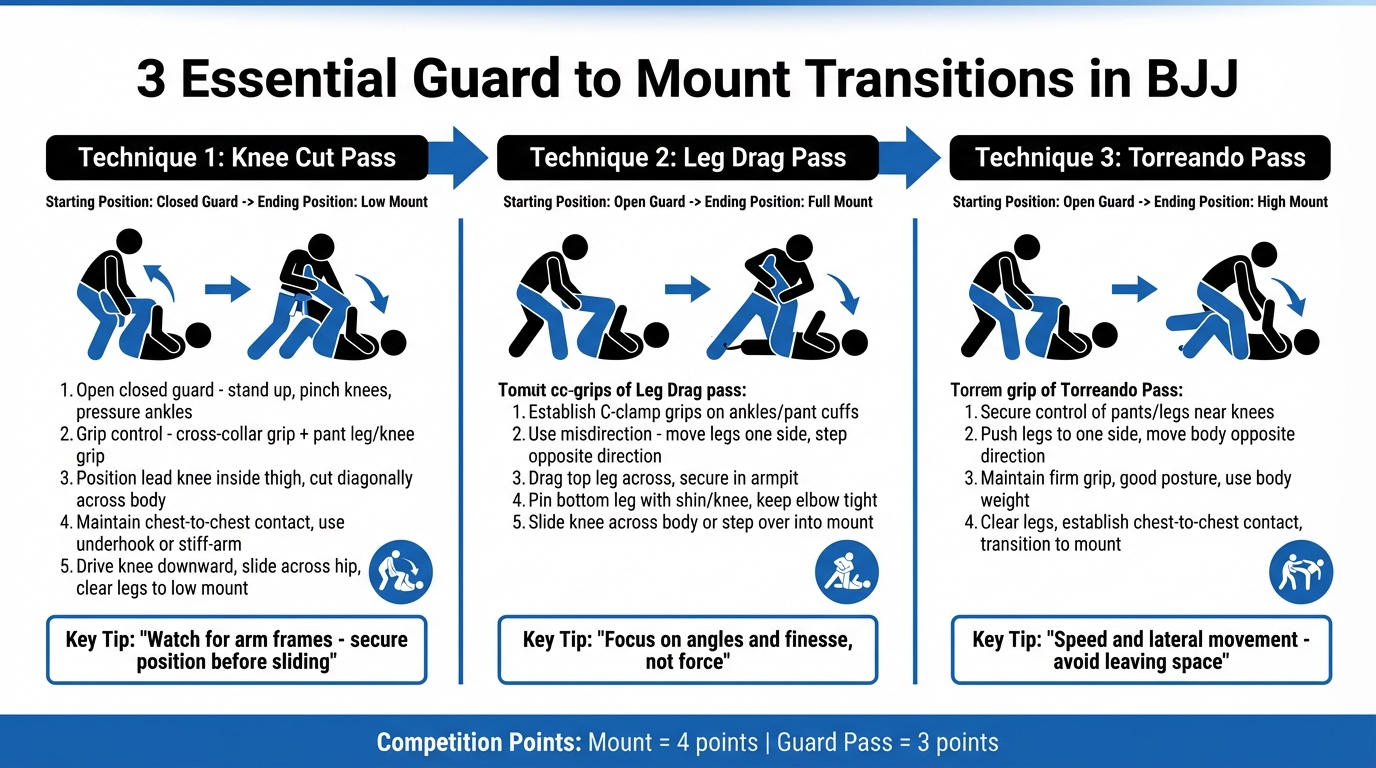
3 Essential BJJ Guard to Mount Transition Techniques
When it comes to Brazilian Jiu-Jitsu (BJJ), transitioning from guard to mount is a skill that can give you a solid upper hand. These techniques are built on core principles of the sport, focusing on precision, timing, and proper body mechanics. Below, we’ll break down three effective methods to move from various guard positions into a dominant mount.
Knee Cut Pass from Closed Guard to Low Mount
The knee cut, also known as the knee slide, is a versatile and reliable pass that works from positions like closed guard, half guard, or even De La Riva guard. It’s a go-to move for grapplers of all levels.
Start by opening the closed guard. Stand up while keeping your tailbone lifted and your knees pinched to apply pressure on your opponent’s ankles. Once their guard opens, grab a cross-collar or same-side collar grip for upper body control, and secure their pant leg or knee to immobilize their bottom leg.
Position your lead knee inside their thigh, aiming to cut diagonally across their body. Keep a low chest-to-chest connection and use an underhook or a stiff-arm to pin their far shoulder to the mat - this stops them from turning and recovering guard. As you drive your lead knee downward and slide it across their hip line, keep your trailing leg posted wide for balance. Shift your weight strategically, maintaining constant pressure throughout the pass.
Watch for their arm frames, as active frames can disrupt your pass. Make sure to fully secure the knee-cut position before sliding through. If you rush, you risk losing control. Once their legs are cleared, settle your hips over their lower torso to establish a strong low mount position.
Next, let’s explore a method that focuses on angles and mobility: the Leg Drag Pass.
Leg Drag Pass from Open Guard to Full Mount
The leg drag pass is all about angles and finesse rather than brute force, making it suitable for grapplers of all body types.
Begin by establishing C-clamp grips on your opponent’s ankles or pant cuffs. Use misdirection: move their legs to one side while stepping your body in the opposite direction to clear their legs and block their hip. Hold onto your grips until you secure a dominant control position, such as pinning their leg with your shin.
"The leg drag is a passing position where you control the opponent's hip by dragging the leg towards one side."
– Evolve MMA
Once you’ve dragged their top leg across, secure it in your armpit while pinning their bottom leg with your shin and knee. This neutralizes their hips and limits their movement. Keep your elbow tight to your ribs to prevent them from using their leg to create space. For better control, extend your arm across their hips; a shallow grip will allow them to shrimp away and recover guard.
"The bottom line is that anytime you get past your opponent's legs and make him turn away from you then good things are going to happen."
– Stephan Kesting, Founder of Grapplearts
Once their hips are pinned and their movement restricted, slide your knee across their body or step over into a stable mount position.
Torreando Pass to High Mount
The torreando, or bullfighter pass, is a fast-paced technique that relies on lateral movement and speed rather than direct pressure. It’s a straightforward option for bypassing the guard quickly and efficiently.
Start by securing control of your opponent’s pants or legs near their knees. Push their legs to one side while moving your body in the opposite direction to clear their guard. A firm grip on the pants is key here - it prevents your opponent from escaping or using their legs to frame against you.
Throughout the pass, maintain good posture and use your body weight effectively. Avoid leaving too much space between you and your opponent, as this gives them room to re-establish their guard. At the same time, don’t overcommit your weight in one direction, as this can set you up for a sweep.
Once you’ve cleared their legs, establish chest-to-chest contact to solidify your position before transitioning to mount. Adjust your elbow positioning - flaring or pinching as needed - to shut down any attempts by your opponent to create space or frame. In a gi match, successfully passing the guard can earn you three points.
Avoiding Counters and Maintaining Control
Dealing with Bridge Escapes and Elbow Escapes
When you're in the mount position, your opponent will usually try one of two main escapes: the upa (bridge and roll) or the elbow escape. Knowing how these escapes work is critical if you want to shut them down effectively.
The bridge escape focuses on trapping your same-side arm and leg before using a powerful hip bridge to roll you over. As Roger Gracie, a BJJ World Champion, explains: "Most people will likely try only two types of escapes: the upa or bridge escape and pushing the leg to get back to guard". The essence of this escape lies in "removing posts" - your opponent needs to take away your ability to stabilize yourself with your hands or feet to complete their sweep.
"The concept underlying this escape is that of 'removing posts.' In other words, when an opponent is in top position, his ability to post a hand or foot on the mat must be removed in order to initiate a sweep."
– Evolve MMA
To counter the bridge escape, advance to high mount by sliding your knees closer to their armpits. This adjustment elevates your knees above their hips, making their bridging efforts far less effective. Keep your arms tight to your body to avoid giving them leverage. If you sense a strong bridge attempt, immediately post your hands wide on the mat to stabilize your base and prevent being rolled.
The elbow escape, on the other hand, is all about creating space. Your opponent will turn to their side, bringing their elbow and knee together to slide their leg free into half guard. To stop this, apply heavy chest-to-chest pressure and prevent them from turning onto their side in the first place. Controlling their head and isolating one arm will make it significantly harder for them to rotate and create the space they need.
Once you've neutralized these escape attempts, you can shift your focus to maintaining a dominant and secure mount.
Tips for Holding Mount Position
After shutting down your opponent's counters, staying in control requires constant adjustments in weight distribution and positioning. The higher you climb up their torso, the harder it becomes for them to escape.
"The higher the top student is able to move up the mounted student's torso, the more difficult it will be for the bottom student to escape. When the top player is in high mount, the mounted student's bridging movements will do little to move the top student."
– Evolve Vacation
Keep your knees pressed tightly against their shoulders and hips to restrict their movement. Pay close attention to any frames they attempt to set up against your waist, as these are meant to stop you from advancing to high mount. Clear these frames while staying mindful of protecting your arms from potential submissions like armbars.
If you feel your mount control slipping, be ready to transition smoothly into a controlled half guard. The moments right after passing the guard, before you've fully settled your weight and grips, are when you're most vulnerable to reversals. Staying proactive and aware during this time will help you maintain control and avoid losing your dominant position.
sbb-itb-d583f1e
Drills to Improve Guard to Mount Transitions
Static Drills for Precision
Static drills are essential for developing the muscle memory needed for smooth and accurate transitions. A great starting point is the double under pass to mount. In this drill, slide both arms under your opponent's legs, stack their knees toward their chin, and then clear their legs to move into the mount position. Practice this slowly and repeatedly to engrain the movement into your muscle memory.
Another key drill is the pendulum sweep to mount, which combines a sweeping motion with a seamless transition. Begin by securing a deep underhook on your opponent’s leg, then swing your leg in a pendulum motion to sweep them, rolling directly into the mount. For those with advanced agility, the cartwheel pass drill is a fun challenge: grip your opponent's knees and cartwheel diagonally to land in mount or side control.
"Moving from one guard to another requires a lot of dedicated practice. It is recommended that you drill these basic chains with a partner a few times a week."
– Evolve MMA
For the knee-in Toreando, try a timed format: 10 minutes of work with 2-minute drill intervals and 60-second rests. This drill involves pinching your opponent’s knees to their chest to provoke a reaction, then sidestepping to transition into knee-on-belly or full mount. Be sure to maintain steady grips to prevent your opponent from recovering their guard.
These drills form a strong foundation, preparing you for more dynamic practice with resistance.
Positional Sparring for Realistic Practice
Once you’ve nailed static drills, it’s time to add resistance through positional sparring. Start each round in specific positions like half guard or closed guard, focusing entirely on opening the guard, passing, and securing the mount. This targeted approach helps you identify and address weak points in a controlled setting.
"Specific sparring... is great for learning new techniques and practicing them with resistance."
– Milos, Owner and Head Coach of Fort Jiu-Jitsu
To simulate competition scenarios, hold the mount for 3–5 seconds after a successful transition to build stability. If your opponent counters with a shrimp or hip escape, immediately chain into another pass, such as a leg drag or smash pass. Use positions like the knee slice as "staging areas" to maintain pressure while your opponent works to recover.
"Having a good guard pass means nothing if you cannot maintain the dominant position."
– Evolve MMA
As you progress, gradually increase the level of resistance. This ensures your success comes from refined technique rather than relying on brute strength.
Conclusion
Mastering the transition from guard to mount requires more than just knowing a few techniques - it’s about creating a system through consistent practice. Techniques like the knee cut, leg drag, and torreando passes each offer their own path to the mount, but they truly shine when you can link them together seamlessly. As Evolve MMA wisely notes:
"Having a good guard pass means nothing if you cannot maintain the dominant position."
Progress happens when the basics - grip fighting, hip control, and pressure management - become second nature through regular drilling. And as Evolve MMA reminds us:
"The best way to get better in Jiu-Jitsu, is to practice Jiu-Jitsu!"
To speed up your development, focus on training in an environment that emphasizes quality instruction and positional sparring. This approach sharpens your techniques and timing, helping you make measurable progress in a shorter period.
Finding the Right Training Environment
Improving your guard-to-mount transitions requires more than just effort - it takes the right setting. A supportive academy with structured coaching and a strong community can make all the difference. The Brazilian Jiu-Jitsu Gyms Directory is a helpful resource for martial artists. It connects you to top academies across the United States, providing details about programs, instructor qualifications, and user reviews. Whether you’re searching for gyms that prioritize positional sparring or instructors who explain the reasoning behind each movement, the directory’s location-based search and ratings can guide you to the academy that best fits your goals.
FAQs
What makes transitioning from guard to mount so effective in BJJ?
Transitioning from guard to mount can completely shift the dynamics in Brazilian Jiu-Jitsu. It places you in a powerful position, where you can maintain control over your opponent and apply steady pressure. Not only does this move earn valuable points in competition, but it also opens the door to high-success submissions like arm locks and chokes.
On top of that, the mount position significantly restricts your opponent's chances of escaping or launching a counterattack, giving you a clear edge. Developing this transition is essential for boosting your overall performance and control during a match.
What are the best ways to improve hip mobility for smoother guard-to-mount transitions in BJJ?
Improving hip mobility plays a crucial role in perfecting guard-to-mount transitions in Brazilian Jiu-Jitsu. Your hips are the powerhouse that provide the leverage and control needed to create space, shift angles, and secure the mount while effectively countering moves like bridges or shrimping. To work on this, try adding a few simple drills to your routine - hip rotations, hip flexor stretches, and prone leg lifts. These exercises help boost flexibility and strengthen the muscles around your hips, making your transitions smoother and more precise.
If you want to take it up a notch, resistance exercises like banded monster walks or clamshells can help build both stability and strength. On top of that, dynamic drills such as shrimping and hip circles are fantastic for ingraining muscle memory and directly applying mobility improvements to your BJJ practice. The key here is consistency - aim to practice these exercises 3–4 times a week. For personalized guidance, consider stopping by a local academy. A qualified instructor can provide expert feedback and show you how to integrate these drills into live training sessions. Use the Brazilian Jiu-Jitsu Gyms Directory to find a gym near you and take your skills to the next level.
What are the most common mistakes to avoid during a knee cut pass in BJJ?
When attempting a knee cut pass, there are a few common missteps that can disrupt your control and leave you open to counters. One of the biggest mistakes is letting your opponent sit up or roll onto their side instead of keeping them flat on their back. This shift in position gives them the chance to counter or escape your pass.
Another frequent error is not securing a solid underhook before driving your knee through. Without this crucial control, your opponent can easily create space or recover their guard. Ignoring a knee shield or failing to neutralize weak grips is another pitfall, as it allows the guard player to gain leverage, defend more effectively, or even take your back. To execute the knee cut pass properly, focus on applying consistent pressure and controlling critical positions throughout the movement.
Related articles
Share this article