
How Commute Time Affects BJJ Progress
How long commutes lower BJJ training frequency, drain focus, and slow skill gains. Choosing a gym within 30 minutes boosts consistency.
Written by BJJ Academy Finder Editorial Team
How Commute Time Affects BJJ Progress
Long commutes can hurt your Brazilian Jiu-Jitsu (BJJ) progress more than you think. Here’s why:
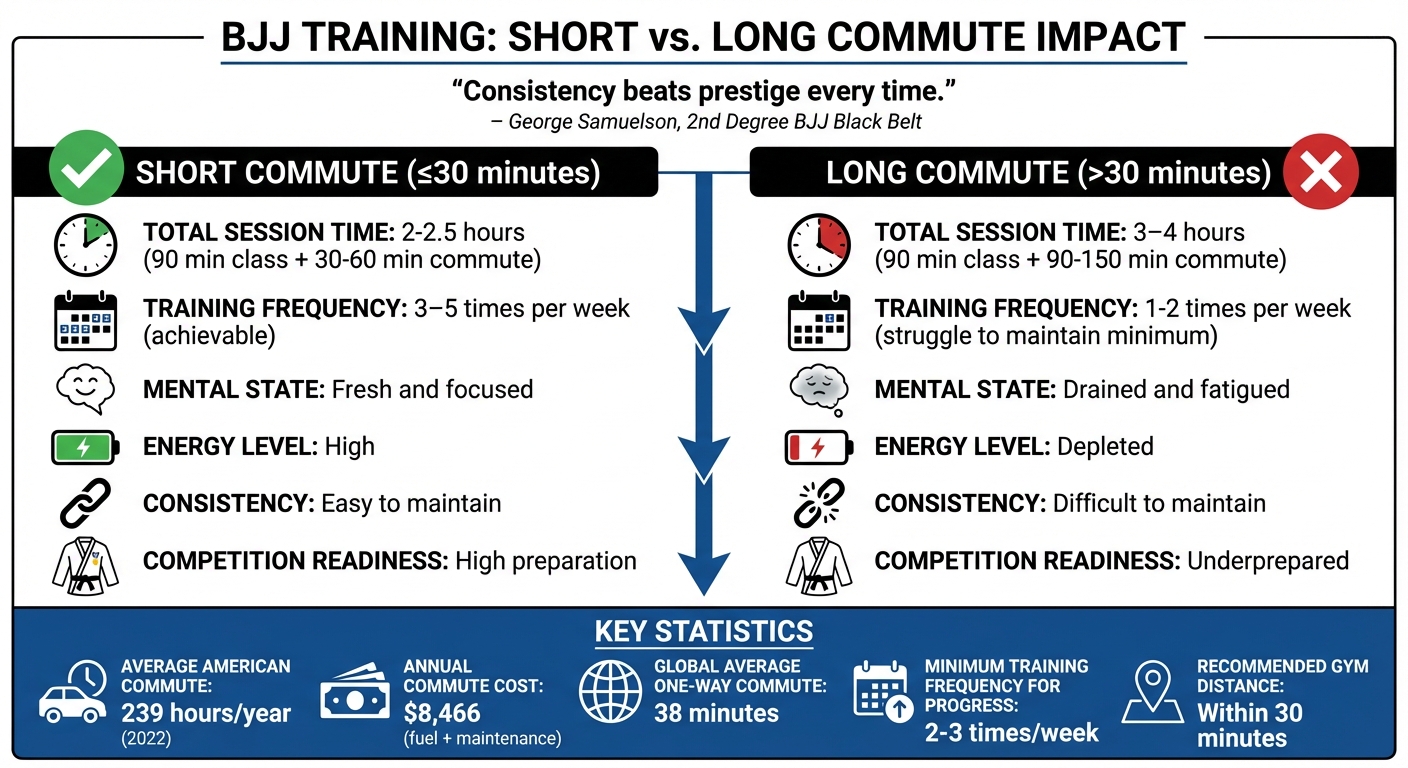
- Time Commitment: A 90-minute class often turns into a 3-4 hour ordeal when you factor in travel, preparation, and recovery.
- Consistency Issues: Training 2-3 times a week is the minimum for improvement, but long commutes make it harder to stick to this schedule.
- Mental Fatigue: Long drives drain energy, making it tough to stay motivated and focused during training.
- Skill Development: Frequent practice is key to retaining techniques and excelling in competitions. A shorter commute makes consistent attendance easier.
Choosing a gym within 30 minutes of home or work can save time, reduce stress, and help you stay on track. Use tools like the Brazilian Jiu-Jitsu Gyms Directory to find nearby academies. Remember, balancing convenience with gym quality is essential for long-term success.
How Commute Time Impacts BJJ Training Frequency and Progress
How Commute Time Affects Training Frequency
How Convenience Shapes Training Habits
Where you live and how far you have to travel can make or break your ability to stick to a consistent training routine. With the global average workday commute clocking in at 38 minutes each way [3], it’s easy to see how a single training session can stretch into a three- or four-hour commitment. Between getting ready, traveling, attending the class, and winding down afterward, the hours quickly pile up [4].
For those training four or five days a week, this time crunch becomes even more intense - especially if you're juggling a full-time job and family life [1]. Many people find themselves giving up hobbies or sacrificing flexibility at work just to keep up with their training schedule.
And it’s not just about the commute itself. These time demands ripple through every part of your daily routine, creating challenges that go beyond just logistics.
Balancing Work, Family, and Training
The strain of balancing long commutes with training isn’t just physical - it’s mental too. That extra time on the road can sap your energy and leave you feeling drained before you even step onto the mat.
Research from Jon Jachimowicz and his team at Harvard Business School and Columbia Business School highlights how exhausting lengthy morning commutes can be. Their findings link these commutes to lower job satisfaction and higher employee turnover [3]. After a full day of work and a draining commute, finding the motivation to train can feel like climbing a mountain.
Even sticking to a modest goal of training twice a week - often considered the minimum for steady progress [1][2] - can become a struggle when commute times eat into other priorities. Life changes, like advancing in your career, attending school, or raising kids, often force practitioners to rethink how often they can train [1]. One strategy that helps is planning training schedules in four-week blocks. This approach allows for some flexibility, but only if the time spent commuting doesn’t become overwhelming [1].
sbb-itb-d583f1e
What Is A Good Travel Distance For A Martial Arts School?
If you're ready to start your journey, you can find a BJJ gym nearby that fits your commute.
How Commute Time Affects Motivation and Mental Focus
Long commutes don’t just eat into your schedule - they drain the mental energy you need for focused, productive training sessions.
Mental Fatigue from Long Commutes
The impact of commuting goes way beyond the clock. In 2022, the average American spent 239 hours commuting - a 20% jump from 2019 - and shelled out $8,466 on fuel and vehicle upkeep [5]. That’s almost 10 full days spent in transit each year. But the real cost? Your mental energy.
"A long day leaves your energy levels depleted, draining your resilience, motivation, and coping skills, making it more difficult to fight off anxious feelings."
– Darren D. Moore, Ph.D., Founder of I AM MOORE, LLC [5]
Sitting in traffic doesn’t just waste time; it chips away at your mental reserves. The unpredictability of delays can trigger your brain’s fight-or-flight response, amplifying stress and anxiety before you even step foot in the gym [5]. This mental weariness can make it harder to stay engaged during training, especially in activities requiring precision and focus [6]. On the flip side, cutting down commute time can help restore your mental energy and boost readiness.
The Psychological Benefits of a Nearby Gym
A short commute can completely change your training mindset. Instead of draining you, a quick trip can serve as a mental reset - a chance to decompress and shift gears from work to training [5].
"A manageable commute can bring healthy structure to the workday, providing workers with the opportunity to transition between work and home life."
– Darren D. Moore, Ph.D., Founder of I AM MOORE, LLC [5]
When your gym is close by, it removes a major obstacle. Chris Foran, Head Coach at Premier BJJ, notes that long commutes increase the mental effort needed just to show up [6]. A shorter drive lowers this barrier, making it easier to stay consistent. Plus, it helps you focus on technique in a relaxed state, rather than battling exhaustion [7].
Skill Development and Training Outcomes
Commute times don't just influence how often you train or how focused you feel - they also directly shape your technical growth and competition readiness. A shorter commute means you can stick to a consistent practice schedule, which is key to improving skills and performing better in competitions.
Training Frequency and Skill Retention
In Brazilian Jiu-Jitsu (BJJ), regular practice is the foundation of technical growth. Studies show that high-performing BJJ programs with consistent, year-round training cycles produce better results than those with irregular attendance. For example, programs that stay active - logging around 188 matches annually - create an environment where students develop well-rounded skills, focusing on both positional control and submission finishes [8].
"Consistency across multiple tournaments is what separates programs with real systems from those with occasional wins."
– Jits.gg [8]
A great example of this is Ceconi BJJ in Santa Catarina, TX. Between 2024 and 2026, the academy maintained an impressive activity level, participating in 23 tournaments per year and averaging 188 matches annually. Their athletes achieved a 26% gold medal rate - 14% higher than the average for similar-sized academies - resulting in 74 tournament placements and a 51% overall medal rate [8]. This level of consistency is only possible with frequent training, which sharpens muscle memory and refines techniques. When choosing a gym, look for those with a strong "Development Pipeline", a system that ensures high-quality coaching as you advance through the belt ranks [8].
Consistent mat time not only strengthens skill retention but also lays the groundwork for better competition performance.
How Consistent Practice Improves Competition Performance
Winning in competitions isn’t just about natural talent - it’s about preparation. Athletes who train regularly enter tournaments feeling confident and ready, not overwhelmed. As one expert puts it:
"Building retention comes from positive tournament experiences - when kids feel prepared rather than thrown to the wolves."
– Jits.gg [8]
Programs with consistent training schedules often show clear technical benchmarks. For instance, academies with a 46% submission finish rate typically train their fighters to close out matches decisively [8]. Additionally, programs that emphasize year-round competition exposure help develop "multi-belt consistency", ensuring that instruction remains strong as students advance from white to black belt [8].
A short commute - like a 10-minute drive instead of an hour - makes it easier to attend those crucial weeknight sessions. This regular practice quickly boosts both technical skills and confidence, giving athletes an edge in competition.
Finding the Right Gym to Reduce Commute Time
When it comes to training, cutting down your commute can make a huge difference - not just in how often you train, but in how well you train. A gym that's close to home or work can mean the difference between sticking to a consistent schedule and skipping sessions because of long drives.
Using Location-Based Tools Like Brazilian Jiu-Jitsu Gyms Directory

Start by searching for gyms conveniently located near your home or workplace. The Brazilian Jiu-Jitsu Gyms Directory is a great resource, covering all 50 states with 17,139 verified academies [12]. This tool allows you to filter gyms by location, programs offered, and instructor credentials, helping you find options within a reasonable commuting distance - ideally 30 minutes or less [9].
Wade Bowling, a BJJ black belt, shares his experience:
"Choosing a school near my office let me train right after work and avoid peak traffic, easing my drive home" [10].
Training near your workplace can save you from rush-hour traffic and reduce the chances of skipping classes.
Take advantage of the directory's reviews to assess factors like class culture, cleanliness, and instructor involvement. Many gyms also offer free trial classes, giving you a chance to experience the environment firsthand before making a commitment [10].
That said, convenience shouldn't come at the expense of quality.
Evaluating Gym Quality Versus Proximity
While a short commute can improve your consistency, the quality of the gym is just as important for your progress. A nearby gym won't do much good if the instruction or facilities fall short. George Samuelson, a second-degree black belt, emphasizes this point:
"The best academy in the world doesn't help if you can't get there consistently" [9].
He also notes:
"Consistency beats prestige every time" [9].
Striking a balance between convenience and quality is key.
When visiting potential gyms, keep an eye out for warning signs like distracted instructors, a lack of higher belts, aggressive sales tactics, or poor mat hygiene [9][11]. It's also crucial to verify the instructor's lineage. Legitimate black belts should be able to trace their promotion back to a respected source, such as the Gracie family [9].
Membership costs typically range from $100 to $200 per month, with most falling between $140 and $180 [9]. Month-to-month contracts usually cost around $175–$225, while 12-month agreements often offer lower rates, ranging from $130 to $160 [9]. However, avoid locking yourself into a long-term commitment until you're confident the gym aligns with your schedule and training goals [9].
Conclusion
The time it takes to commute can have a big impact on how consistently you train in Brazilian Jiu-Jitsu (BJJ). Shorter travel times not only make it easier to attend classes more often but also help you stay focused and perform better. Studies highlight that regular practice is crucial for steady progress [1], and cutting down on commute time allows you to better manage preparation, training, and recovery.
If your gym is more than 30 minutes away, it can become a barrier to regular attendance, especially when life gets busy [9]. Even squeezing in one session during a hectic week is better than skipping entirely - consistent practice is key to retaining skills and improving. That’s why choosing a gym close to home or work is so important.
To make the search easier, the Brazilian Jiu-Jitsu Gyms Directory provides a nationwide list of 17,139 verified academies across all 50 states [12]. When evaluating gyms, pay attention to trial classes, the level of instructor involvement, and the quality of the facilities to ensure they meet your needs for both convenience and training quality. As George Samuelson, a Second-Degree BJJ Black Belt, puts it:
"Consistency beats prestige every time" [9].
Start by identifying gyms within a 30-minute drive and take into account total session time, including traffic during peak hours. By finding a gym that balances convenience and quality, you’ll set yourself up for consistent training and long-term progress.
FAQs
How far is too far to drive for BJJ?
The ideal commute for Brazilian Jiu-Jitsu depends on personal preferences and circumstances, but many find a one-way trip of 30–45 minutes manageable. For those with strong motivation, longer drives - over an hour - might still be feasible, though they can lead to fatigue and potentially less frequent training. The key is finding a balance between commute time, your energy levels, and your overall schedule. If a long drive starts to feel draining, choosing a gym closer to home could help you stay consistent and enjoy your training more.
Should I pick a closer gym even if it’s less famous?
Choosing a gym that's near your home or workplace can make a big difference in how often you show up and how motivated you feel - both of which are crucial for making progress. Even if the gym isn’t a big name, its convenience might help you stick to your routine more consistently. As long as the closer gym offers good instructors and a supportive environment, it’s often a smarter pick than traveling farther to a well-known academy.
How can I train more if my commute can’t change?
If your daily commute is set in stone, the key to staying consistent lies in how you use your time outside the gym. Add variety to your routine with activities like conditioning exercises, strength training, and movement drills that complement your BJJ practice. You can also squeeze in short, focused workouts that mirror BJJ movements during your free moments. These small but effective adjustments can keep you progressing, even when your schedule feels tight.
Related articles
Share this article