
Rehab Exercises for BJJ Shoulder Injuries
Fix BJJ shoulder pain by restoring mobility, strengthening the rotator cuff and scapula, then safely return to sparring.
Written by BJJ Academy Finder Editorial Team
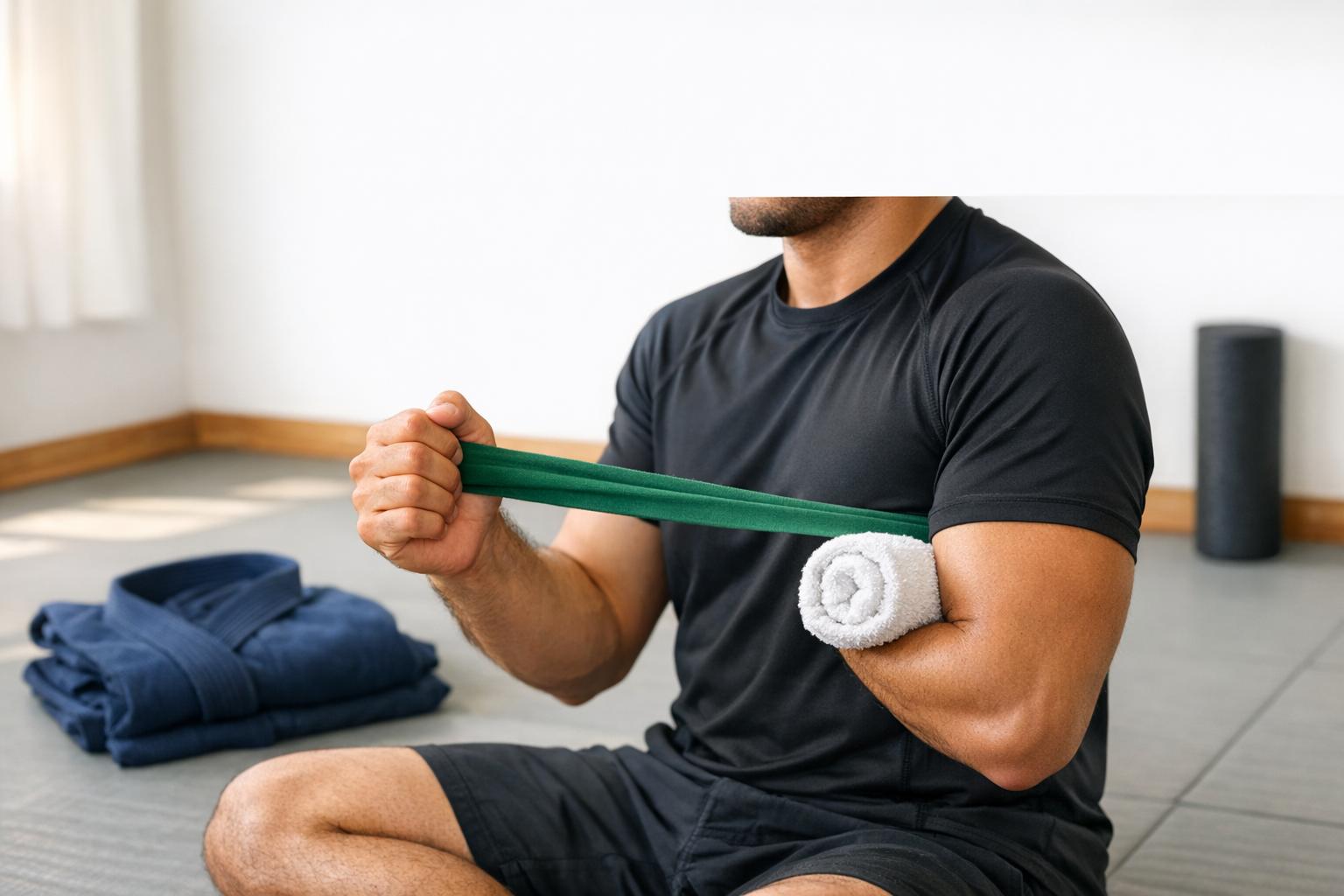
Rehab Exercises for BJJ Shoulder Injuries
Shoulder injuries are common in Brazilian Jiu-Jitsu (BJJ) due to the intense strain and extreme positions the sport demands. Most injuries, like rotator cuff tendinopathy, labral tears, and shoulder impingement, can be treated without surgery if you focus on proper rehab exercises. The key is addressing the root causes - like restricted mobility and weak stabilizing muscles - rather than just resting and icing.
Here’s what you need to know:
- Mobility first: Restore range of motion, especially internal rotation, to avoid recurring pain.
- Strength progression: Gradually strengthen the rotator cuff and scapular muscles with controlled resistance.
- BJJ-specific exercises: Incorporate drills that mimic mat scenarios, like kettlebell arm bars and push-up pluses.
- Structured recovery: Follow a phased rehab plan - mobility, strengthening, then functional movements - before returning to full sparring.
- Prevention: Maintain shoulder health with regular prehab exercises like face pulls and foam roller stretches.
BJJ, the scapula & shoulder pain. 6 essential exercises!
sbb-itb-d583f1e
Core Principles for Shoulder Injury Rehabilitation
Recovering from a shoulder injury in Brazilian Jiu-Jitsu (BJJ) isn't just about regaining full range of motion (ROM) before starting strengthening exercises. If your shoulder struggles with inward rotation - a condition known as Internal Rotation Deficit (IRD), which affects over 80% of BJJ athletes with shoulder pain - the humeral head doesn't move as it should. This misalignment increases the risk of impingement, even if your rotator cuff muscles are strong[3][2].
"Posterior tightness is not the painful injury - it's the primary driver of the painful injury." - Grapplers PerformX[3]
Focusing solely on improving mobility can resolve shoulder pain in 60–70% of cases. But when mobility work is paired with strengthening exercises, success rates jump to 85–90%[3]. That's why the rehab process needs a clear progression: start with mobility, move to activation, then strength, and finally incorporate dynamic movements that mimic BJJ scenarios. Here's how to safely navigate this process.
Gradual Loading and Recovery
Mobility lays the groundwork, but gradual loading is key for progress. Before introducing resistance, ensure your internal rotation is within 10–15° of your uninjured shoulder[3][2]. A simple monthly test involves lying on your back and rotating your arm forward - if one shoulder lags behind by more than 15°, it’s too soon for loaded exercises. Stick to the "pain rule" during all exercises: discomfort should stay below a 3 out of 10, and if symptoms worsen the next day, scale back the intensity or volume[2].
Scapular control is another crucial step. Spend at least 6–8 weeks working on exercises like wall slides and push-up pluses to stabilize your shoulder blade. This stability is essential for your rotator cuff to function properly. Skipping this phase can leave you vulnerable to incomplete recovery and potential re-injury[3].
Adapting Exercises for BJJ Movements
Once you've built a foundation of mobility and strength, your rehab program should reflect the unique demands of BJJ. Unlike generic shoulder recovery plans, BJJ requires your shoulders to handle extreme ranges of motion under load while reacting to unpredictable forces[1][4]. Standard protocols won’t fully prepare you for situations like defending a kimura or managing the dynamic stresses of rolling.
Incorporate exercises that mimic mat scenarios. For example:
- Kettlebell arm bars: Train stabilization for armbar escapes or maintaining side control.
- Push-up pluses: Strengthen the serratus anterior for effective framing and pummeling.
- External rotations: Help your rotator cuff resist submissions like kimuras and americanas.
- Overhead carries: Build endurance for holding top control during long rounds[4].
BJJ also tends to create "grappler's posture" - a rounded shoulder position caused by overactive pecs and a weakened upper back[5]. Combat this with exercises like face pulls and foam roller pec stretches, especially after training. If you train in the gi, focus on postural endurance and managing grip-related stress on the rotator cuff. No-gi athletes, on the other hand, should emphasize explosive stability for scrambles and underhook battles[4].
Finally, modify your sparring approach as you recover. Use flow rolling at a lower intensity and clearly communicate "no-go" positions to your training partners until your shoulder is ready for full resistance[6]. If you are looking for a new place to train that prioritizes safety, you can find a BJJ gym that fits your needs.
Shoulder Rehab Exercises for BJJ
These exercises are designed to enhance scapular control, strengthen the rotator cuff, improve posture, and stabilize loads. Start with mobility-focused drills before advancing to strength-based movements. Here's a closer look at each exercise.
Scapular Wall Slides
Once you've worked on mobility and begun gradual loading, this exercise hones shoulder stability for the specific demands of BJJ.
Stand with your heels, glutes, upper back, shoulders, and the entire length of your arms flat against a wall. Keep your lower back's arch minimal, and maintain a neutral head position. Slowly slide your hands up and down the wall.
"The goal is to get to about 135 degrees of shoulder flexion without shrugging. In other words, you're checking just how well you upwardly rotate the scapulae."
- Eric Cressey, President of Cressey Sports Performance [8]
This movement targets the lower traps, rotator cuff, and rear deltoids. Use a controlled tempo: 2 seconds up, 1-second hold, 2 seconds down, and a 1-second pause. If you feel tension in your upper traps or biceps, or notice yourself shrugging, pause and adjust your form.
For added difficulty, use a small resistance band around your wrists. This variation engages the external rotators isometrically, preventing the band from pulling your wrists inward. It's especially beneficial for BJJ athletes, as it activates the lower traps and reduces stress on the anterior deltoids - muscles often overused during guard play and submission defense.
External Rotations with Resistance Bands
This exercise strengthens the rotator cuff, helping to keep the humeral head centered in its socket. It also addresses anterior shoulder glide, a common problem where the arm bone shifts forward, risking impingement. In BJJ, the infraspinatus and teres minor are critical for maintaining shoulder stability during posting, framing, and defensive movements.
"Adding some mild resistance can 'remind' the muscles of the rotator cuff to center the humeral head in the socket and create a much more effective external rotation position."
- Lee Boyce, Strength Coach [7]
Use a neutral grip (palms facing each other) for a more shoulder-friendly movement. Maintain thoracic extension, avoid shrugging, and keep your lower back neutral. Stick to a controlled tempo of 2 seconds on the pull, 1-second hold, 2 seconds back, and 1-second pause. Focus on upwardly rotating your scapulae without shrugging.
Once comfortable with this exercise, you can move on to face pulls for more balanced shoulder activation.
Face Pulls
BJJ athletes often develop rounded shoulders and a hunched posture due to constant internal rotation during guard play and framing. Face pulls help counteract these issues by strengthening the posterior deltoids, rhomboids, and middle-to-lower trapezius. They also engage the infraspinatus and teres minor, which are crucial for resisting extreme shoulder positions during submissions.
"Face pulls are the single most important exercise for shoulder health."
- John Rusin, Sports Performance Coach and Physical Therapist [9]
Set the pulley at face height. Use a neutral or underhand grip to reduce impingement risk while promoting external rotation. Pull the rope toward your forehead or ears, aiming for maximum external rotation. At the peak of the movement, externally rotate your shoulders so your knuckles face the ceiling, mimicking a front double-bicep pose, and hold for one second.
Stick to light or moderate weights (15–40 lbs for most athletes) to maintain proper form. Using too much weight can lead to momentum-based movements or turn the exercise into a row. Keep your shoulders down, core braced, and avoid hyperextending your lower back during the movement.
How to Structure Your Shoulder Rehab Program
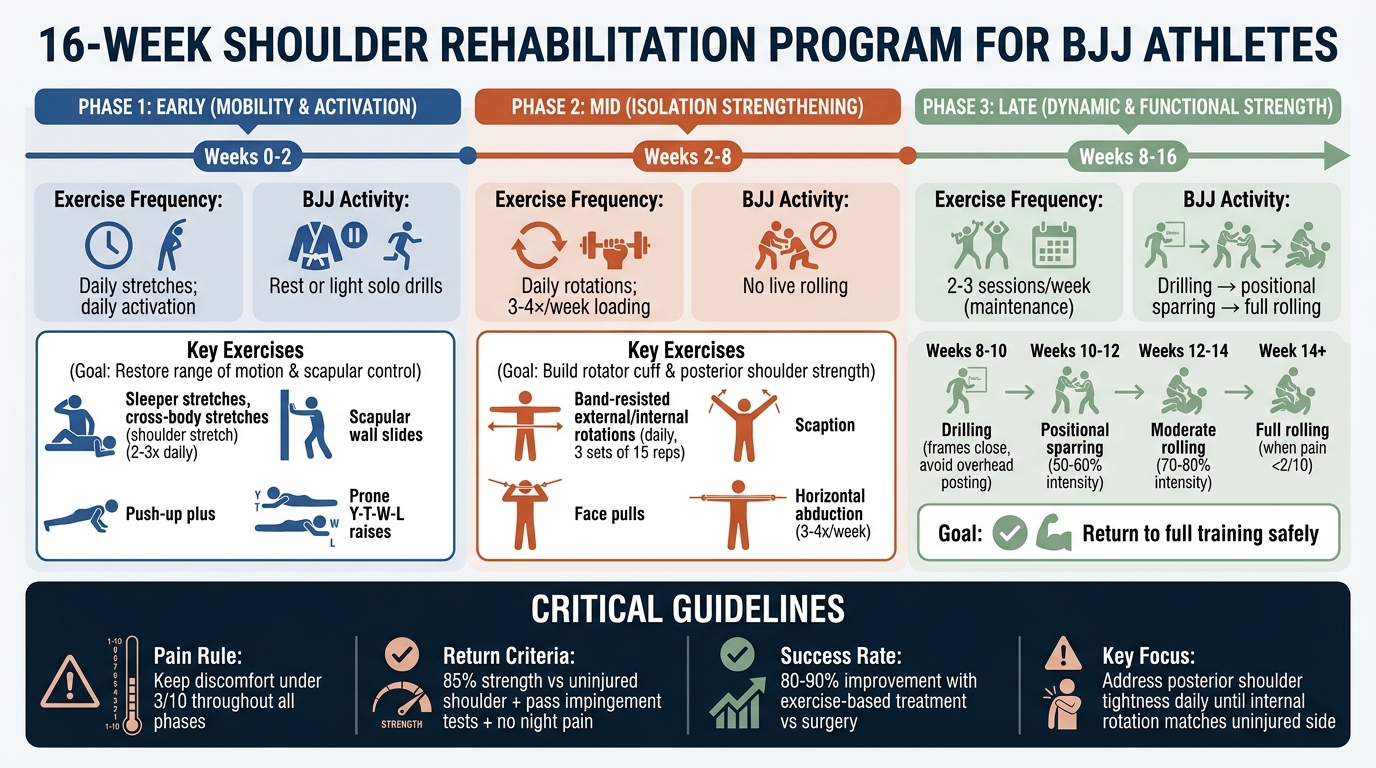
16-Week BJJ Shoulder Rehab Program: Phases, Timeline and Training Progression
Recovering from a shoulder injury requires a step-by-step approach, with each phase targeting specific goals. Take your time - most grapplers (80–90%) see improvement with exercise-based treatments rather than surgery [2]. The key to success? Progress only when you hit clinical milestones, not just because the calendar says so.
This 16-week program is divided into three phases, each focusing on different aspects of recovery. A major priority throughout is addressing posterior shoulder tightness. Perform daily sleeper and cross-body stretches until your internal rotation closely matches the uninjured side.
"Addressing posterior shoulder tightness is critical - it's the primary driver, not just a symptom."
- Dalton Urrutia, Founder & Performance Physical Therapist, Grapplers PerformX [2]
Stick to the pain rule: keep discomfort under 3/10. If pain flares up or soreness worsens the next day, dial back the intensity [2]. Before returning to full training, ensure your injured shoulder is at least 85% as strong as the uninjured one and that you pass impingement tests without experiencing night pain [2]. This phased progression is designed to help you safely get back to Brazilian Jiu-Jitsu (BJJ) without setbacks.
| Phase | Timeline | Exercise Frequency | BJJ Activity |
|---|---|---|---|
| Early (Mobility) | Weeks 0–2 | Daily stretches; daily activation | Rest or light solo drills |
| Mid (Strengthening) | Weeks 2–8 | Daily rotations; 3–4×/week loading | No live rolling |
| Late (Functional) | Weeks 8–16 | 2–3 sessions/week | Drilling → positional sparring → full rolling |
Start with the Early Phase to restore mobility and build a solid foundation before moving on to more intense exercises.
Early Phase: Mobility and Activation
The first two weeks are all about regaining range of motion and improving scapular control. Perform sleeper and cross-body stretches 2–3 times daily to restore internal rotation [2]. Add exercises like scapular wall slides, push-up plus, and prone Y-T-W-L raises to activate key muscles like the serratus anterior and lower traps. These should be done daily. During this phase, avoid live training completely.
Mid Phase: Isolation Strengthening
From weeks 2–8, the focus shifts to strengthening, using moderate resistance. Perform band-resisted external and internal rotations every day (3 sets of 15 reps). For heavier exercises, such as scaption, face pulls, and horizontal abduction, aim for 3–4 sessions per week [2]. This phase is about building the rotator cuff and posterior shoulder muscles' capacity to handle more load. Live rolling is still off-limits to let your shoulder adapt to the increasing demands.
Late Phase: Dynamic and Functional Strength
As you approach full recovery, it's time to integrate movements specific to BJJ. During weeks 8–16, reduce strengthening sessions to 2–3 times per week for maintenance and gradually reintroduce BJJ [2]. Start with drilling in weeks 8–10, focusing on keeping your frames close to your body and avoiding overhead movements like posting. Move on to light positional sparring at 50–60% intensity in weeks 10–12, then progress to moderate rolling at 70–80% in weeks 12–14 [2]. Only return to full-intensity rolling once you meet all strength and range-of-motion goals, with pain consistently staying below 2/10 [2].
Preventing Future Shoulder Injuries
Once you've regained strength and mobility, the next step is keeping your shoulders healthy for the long haul. Injury prevention should become part of your routine, not just an afterthought. One of the best ways to do this is by incorporating prehab exercises into your regular training. Many shoulder injuries stem from poor posture - specifically, a hunched position that weakens the upper back and tightens the chest muscles [5]. Regular mobility work and targeted strengthening can help correct this imbalance.
"This curled up posture is great for defense... but it causes certain muscles to become tight and overactive, while other muscles become stretched out and weakened."
- Claire, Physical Therapist, Rose Physical Therapy [5]
To make prehab sustainable, weave it into your warm-up and cool-down routines. This approach helps you build strong habits without adding extra gym sessions. By sticking to these strategies, you can maintain the progress you made during rehab and safeguard your shoulders for the future.
Warm-Up and Cool-Down Strategies
Before training, dedicate 10–15 minutes to activating your posterior shoulders. Exercises like band pull-aparts, shoulder dislocates (using a PVC pipe or resistance band), and scapular wall slides are excellent choices [4]. These movements wake up the stabilizing muscles in your shoulders, improve overhead mobility, and prepare you for the demands of grappling - all without exhausting your muscles before class.
After training, shift your focus to restoring mobility and loosening up tight areas. Start by lying lengthwise on a foam roller with your arms spread out for a pec stretch - hold this position for two minutes to counteract the rounded posture that grappling often reinforces [4][5]. Next, do sleeper stretches to preserve internal rotation, which can become limited from repetitive "arm-in" positions [4]. Wrap up your cooldown with foam rolling your thoracic spine to release tension in your upper back and improve spinal mobility. These routines not only help you recover from training but also build a foundation of strength and flexibility for the future.
Maintaining Shoulder Strength and Stability
Keeping your shoulders strong doesn't have to be overly complicated or time-consuming. Exercises like I-Y-T raises and scapular push-ups, done 2–3 times per week, can strengthen the scapular retractors and serratus anterior [4]. These muscles are key for maintaining posture and framing during grappling. Add external rotations with resistance bands (3 sets of 15 reps) to protect your rotator cuff from submissions like Kimuras and Americanas [4][5].
For stability under load, try kettlebell arm bars and overhead carries (holding for 30–60 seconds) [4]. These exercises mimic the stabilization needed for armbar escapes and controlling scrambles. To round out your routine, include corrective exercises like "No money" rotations or face pulls at least five times a week, ideally right after training when your shoulders are already warm [5]. This consistency will help keep your shoulders strong, stable, and ready for whatever challenges come your way.
Conclusion
Shoulder injuries don’t have to sideline your training permanently, but they require more than just taking time off. Without a solid rehab plan, the risk of re-injury stays high. The goal should be to tackle the root causes, not just mask the symptoms. Shoulder pain often signals deeper issues, like limited mobility - restricted internal rotation, tightness in the thoracic spine, or postural problems from a defensive BJJ stance - that put your shoulder in harm’s way.
"Education and understanding injury/the body combined with exercise-based rehab is the key to effective rehab."
- Dalton Urrutia, Founder & Performance Physical Therapist, Grapplers PerformX [1]
This perspective highlights how targeted exercises are essential for building the resilience needed to meet the demands of BJJ.
The exercises outlined earlier aren’t just about getting you back to training - they’re about strengthening, stabilizing, and improving mobility so your shoulders can handle the unique stresses of BJJ. Whether you’re rolling gi or no-gi, your shoulders face constant challenges that require specific preparation.
When you’re ready to return to the mats, stick to the progression discussed earlier: start with solo drills, then move to flow rolling, and finally, full sparring. Be upfront with your training partners about any limitations, and consider working with higher belts who will respect those boundaries. Use this recovery period as a chance to refine other aspects of your game - if your shoulder limits top pressure, work on guard retention or develop skills on your weaker side.
Consistency is key to long-term shoulder health. Perform mobility, strength, and stability exercises 2–3 times a week, focusing on proper form over heavy weights. Incorporate these movements into your warm-ups and cool-downs until they feel like second nature. By sticking to a structured rehab routine and making these habits part of your training, you’ll reduce the risk of chronic issues and keep rolling strong for years to come.
FAQs
How do I know if my shoulder pain is serious?
Shoulder pain could indicate a more serious issue if you experience sharp, persistent, or worsening discomfort. It’s also concerning if it restricts your range of motion or disrupts your ability to perform everyday tasks. In such cases, it’s important to consult a medical professional for an accurate diagnosis and appropriate treatment.
When can I start lifting again after a BJJ shoulder injury?
You can typically get back to lifting weights after finishing a well-structured rehabilitation program and receiving approval from a healthcare professional. The time it takes to recover depends on how severe the injury is, ranging from a few weeks to several months. It's crucial to stick to your doctor’s recommendations to prevent setbacks and ensure you’re progressing safely.
When is it safe to roll again?
You can get back to rolling once you've completely recovered, which typically takes a few weeks of rest, applying ice, and doing focused rehab exercises. Make sure the pain has reduced significantly and your shoulder's range of motion is back to normal. Only return to training when you're sure your shoulder is strong enough to prevent further injury.
Related articles
Share this article