
Ultimate Guide to Breathing in Brazilian Jiu-Jitsu
Diaphragmatic, box, and nasal breathing to boost endurance, calm, and recovery for Brazilian Jiu-Jitsu practitioners.
Written by BJJ Academy Finder Editorial Team
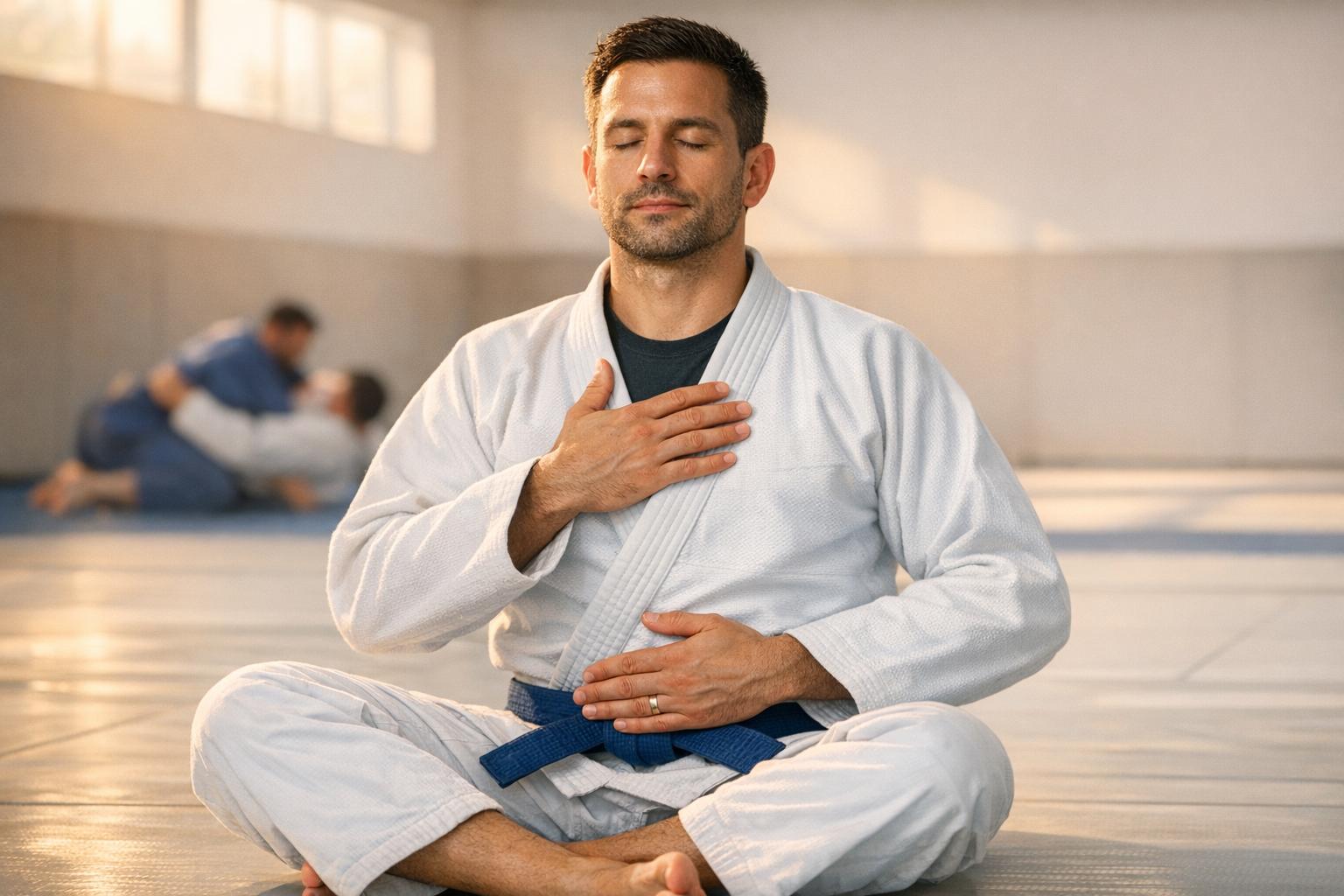
Ultimate Guide to Breathing in Brazilian Jiu-Jitsu
Breathing is one of the most overlooked yet critical aspects of Brazilian Jiu-Jitsu (BJJ). If you're just starting out, you can find a BJJ gym nearby to begin your training. While most practitioners focus on techniques, strength, and endurance, proper breathing can drastically improve your performance, energy management, and composure. Here’s what you need to know:
- Common Mistake: Many grapplers hold their breath during rolls, leading to faster fatigue and poor decision-making.
- Why It Matters: Shallow breathing triggers stress responses, while controlled breathing keeps you calm, improves oxygen flow, and conserves energy.
- Key Techniques:
- Diaphragmatic Breathing: Deep "belly breathing" to maximize oxygen intake.
- Box Breathing: A rhythmic pattern (inhale, hold, exhale, hold) to stay focused under pressure.
- Nasal Breathing: Breathing through the nose for better stamina and oxygen efficiency.
The 3 Best Breathing Techniques for Jiu-Jitsu | Breathe and Flow Yoga for BJJ
sbb-itb-d583f1e
Core Breathing Techniques for BJJ
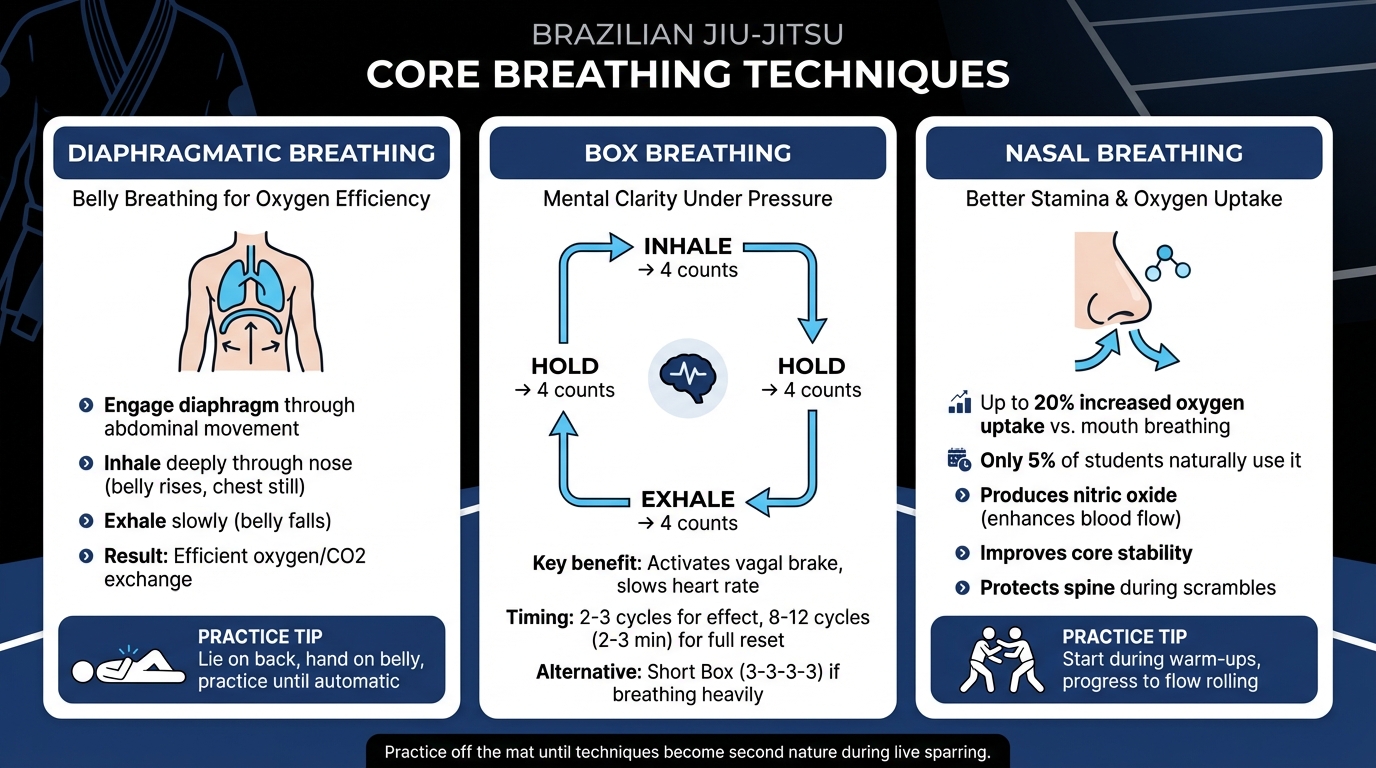
3 Core Breathing Techniques for Brazilian Jiu-Jitsu Performance
Now that we’ve covered why breathing is so important, let’s dive into three core techniques that can elevate your performance on the mats. These methods are simple but powerful - practice them regularly off the mat so they become second nature.
Diaphragmatic Breathing
Also known as "belly breathing", diaphragmatic breathing is the cornerstone of effective breathing in BJJ. Instead of relying on your chest muscles, this technique engages your diaphragm through abdominal movement. The result? A more efficient exchange of oxygen and carbon dioxide, ensuring your muscles get the oxygen they need during intense sparring sessions [3].
Here’s why it’s essential: shallow chest breathing can’t keep up with the oxygen demands of grappling, leaving you exhausted mid-roll. As BJJ World puts it:
The method in all the best breathing exercises is using your belly to move your diaphragm, rather than just your intercostal muscles [3].
To practice, lie on your back and place one hand on your chest and the other on your belly. Inhale deeply through your nose, focusing on making your belly rise while keeping your chest still. Then, exhale slowly and feel your belly fall. Keep practicing this at home until it feels automatic. Once you’ve nailed it, you’ll be able to use it during live sparring to stay calm and conserve energy [3].
Box Breathing for Mental Clarity
Box breathing follows a simple rhythm: inhale for 4 counts, hold for 4, exhale for 4, and hold for 4. It’s a favorite among Navy SEALs because it’s discreet and effective - even when you’re under pressure, like trapped in bottom side control [4].
The key lies in the exhale and the post-exhale hold. These phases activate the "vagal brake", slowing your heart rate and allowing carbon dioxide levels to normalize. This signals your brainstem that you’re safe, helping you avoid panic and stay mentally sharp [4].
You’ll notice the effects after just 2–3 cycles, but a full reset takes about 8–12 cycles (roughly 2–3 minutes) [4]. Use box breathing between rounds to recover faster than your opponent or during quick pauses to gather yourself. If you’re breathing too heavily for a 4-count, start with a "Short Box" (3-3-3-3) until you regain control [4].
Nasal Breathing for Better Stamina
Nasal breathing, which involves inhaling and exhaling exclusively through your nose, is an underrated tool in BJJ. While only 5% of active students naturally use it during resistance training, it can increase oxygen uptake by up to 20% compared to mouth breathing [5].
Why is it so effective? Nasal breathing produces nitric oxide, a molecule that enhances blood flow and oxygen delivery throughout your body. It also engages your diaphragm more, improving core stability and protecting your spine during scrambles [5]. As František Lörinczi from Comenius University explains:
Nasal breathing contributes to inhalation of increased nitric oxide, which is a potent bronchodilator and vasodilator and has antiviral and antibacterial effects and improves oxygen transport through the body [5].
Start by practicing nasal breathing during warm-ups and solo drills. Once it feels natural, incorporate it into flow rolling and light sparring. If you’re forced to switch to mouth breathing during a scramble, try to return to nasal breathing as soon as the pace slows [1][2]. Some practitioners even tape their mouths during solo drills to reinforce nasal breathing - just make sure you’re supervised if you decide to try this [1][2].
Breathing Strategies for Different BJJ Situations
Mastering your breathing can make all the difference in Brazilian Jiu-Jitsu (BJJ). By tailoring your breathing techniques to specific scenarios, you can improve endurance, focus, and overall performance.
Maintaining Steady Breathing During Sparring
Your breathing during sparring sets the tone for the entire roll. Start each round with nasal breathing to activate your parasympathetic system, which keeps you calm and focused. If you find yourself switching to mouth breathing during intense scrambles, aim to return to nasal breathing as soon as possible.
Avoid holding your breath at all costs. Instead, sync your breathing with your movements: inhale during setups and exhale forcefully during execution. This rhythm helps stabilize your core and maximize power, whether you're bridging, shrimping, or passing guard.
If you feel panic or exhaustion creeping in, use percussive breathing. Take a deep inhale, then follow it with 5–6 short, controlled exhales. This technique helps clear excess carbon dioxide and combats the "out of breath" sensation that often arises during high-pressure exchanges. As RollBliss puts it:
Breathing is a performance multiplier in grappling - it affects endurance, mental state, and movement quality. [2]
Staying Calm in Submissions
When defending submissions, controlled breathing can be your best ally. If you're caught in a tight spot, focus on exhaling sharply 5–6 times to clear carbon dioxide and keep panic at bay.
For situations where you’re stuck but not actively moving, try the calming ratio: inhale for 4 seconds, hold for 16 seconds, and exhale for 8 seconds. This deliberate pattern helps lower your heart rate and clears your mind, giving you the clarity needed to strategize your escape. Additionally, nasal breathing during these moments boosts nitric oxide production, which enhances blood flow and oxygen delivery to your muscles - essential for enduring prolonged defensive positions. Practice this technique during lighter rolls so it becomes second nature under pressure.
Recovery Breathing Between Rounds
The way you breathe between rounds can significantly impact how quickly you recover. The goal here is to clear out carbon dioxide and shift your body into recovery mode, aligning with the principles of efficient oxygen exchange.
Maintain an upright posture during breaks to allow for optimal lung expansion. Use tactical breathing: inhale through your nose for 4 seconds, then exhale through your mouth for 6 seconds. For faster recovery after an especially intense round, try the 2:4 ratio - inhale for 2 seconds and exhale for 4 seconds, ensuring your exhale is complete and deliberate.
If you’re in need of a quick reset, turn to percussive breathing (often referred to as the Gracie method). Take a deep inhale, followed by 5–6 rapid, controlled exhales. This technique helps expel stale air and prepares your body for the next round. As Rolladek emphasizes:
Jiujitsu is as much about mastering your breath as it is about mastering the art. [6]
Drills and Exercises for Breath Control
Adding breath control drills to your practice can help make efficient breathing second nature, even during intense live rolling sessions.
Solo Breathing Drills
Start with diaphragmatic breathing to train deep, effective breaths. Lie on your back and place one hand on your belly and the other on your chest. Focus on inhaling through your nose so your belly rises while your chest remains still. This method reduces shallow chest breathing and improves oxygen flow [1].
Once you’ve nailed belly breathing, you can step it up with CO2 tolerance training. Here’s how: inhale for 3 seconds, exhale for 6 seconds, and then hold your breath after exhaling until you feel discomfort. This drill helps you adapt to the high carbon dioxide levels that build up during scrambles, keeping panic at bay [1]. You might also try the Wim Hof Method for mental toughness. Perform 30 quick deep breaths with partial exhales, hold your breath on the last exhale as long as you can, and finish with a 15-second recovery hold after inhaling [1].
Another option is breath ladders, which blend conditioning with breathing practice. For example, pair kettlebell swings or squats with your breathing: do 1 rep and take 1 breath, then 2 reps and 2 breaths, working your way up to 10 reps and back down. You can also use solo movements like hip shrimping, bridging, or granby rolls to sync your breath with your motions [7].
Once you’re comfortable with these solo drills, bring a partner into the mix to simulate live sparring.
Partner Drills for Breathing Under Pressure
Managing your breath during stressful situations is essential for staying composed. Partner drills recreate the unpredictability of live matches, helping you control your breathing while under pressure. Begin with nasal-only sparring during light flow rolling or positional work. This trains your aerobic capacity and keeps you calm. Advanced practitioners can even try mouth tape (under coach supervision) during drills to enforce nasal breathing and improve focus [1][2].
During these drills, practice cadenced exhalation - a sharp exhale during explosive movements like bridging or guard passes. This technique stabilizes your core and prevents you from unconsciously holding your breath [2]. Many practitioners notice improvements in their focus and composure after just a week or two of consistent practice [2]. As Novakik BJJ puts it:
BJJ is about control and the first thing you should learn to control is your breath. [1]
Once you’ve mastered these partner drills, start integrating your breathwork into your BJJ movements.
Combining Breathing with BJJ Movements
The key to effective breathwork in BJJ is syncing your breathing with your movements. Inhale during the setup phase and exhale during the execution. For example, if you’re setting up a sweep, inhale as you establish your grips and position. Then, exhale forcefully as you bridge or pull to complete the move. This same rhythm applies to guard passes, escapes, and takedowns - your exhale helps stabilize your core and maximize power during explosive actions [1][2].
Between techniques or rounds, use tactical breathing to recover. Sit upright and inhale through your nose for 4 seconds, then exhale through your mouth for 6 seconds. This helps lower your heart rate and clear CO2 more quickly than your opponent [2]. Avoid holding your breath while actively moving; save breath-holding for stationary moments when you need to calm your mind [3].
Conclusion
Main Points for Practitioners
Breathing is a game-changer for endurance, focus, and staying calm under pressure on the mats [2]. The breathing techniques outlined here - like diaphragmatic breathing, box breathing, CO2 tolerance training, and cadenced exhalation - are essential tools for anyone serious about improving their grappling. As BJJ World aptly puts it:
Breathing correctly is one of the hardest and most important lessons you'll learn in Jiu-Jitsu. [3]
With just 1–2 weeks of consistent practice, many practitioners notice better focus, higher energy, and improved composure during tough rolls [2]. The secret lies in making breathwork a daily habit. Spend 5–10 minutes a day practicing diaphragmatic breathing, stick to nasal breathing during warm-ups, and coordinate your exhales with explosive moves like sweeps or escapes [1]. This approach not only enhances performance but also sharpens your strategy, giving you an edge - especially when you spot an opponent’s erratic breathing. Plus, proper breath control can save you from self-induced submissions [3].
By incorporating these techniques into your routine and practicing in a supportive setting, you'll see real growth in your game.
Finding the Right BJJ Academy
While breathwork can be practiced anywhere, training at a quality academy helps you refine your form and integrate these skills into live rolling sessions. A great academy won’t just tell you to "relax" - it’ll teach you how to use your breath to achieve that relaxation [3]. Seek out instructors who break down the physiological side of grappling and include breath drills in their training.
The Brazilian Jiu-Jitsu Gyms Directory is a fantastic resource for finding top-notch academies across the U.S. that focus on both technical and internal skills like breath control. You can search by location, explore program details, verify instructor credentials, and read reviews from other practitioners - all at no cost. Joining an academy that prioritizes these "invisible Jiu-Jitsu" techniques during intense scrambles will accelerate your progress and help you unlock your full potential on the mats.
FAQs
How do I stop holding my breath while rolling?
To keep your breathing steady during Brazilian Jiu-Jitsu, work on controlled breathing techniques. A simple approach is to inhale for 2 seconds and exhale for 4 seconds, which helps maintain a calm and rhythmic breath. Practicing diaphragmatic or box breathing both before and during rolling can ease nerves and bring down your heart rate. Additionally, focusing on nasal breathing can improve your ability to regulate your breath. With regular practice, these methods can significantly improve your breath control during high-intensity sessions.
When should I use nasal vs mouth breathing in BJJ?
In Brazilian Jiu-Jitsu, breathing through your nose is the go-to method. It encourages a steady flow of air, boosts oxygen delivery to your muscles, and helps keep your nervous system calm. While breathing through your mouth might be necessary during short bursts of intense effort or if your nose is blocked, it’s not something to rely on regularly. Habitual mouth breathing can potentially harm your health and even affect facial structure. Stick with nasal breathing to support your endurance and overall performance.
What’s the fastest breathing method to recover between rounds?
The quickest way to recharge between rounds is by practicing tactical breathing. Here's how: Sit up straight, close your eyes, and take a deep breath in for 4 seconds. Then, exhale slowly for 6 seconds. This method helps you recover faster and feel more refreshed.
If you're in the middle of intense activity, adjust the pattern slightly - inhale for 2 seconds and exhale for 4 seconds. This keeps your breathing steady and helps you stay in control.
Related articles
Share this article